9 Popular Lapis Lazuli Healing Claims: Ancient Traditions, Verified Facts & Safe Use
Lapis lazuli healing properties are commonly associated with wisdom, communication, confidence, self-awareness, emotional perspective, concentration, creativity, relationship honesty, and spiritual reflection. Unlike many recently named crystal-shop stones, lapis lazuli has a genuine human history extending more than six thousand years. It was traded from the mountains of Badakhshan into Mesopotamia and other ancient centers, fashioned into beads, inlays, seals, carvings, and prestigious objects, and later ground to create the celebrated ultramarine pigment. That deep history establishes cultural importance, not modern therapeutic efficacy. Lapis lazuli has not been demonstrated to treat anxiety, depression, thyroid disease, headaches, high blood pressure, neurological disorders, insomnia, inflammation, or another medical condition, nor is there evidence that wearing a blue stone biologically improves speech or opens an anatomical energy center. Gemologically, lapis lazuli is not one mineral. It is a rock composed mainly of lazurite, calcite, and pyrite, sometimes with diopside, amphibole, feldspar, mica, or other minerals. Its composition, hardness, color, and care requirements therefore vary from specimen to specimen.
9 Lapis Lazuli Claims Shaped by Deep Blue Color, Ancient Prestige, and Reflective Use
- Wisdom and thoughtful judgment
- Clearer communication
- Confidence in self-expression
- Greater self-awareness
- Emotional perspective during difficult periods
- Concentration and mental organization
- Creativity and imaginative thinking
- Honest relationship communication
- Spiritual contemplation and personal values
These nine themes are distinct enough to support different reflective practices without becoming nine scientifically verified healing effects. Many lapis lazuli benefits make more sense when translated into actions a person controls, such as preparing what to say, reviewing evidence before a decision, journaling honestly, reducing distractions, or reflecting on values before acting.
Lapis Lazuli Mineral Science: Lazurite, Calcite, Pyrite, Hardness, and Rock Composition
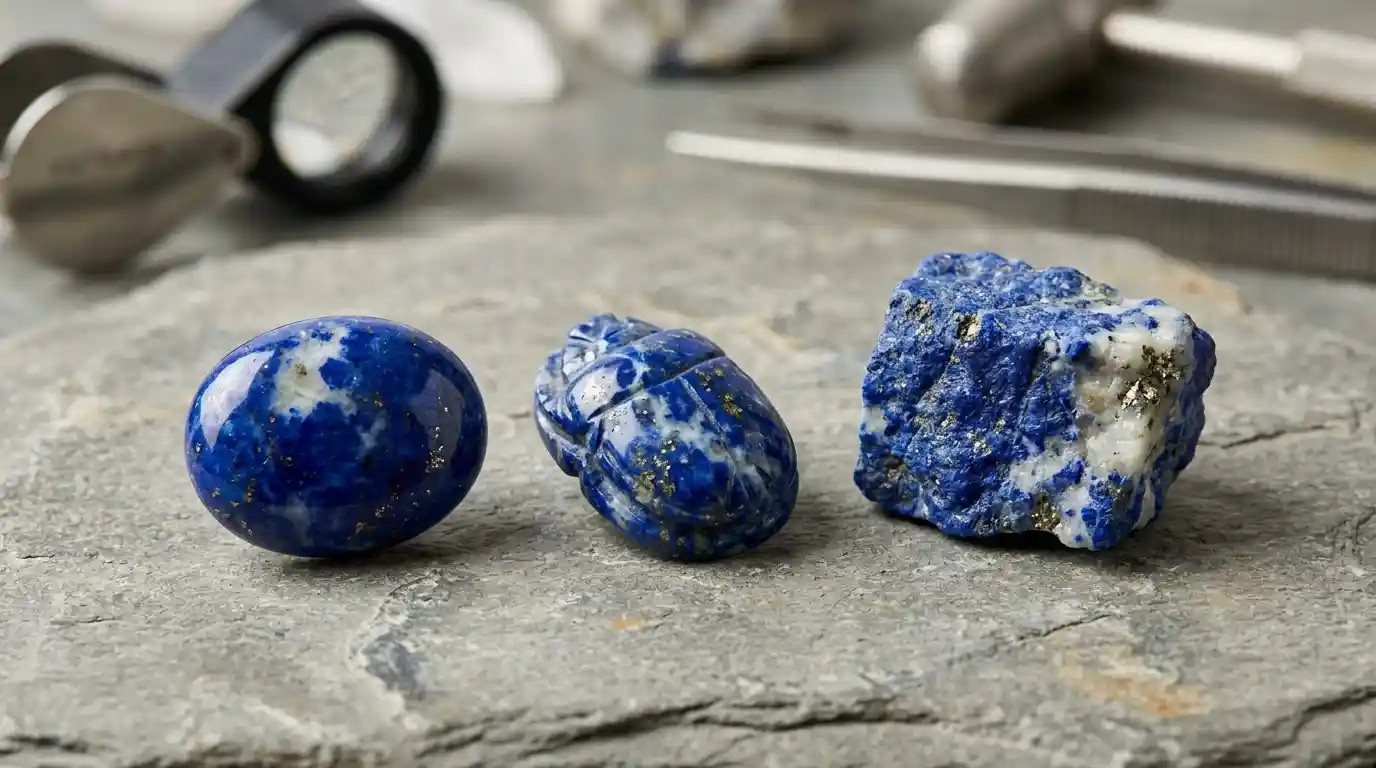
Lapis lazuli is a metamorphic rock rather than a single mineral species. The vivid blue component is lazurite, a sulfur-bearing aluminosilicate in the sodalite group. White streaks or patches are commonly calcite, while metallic golden flecks are pyrite. Diopside, amphibole, mica, feldspar, and other minerals may also occur in smaller amounts.
Because lapis lazuli is a rock made from several minerals, it does not have one chemical formula or one crystal system. Lazurite itself belongs to the cubic system and has a complex sodium-calcium aluminosilicate framework containing sulfur species that produce the characteristic blue color. Calcite is trigonal calcium carbonate, CaCO₃, while pyrite is cubic iron disulfide, FeS₂. The finished stone therefore combines minerals with very different chemistry.
Color ranges from slightly greenish blue through royal blue, ultramarine, indigo, and violetish blue. Fine lapis is valued for strong, saturated blue with limited white calcite. Small, evenly distributed pyrite flecks can create attractive contrast, while excessive pyrite can make the stone look duller or greener. Large white calcite patches usually reduce the visual uniformity prized in fine jewelry.
Lapis lazuli generally falls between Mohs 5 and 6 because its hardness depends on the mineral proportions present. Lazurite is harder than calcite, while individual inclusions and veins can create local differences. Toughness is usually considered fair. The rock can chip along weak zones or boundaries between mineral grains even though it can take an excellent polish.
Luster ranges from waxy to vitreous, and the stone is generally opaque, although thinner areas can occasionally show slight translucency. The combination of deep blue lazurite, white calcite, and metallic pyrite provides one of the most recognizable appearances in the gemstone world.
Badakhshan Lapis Lazuli, Mesopotamian Trade, Egypt, and Ultramarine History
Lapis lazuli has one of the strongest archaeological histories among ornamental stones. Human use stretches back more than 6,500 years, and beads have been recovered from ancient Mesopotamian contexts. Objects from the Royal Cemetery at Ur include lapis that is believed to have traveled from the Badakhshan region of present-day Afghanistan through long-distance trade networks.
Badakhshan has remained the most famous source for fine lapis for thousands of years. The Sar-e-Sang mining district in northeastern Afghanistan is especially renowned. Ancient traders moved lapis westward into Mesopotamia, Syria, and Egypt and eastward toward Central and South Asia, making the blue stone part of one of the world’s oldest luxury trade networks.
Ancient Egyptian artisans also used lapis in jewelry, inlays, carved objects, and elite decorative work. Historical texts and archaeological finds show its prestige, while later Greek and Roman writers knew blue stones that included lapis and related gems. Ancient terminology was not always mineralogically precise, so modern identifications should rely on surviving objects rather than names alone.
Ground lapis later became the source of natural ultramarine, one of the most expensive pigments in medieval and Renaissance Europe. Painters reserved it for important areas, particularly richly colored robes and sacred imagery, because obtaining pure blue pigment required laborious processing of imported lapis.
These historical uses make the “Ancient Traditions” wording in the H1 defensible, but the distinction remains important. Ancient people demonstrably valued lapis, while today’s nine healing themes, chakra correspondences, and wellness language developed in different contexts. The workbook-verified lapis lazuli quality grading focuses on the physical features that determine gem quality rather than metaphysical reputation.
Wisdom, Communication, and Confidence Claims
1. Wisdom Through Slower Judgment
Lapis lazuli has long carried associations with status, knowledge, and authority, which helps explain its modern reputation as a wisdom stone. It cannot transfer knowledge into the mind or improve reasoning biologically. A practical ritual is to use the stone before an important decision and ask what facts are known, what assumptions are being made, and what evidence could change the conclusion. Wisdom becomes a process of judgment rather than an invisible property of the rock.
2. Clearer Communication Through Preparation
Deep blue stones are frequently connected with communication in contemporary crystal practice. Lapis cannot improve speech centers, vocabulary, or language processing through skin contact. Before a difficult conversation, use it as a reminder to identify the main point, the specific request, and anything that would distract from the issue. Preparation makes communication clearer.
3. Confidence in Self-Expression
Lapis is also used symbolically when someone wants to speak more confidently or express an unpopular opinion. The stone does not biologically increase self-esteem. A practical use is to hold or wear it while rehearsing the opening sentence of a conversation, presentation, or boundary statement. Confidence develops through preparation and repeated action.
Self-Awareness, Emotional Perspective, and Concentration Claims
4. Self-Awareness Through Honest Reflection
Some traditions describe lapis as revealing truth about the self. A gemstone cannot retrieve hidden psychological information. It can instead serve as a journaling cue. Write what happened, what emotion appeared, what reaction followed, and whether the reaction matched personal values. Repeated observation can reveal patterns without assigning that insight to mineral energy.
5. Emotional Perspective During Difficult Periods
Lapis lazuli is sometimes said to calm emotional intensity or help people see situations more clearly. It has not been shown to regulate stress hormones or mood chemistry. A more grounded ritual is to separate facts, emotions, interpretations, and next actions. The structure helps prevent one immediate feeling from becoming the only possible interpretation of an event.
6. Concentration and Mental Organization
Blue lapis is also associated with mental focus. It does not increase attention span or memory through contact. A practical routine is to place the stone beside one task, remove unnecessary alerts, and work for a defined interval. If another task comes to mind, write it down rather than switching immediately. The organized environment provides the benefit.
Creativity, Relationship Honesty, and Spiritual Reflection Claims
7. Creativity and Imaginative Thinking
Lapis lazuli’s saturated blue and metallic pyrite can provide strong visual stimulation, which makes creativity a natural symbolic theme. The stone does not directly enhance creative cognition. A writer, artist, or designer can use it as a prompt to generate several possibilities before judging them, giving imaginative exploration more room.
8. Honest Relationship Communication
Modern crystal practice often links lapis with truthfulness in relationships. A stone cannot make another person honest, loyal, or emotionally available. It can symbolize a communication standard: ask direct questions, state expectations clearly, listen to the answer, and judge reliability by repeated behavior rather than by assumptions.
9. Spiritual Contemplation and Personal Values
Lapis lazuli has genuine historical associations with sacred art, elite objects, and symbolic use, making it an understandable object for spiritual contemplation today. A person may use it during prayer, meditation, or reflection on integrity and responsibility. That can carry personal meaning without establishing that lazurite alters consciousness through a measurable energy field.
Lapis Lazuli Chakra Associations: Throat, Third-Eye, and Modern Blue-Stone Symbolism
Modern crystal systems most commonly associate lapis lazuli with the throat chakra because of its blue color and reputation for communication. It is also frequently linked with the third-eye chakra through themes involving insight, reflection, intuition, and wisdom.
Chakras are a spiritual framework rather than anatomical structures. Lapis lazuli has not been demonstrated to affect the thyroid, vocal cords, brain, pineal gland, nervous system, or another physiological system through chakra placement.
These chakra associations should also be separated from lapis lazuli’s authentic ancient history. Mesopotamian, Egyptian, and other historical uses did not constitute the same chakra system practiced in modern crystal culture.
Lapis Lazuli Physical Care: Mohs 5 to 6, Calcite Sensitivity, Dye, Wax, Water, and Cleaning
Lapis lazuli requires moderate care because its mixed composition makes it softer and less uniform than quartz-rich gemstones. With a hardness around Mohs 5 to 6, it can be scratched by quartz, feldspar, topaz, sapphire, ruby, diamond, and many ordinary abrasive particles. Store polished lapis separately from harder stones.
White calcite veins can create softer areas, while boundaries between lazurite, pyrite, and calcite can introduce local weaknesses. Hard impacts can chip carvings or cabochons, particularly along veins and edges.
Warm, mild soapy water is generally the safest physical cleaning method for untreated lapis. Brief water contact is acceptable, but prolonged soaking is unnecessary. The stone’s mixed composition and possible treatments make repeated immersion a poor default.
Treatment is especially important. Lapis may be dyed to deepen blue color or conceal pale calcite, and some pieces are impregnated with wax or oil to improve luster and appearance. Alcohol, acetone, strong solvents, heat, and harsh cleaners can remove dye or damage wax and other surface treatments.
Acids should also be avoided because calcite reacts readily with them. Vinegar, lemon juice, acidic descalers, and similar household products can etch pale carbonate areas even when blue portions appear unchanged.
Steam and ultrasonic cleaning should not be used. Heat can affect treatments, while vibration can exploit fractures, grain boundaries, and weaker calcite-rich zones. Gentle hand cleaning provides much better control.
The workbook-verified buy lapis lazuli topic is especially useful because dyed stones, reconstituted products, glass, ceramic, and plastic imitations all occur in the market.
Ritual Cleansing Lapis Lazuli Without Damaging Dye, Calcite, or Polish
Ritual cleansing does not require physically stressing lapis lazuli. There is no scientifically demonstrated negative energy that must be removed from the stone.
Sound, quiet reflection, intention-setting, prayer, or dry placement on a clean cloth are low-risk options. Someone can also use a soft cloth to remove ordinary surface oils and then assign the stone a new symbolic purpose.
Avoid saltwater soaking, vinegar, citrus, alcohol sprays, acetone, steam, flame, abrasive salt, and prolonged damp burial. These methods can damage treatments, etch calcite, or dull polished surfaces without providing a verified spiritual advantage.
Conclusion
Lapis lazuli already has an extraordinary verified story: a complex blue rock dominated by lazurite, traded from Afghanistan across ancient civilizations, used in jewelry and sacred objects, and transformed into ultramarine pigment. Its nine healing themes can still support reflection on wisdom, communication, confidence, creativity, and values when symbolic practice remains separate from medical claims.
Frequently Asked Questions About Lapis Lazuli Healing Properties
What are the main lapis lazuli healing properties people claim?
Common claims include wisdom, communication, confidence, self-awareness, emotional perspective, concentration, creativity, relationship honesty, and spiritual reflection. These are traditional or contemporary beliefs rather than scientifically proven therapeutic effects.
Is lapis lazuli one mineral?
No. Lapis lazuli is a rock composed mainly of lazurite, calcite, and pyrite, sometimes with additional minerals such as diopside, amphibole, feldspar, or mica.
What makes lapis lazuli blue?
Lazurite is responsible for the characteristic blue color. Sulfur species within its aluminosilicate structure produce the intense blue appearance associated with fine lapis.
How hard is lapis lazuli?
Lapis lazuli generally ranges from Mohs 5 to 6 depending on its mineral composition. Calcite-rich areas are softer, which is one reason polished pieces require careful handling.
Does lapis lazuli have genuine ancient history?
Yes. Human use extends back more than six thousand years, with important examples from ancient Mesopotamia and Egypt. Badakhshan in Afghanistan has been an important source for thousands of years.
Does ancient use prove lapis lazuli has healing powers?
No. Archaeology demonstrates cultural, artistic, religious, and commercial importance. It does not prove modern claims that lapis treats disease, changes brain function, or activates chakras.
Which chakras are associated with lapis lazuli?
Modern crystal systems usually connect lapis with the throat and third-eye chakras. These are spiritual correspondences rather than anatomical effects.
Can lapis lazuli go in water?
Brief gentle washing with warm water and mild soap is generally acceptable, but prolonged soaking is unnecessary. Extra caution is needed with dyed, waxed, oiled, fractured, or heavily calcite-rich stones.
Can lapis lazuli be cleaned with vinegar or alcohol?
No. Acids such as vinegar can attack calcite, while alcohol or acetone may affect dyes, waxes, oils, and other treatments.
How can buyers avoid imitation lapis lazuli?
Look for natural variation in blue color, believable calcite and pyrite distribution, treatment disclosure, and trustworthy identification. The workbook-verified real vs fake lapis lazuli topic focuses specifically on authenticity checks.
Crystal healing claims are traditional or personal beliefs and should not replace qualified medical or mental health care.