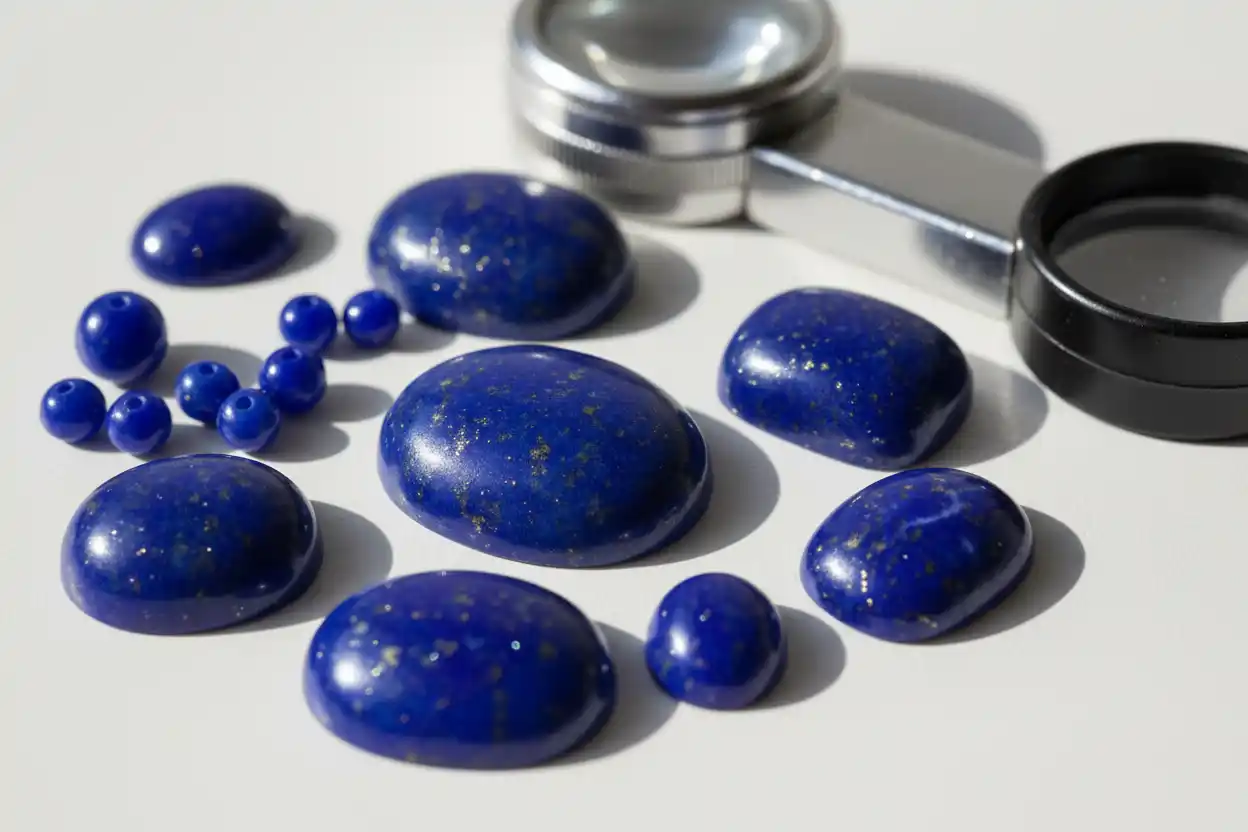
Buy Lapis Lazuli: Quality Checks, Treatments & Value
To buy lapis lazuli intelligently, start by recognizing that lapis lazuli is a rock rather than a single mineral crystal. GIA defines it as an aggregate composed principally of lazurite, calcite, and pyrite, with lazurite providing the prized blue bodycolor, calcite commonly appearing as white areas or streaks, and pyrite producing metallic golden flecks. Other minerals such as diopside, amphibole, feldspar, and mica can also occur. This mixed composition explains why two pieces of genuine lapis can look radically different in color, matrix, texture, polish, and value even when they came from the same broad region.
Color is the primary commercial quality factor. GIA identifies intense, uniform medium-to-dark blue or slightly violetish blue as the most prized appearance and notes that top-quality lapis ideally shows no visible calcite. Small, attractively distributed pyrite flecks can remain desirable and need not lower quality, whereas heavy pyrite that dulls the blue or obvious white calcite streaks generally reduce market value. Treatment is equally important because lapis can be dyed to deepen color and conceal pale calcite, while untreated material can be impregnated with wax or oil to enhance luster and color. GIA considers these treatments only fairly stable and notes that trained gemologists can detect them.
Buy Lapis Lazuli At a Glance
| Buying Factor | What to Examine | Why It Matters |
|---|---|---|
| Identity | Natural lapis lazuli aggregate | Glass, plastic, ceramic, and reconstructed imitations exist |
| Blue Color | Intense medium-to-dark blue or violetish blue | Color is the main value driver |
| Uniformity | Smooth consistent blue | Large pale, greenish, or mottled zones usually reduce value |
| Calcite | White streaks, patches, or matrix | Visible calcite generally lowers top jewelry quality |
| Pyrite | Fine attractive golden flecks versus dense metallic areas | Small evenly distributed pyrite can enhance appearance |
| Texture | Fine compact polished surface | Coarse or porous material may polish less attractively |
| Dye | Unnaturally concentrated or suspiciously uniform color | Dye can conceal low-grade pale or calcite-rich material |
| Wax/Oil | Surface enhancement and luster | Impregnation changes treatment status and care |
| Cut | Cabochon, bead, tablet, carving, inlay | Craftsmanship can add substantial value |
| Size | Dimensions and finished form | Large rough is available, so size alone is a weak rarity indicator |
| Origin | Afghanistan, Chile, Russia, Pakistan, others | Source can influence demand but requires evidence |
| “Afghan Grade” | Treat as a quality description unless provenance is documented | Trade grade does not automatically prove geographic origin |
| Durability | Mohs 5–6, fair toughness | Softer than many transparent gemstones |
| Care | Warm soapy water, conservative cleaning | Dye, wax, oil, heat, and solvents can create risks |
| Documentation | Laboratory identification for expensive or unusual pieces | Useful when treatment or imitation is a concern |
Lapis Lazuli Is a Rock, Not a Single Mineral
The blue material commonly called lapis is an aggregate whose exact mineral proportions vary. Lazurite supplies the richest royal-blue coloration, calcite contributes white matrix, and pyrite produces the metallic gold flecks commonly associated with classic lapis appearance. GIA notes that higher lazurite content generally contributes to darker prized blue, while the overall mixture of minerals controls the final bodycolor.
This matters when buying because the term natural lapis lazuli does not guarantee high quality. A piece containing extensive white calcite, weak blue lazurite, or excessive pyrite can be entirely natural while remaining commercial grade.
The correct buying question is therefore not simply “Is it real lapis?” but “What is the quality of this particular lapis aggregate?”
Color Is the Most Important Quality Factor
GIA describes lapis lazuli’s signature colors as slightly greenish blue through violetish blue, generally medium to dark in tone and strongly saturated. The most prized material is intense and relatively uniform, especially when it avoids obvious white calcite.
Rich royal blue or slightly violetish royal blue typically attracts the strongest demand. Pale blue, gray-blue, strongly greenish blue, or washed-out material usually occupies lower commercial tiers.
Darkness alone is not enough. An attractive stone should look richly blue rather than nearly black or so pyrite-rich that the metallic component overwhelms the blue bodycolor.
A Uniform Blue Surface Usually Commands a Premium
Top-quality lapis can appear almost velvety because its color remains consistent across a cabochon, bead, or tablet. Large color interruptions can reduce this premium.
Uniformity is particularly important for matched earrings, bead strands, cufflinks, watch dials, inlays, and suites where differences between pieces become immediately obvious.
Carvings are more flexible because a skilled artist can incorporate white calcite, pyrite veins, or tonal variation intentionally into the design.
Calcite Usually Lowers Fine-Gem Value
Calcite commonly appears as white streaks, clouds, or matrix within lapis. GIA states that the most prized quality generally lacks visible calcite and illustrates how obvious calcite lowers the appeal of otherwise blue material.
A small white area does not make the stone fake or worthless. It simply moves the piece away from the elite uniform-blue category.
Calcite can also become part of an artistic carving or specimen aesthetic, so its effect on value depends on whether the object is being judged as fine jewelry material, ornamental stone, or mineral specimen.
Pyrite Can Enhance or Reduce Value
Small golden pyrite flecks scattered attractively through strong blue lapis can produce the classic starry appearance many buyers associate with the gem. GIA specifically notes that fine pyrite flecks do not necessarily reduce quality.
Excess pyrite can have the opposite effect. Dense metallic zones can cloud the bodycolor or contribute to dull greenish appearance, moving the stone into a lower commercial category.
A balanced pattern matters more than a simplistic rule that pyrite is either always good or always bad.
“No Pyrite” Is Not Automatically Better for Every Buyer
The highest traditional jewelry grade often emphasizes clean blue material with little or no visible pyrite, especially when the color is intense and uniform. Some consumers, however, deliberately prefer a field of small gold flecks because the contrast creates a distinctive natural appearance.
Personal preference therefore matters once quality is otherwise strong.
What should be avoided is confusing large unattractive pyrite masses with fine evenly distributed flecks merely because both are metallic.
Afghan Lapis Has a Long Historical Reputation
Afghanistan has supplied celebrated lapis for thousands of years, and GIA identifies Badakhshan as the principal historic source of many of the world’s finest examples.
The Sar-e-Sang deposits in Badakhshan are especially famous, with documented mining stretching back to ancient civilizations. GIA’s geological study describes lapis there occurring in carbonate-rich host rocks with lazurite, calcite, pyrite, and associated silicate minerals.
That history gives genuine Afghan provenance strong market recognition, particularly when the material also displays the classic intense uniform blue associated with premium lapis.
“Afghan Grade” Does Not Prove Afghan Origin
The gem trade also uses geographic-looking terms as quality descriptions. GIA specifically warns that a country or region adjective does not necessarily mean a piece actually originated there.
A seller might call intensely colored low-calcite lapis “Afghan grade” because it resembles traditional fine Afghan material even when the actual source is unknown.
Buyers paying a source premium should therefore separate appearance-based trade terminology from documented mine provenance.
Chilean Lapis Can Range Widely in Quality
Chile is an important lapis source, and GIA’s research into the Coquimbo region confirms that some Chilean material can approach fine Afghan quality even though typical commercial Chilean lapis is often associated with more visible calcite or greenish components.
This is another reason trade labels should not be treated rigidly. “Chilean” does not automatically mean low quality, just as “Afghan” does not guarantee top quality.
The individual stone still needs to be judged by color, calcite, pyrite, polish, treatment, and craftsmanship.
Russian and Other Lapis Sources Also Enter the Market
GIA lists Lake Baikal in Siberia among the important lapis sources and notes additional occurrences in places including Angola, Canada, the United States, and Pakistan.
Russian or Siberian material can display attractive blues with visible pyrite and calcite, while other sources produce a wide variety of qualities.
Country should therefore be treated as provenance rather than a substitute for examining the actual object.
Dye Is One of the Most Important Treatment Risks
Lapis can be dyed to deepen weak color or conceal pale calcite. GIA explicitly identifies dyeing as a known enhancement and notes that the treatment can make lower-quality material appear more uniformly blue.
Dyed lapis can still be attractive and affordable when disclosed honestly.
The problem arises when treated commercial material is sold as naturally intense premium blue lapis at an untreated premium.
Dye Can Have Limited Stability
GIA reports that some lapis dye can be affected by solvents such as acetone or denatured alcohol and that dyed material may be sealed with wax or plastic.
Consumers should not deliberately test valuable jewelry with strong solvents because doing so can damage the finish or treatment.
Professional gemological testing provides a safer approach when treatment status materially affects the purchase price.
Wax and Oil Can Improve Luster
Undyed lapis can also be impregnated with wax or oil to deepen color and improve surface luster. GIA classifies these treatments as only fairly stable.
This is especially important for porous or lower-luster material because enhancement can make the surface look richer and more polished than the untreated stone.
The treatment does not transform the material into imitation lapis, but disclosure matters because it affects care and market comparison.
Glass, Plastic, and Ceramic Can Imitate Lapis
GIA identifies glass, plastic, and ceramic materials among known lapis imitations and specifically notes Gilson imitation lapis as a manufactured material with different ingredients and properties from natural lapis lazuli.
A convincing imitation can reproduce intense blue color and even apparent metallic flecks.
The buyer should therefore be cautious when a supposedly flawless large lapis piece has a suspiciously uniform texture, identical repeated patterning, unusually low price, or material properties inconsistent with natural stone.
Reconstituted or Composite Material Needs Clear Disclosure
Powdered lapis or lapis-like material can be combined with binders to create manufactured blocks, beads, or carvings. These products can be useful decorative materials but do not possess the same natural aggregate structure as solid lapis.
A seller should describe reconstructed, compressed, or composite material clearly.
The buyer should not pay the premium associated with a large solid high-quality natural piece when the object is manufactured from smaller particles.
Carvings Should Be Evaluated as Both Stone and Art
Lapis has a long history as a carving material because rich blue rough can occur in pieces large enough for sculpture, vessels, inlays, tablets, and decorative objects. GIA notes that lapis rough can become large and is frequently fashioned into carvings and art objects.
The final price can therefore reflect far more than the gemstone quality.
Fine hand carving, design complexity, artist reputation, historical provenance, age, condition, and use of the natural color pattern can outweigh the raw material value.
Bead Strands Need Matching Evaluation
For lapis necklaces and bracelets, compare the beads collectively rather than judging one attractive bead shown in a close-up photograph.
Strong strands should have reasonable consistency in hue, saturation, pyrite pattern, calcite content, diameter, polish, drill quality, and shape.
Natural variation is expected, but extreme mismatching can reduce the polished appearance of the strand.
Polishing Quality Matters
Lapis ranges from waxy to vitreous in luster depending on composition and surface finish. A premium polished piece should feel smooth and show even luster rather than pits, scratches, porous patches, poorly finished drill holes, or matte areas.
A heavy wax coating can temporarily conceal poor polish, so the buyer should consider both visual surface quality and treatment status.
Good workmanship can raise the value of otherwise similar rough.
Lapis Is Softer Than Many Popular Gems
GIA places lapis between 5 and 6 on the Mohs scale and describes its toughness as fair.
That durability is adequate for jewelry when the owner uses sensible care, but it is substantially softer than quartz, sapphire, or diamond.
Rings and bracelets can accumulate scratches more quickly than earrings or pendants, especially when lapis rubs against harder gemstones or abrasive surfaces.
Warm Soapy Water Is the Safest General Cleaning Method
GIA recommends warm soapy water for lapis and advises against steam and ultrasonic cleaning.
This conservative advice is particularly important because dye, wax, oil, resin, or other surface treatments may react poorly to heat, chemicals, or solvents.
Clean gently with a soft cloth or soft brush and avoid soaking treated pieces unnecessarily.
Large Size Does Not Automatically Mean High Rarity
Lapis rough can occur in substantial blocks, allowing manufacturers to produce large carvings, spheres, beads, slabs, boxes, tablets, and decorative objects. GIA emphasizes that large fashioned sizes are more common than in many transparent gemstones.
A large pale block full of calcite can therefore be worth less than a much smaller intensely saturated uniform-blue cabochon.
Size adds value most strongly when fine color and low undesirable matrix persist throughout the larger piece.
Seller Grades Are Not Universal Standards
GIA explicitly states that it evaluates lapis lazuli but does not issue an overall grade.
AAA, AAAA, 5A, royal grade, Persian grade, Afghan grade, museum grade, and investment grade are therefore seller or trade descriptions rather than universally standardized laboratory grades.
Translate every grade into actual qualities: color, uniformity, calcite, pyrite, treatment, polish, dimensions, provenance, and craftsmanship.
Lapis Lazuli Versus Labradorite
Lapis lazuli and labradorite can both be used in substantial cabochons, beads, carvings, and statement jewelry, but their value systems are very different. Labradorite is prized primarily for moving optical flash, while lapis is valued for saturated blue bodycolor and the balance of lazurite, pyrite, and calcite.
The Gems Lore buy labradorite guide and labradorite price guide explain why phenomenon quality dominates feldspar valuation.
The comparison reinforces the need to judge each opaque or translucent gem according to its own quality system rather than using weight alone.
Common Red Flags When You Buy Lapis Lazuli
Be cautious when:
An extremely bright uniform blue surface is sold as untreated without supporting evidence.
A seller claims every pyrite fleck makes the stone higher grade.
Large white calcite areas are hidden from photographs.
“Afghan grade” is represented automatically as verified Afghan origin.
Plastic, ceramic, glass, or reconstructed material is labeled natural lapis.
Dye or wax treatment is concealed.
The seller recommends solvent cleaning despite unknown treatment.
Huge size is presented as exceptional rarity by itself.
AAAA is described as an official GIA grade.
A certificate gives a retail value but does not independently identify the stone.
Guaranteed investment appreciation is used as the main sales argument.
How to Compare Lapis Lazuli Listings Fairly
Compare pieces by natural identity, hue, saturation, uniformity, lazurite-rich appearance, calcite content, pyrite pattern, treatment, polish, dimensions, form, craftsmanship, source documentation, condition, and seller return rights. A uniform royal-blue Afghan-provenance cabochon, a calcite-rich Chilean carving, a dyed bead strand, and a ceramic imitation belong to completely different market categories despite all being marketed around the lapis look.
Conclusion
To buy lapis lazuli confidently, judge the material as a mineral aggregate rather than as a single blue crystal. GIA identifies lazurite, calcite, and pyrite as its principal components, with lazurite creating the prized royal-blue color, calcite contributing white matrix, and pyrite providing metallic golden flecks.
Fine material combines intense medium-to-dark or violetish blue, strong uniformity, little or no visible calcite, and either minimal pyrite or small attractively distributed flecks. Afghan material has extraordinary historical prestige, but quality descriptors such as Afghan grade should not be mistaken automatically for documented geographic origin.
Treatment disclosure remains critical because dye can deepen color and conceal calcite, while wax or oil can improve color and luster; GIA considers these treatments only fairly stable and recommends conservative warm-soapy-water cleaning. Buyers who separate natural quality from dye, imitation, trade grades, provenance, and craftsmanship can recognize excellent lapis without overpaying for marketing language.
Frequently Asked Questions
What is lapis lazuli made of?
Lapis lazuli is a rock composed mainly of lazurite, calcite, and pyrite, with additional minerals sometimes present. Lazurite is primarily responsible for the prized blue color.
What is the best lapis lazuli color?
GIA identifies intense medium-to-dark blue or violetish blue as the most prized color, especially when the bodycolor is uniform and visible calcite is absent.
Is pyrite good in lapis lazuli?
Small, attractively distributed pyrite flecks can be desirable and do not necessarily reduce value. Excessive pyrite that clouds the bodycolor can lower quality.
Does white calcite lower lapis quality?
Generally, yes. Fine jewelry-quality lapis is usually valued more highly when obvious white calcite is absent.
Is Afghan lapis the best?
Afghanistan has historically produced some of the world’s finest lapis and remains strongly associated with premium material. Individual quality still varies, so origin should not replace inspection.
Does Afghan grade prove Afghan origin?
No. GIA warns that geographic-looking trade descriptions can refer to appearance rather than actual source.
Can lapis lazuli be dyed?
Yes. GIA states that lapis can be dyed to deepen color and conceal calcite.
Is lapis treated with wax or oil?
Yes. Undyed lapis can be impregnated with wax or oil to improve color and luster, and GIA considers these treatments only fairly stable.
Are there fake lapis lazuli products?
Yes. GIA identifies glass, plastic, ceramic, and manufactured imitation lapis among known substitutes.
How hard is lapis lazuli?
Lapis generally ranges from about 5 to 6 on the Mohs scale and has fair toughness.
How should lapis lazuli be cleaned?
GIA recommends warm soapy water and advises against steam and ultrasonic cleaning.
Does GIA grade lapis lazuli AAA?
No. GIA evaluates lapis lazuli but does not give it an overall commercial quality grade.
Is large lapis rare?
Large rough is available, so size alone does not establish premium rarity. Fine color and low calcite content across a large piece are more important.
Is lapis lazuli a guaranteed investment?
No. Future value depends on natural quality, treatment, provenance, craftsmanship, condition, historical importance, demand, and market liquidity.