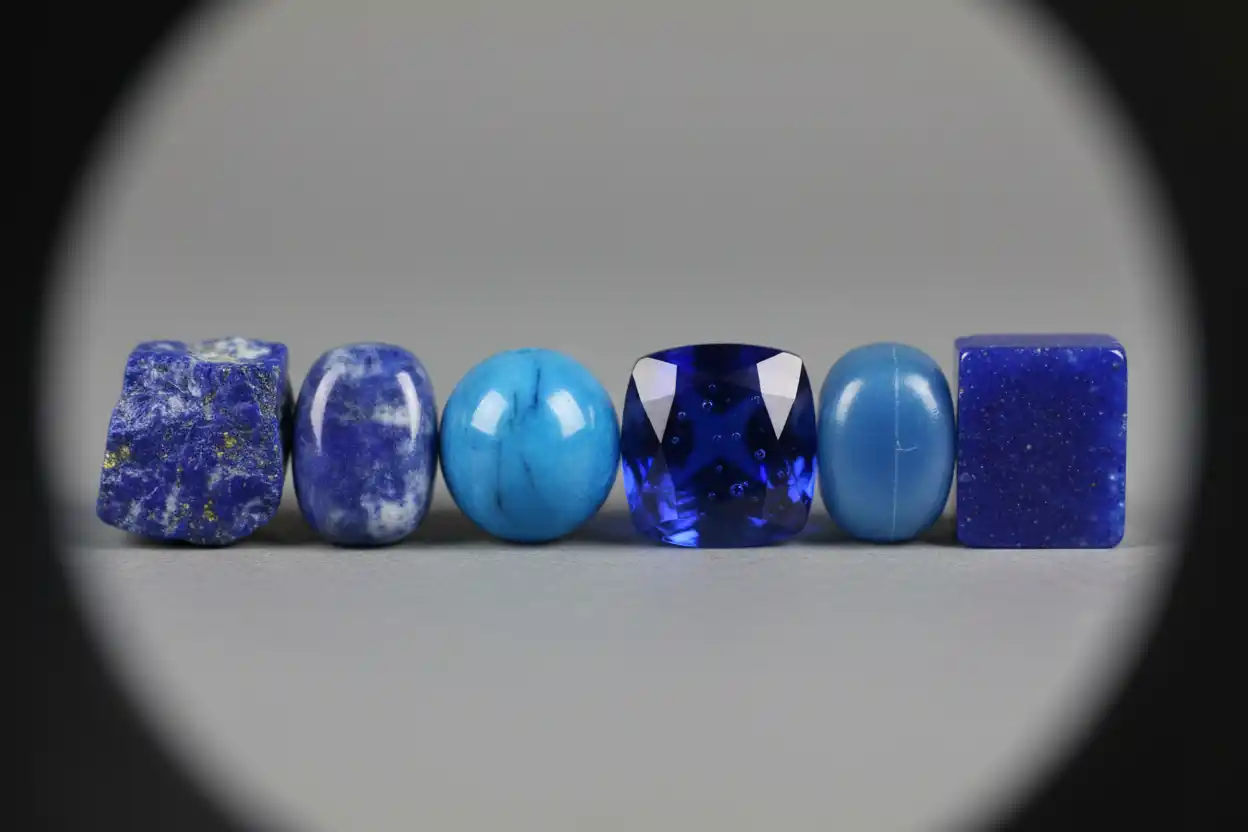
Real vs Fake Lapis Lazuli: Identification Tests and Imitations
Real lapis lazuli is a blue metamorphic rock composed of several minerals rather than one crystal species. Lazurite supplies its most desirable blue color, while calcite, pyrite, diopside, sodalite-group minerals, mica, and other constituents may occur in different proportions.
That mixed composition explains why genuine lapis varies so much. One piece may be an even royal blue with only a few metallic pyrite grains. Another may contain broad white calcite veins, gray patches, or irregular areas of several blues.
Imitations include dyed howlite, dyed magnesite, dyed calcite, sodalite, glass, resin, ceramic, reconstructed material, and other blue rocks. Genuine lapis may also be dyed, waxed, filled, or coated, which means material identity and treatment status must be evaluated separately.
This page owns the direct real-versus-fake workflow. The completed treated lapis lazuli guide retains detailed enhancement processes, disclosure, and care implications.
Real Lapis Lazuli vs Common Imitations
| Feature | Genuine lapis lazuli | Sodalite | Dyed howlite or magnesite | Cobalt glass | Resin or reconstructed material |
|---|---|---|---|---|---|
| Material | Lazurite-rich metamorphic rock | Sodalite-group mineral or sodalite-rich rock | Different porous minerals | Manufactured glass | Polymer or bonded composite |
| Typical blue | Royal, violetish blue, indigo, or greenish blue | Commonly medium to dark blue | Any dye-controlled blue | Uniform cobalt or ultramarine blue | Any manufactured shade |
| White areas | Natural calcite or other pale minerals | White calcite commonly occurs | Veins or porous host structure | Manufactured inclusions or none | Printed, poured, or embedded pattern |
| Metallic grains | Natural pyrite may occur | Usually absent, although mixed rocks can vary | Artificial glitter may be added | Metallic particles may be embedded | Glitter or metal flakes may be added |
| Internal structure | Irregular multi-mineral aggregate | More uniform blue mineral texture | Porous, veined, or chalky structure | Glass flow or devitrification features | Molded, cast, or fragment-bound structure |
| Hardness | Variable, commonly around 5–6 | About 5.5–6 | Commonly softer | Usually about 5–6 | Variable and often softer |
| Specific gravity | Commonly around 2.5–3.0 | Usually near the lower part of that range | Host-dependent | Glass-dependent | Variable |
| Best confirmation | Microscopy, Raman, XRD, chemistry, and aggregate properties | Mineral identification | Mineral and dye testing | Optical and spectroscopic testing | Microscopy and polymer analysis |
No single row in the table proves identity. Natural lapis can lack visible pyrite, while sophisticated glass can lack obvious bubbles.
What Is Genuine Lapis Lazuli?
The completed lapis lazuli meaning guide owns the rock’s formation, historical use, symbolism, and broader properties.
Lapis is best described as a lazurite-rich rock. Lazurite belongs to the sodalite mineral group and contains sulfur species responsible for the prized blue.
Calcite commonly appears as white, gray, or pale streaks. Pyrite produces brass-yellow metallic grains that can resemble tiny gold flecks.
Because lapis is an aggregate, it does not have one perfectly fixed chemical formula or one narrow refractive-index reading. Measurements can vary according to which constituent reaches the surface.
That variability is normal and should not be mistaken for evidence of an imitation.
Natural Lapis Color
Genuine lapis ranges from greenish blue through royal blue and deep indigo to violetish blue.
Fine material usually combines strong saturation with enough brightness to remain visibly blue under ordinary indoor light. An excessively dark piece can look nearly black away from concentrated lighting.
White calcite lowers the apparent uniformity of the color, although attractive natural veining can suit carvings or artistic jewelry. Greenish, gray, or pale zones may indicate a lower lazurite proportion.
Color alone provides little proof. Dye, glass, ceramic, and resin can reproduce nearly any shade.
Photographs can also exaggerate saturation. Dark backgrounds and cool lighting may transform an ordinary medium-blue piece into an apparent electric royal blue.
Does Real Lapis Always Contain Pyrite?
No. Pyrite is common but not compulsory.
Fine lapis may contain a small, attractive distribution of metallic grains. Other high-quality pieces show little or no pyrite and are valued primarily for uniform blue color.
Large or crowded pyrite patches can interrupt the blue and may affect structural consistency. However, their presence still supports a natural mixed-rock appearance when the grains are genuinely embedded.
The recently drafted pyrite guide explains the metallic mineral’s identity separately.
A seller should not claim that every gold-colored speck proves lapis. Paint, brass particles, foil, and glitter can be added to imitations.
How Natural Pyrite Looks
Natural pyrite grains are commonly irregular, angular, or partly crystalline.
They sit within the rock rather than floating over a clear surface coating. Their edges may continue below the polish, and individual grains can differ in size and orientation.
Artificial glitter often appears flatter, more uniformly sized, or concentrated at the surface. Under magnification, it may show rounded metallic flakes, foil-like reflections, or a clear resin boundary.
A perfectly even constellation of identical gold dots is suspicious, although sequential beads cut from one manufactured block may also show more obvious repetition.
Do not scrape metallic grains to test them. Genuine pyrite can loosen, and the scratch permanently damages the polish.
Calcite in Lapis Lazuli
Calcite commonly creates white, pale gray, or cream-colored areas in lapis.
Thin natural veinlets may curve, branch, widen, or disappear into the blue. Broad calcite zones usually lower the value of material sold for saturated color, but they may create attractive landscape patterns.
Dyed lapis can show intense blue concentrated around calcite boundaries because the pale mineral or adjacent fractures absorb color differently.
An imitation may use painted white streaks or poured resin to reproduce calcite. Examine whether the pale material has depth and continues beneath the surface.
Acid testing should never be used on a finished piece. Calcite reacts with acid, but the procedure damages genuine lapis and can alter dyes, metal, and fillers.
Lapis Lazuli Versus Sodalite
Sodalite can resemble lapis closely because lazurite and sodalite belong to the same mineral group.
Sodalite is commonly blue with white calcite veining, but it usually lacks the natural pyrite associated with classic lapis. Its blue may appear more violet, gray, or uniform.
Nevertheless, absence of pyrite does not prove sodalite, and metallic particles can be added to a sodalite imitation.
The complete side-by-side workflow belongs in lapis lazuli versus sodalite. The planned real-versus-fake sodalite guide will retain sodalite-specific treatments and imitations.
Professional testing may use Raman spectroscopy to identify lazurite, sodalite, calcite, and other constituents within the same object.
Dyed Lapis Lazuli
Low-saturation lapis can be dyed to deepen its blue and disguise pale calcite or gray areas.
Dye may concentrate in fractures, pores, drill holes, grain boundaries, and calcite-rich zones. Under magnification, those areas can appear brighter or darker than the surrounding rock.
A chipped edge may reveal a paler interior. Beads may show intense blue inside the drill hole or around surface cracks.
However, modern dyes can penetrate deeply and remain stable. Failure to see surface concentration does not prove natural color.
Dyed natural lapis remains lapis as its base material, but its color is treated. The distinction affects value and care.
The broader gemstone treatments guide explains how dyeing differs from filling, coating, and reconstruction.
Waxed, Oiled, and Filled Lapis
Wax or oil can deepen blue color and improve surface gloss.
Resin may fill pores, fractures, or granular areas, increasing apparent durability and creating a smoother polish.
A filler can be difficult to see without magnification or spectroscopy. Uneven luster, bubbles within fractures, and transparent material between mineral grains are useful warning signs.
Heavy impregnation changes the way the piece should be cleaned and repaired. Heat and solvents may soften, discolor, or remove the treatment.
Reconstructed Lapis
Lapis fragments or powder can be bonded with resin and molded into beads, slabs, carvings, or cabochons.
The result may contain genuine lazurite-rich material while lacking the continuous structure of one natural rock piece.
Magnification may reveal fragment boundaries, resin-rich gaps, trapped bubbles, and repeated granular patterns.
Reconstructed products can be attractive and make use of small offcuts. They should be described as reconstructed, composite, or reconstituted lapis rather than solid natural lapis.
Manufactured “Synthetic Lapis”
Lapis lazuli is a multi-mineral rock, so the term synthetic lapis is less straightforward than synthetic sapphire or synthetic quartz.
Manufacturers can create convincing lapis-like products using synthetic blue pigment, mineral particles, glass, ceramic, or resin. Some are engineered to include metallic grains and white areas.
Such material is better described by its actual construction unless laboratory analysis confirms a deliberately reproduced lapis-like mineral aggregate.
An evenly manufactured product may show repeated texture, exceptionally uniform color, or particles distributed more regularly than in natural rock.
Cobalt-Blue Glass
Cobalt glass can be an effective lapis imitation.
Round gas bubbles and curved flow lines provide easy clues when present. Yet high-quality opaque glass may contain no obvious bubbles or swirls.
Some products contain crystalline particles created during controlled cooling, giving the body a rock-like granular appearance.
Glass can also include gold-colored particles and pale specks to imitate pyrite and calcite.
A smooth glassy chip, uniform body, and molded shape may raise suspicion, but advanced examples require refractive-index, density, spectroscopic, or diffraction testing.
The general crystal identification guide provides the safe first steps for an unknown decorative stone.
Dyed Howlite and Magnesite
Howlite and magnesite are pale porous minerals that absorb dye easily.
Dyed howlite commonly retains dark gray or black web-like veins. Lapis more often contains pale calcite and metallic pyrite within a blue multi-mineral texture.
Magnesite may appear chalky or granular, with dye concentrated in pores and irregular veins.
Neither material becomes lapis because it was dyed ultramarine blue. Accurate listings should state the host mineral.
Dyed Calcite, Marble, and Jasper
Calcite-rich rocks and marble can be dyed blue and sold as low-cost lapis.
They may show broad white areas, granular texture, or cleavage-related reflections. Their lower hardness and carbonate chemistry differ from lazurite-rich rock.
Blue-dyed jasper or quartzite is generally harder and may have a finer granular or conchoidal texture.
Do not use acid or scratch tests. Raman spectroscopy and microscopic texture provide safer identification.
Resin, Plastic, and Ceramic
Resin can reproduce lapis color, pyrite glitter, and calcite-like swirls in one molded body.
Look for mold seams, casting bubbles, surface scratches, repeated patterns, and metal flakes suspended in clear polymer.
Plastic often feels light and warms quickly, although touch tests remain subjective.
Ceramic may show a glazed surface over a different-colored interior. Chips can reveal a pale or granular body beneath the blue coating.
A hot-needle test is unsafe and destructive. It can release fumes and provides no information unavailable through safer examination.
Pattern Repetition
Natural pieces cut sequentially from one slab can look similar, so repetition alone does not prove manufacture.
Suspicion increases when several beads contain exactly the same white vein, metallic dots, and color patches in the same positions.
Manufactured blocks, printed resin, and molds can reproduce a pattern precisely.
Photographing a full strand and comparing bead orientation can reveal whether the design is naturally progressive or mechanically repeated.
Magnification
Use a clean 10× loupe under neutral lighting.
Inspect drill holes, chips, calcite boundaries, metallic grains, and areas where color changes. Search for dye accumulation, coating wear, glass bubbles, resin boundaries, mold seams, and artificial glitter.
Natural lapis should display an aggregate of distinguishable mineral textures rather than one perfectly homogeneous blue body.
However, very fine-grained lapis can look uniform even under modest magnification. Laboratory analysis may be needed when the material is valuable or unusually convincing.
Refractive Index and Specific Gravity
Lapis commonly provides a spot refractive-index reading near 1.50, but calcite-rich surface areas can produce higher values.
Specific gravity also varies because lazurite, calcite, pyrite, and other minerals have different densities.
This variability is itself consistent with a rock aggregate. A perfectly uniform manufactured material may produce a narrower set of readings.
Sodalite, glass, calcite, resin, and reconstructed products can sometimes be eliminated through the combined results.
Mounted jewelry and hollow objects complicate density testing.
Ultraviolet Light
Lapis can show varied fluorescence because its constituent minerals react differently.
Calcite may fluoresce, while lazurite-rich areas can respond weakly or differently according to chemistry. Fillers and dyes may produce contrasting reactions.
Sodalite-group materials can also show notable fluorescence, preventing a simple pass-or-fail test.
Ultraviolet examination is most useful for locating treatment or mixed materials, not for proving lapis through one color.
Laboratory Identification
Raman spectroscopy can identify lazurite, sodalite, calcite, pyrite, and many substitute minerals.
X-ray diffraction determines crystalline phases within an opaque aggregate. Chemical analysis can detect elemental patterns consistent with lapis or cobalt-colored glass.
Infrared spectroscopy may reveal polymer fillers, waxes, or resins.
A report is most useful when an expensive carving, claimed archaeological object, or premium-origin piece requires verification. The gemstone certification guide explains laboratory scope, while how to read a gem lab report helps interpret material and treatment wording.
Tests to Avoid
Do not use acid to look for calcite.
Avoid scraping pyrite, scratching the blue body, heating the object, soaking it in solvent, or using a hot needle.
Acetone may sometimes lift surface dye, but a stable dye may not transfer, while resin, coating, glue, and metal finishes can be damaged.
The gemstone hardness chart describes comparative scratch resistance without recommending destructive testing. The toughness-versus-hardness guide explains why a mixed rock may chip even when selected grains are harder.
A Safe Home Inspection Sequence
First, examine the object under daylight and warm indoor light. Record whether the blue remains natural-looking or becomes artificially saturated under one source.
Next, inspect the edges and back. Determine whether white and metallic areas continue below the polish.
Use a loupe around drill holes and fractures. Look for concentrated dye, flat glitter, bubbles, resin, and mold lines.
Compare the texture with the seller’s claimed form. A carving may hide natural rough evidence, while an unpolished specimen should retain believable multi-mineral structure.
Review the treatment disclosure and return terms. Stop before chemical or destructive testing.
Buying Genuine Lapis Lazuli
The completed lapis lazuli buying guide owns color, calcite, pyrite, workmanship, and seller selection.
Detailed cost ranges remain within the lapis lazuli price guide.
Request photographs of the exact piece from several angles. Ask whether it is natural color, dyed, filled, waxed, reconstructed, or assembled.
Descriptions such as Afghan blue, royal grade, or museum quality are not laboratory conclusions.
For remote transactions, follow how to buy gemstones online and preserve enough of the return window for independent inspection.
Lapis Jewelry and Care
Lapis is comparatively soft, porous, and compositionally variable.
The completed lapis lazuli ring guide explains why daily rings need protection. A lapis necklace or lapis earrings generally faces less impact than a lapis bracelet.
Use the dedicated lapis lazuli jewelry cleaning guide rather than soaking, steam, ultrasonic vibration, acids, or solvent.
Belief-based practices belong in how to cleanse and charge lapis lazuli and should remain physically gentle.
Frequently Asked Questions
1. What is real lapis lazuli?
Real lapis lazuli is a lazurite-rich metamorphic rock containing varying amounts of calcite, pyrite, and other minerals.
2. Does genuine lapis always have gold flecks?
No. Natural pyrite may occur, but some genuine high-quality lapis contains little or no visible pyrite.
3. Are white streaks proof of real lapis?
No. Natural calcite creates white areas, but paint, glass, resin, and other stones can imitate them.
4. Is sodalite fake lapis?
Sodalite is a genuine mineral, not fake stone. It becomes a lapis imitation when sold under the wrong identity.
5. Is dyed lapis still real?
It remains genuine lapis as its base material when correctly identified, but its color is treated and must be disclosed.
6. Can lapis be made from powder and resin?
Yes. Reconstructed lapis can combine fragments or powder with polymer. It should not be sold as one solid untreated rock.
7. Do glass bubbles always appear in fake lapis?
No. Sophisticated opaque cobalt glass can lack visible bubbles and swirls.
8. Can I test lapis with acetone?
The test is unreliable and can damage dye, filler, coating, adhesive, or jewelry components.
9. Can real lapis go in water?
Brief careful cleaning may be possible for untreated stable material, but soaking is not recommended because lapis can be porous and treated.
10. Does a uniform royal-blue color prove high quality?
No. Fine natural lapis can be even blue, but dye, glass, ceramic, and resin can produce the same appearance.
11. What laboratory tests identify lapis?
Raman spectroscopy, X-ray diffraction, microscopy, chemical analysis, and infrared spectroscopy can identify minerals, glass, and treatments.
12. When should lapis receive professional testing?
Testing is useful for expensive carvings, archaeological claims, rare provenance, major untreated-color premiums, or disputed reconstructed material.
Authentic lapis is identified through its complete rock structure, not one gold fleck or one shade of blue. Lazurite, calcite, pyrite, and minor minerals should form a believable aggregate whose features continue beneath the polish. Treatment and reconstruction remain separate questions, so a genuine lapis base can still require careful disclosure.
Lapis lazuli is indexed in Crystals That Start With L and Gemstones That Start With L.