11 Lithium Quartz Healing Claims: Traditions, Verified Facts & Safe Use
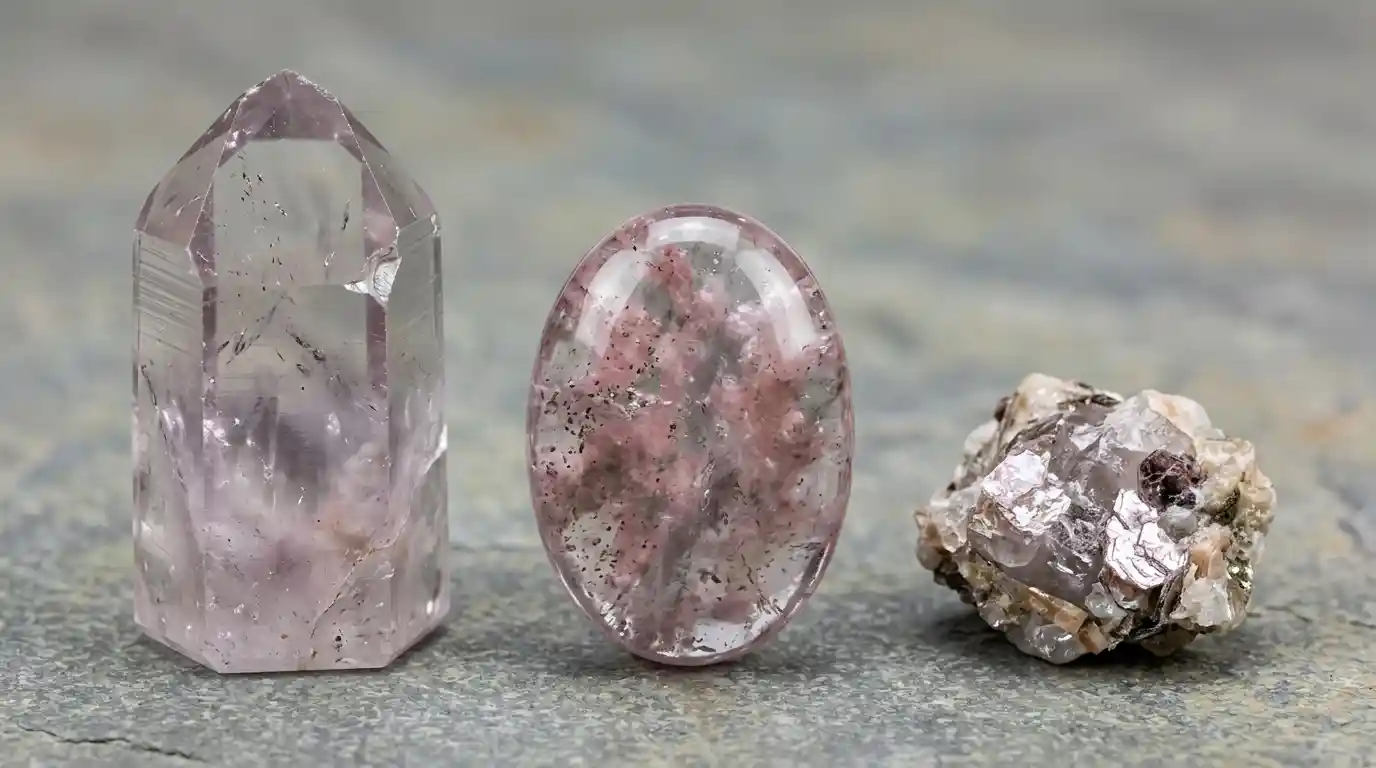
Lithium quartz healing properties are commonly associated with calm, emotional perspective, concentration, self-awareness, patience, resilience, sleep preparation, confidence, meditation, personal growth, and spiritual reflection. The name suggests a clear mineral identity, but the geology is less certain than the marketing. “Lithium Quartz” is an informal trade term used for pink, lavender, purple, cloudy, or included quartz that sellers associate with lithium-bearing minerals. Some specimens may genuinely contain inclusions of lithium-rich mica, cookeite, or other lithium-bearing phases, while other stones sold under the name may simply be colored quartz with no demonstrated lithium-rich inclusion at all. The quartz host remains SiO₂. Lithium quartz has not been demonstrated to treat anxiety, depression, bipolar disorder, insomnia, pain, hormonal problems, neurological illness, or another health condition, and a specimen cannot be assumed to deliver medicinal lithium simply because a seller uses the word “lithium.”
11 Lithium Quartz Claims Built Around Soft Color, Quiet Reflection, and an Uncertain Trade Identity
- Calm during stressful periods
- Emotional perspective and balance
- Concentration and reduced distraction
- Self-awareness through reflection
- Patience before reacting
- Resilience after setbacks
- Better preparation for sleep
- Confidence during personal change
- Meditation and present-moment awareness
- Personal growth and habit change
- Spiritual reflection and inner direction
These eleven themes can support separate reflective practices without becoming eleven scientifically demonstrated effects. The lithium quartz benefits described in modern crystal culture become more useful when they are translated into routines such as journaling, breathing, reducing stimulation, maintaining a bedtime ritual, or connecting a visible object with one deliberate behavior.
What Lithium Quartz Really Is: Ordinary SiO₂ With a Trade Name That Requires Verification
The host mineral in lithium quartz is ordinary crystalline quartz with the formula SiO₂. Quartz belongs to the trigonal crystal system, commonly forms six-sided prisms with rhombohedral terminations, has vitreous luster, lacks useful cleavage, and breaks with conchoidal fracture.
Quartz has Mohs hardness 7, giving it good scratch resistance compared with calcite, fluorite, opal, feldspar, and many decorative stones. Tenacity is brittle, so sharp terminations and thin edges can still chip after impact.
The important complication is the word “lithium.” Mineralogical references treat “Lithium Quartz” as a common New Age trade name rather than a formally defined species. Pink or purple specimens have been proposed to contain lithium-bearing inclusions such as lepidolite or related micas, yet that composition has not been established for every stone sold under the label.
In properly documented specimens, lithium-bearing minerals could occur as internal inclusions, coatings, fine flakes, clouds, or phantom-like growth zones within quartz. Lithium-rich pegmatites commonly contain quartz beside spodumene, lithium mica, elbaite tourmaline, cookeite, and lithium phosphates, so such associations are geologically plausible.
Appearance alone is not proof. Rose quartz, amethyst, iron-stained quartz, included quartz, dyed quartz, and other colored silica can all be marketed under creative names. A pink or lilac quartz point should therefore not be assumed to contain significant lithium without analytical evidence.
Lithium-Rich Pegmatites, Brazilian Trade Specimens, and Why Provenance Matters
Many specimens sold as lithium quartz are associated with Brazilian pegmatite districts, particularly Minas Gerais, where lithium-bearing minerals, quartz, tourmaline, spodumene, feldspar, beryl, phosphates, and mica can crystallize together during late stages of granitic pegmatite formation.
Pegmatites develop from highly evolved granitic melts and fluids in which elements such as lithium, cesium, rubidium, boron, beryllium, and fluorine can become concentrated. Large open pockets sometimes allow exceptionally well-formed quartz crystals to grow beside uncommon lithium minerals.
That geological setting makes genuine quartz containing lithium-bearing inclusions possible, but it does not validate every commercial label. A crystal found in a lithium-rich pegmatite does not automatically contain lithium-rich inclusions, just as a quartz crystal found beside tourmaline is not chemically tourmaline.
This uncertainty is central to the lithium quartz meaning used in modern metaphysical practice. The symbolism of calm and emotional balance often comes directly from the word lithium because pharmaceutical lithium has medical associations. That resemblance in naming should not be mistaken for evidence that the quartz acts pharmacologically.
Calm, Emotional Perspective, and Concentration Claims
1. Calm Through a Consistent Pause Ritual
Lithium quartz is often described as calming, and sellers frequently imply that lithium content explains the effect. Even if a specimen contains lithium-bearing inclusions, there is no evidence that holding it provides a medicinal lithium exposure. A grounded practice is to use the crystal as a cue to stop multitasking, slow the breathing, and focus on one immediate concern.
2. Emotional Perspective Through Written Structure
Another popular claim says lithium quartz balances emotions. It has not been shown to regulate neurotransmitters or mood chemistry. A practical ritual is to separate a difficult experience into what happened, what emotion appeared, what interpretation followed, and what action remains possible. The framework creates perspective.
3. Concentration and Reduced Distraction
Clear quartz frequently receives focus and amplification claims, and the lithium label adds another layer of wellness marketing. Quartz does not biologically increase attention span. It can nevertheless become a stable work cue when paired with a defined task, reduced notifications, and a predetermined focus interval.
Self-Awareness, Patience, and Resilience Claims
4. Self-Awareness Through Journaling
Lithium quartz is sometimes said to reveal emotional patterns or hidden thoughts. The crystal cannot retrieve psychological information. Keeping it beside a journal can still provide a consistent prompt to record triggers, reactions, assumptions, and alternative responses. Repeated observation can reveal patterns over time.
5. Patience Before Reacting
Soft pink and lavender colors often encourage symbolism around gentleness and patience. The stone cannot improve impulse control biologically. A practical use is to associate it with a simple rule: when emotions rise sharply, postpone non-urgent messages and decisions until the intensity has decreased.
6. Resilience After Setbacks
Modern crystal descriptions sometimes connect lithium quartz with emotional recovery. It cannot heal trauma or make someone psychologically resilient through mineral energy. After a setback, use it to identify what cannot be changed, what lesson remains useful, and what next step can be taken without repeating the same error.
Sleep Preparation, Confidence, and Meditation Claims
7. Better Preparation for Sleep
Lithium quartz is frequently marketed for peaceful sleep. There is no evidence that placing quartz beside a bed changes melatonin, sleep stages, or insomnia through a lithium mechanism. It can instead mark the beginning of a consistent bedtime routine involving dim light, reduced screen exposure, lower stimulation, and writing unfinished tasks down before trying to sleep.
8. Confidence During Personal Change
The stone’s gentle color and transition symbolism are sometimes associated with quiet confidence. It cannot biologically increase self-esteem. During a period of change, use it as a cue to identify what has already been prepared, what remains uncertain, and which first step is still under personal control.
9. Meditation and Present-Moment Awareness
A transparent or translucent quartz crystal with pink or lilac inclusions can make an effective visual meditation object. A practitioner may focus on one internal cloud or phantom, notice when attention wanders, and return to the breath. That is a real attention exercise without demonstrating that the quartz alters consciousness through lithium-bearing energy.
Personal Growth and Spiritual Direction Claims
10. Personal Growth Through Habit Change
Lithium quartz is sometimes associated with emotional transformation or personal evolution. The crystal cannot cause growth, but it can represent one concrete behavior that the user wants to strengthen. Place it where that behavior begins and connect seeing the crystal with taking the actual action.
11. Spiritual Reflection and Inner Direction
Modern metaphysical practice often assigns lithium quartz themes of intuition, higher awareness, or spiritual guidance. These claims are not established mineralogical properties. A person can still use the crystal during prayer, meditation, or reflection on values, responsibilities, and personal direction without interpreting subjective experience as scientific evidence.
Lithium Quartz Chakra Associations and Why the Name Should Not Be Treated as Pharmacology
Pink lithium quartz is often associated with the heart chakra, while lavender or violet specimens may be linked with the third-eye or crown chakra. Themes commonly include calm, emotional openness, compassion, reflection, intuition, and spiritual awareness.
Chakras are a spiritual framework rather than anatomical structures. Lithium quartz has not been demonstrated to affect the heart, brain, pineal gland, nervous system, hormones, or another organ through chakra placement.
The trade name can create additional confusion because lithium is also a medically important element. Prescription lithium compounds are pharmacologically active only at controlled doses and require medical monitoring. A quartz crystal that may contain small lithium-bearing inclusions is not equivalent to medication and should never be treated as one.
Lithium Quartz Physical Care: Mohs 7 Quartz, Inclusions, Water, Heat, and Chemical Safety
Because the host is quartz, lithium quartz generally has Mohs hardness 7, good resistance to ordinary scratching, no useful cleavage, and conchoidal fracture. Sharp points and crystals with heavy inclusions or internal fractures can still chip or split after impact.
Store quartz points so their terminations do not strike other stones. Quartz can scratch many softer gemstones, while topaz, sapphire, ruby, and diamond can scratch quartz.
Brief contact with plain water is generally safe for sound natural quartz. Warm water, mild soap, and a soft brush are suitable for many specimens. The caveat is that the identity of the inclusions may not be known. Surface coatings, matrix minerals, open fractures, adhesives, repairs, or soft mica inclusions can make prolonged soaking less suitable.
Steam cleaning is unnecessary, especially for heavily included or fractured crystals. Sudden heat can stress internal fractures or fluid inclusions. Ultrasonic cleaning can also extend pre-existing cracks, so gentle hand cleaning is the safer default.
Hydrofluoric acid attacks quartz and is extremely hazardous. Strong alkaline chemicals can also damage silica under suitable conditions. No household crystal cleaning requires such substances.
Quartz should never be ground into powder or intentionally ingested. Cutting and grinding create respirable crystalline silica, so lapidary work requires wet methods, effective extraction, eye protection, and appropriate respiratory controls.
Ritual Cleansing Lithium Quartz Without Turning the Lithium Label Into a Health Claim
Ritual cleansing can remain simple and symbolic. There is no scientifically demonstrated negative energy that needs to be extracted from lithium quartz, and no ritual method increases its lithium content or makes it medicinal.
Sound, intention-setting, meditation, dry placement, or gentle physical cleaning are low-risk choices. A person using the crystal for calm can make the ritual concrete by identifying one source of unnecessary stimulation and removing it from the environment.
Avoid harsh chemicals, flame, extreme heat, abrasive salt, unnecessary prolonged soaking, and any practice involving crystal powder or drinking water prepared by direct immersion. Symbolic use does not require ingestion or chemical exposure.
Conclusion
Lithium quartz illustrates why trade names need careful interpretation. The host is ordinary quartz, SiO₂, while the presence and identity of lithium-bearing inclusions may vary and are not proven merely by pink or lavender color. Its eleven healing themes can still support journaling, calm routines, concentration, meditation, sleep preparation, and habit change, but neither the word lithium nor the appearance of the crystal establishes a therapeutic effect.
Frequently Asked Questions About Lithium Quartz Healing Properties
What are the main lithium quartz healing properties people claim?
Common claims include calm, emotional balance, concentration, self-awareness, patience, resilience, sleep support, confidence, meditation, personal growth, and spiritual reflection. These are contemporary wellness or spiritual beliefs rather than proven therapeutic effects.
Is lithium quartz an official mineral species?
No. Lithium quartz is an informal trade and New Age name applied to certain pink, purple, cloudy, or included quartz specimens.
Does all lithium quartz actually contain lithium?
Not necessarily. Some specimens may contain lithium-bearing mineral inclusions, but mineralogical references caution that the presence of lithium has not been demonstrated in many pieces sold under the name.
What is lithium quartz made of?
The host mineral is quartz, SiO₂. If lithium is genuinely present, it is generally associated with included or attached lithium-bearing minerals rather than turning quartz into a different mineral species.
How hard is lithium quartz?
The quartz host is Mohs 7. Areas containing soft inclusions or open fractures may be more vulnerable than clean rock crystal.
Does lithium quartz work like lithium medication?
No. Even a quartz specimen containing lithium-bearing inclusions does not provide a controlled pharmaceutical lithium dose through wearing or touching it.
Which chakras are associated with lithium quartz?
Modern crystal practice often links pink specimens with the heart chakra and lavender specimens with the third-eye or crown chakras. These are spiritual correspondences rather than anatomical effects.
Can lithium quartz go in water?
Brief washing is generally safe for sound quartz, but prolonged soaking is unnecessary when the identity of inclusions, coatings, repairs, or matrix minerals is uncertain.
How can you tell whether a quartz crystal really contains lithium-bearing inclusions?
Color alone is not enough. Reliable confirmation may require provenance, microscopy, spectroscopy, X-ray analysis, or other mineralogical testing of the inclusions.
Is lithium quartz the same as rose quartz?
No. Rose quartz is an established pink variety of quartz, while lithium quartz is an informal trade label whose claimed lithium-bearing inclusions may vary or remain unverified.
Crystal healing claims are traditional or personal beliefs and should not replace qualified medical or mental health care.