Lithium Quartz: Meaning, Properties & Symbolism
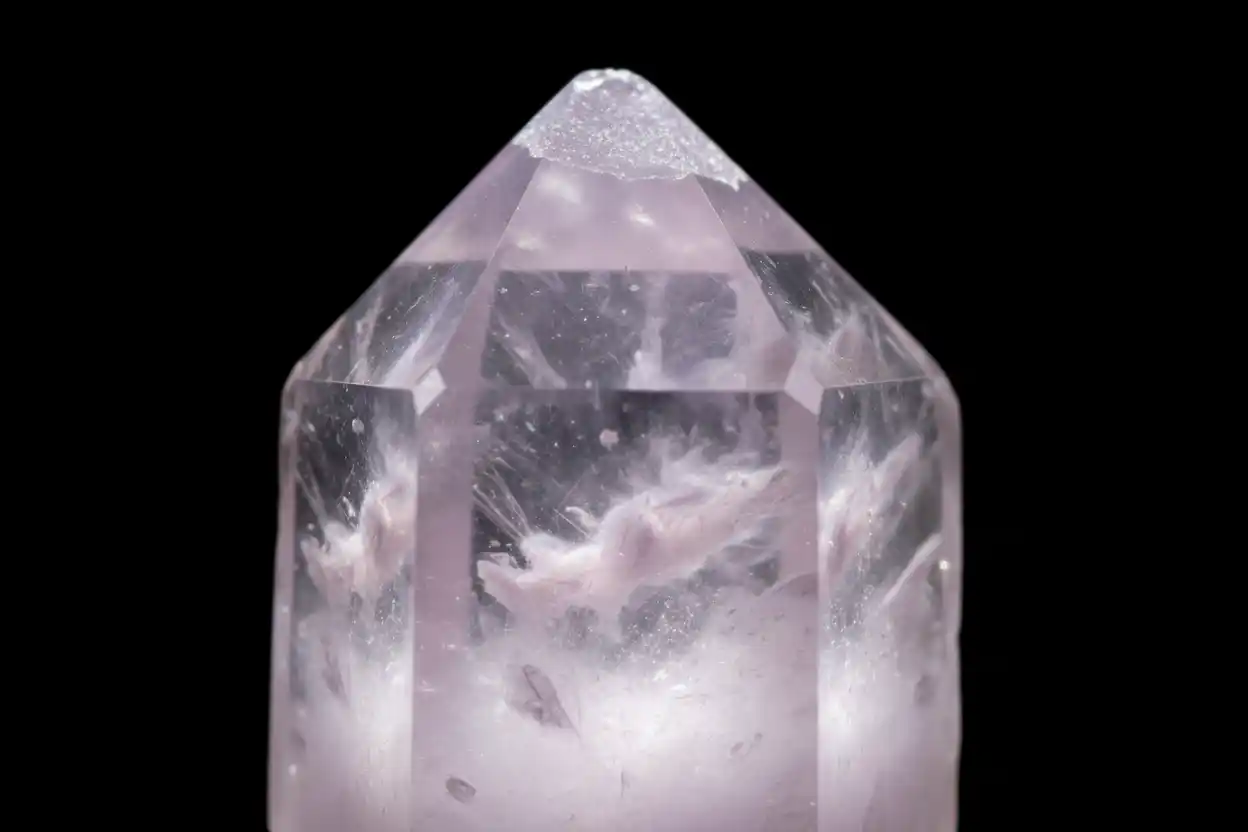
Lithium quartz is an unstandardized commercial name for quartz containing pink, mauve, violet, reddish or smoky inclusions and coatings that sellers associate with lithium-bearing minerals. The name does not guarantee a specific lithium concentration, one inclusion species or a recognized mineral variety, so composition should be verified rather than inferred from color.
Lithium Quartz at a Glance
| Property | Lithium Quartz Characteristics |
|---|---|
| Material type | Trade-named included or coated quartz |
| Composition | Quartz, SiO₂, with variable mineral inclusions; actual lithium-bearing content is not guaranteed |
| Colors | Colorless, smoky, pale pink, mauve, lavender, red violet, gray and brown |
| Crystal system | Trigonal |
| Habit or texture | Quartz points, clusters, phantoms, included crystals, coated surfaces and polished shapes |
| Luster | Vitreous on quartz; earthy, pearly or dull across inclusions and coatings |
| Transparency | Transparent to opaque depending on inclusion density |
| Mohs hardness | 7 for the quartz host; inclusions may be softer |
| Cleavage | None in quartz |
| Tenacity | Brittle |
| Common uses | Mineral specimens, natural points, pendants, cabochons, polished towers and collector pieces |
| Main care concern | Unverified lithium claims, dyed or coated quartz, fragile inclusions and confusion with lepidolite or iron-stained quartz |
What Is Lithium Quartz?
Lithium quartz is not a formally defined mineral species.
Mineralogical references treat the term as a New Age or commercial name applied to pink, purple, smoky or included quartz believed or claimed to contain lithium-bearing material.
The quartz itself has the formula SiO₂ and the same trigonal structure as clear quartz.
What varies is the included material.
Some specimens may contain lithium-bearing mica, clay or other pegmatite minerals. Others derive their pink and violet color from iron oxides, manganese-bearing minerals, hematite, lepidolite-like mica, clay or combinations that have not been analyzed.
A seller’s use of the word lithium therefore should not be interpreted as a laboratory result.
This page owns the trade-name, inclusion and verification intent. The broad types of clear quartz guide covers the wider range of natural quartz habits without assigning every included crystal to the lithium category.
Does Lithium Quartz Actually Contain Lithium?
Some specimens may contain lithium, but the name alone does not prove it.
Lithium is a light chemical element that can occur in pegmatite minerals such as spodumene, lepidolite, petalite, amblygonite and several clays.
Quartz growing in a lithium-rich pegmatite can trap microscopic grains or surface coatings from neighboring minerals. Trace lithium can also enter defects or channels within quartz at concentrations that are invisible to the eye.
However, detecting lithium requires appropriate analytical methods. Standard handheld X-ray fluorescence instruments often have difficulty measuring very light elements such as lithium directly.
Laser-ablation mass spectrometry, ion-beam methods and other specialized techniques can provide stronger evidence.
Even when lithium is detected, the result does not establish that lithium causes the visible color. Iron, manganese and other mineral inclusions may dominate the appearance.
A responsible seller should distinguish between confirmed lithium-bearing inclusions, a locality known for lithium minerals and an unverified trade label.
What Causes the Pink and Purple Color?
The color is usually inclusion related rather than an intrinsic quartz variety color.
Fine iron oxides can produce red, pink and rusty tones. Hematite plates, particles or coatings may create stronger red areas.
Manganese-bearing minerals can contribute pink, violet or brownish-purple hues.
Lithium mica such as lepidolite may produce lilac flakes or cloudy inclusions, but visible purple material should not automatically be identified as lepidolite.
Clay minerals and fine alteration products can create soft mauve or gray-pink phantoms.
Smoky color in the host quartz may come from natural irradiation interacting with aluminum-related defects, as explained in the smoky quartz guide.
Several causes can occur in one crystal. A quartz point may contain a smoky center, red iron coating and pale-purple mica particles while being sold under one lithium-quartz label.
Quartz Phantoms and Growth Zones
Many lithium-quartz specimens show internal phantom outlines.
A phantom forms when quartz growth pauses and the existing crystal surface becomes coated with another mineral. When quartz growth resumes, the coating is enclosed inside the later transparent layer.
Repeated interruptions create several nested crystal shapes.
Pink, red or purple phantoms may contain iron oxides, clay, mica or other fine particles.
A phantom does not prove lithium. It records interrupted growth and mineral deposition, not one specific chemical element.
The material may also show color concentrated along fractures or growth-sector boundaries. Such patterns can be natural, but dye can exploit the same pathways.
Identification should therefore evaluate whether the color consists of discrete mineral particles, a surface coating, a lattice color or introduced pigment.
Formation in Pegmatites and Hydrothermal Veins
Many commercial lithium-quartz specimens are associated with granitic pegmatites.
Pegmatites form from volatile-rich residual melts or fluids during late stages of granite crystallization. Their chemistry can concentrate lithium, boron, fluorine, cesium and other elements.
Quartz grows beside feldspar, mica and lithium-bearing minerals such as kunzite, petalite and lepidolite.
Fluids moving through the pegmatite can deposit iron, manganese, clay or mica on a quartz surface. Later quartz growth encloses these materials as phantoms and veils.
Hydrothermal veins can produce similar included quartz without a lithium-rich environment.
Consequently, geological context matters. A pink included quartz crystal from a generic hydrothermal vein should not receive a lithium name without evidence.
Reported Commercial Sources
Brazil is the source most strongly associated with the classic trade appearance, particularly pale-pink, mauve and smoky quartz points.
Minas Gerais contains extensive pegmatite districts capable of producing quartz beside lithium mica, spodumene, tourmaline and feldspar.
Material marketed under the name also appears from Madagascar, Pakistan and other pegmatite regions.
Pakistani quartz may contain chlorite, hematite, clay, mica, feldspar and other inclusions. A generic Himalayan or Skardu label does not prove lithium enrichment.
Location can support a geological possibility but cannot establish the composition of an individual specimen.
A precise dealer should provide the mine or district when known and avoid treating the place name as a chemical analysis.
Lithium Quartz vs Lepidolite
Lepidolite is a lithium-bearing mica-group mineral, whereas lithium quartz is quartz with claimed or possible inclusions.
Massive lepidolite commonly appears lavender, pink or gray and has pearly mica cleavage. It is much softer than quartz and can split into flakes.
A lithium-quartz point should retain the hard transparent or translucent SiO₂ host. Purple inclusions may be embedded within it rather than forming the entire specimen.
Some polished products combine quartz and lepidolite in one pegmatite rock. Those pieces may accurately contain both minerals but should be described as a mixed rock rather than pure quartz.
The distinction matters for water resistance, polishing behavior and value.
Lithium Quartz vs Petalite
Petalite is a lithium aluminum silicate mineral.
It can be colorless, white, gray or pink and is occasionally faceted as a transparent gem.
Petalite has cleavage and different optical properties from quartz. A transparent petalite crystal does not become lithium quartz merely because both contain or occur near lithium.
Likewise, quartz associated with petalite remains quartz unless the petalite occurs as a confirmed inclusion.
The relationship is geological rather than one of mineral identity.
Lithium Quartz vs Kunzite
Kunzite is the pink-to-violet variety of spodumene and contains essential lithium within its crystal structure.
Lithium quartz contains quartz as the host and may or may not include lithium-bearing minerals.
Kunzite shows strong pleochroism, two perfect cleavage directions and refractive properties different from quartz.
Pink transparent crystals sold inexpensively as raw lithium quartz should therefore be examined carefully. A genuine kunzite blade, rose quartz, dyed quartz and included rock crystal can each require a different identification.
The kunzite meaning guide owns the spodumene mineral and jewelry intent.
Lithium Quartz vs Amethyst and Rose Quartz
Amethyst is quartz with violet lattice color primarily related to iron and irradiation.
Its color is distributed through the crystal structure rather than confined to visible pink inclusions.
Rose quartz has pale-to-medium pink body color caused by microscopic inclusions or defect-related mechanisms, depending on the material.
Lithium quartz usually shows localized phantoms, clouds, coatings or red-purple particles within clearer quartz.
However, the trade boundary is inconsistent. Some sellers apply the lithium label to any pale pink included point.
The real versus fake clear quartz guide helps confirm the quartz host, but identifying the inclusions requires separate analysis.
How to Identify Lithium Quartz
Begin by confirming that the host is quartz.
Quartz has Mohs hardness 7, no cleavage, vitreous luster, specific gravity near 2.65 and refractive indices near 1.544–1.553.
Natural crystals may show growth lines, internal fractures, fluid inclusions and contact marks.
Next, inspect the colored material under magnification. Mineral inclusions should have physical boundaries, flakes, particles, phantoms or coatings. Dye often pools in fractures and produces unnaturally concentrated color around damaged areas.
Raman spectroscopy can identify many mineral inclusions if the laser can focus on a sufficiently large particle.
Electron microscopy and chemical analysis provide further evidence, but confirming lithium may require specialized methods because it is a light element.
The most defensible report may identify the specimen as natural quartz with iron-oxide, mica or clay inclusions rather than certify the commercial name.
Dyed, Coated and Artificial Products
Pale quartz can be dyed pink, purple or red.
Pigment commonly enters fractures, creating dark lines or color halos. Drill holes may show stronger saturation than the outer surface.
Some specimens receive metallic or iridescent coatings. These products may be attractive but should not be sold as untreated lithium quartz.
Artificially polished towers can be made from quartz-rich pegmatite containing purple mica. Such material may genuinely include lepidolite but differs from a naturally terminated clear quartz point.
Resin composites may combine crushed quartz, mica and pigment. Bubbles, mold seams and repeated swirls provide warning signs.
The treated clear quartz guide owns the detailed treatment and synthetic-detection intent, while how to spot fake crystals covers general composite and coating signs.
Is Lithium Quartz a Gemstone?
Transparent material can be faceted, although cutting usually removes the natural point and may reduce the visibility of inclusions.
Cabochons and polished freeforms better preserve broad phantoms and clouds.
Most commercial material remains in natural crystal or cluster form because its value comes from the relationship between the quartz and visible inclusions.
Quartz hardness makes it suitable for pendants and earrings. Rings require protection from impact because quartz remains brittle despite its scratch resistance.
The gemstone hardness chart places quartz at Mohs 7, while gemstone toughness versus hardness explains why points and fracture-rich pieces can still chip.
No cleavage improves durability, but narrow terminations remain vulnerable.
Treatments and Stabilization
Natural included quartz usually receives cleaning and trimming.
Fractured material may be resin filled, while polished towers can receive wax or clear coating.
Iron staining is sometimes removed with acid, which may alter the very surface features that contributed to the trade appearance.
Conversely, additional iron staining or dye can be introduced to intensify pink and red color.
A specimen glued to matrix or repaired at its base should be disclosed.
The word lithium does not indicate whether any of these treatments occurred. Origin, composition and treatment remain separate questions.
Lithium Quartz Price and Value
The market is driven mainly by quartz aesthetics rather than confirmed lithium concentration.
| Lithium Quartz Product | Broad Current Asking Range |
|---|---|
| Small included quartz point | $8–$25 |
| Medium natural point or small cluster | $20–$75 |
| Attractive phantom crystal | $50–$150 |
| Large polished tower or freeform | $75–$300 |
| Fine natural cluster with strong color zoning | $150–$500+ |
| Documented analytically verified inclusion specimen | Individually priced |
| Simple pendant or silver jewelry | Commonly $25–$200 |
A clear terminated crystal with balanced pink phantoms can cost more than a larger cloudy specimen.
Natural crystal form, color distribution, transparency, locality, condition and documented analysis contribute to value.
Unverified claims about high lithium content, healing grade or extreme rarity do not provide a reliable premium.
Because the full seller and authenticity checklist belongs to the dedicated Lithium Quartz buying guide, this article should not duplicate detailed retailer comparisons.
Buying Lithium Quartz
Ask what evidence supports the lithium name.
A strong answer might identify a tested inclusion, documented association with lithium mica or a recognized locality. A weak answer simply repeats supplier marketing.
Request neutral-light photographs of the exact specimen, including the base, termination and colored zones.
The seller should disclose dye, polishing, coatings, repairs and whether the crystal is natural or carved.
A certificate that states only “lithium quartz” without analytical methods adds little value.
Buyers should value the specimen as included quartz unless independent evidence establishes more specific mineralogy.
Cleaning and Storage
Stable natural quartz can be cleaned with lukewarm water, mild soap and a soft brush.
However, inclusion-bearing material may contain softer mica, clay, iron oxides or open fractures. Prolonged soaking can loosen earthy coatings or trap water inside cracks.
Avoid acids because they may remove or alter iron-rich surface material.
Ultrasonic cleaning is unnecessary and may extend fractures or detach included coatings. Hand cleaning is safer under the guidance in gemstones and ultrasonic cleaners.
Store natural points separately so their terminations do not strike other stones.
Lithium Quartz Meaning and Symbolism
Lithium quartz has a modern metaphysical identity rather than an ancient tradition under that name.
Contemporary symbolism connects its soft pink, mauve and smoky inclusions with reflection, emotional balance and recognizing complexity beneath a clear exterior.
Phantom growth offers a material-specific theme. Earlier mineral coatings remain visible after later quartz growth encloses them, suggesting that past stages can become part of a larger structure without disappearing.
The lithium name has also led sellers to imply that the crystal produces effects similar to lithium medication. That comparison is scientifically inappropriate.
A trace element or lithium-bearing inclusion inside quartz does not deliver a controlled medical dose, and the stone should never be used as a substitute for professional care.
Scientific evidence does not show that lithium quartz treats anxiety, stabilizes mood or produces measurable healing energy.
The pink crystals and purple crystals pages provide broader color symbolism without repeating the trade-name and identification focus of this guide.
Frequently Asked Questions About Lithium Quartz
Is lithium quartz a recognized mineral variety?
No. It is an unstandardized commercial name for pink, purple, smoky or included quartz.
Does every lithium-quartz crystal contain lithium?
No. The trade label does not guarantee detectable lithium or a specific lithium-bearing inclusion.
What causes its pink and purple colors?
Iron oxides, manganese-bearing minerals, mica, clay and other inclusions can create the visible color.
Is the host mineral genuine quartz?
Authentic specimens use natural quartz as the host, although glass, dyed quartz and resin composites can imitate the appearance.
Is lithium quartz the same as lepidolite?
No. Lepidolite is a lithium-bearing mica, while lithium quartz is quartz that may contain mica or other inclusions.
Is lithium quartz the same as kunzite?
No. Kunzite is lithium-bearing spodumene with different cleavage, optics and crystal structure.
How can lithium content be confirmed?
Specialized chemical analysis is required. Color and locality alone cannot prove lithium.
Are lithium-quartz phantoms natural?
They can be. Natural phantoms form when mineral coatings settle on an earlier quartz surface before later growth encloses them.
Can lithium quartz be dyed?
Yes. Dye may concentrate in fractures, drill holes and porous coatings.
Is lithium quartz suitable for rings?
Compact pieces can be worn in protective settings, but natural points and fracture-rich material are better suited to pendants or display.
Can lithium quartz go in water?
Brief washing may suit stable untreated quartz. Avoid soaking clay-rich, mica-bearing, repaired or heavily fractured pieces.
Does lithium quartz provide the effects of lithium medication?
No. A mineral specimen cannot replace prescribed medication or professional medical treatment.
Lithium quartz appears in both Crystals That Start With L and Gemstones That Start With L, but its value should rest on verifiable quartz features rather than unsupported chemistry.
Safety disclaimer: Do not ingest, lick or prepare drinking-water infusions with lithium quartz. Its inclusions may be unidentified, and a mineral specimen cannot provide a safe or controlled medical lithium dose. Cutting quartz also releases respirable crystalline-silica dust, requiring wet methods, extraction, eye protection and appropriate respiratory protection.