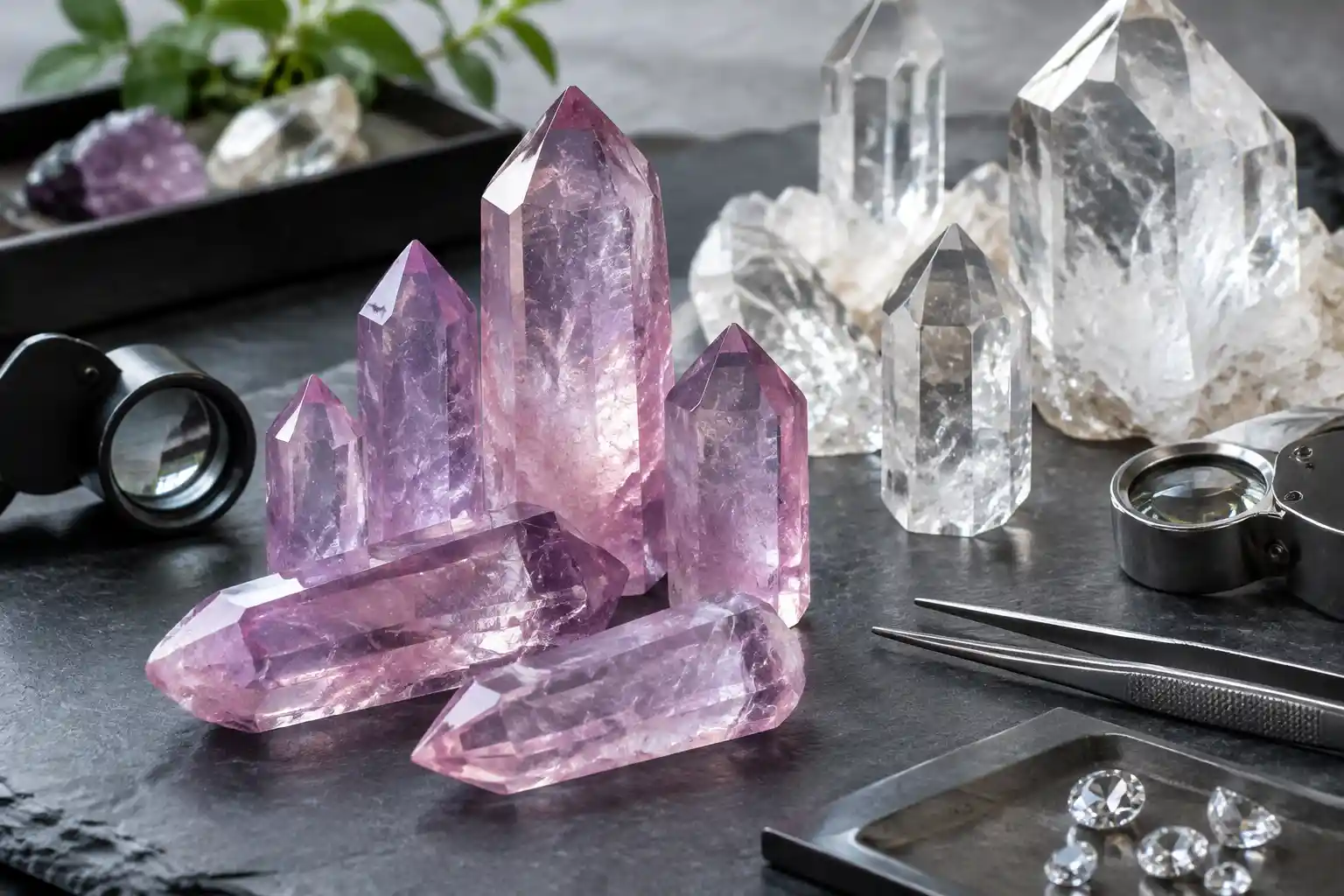
Lithium Quartz Benefits: 9 Real Uses, Gentle Symbolism & Hidden Facts, Responsible Use
Lithium Quartz benefits require unusually careful explanation because the name sounds more mineralogically precise than it often is. Lithium Quartz is a trade term commonly applied to pink, lilac, purple, translucent, or included quartz crystals. The underlying mineral is quartz, with the formula SiO₂ and Mohs hardness 7. Despite the commercial name, the presence of significant lithium or lithium-rich mineral inclusions has not been demonstrated consistently across specimens sold as Lithium Quartz.
That distinction changes how the stone should be described. Some sellers claim the coloration comes from lithium-bearing inclusions or that the crystal contains enough lithium to explain its metaphysical reputation. In practice, stones carrying the trade name can vary, and some may instead be colored quartz, iron-stained quartz, amethyst-like quartz, rose-colored quartz, or crystals containing unidentified inclusions. A trade label is not a substitute for laboratory analysis.
The most defensible Lithium Quartz benefits therefore come from the properties of quartz itself: useful hardness, attractive natural crystal forms, collector interest, varied inclusions and color, decorative use, and suitability as a personal meditation or symbolic object. Claims that the stone delivers lithium through the skin or works like psychiatric lithium medication are unsupported and should be avoided.
9 Lithium Quartz Benefits at a Glance
- Quartz hardness of 7 provides useful scratch resistance for specimens and selected jewelry.
- Natural quartz points can display attractive pink, lilac, violet, reddish, or translucent coloration.
- Inclusions and surface features create collector interest when accurately described.
- Crystal form provides educational value for studying quartz growth and trade-name classification.
- Decorative appeal makes specimens suitable for display, photography, jewelry, and personal collections.
- Modern symbolism can connect the stone with gentleness, reflection, change, and emotional intention.
- Meditation and journaling use can provide a consistent visual or tactile focus.
- Care is generally straightforward because the base mineral is quartz, although inclusions, fractures, and treatments still matter.
- Responsible interpretation prevents the word lithium from being confused with pharmaceutical treatment or guaranteed chemical composition.
Quartz Mineralogy Is the Foundation of Lithium Quartz Benefits
The starting point for Lithium Quartz benefits is ordinary quartz mineralogy. Quartz is silicon dioxide, SiO₂, crystallizes in the trigonal system, and has a Mohs hardness of 7. It commonly develops six-sided prism forms terminated by rhombohedral faces, although habits vary considerably depending on growth conditions.
Quartz can be transparent, translucent, or opaque and can contain an extraordinary range of inclusions. Iron oxides, chlorite, rutile, tourmaline, fluid inclusions, clay minerals, mica, and many other substances can occur inside or on quartz crystals. Color can also result from trace elements, structural defects, irradiation, inclusions, coatings, or staining.
This natural variability makes quartz particularly susceptible to attractive trade names. A specimen with pink-purple coloration may be visually unusual even when its exact coloring agent has not been identified. The problem arises when a descriptive name is treated as chemical proof.
Lithium Quartz should therefore be appreciated first as quartz. Any additional claim about lithium concentration, lithium-bearing inclusions, or a specific coloring mechanism needs analytical support for the individual type of stone being discussed.
The Word Lithium Does Not Guarantee Lithium-Rich Quartz
One of the most important hidden facts about Lithium Quartz benefits is that the trade name does not itself demonstrate significant lithium. Modern mineral references describe Lithium Quartz as a name used in New Age and commercial markets for pinkish or purple quartz, while noting that evidence for lithium or lithium-rich inclusions is lacking in many specimens.
This is important because quartz itself is SiO₂. Lithium is not an essential component of the quartz formula. Trace amounts can occur in natural geological systems, and quartz can grow alongside lithium-rich minerals in pegmatites, but association with lithium-bearing geology does not automatically make the finished crystal lithium-rich.
A seller may sometimes describe visible inclusions as lepidolite or another lithium mineral. Such an identification may be correct in a particular specimen, but color and visual inspection alone may not establish it. Confirming very fine inclusions can require microscopy, spectroscopy, chemical analysis, or another appropriate laboratory technique.
The distinction between lepidolite benefits and Lithium Quartz is therefore important. Lepidolite is a field name associated with genuinely lithium-rich micas. Lithium Quartz is quartz carrying a commercial name that should not be treated as proof of comparable lithium content.
Attractive Pink and Purple Colors Give Lithium Quartz Visual Appeal
Color is one of the most immediate Lithium Quartz benefits. Commercial specimens may display pale pink, mauve, lilac, lavender, reddish violet, smoky purple, or mixed translucent zones. Some crystals have delicate internal veils, wispy inclusions, coatings, or color concentrated around fractures and growth areas.
These variations can create appealing collector pieces even when the exact source of color is uncertain. A transparent point with subtle pink internal wisps has a different character from an opaque lavender specimen or quartz containing reddish mineral particles.
Responsible description should acknowledge uncertainty when identification has not been established. Calling every purple inclusion lithium mica simply because the specimen was sold as Lithium Quartz can turn an attractive observation into an unsupported mineralogical claim.
For collectors, uncertainty can itself become part of the interest. Examining inclusions under magnification, comparing crystal habit, investigating provenance, and seeking laboratory identification are all legitimate ways to learn more about an unusual quartz specimen.
Mohs Hardness 7 Gives Lithium Quartz Useful Durability
Because the base mineral is quartz, one of the practical Lithium Quartz benefits is Mohs hardness 7. Quartz resists scratching better than many softer ornamental stones and is suitable for numerous jewelry and decorative applications.
Durability still involves more than hardness. Natural quartz crystals can contain internal fractures, healed fissures, inclusions, contact zones, and chipped terminations. A hard blow can break a crystal even though its surface resists ordinary scratches. Thin points and sharp crystal tips require more protection than rounded cabochons or beads.
Jewelry suitability depends on how the quartz has been fashioned. Pendants and earrings are generally easy to wear, while rings receive more impact. A crystal point mounted with an exposed termination may be visually attractive but vulnerable to catching or chipping.
These physical properties are normal quartz properties rather than special lithium-related advantages. Recognizing that fact gives Lithium Quartz benefits a reliable scientific foundation.
Collector Value Comes From Crystal Form, Color, and Accurate Description
Lithium Quartz can appeal to collectors because each crystal may combine unusual color, transparency, inclusions, growth features, and crystal habit. Some buyers prefer intact natural points, while others value polished stones that expose internal pink or purple features more clearly.
Provenance matters. A specimen with a documented mine or region can be more scientifically useful than a stone labeled only with a metaphysical trade name. Locality may also help researchers understand what minerals plausibly occur as inclusions.
Accurate labeling is equally important. A quartz point does not become more scientifically valuable because an uncertain inclusion has been given a dramatic name. A seller who states that a crystal is pink-purple quartz marketed as Lithium Quartz may provide more useful information than one who guarantees high lithium content without testing.
The commercial name can remain meaningful within crystal culture while the mineralogical description stays cautious. Both pieces of information help a collector understand what is being purchased.
Quartz Growth Makes the Stone Useful for Mineral Education
Lithium Quartz benefits can include education because the stone offers a clear example of the difference between a formal mineral species and a trade designation. Quartz is mineralogically defined. Lithium Quartz is not a separate mineral species with its own universal formula or crystal system.
Students can use such specimens to ask useful questions. Which features belong to quartz itself? What produces the color? Are inclusions present? How were they identified? Is the trade name linked to a specific locality? Does the label make a chemical claim that has actually been tested?
This approach teaches skepticism without dismissing the specimen. Trade names are common throughout the gemstone market and can be useful when everyone understands what they mean. Problems arise when marketing terminology is presented as formal mineral identification.
The same principle applies to other quartz varieties. Color, inclusions, growth form, provenance, and commercial tradition can all influence names, but mineralogical claims still require evidence.
Modern Symbolism Focuses on Gentleness, Reflection, and Change
Modern Lithium Quartz benefits often include themes of peace, emotional gentleness, balance, transition, compassion, or reflection. Pink and lavender coloration probably contributes strongly to these associations because softer colors are frequently given calming or nurturing symbolism in contemporary crystal culture.
A person may choose the stone to represent a deliberate change in routine, a period of self-reflection, or a commitment to communicate more thoughtfully. The crystal can serve as a reminder of these intentions without being responsible for causing emotional change.
This distinction is especially important because the word lithium can make wellness claims sound scientifically grounded. Pharmaceutical lithium has legitimate medical uses, but those uses do not validate claims about a quartz crystal sold under a lithium-related trade name.
The symbolism is enough on its own. Jewelry and personal objects have represented relationships, values, memories, and intentions throughout human history. Lithium Quartz can serve the same role without needing a pharmaceutical explanation.
Meditation and Journaling Can Use Lithium Quartz Responsibly
Some people include Lithium Quartz in meditation, intention setting, quiet reflection, or journaling. A crystal point may be held during breathing exercises, kept beside a notebook, or placed in a familiar meditation area.
Such routines can be personally useful because objects create associations. Seeing the same crystal may become a cue to put away distractions, sit quietly, write, or focus on a chosen goal. The benefit comes from behavior, meaning, repetition, and attention rather than proof that the quartz emits a medically active substance.
The modern symbolism described under Lithium Quartz meaning may therefore be approached as personal interpretation rather than chemical evidence. A person does not need to establish high lithium content in order to associate a pink crystal with gentleness or reflection.
This is a safer and more flexible way to use the stone because it leaves health treatment where it belongs while allowing symbolic practices to remain personally meaningful.
Care Is Generally Straightforward but Individual Specimens Vary
Quartz has good scratch resistance and is generally stable under ordinary conditions, so care for Lithium Quartz is usually uncomplicated. Lukewarm water, mild soap, and a soft brush or cloth are appropriate for many simple untreated quartz pieces.
Individual stones still require judgment. A crystal with open fractures, delicate inclusions, attached matrix, coatings, fracture fillers, or glued jewelry components may not tolerate the same cleaning method as a solid untreated quartz point. High heat and sudden temperature changes can also create problems in fractured stones.
Natural crystal tips should be protected from impacts. Storing individual specimens so that terminations do not strike one another helps preserve condition. Jewelry should be removed before activities where the stone may hit hard surfaces.
If the coloring agent or treatment is unknown, conservative care is sensible. There is little reason to expose an unusual specimen to harsh chemicals merely because quartz itself is relatively stable.
Lithium Quartz Does Not Work Like Lithium Medication
Responsible discussion of Lithium Quartz benefits must make this distinction explicit. Pharmaceutical lithium involves specific lithium salts prescribed at controlled doses and monitored because the therapeutic range and potential side effects require medical supervision.
A crystal marketed as Lithium Quartz does not reproduce that process. In many specimens, substantial lithium content has not even been established. Even where trace lithium or a lithium-bearing inclusion is present, ordinary skin contact does not provide a controlled therapeutic dose.
The stone should therefore not be promoted as treating bipolar disorder, depression, anxiety disorders, trauma, insomnia, neurological conditions, hormonal problems, or other medical issues. It should never be used as a substitute for prescribed medication or professional mental-health care.
Similarly, there is no evidence-based reason to consume the stone, add it to drinking water, create homemade elixirs, or attempt to extract lithium from it for wellness purposes.
Claims grouped within Lithium Quartz healing properties belong to crystal belief traditions and require clear separation from medical science. The quartz can remain a beautiful, collectible, and meaningful object without acting as medicine.
What the Real Lithium Quartz Benefits Ultimately Are
The most reliable Lithium Quartz benefits are straightforward. It is quartz, so it offers useful hardness, recognizable crystal forms, attractive natural variations, collecting value, decorative appeal, and opportunities for mineralogical study. Pink-purple examples can also be visually distinctive within a quartz collection.
The commercial name adds an interesting lesson about gemstone terminology. It reminds buyers that attractive labels do not automatically establish chemistry and that specific claims about inclusions or trace elements should be tested rather than assumed.
Modern symbolism adds another layer. Reflection, gentleness, change, and personal intention can be meaningful reasons to own a stone when they remain clearly identified as interpretations.
These benefits are substantial enough without extending them into unsupported claims about pharmaceutical lithium, medical treatment, or guaranteed energetic effects.
Conclusion
Lithium Quartz benefits begin with ordinary quartz rather than with the word lithium. The stone has SiO₂ chemistry, Mohs hardness 7, attractive crystal forms, collector appeal, decorative potential, and varied pink-purple appearances. The commercial term does not reliably prove substantial lithium content or a specific lithium-bearing inclusion in every specimen.
Modern symbolism involving calm reflection, gentleness, change, and personal intention can still have value, particularly in meditation or journaling routines. The critical limit is medical: Lithium Quartz does not act like prescription lithium, and its trade name should never be used to justify claims about psychiatric or physical treatment.
FAQs
What are the main Lithium Quartz benefits?
The most reliable Lithium Quartz benefits include quartz durability, attractive pink or purple coloration, natural crystal form, collector interest, decorative use, and usefulness as a symbolic focus during meditation or journaling. Its Mohs hardness of 7 is a genuine physical property. Claims involving lithium-based medical or psychiatric effects are not supported by the trade name or by ordinary contact with the stone.
Is Lithium Quartz a real mineral?
Lithium Quartz is not a separate formal mineral species. The underlying mineral is quartz, SiO₂. The term is used commercially for certain pink, purple, translucent, or included quartz specimens. Modern mineral references caution that significant lithium or lithium-rich inclusions have not been demonstrated consistently in stones sold under the name.
Does Lithium Quartz actually contain lithium?
Some specimens might occur with lithium-bearing minerals or contain trace chemistry associated with lithium-rich geological environments, but the commercial name alone does not prove this. In many stones marketed as Lithium Quartz, evidence for meaningful lithium content is uncertain or absent. Specific claims about lithium-bearing inclusions require appropriate mineralogical testing.
What gives Lithium Quartz its pink or purple color?
There is no single confirmed color mechanism that applies to every stone sold under the Lithium Quartz name. Commercial specimens may include colored quartz, iron-stained crystals, amethyst-like quartz, rose-colored quartz, or stones containing various inclusions. Identifying the coloring agent accurately may require laboratory analysis rather than visual inspection alone.
Is Lithium Quartz durable enough for jewelry?
The base mineral quartz has Mohs hardness 7, making it suitable for many forms of jewelry. Natural fractures, inclusions, crystal tips, setting design, and treatments can still affect durability. Pendants and earrings are relatively protected, while rings and exposed crystal-point jewelry should be worn with greater care to reduce the chance of chips or fractures.
Does Lithium Quartz have the same effect as lithium medication?
No. Prescription lithium involves medically formulated lithium compounds given at controlled doses under professional supervision. A quartz crystal does not provide an equivalent dose through touch or ordinary wear. In addition, substantial lithium content has not been demonstrated consistently in specimens sold as Lithium Quartz. The gemstone should never replace prescribed treatment.
Can Lithium Quartz be used during meditation?
Yes, a person can use a quartz point as a visual or tactile focus during meditation, journaling, breathing exercises, or personal reflection. The routine may acquire meaning through repetition and symbolism. This does not demonstrate that the crystal medically changes mood, brain chemistry, or neurological function.
Is Lithium Quartz the same as lepidolite?
No. Lepidolite is a traditional field name for lithium-rich mica minerals, whereas Lithium Quartz is a trade name applied to quartz. A quartz specimen may occasionally contain lithium-bearing mineral inclusions, but that should be demonstrated rather than assumed. The two names refer to different mineralogical contexts even though both contain the word lithium.
Are Lithium Quartz healing benefits scientifically proven?
No. Lithium Quartz has not been shown to diagnose, treat, cure, or prevent mental or physical illness. Claims involving anxiety, depression, bipolar disorder, trauma, sleep problems, hormones, pain, or neurological conditions are not established medical effects of the crystal. Its demonstrated qualities concern quartz mineralogy, durability, appearance, collecting, and decorative use.
Lithium Quartz benefits involving calmness, emotional healing, lithium-related wellness, or energetic effects are symbolic or belief-based interpretations and should not replace qualified physical or mental-health care or prescribed medication.