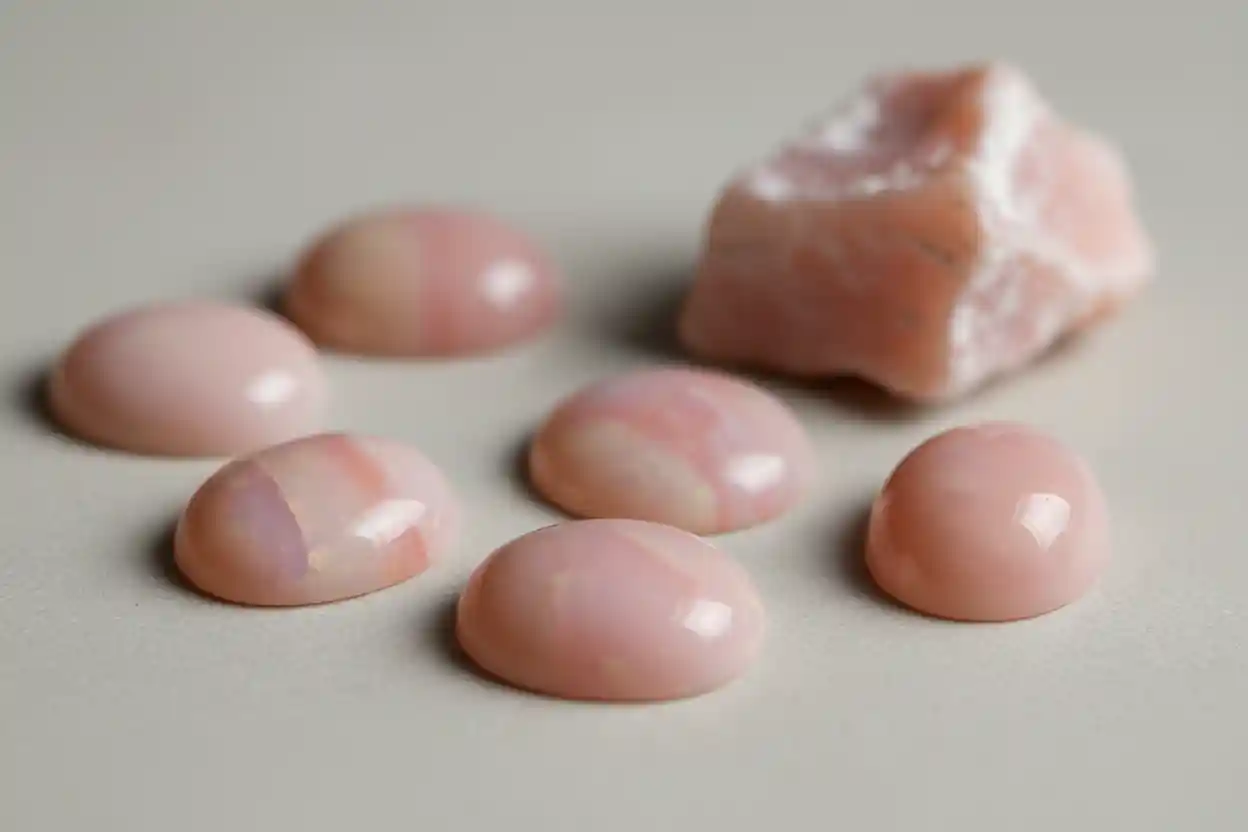
Pink Opal Healing Properties: 12 Claims, Opal Science & Safe Use
Pink opal healing properties are commonly associated with emotional calm, compassion, self-acceptance, relationship awareness, patience, resilience, confidence, forgiveness, sleep preparation, creativity, meditation, and spiritual renewal. Its blush, rose, peach-pink, cream, and mauve colors encourage gentleness and heart-centered symbolism, but appearance does not establish a therapeutic mechanism. Pink Opal has not been demonstrated to treat anxiety, depression, trauma, insomnia, cardiovascular disease, hormonal conditions, fertility problems, inflammation, pain, or another medical condition. The name also covers more geological variation than many crystal descriptions acknowledge. Some well-studied translucent pink opals from Peru and Mexico are opal-CT containing substantial palygorskite, while other stones sold as pink opal can have different structures or origins. Pink color therefore does not identify one universal mineral composition or one healing action.
12 Pink Opal Healing Claims
- Emotional calm during stressful periods
- Compassion toward oneself and others
- Self-acceptance and kinder reflection
- Relationship awareness and communication
- Patience before reacting
- Resilience after disappointment
- Confidence during emotional change
- Forgiveness without losing boundaries
- Better preparation for sleep
- Creativity and emotional expression
- Meditation and present awareness
- Spiritual renewal and heart-centered reflection
These twelve themes can support personal practices without becoming twelve scientifically proven healing effects. Many Pink Opal benefits become more useful when translated into actions such as journaling, slowing down before responding, preparing for a difficult conversation, establishing boundaries, or building a consistent evening routine.
Pink Opal Mineral Facts
Opal is hydrated silica with the general formula SiO₂·nH₂O. Unlike quartz, it does not usually possess a fully ordered long-range crystal lattice. Different structural forms include largely amorphous opal and more ordered varieties known as opal-C and opal-CT.
Pink Opal is a color-based trade name rather than one precisely defined opal structure. It is usually common opal, meaning it does not display the moving spectral play-of-color associated with precious opal.
Some of the best-studied pink gem opal comes from the Acarí area of southern Peru. Research on translucent pink opals from Peru and Mexico identified them as opal-CT containing roughly 10 to 40 percent palygorskite.
Palygorskite is a fibrous magnesium-aluminum silicate. In these studied pink opals, the silica and palygorskite occur together at extremely fine scale, creating a structure different from the ordered silica-sphere arrays responsible for play-of-color in precious opal.
The pink coloration in the researched Peruvian and Mexican specimens has been linked to a broad absorption feature associated with organic quinone-related compounds connected with the palygorskite fibers. That finding is important because it shows that pink color does not simply come from iron, manganese, or one universal pigment.
Not every stone sold as Pink Opal shares this exact composition. Western Australian pink stones sold under the name can involve opalized radiolarite, while other localities may produce different opal structures. Accurate statements therefore need to remain locality-specific.
Common Opal vs Precious Opal
Most Pink Opal is common opal rather than precious opal. The difference centers on internal structure and optics.
Precious opal displays play-of-color because ordered arrays of silica particles diffract visible light. The viewer sees shifting red, orange, yellow, green, blue, or violet flashes as the gem or light source moves.
Common opal lacks sufficiently ordered silica arrays to create that effect. It can still have attractive bodycolor, translucency, pattern, and luster.
Pink Opal therefore should not be considered inferior simply because it lacks rainbow play-of-color. Its appeal comes primarily from bodycolor and texture rather than diffraction.
This distinction also separates the present article from general opal healing properties, where precious opal’s play-of-color and wider historical traditions require more attention.
Peruvian Pink Opal
Peru is strongly associated with commercial Pink Opal, especially the Acarí region of Arequipa. Mindat records pink Andean opal from the country rock surrounding the Acarí mining area rather than treating the pink stone itself as the primary copper ore commodity.
Scientific study of Peruvian and Mexican translucent pink opal showed that the gem can contain unusually high proportions of palygorskite within opal-CT. This fibrous nanostructure helps distinguish those stones from ordinary precious opal.
The geological environment has been interpreted as connected with volcanic regions and ancient lake conditions. Silica, fibrous clay-like palygorskite, and organic compounds interacted during formation to produce the distinctive pink stone.
Peru also produces blue Andean opal, but the color mechanism differs. Blue material from the same wider region may owe its appearance to chrysocolla-related inclusions, while studied pink opal has a different microscopic association.
This geological distinction matters because color names alone do not imply identical chemistry, healing effects, or treatment requirements.
Pink Opal History
Opal as a general gem has ancient history, including Roman admiration and later traditions across Europe, the Middle East, and other regions. Pink Opal as a distinct modern trade category is much harder to trace into antiquity with confidence.
Ancient references usually describe opal by its shifting colors, rarity, or general appearance rather than identifying modern mineralogical varieties such as Peruvian palygorskite-bearing Pink Opal.
It is therefore more accurate to treat today’s pink-opal symbolism as largely modern rather than claiming a documented ancient Pink Opal healing system.
The Pink Opal meaning associated with compassion, emotional comfort, forgiveness, and heart-centered spirituality is mainly a contemporary interpretation of its color and gentle appearance.
Calm and Compassion
Emotional Calm Through a Pause
Pink Opal is frequently described as soothing. Hydrated silica has not been shown to regulate cortisol, serotonin, or another biological pathway through contact. A practical ritual is to use the stone as a cue to pause before reacting, slow the breathing, reduce unnecessary stimulation, and identify the one issue that needs attention now.
Compassion Through Perspective
Pink stones often receive compassion symbolism, and Pink Opal follows that pattern. The gem cannot biologically increase empathy. A useful practice is to consider another person’s perspective while also checking whether their behavior is respectful and whether a boundary remains necessary.
Self-Acceptance and Relationships
Self-Acceptance Through Fairer Reflection
Pink Opal is frequently included in self-love practices. It cannot change self-esteem directly. Keeping it near a journal can instead create a cue to replace sweeping self-criticism with a specific assessment of what happened, what went well, and what needs improvement.
Relationship Awareness
The stone is often associated with emotional openness and harmony. It cannot make another person loyal, affectionate, or compatible. A grounded relationship review looks at repeated behavior, communication, reliability, and respect for boundaries.
Patience and Resilience
Patience Before Reacting
Pink Opal’s soft appearance encourages symbolism around patience and gentleness. The gem cannot biologically suppress impulsive responses. It can become a reminder to delay non-urgent messages or decisions until emotional intensity has reduced.
Resilience After Disappointment
Modern crystal descriptions sometimes connect Pink Opal with emotional recovery. It cannot heal trauma or grief through gemstone energy. After disappointment, use it as a cue to identify what cannot be changed, what lesson matters, and what action can support recovery now.
Confidence and Forgiveness
Confidence During Emotional Change
Pink Opal is sometimes associated with quiet confidence. It cannot directly raise self-esteem. Before a difficult conversation or transition, use it as a reminder to identify what has already been prepared, what remains uncertain, and what first action is still under personal control.
Forgiveness With Boundaries
Forgiveness is another common Pink Opal theme. A stone cannot erase hurt or trauma, and forgiveness does not require renewed access to someone who behaves harmfully. A useful reflection is to decide what resentment you want to stop rehearsing while separately maintaining any boundary that remains necessary.
Sleep and Creativity
Better Preparation for Sleep
Pink Opal is sometimes marketed for peaceful sleep. There is no evidence that keeping the gem near a bed changes melatonin, sleep stages, or insomnia through a mineral-specific effect. It can instead mark the beginning of a consistent bedtime routine involving lower light, fewer screens, reduced stimulation, and writing unfinished tasks down before sleep.
Creativity and Emotional Expression
Pink Opal’s soft color and natural pattern can make it a useful creative prompt. The stone does not biologically enhance artistic ability. Writers, artists, and designers can use it as a cue to begin expressive work or generate several ideas before judging them.
Meditation and Spiritual Renewal
Meditation and Present Awareness
A smooth Pink Opal cabochon can serve as a tactile meditation object. Notice its temperature, color transitions, weight, and surface while returning attention to the breath whenever the mind wanders. The attentional practice is real without proving a Pink Opal energy field.
Spiritual Renewal
Modern metaphysical practice often links Pink Opal with emotional renewal, heart-centered spirituality, and gentle personal change. Someone may use the gem during prayer or reflection on compassion, relationships, or values without treating subjective meaning as scientific evidence.
Pink Opal Chakra Meaning
Pink Opal is most commonly associated with the heart chakra because of its color. Contemporary practitioners connect it with compassion, affection, forgiveness, emotional openness, self-acceptance, and relationships.
Some systems also extend the stone toward higher-heart or crown themes depending on its pale pink or white coloration.
Chakras are a spiritual framework rather than anatomical structures. Pink Opal has not been demonstrated to affect the physical heart, lungs, nervous system, endocrine glands, reproductive organs, or another physiological system through chakra placement.
Pink Opal Care
Pink Opal requires moderate care. General opal hardness is around Mohs 5 to 6.5, and toughness ranges from very poor to fair. It can scratch more easily than quartz, topaz, sapphire, ruby, and diamond.
Warm soapy water is the safest routine cleaning method for opal. Use a soft cloth and avoid abrasive brushes or powders.
The exact response to prolonged soaking can vary because Pink Opal from different localities does not always have identical structure or porosity. Some opals can absorb liquids, while natural fractures and palygorskite-rich zones may complicate behavior. Brief controlled cleaning is therefore preferable to routine soaking.
Steam and ultrasonic cleaning should be avoided. Heat and sudden temperature changes can cause cracking or crazing, while vibration may exploit existing fractures.
Opal can also be treated with oils, waxes, polymers, dyes, or other processes. GIA has documented artificially dyed pink hydrophane opal, showing why strong saturated pink color should not automatically be assumed natural.
Hydrogen peroxide, acetone, bleach, acids, and other strong chemicals should never be used as home treatment tests. They can alter dye, damage the gem, or increase fracture risk.
Store Pink Opal separately from harder gemstones and avoid hot, dry environments or sudden temperature changes.
Safe Ritual Cleansing
Pink Opal does not need prolonged water immersion, salt, heat, or chemical exposure for ritual cleansing. There is no scientifically demonstrated negative energy that must be removed from hydrated silica.
Sound, intentional breathing, quiet reflection, dry placement, or a gentle wipe are low-risk options. A compassion-focused ritual can involve choosing one supportive action for yourself and one respectful action toward another person.
Avoid saltwater, flame, steam, harsh sunlight that heats the gem, abrasive salt, strong chemicals, and prolonged soaking when porosity or treatment history is unknown.
Conclusion
Pink Opal deserves more precise treatment than simply calling it a pink version of precious opal. Studied Peruvian and Mexican stones can be palygorskite-rich opal-CT with unusual fibrous nanostructure and a distinctive pink color mechanism, while other pink opals can differ geologically. Its twelve healing themes can support calm, compassion, reflection, relationships, sleep routines, and meditation when symbolism remains separate from medical claims.
FAQs
What are the main Pink Opal healing properties?
Common claims include calm, compassion, self-acceptance, relationship awareness, patience, resilience, confidence, forgiveness, sleep support, creativity, meditation, and spiritual renewal. These are contemporary wellness or spiritual beliefs rather than scientifically proven effects.
What is Pink Opal made of?
Pink Opal is hydrated silica, but composition can vary. Studied pink opals from Peru and Mexico are opal-CT containing significant palygorskite.
What makes Peruvian Pink Opal pink?
Research on Peruvian and Mexican specimens links the pink color to an absorption associated with organic quinone-related compounds occurring with palygorskite fibers.
Does Pink Opal show play-of-color?
Most Pink Opal is common opal and does not show the spectral play-of-color characteristic of precious opal.
Is all Pink Opal from Peru?
No. Peru is an important commercial source, but pink opal and stones sold under that name also occur elsewhere, including Mexico, Australia, and other localities.
Does Pink Opal have ancient healing traditions?
Opal itself has ancient cultural history, but a specifically identified ancient Pink Opal healing tradition is not well documented. Most current Pink Opal metaphysical claims are modern.
Which chakra is Pink Opal associated with?
Modern crystal practice most commonly associates Pink Opal with the heart chakra and themes involving compassion, relationships, forgiveness, and self-acceptance. These are spiritual rather than anatomical associations.
Can Pink Opal go in water?
Brief cleaning with warm soapy water is appropriate for many stones, but prolonged soaking is unnecessary because porosity, fractures, treatments, and locality-specific structure can vary.
Can Pink Opal be dyed?
Yes. Dyed pink hydrophane opal has been documented. Strong or unusual color should not be assumed natural without treatment disclosure or gemological testing.
How hard is Pink Opal?
Opal generally measures about Mohs 5 to 6.5 and has limited toughness, so it should be protected from scratches, impact, high heat, and sudden temperature changes.
Crystal healing claims are traditional or personal beliefs and should not replace qualified medical or mental health care.