Stilbite Healing Properties: 10 Modern Beliefs, Zeolite Science & Safe Care
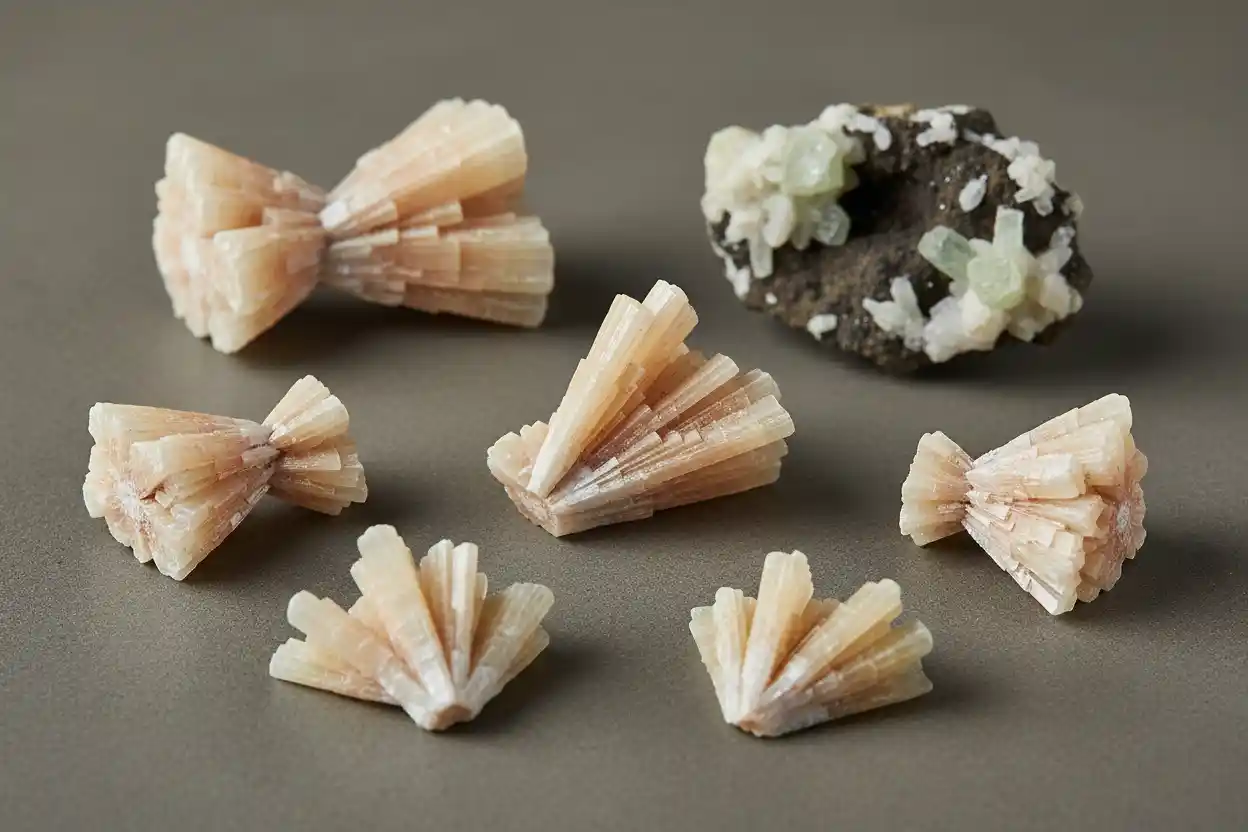
Stilbite healing properties are commonly associated with calm, patience, emotional perspective, self-reflection, communication, concentration, adaptability, creativity, meditation, and spiritual awareness. Soft white, cream, peach, pink, and pale-orange crystals often form bow-tie, fan-like, or radiating clusters with a pearly sheen, so the stone naturally lends itself to modern ideas about gentleness and stillness. Appearance, however, does not establish a therapeutic mechanism. Stilbite healing properties have not been scientifically demonstrated to treat anxiety, depression, insomnia, pain, inflammation, neurological conditions, hormonal problems, cardiovascular disease, or another medical condition. Mineralogically, the name stilbite covers closely related zeolite species, with Stilbite-Ca being the form most commonly encountered. Stilbite-Ca is a hydrated sodium-calcium aluminosilicate, crystallizes in the monoclinic system, measures only about Mohs 3.5 to 4, and has perfect cleavage.
10 Stilbite Healing Properties Beliefs
- Emotional calm during overstimulation
- Patience with gradual progress
- Perspective before reacting
- Self-reflection and pattern awareness
- Gentler, more deliberate communication
- Concentration during quiet work
- Adaptability when plans change
- Creativity and imaginative thinking
- Meditation and sustained awareness
- Spiritual reflection on simplicity and direction
These ten stilbite healing properties become more useful when they are translated into deliberate behavior rather than treated as automatic effects of a hydrated zeolite. Calm can mean lowering stimulation, patience can mean evaluating progress over a realistic period, and communication can mean pausing before responding. The separate Stilbite benefits page can address practical uses, while this article keeps stilbite healing properties focused on wellness beliefs, mineral science, evidence limits, and safe handling.
Stilbite Is a Zeolite, Not One Simple Crystal Formula
Understanding stilbite healing properties begins with accurate mineral identification. “Stilbite” historically referred to a zeolite that modern mineral classification separates into calcium-dominant Stilbite-Ca and sodium-dominant Stilbite-Na.
Stilbite-Ca has the idealized formula NaCa₄(Si₂₇Al₉)O₇₂·28H₂O. It belongs to the zeolite group, a family of hydrated aluminosilicate minerals whose frameworks contain channels and cavities occupied by water molecules and exchangeable ions.
Stilbite-Ca is monoclinic and usually transparent to translucent. Its colors include colorless, white, cream, yellowish, pale brown, orange, peach, and pink. Vitreous luster can appear on some crystal faces, while cleavage surfaces often show an attractive pearly sheen.
Stilbite healing properties do not arise from the presence of structural water or from the zeolite framework acting as a biological purifier. Those are mineralogical characteristics, not evidence of a therapeutic effect in the human body.
Why Stilbite Forms Fans and Bow-Tie Clusters
The crystal habit behind many stilbite healing properties is one of the mineral’s most recognizable features. Stilbite commonly forms flattened or bladed crystals that gather into sheaf-like, bow-tie, fan-shaped, or radiating aggregates.
Twinning and repeated crystal growth can make individual blades appear bundled together. Some clusters resemble flowers or soft fans, while other specimens develop more distinct tabular crystals.
The pearly luster becomes especially noticeable along cleavage surfaces. This soft reflective appearance helped inspire the mineral’s name.
The word stilbite was introduced in the late eighteenth century and comes from Greek roots associated with shining or glittering. The name describes luster rather than an ancient spiritual function.
For that reason, stilbite healing properties should not be presented as an ancient system merely because the mineral’s scientific name has Greek linguistic roots.
Stilbite Forms in Low-Temperature Volcanic Environments
Stilbite commonly forms during relatively low-temperature alteration of volcanic rocks. Mineral-rich fluids circulate through fractures and cavities, allowing zeolites to crystallize inside spaces left by gas bubbles or later rock alteration.
Basalt cavities are especially important. Stilbite can grow with apophyllite, heulandite, scolecite, mesolite, calcite, quartz, and other minerals commonly found in zeolite-rich environments.
India, particularly basalt districts in Maharashtra, has produced exceptional Stilbite-Ca clusters in white, cream, peach, pink, and orange shades. Iceland is another classic zeolite region, while notable stilbite occurs in the United States, Canada, Scotland, Norway, and many other volcanic areas.
These geological settings are real. Stilbite healing properties involving “flow,” “release,” or emotional purification are modern interpretations rather than consequences of the mineral’s ability to form in volcanic cavities.
Calm, Patience, and Emotional Perspective
Calm Through Reduced Stimulation
Calm is one of the most common stilbite healing properties. A hydrated aluminosilicate does not regulate cortisol, serotonin, heart rate, or another stress pathway merely by being held.
A practical use is to make the crystal a cue for reducing unnecessary stimulation. Silence nonessential notifications, lower background noise, slow the breathing, and identify which issue actually requires attention.
Patience With Realistic Timelines
Patience appears frequently among stilbite healing properties because the delicate mineral is associated visually with quietness and softness.
The stone cannot biologically create patience. Instead, use it as a reminder to evaluate a long-term goal over a meaningful period rather than deciding that one slow day proves the entire effort has failed.
Perspective Before Reacting
Another recurring part of stilbite healing properties is emotional perspective. The crystal cannot reveal an objectively correct interpretation of an event.
Before reacting, distinguish what definitely happened from what was inferred. If an immediate response is unnecessary, allowing time before replying can reduce impulsive decisions.
Self-Reflection and Communication
Reflection Through Documented Patterns
Self-awareness is commonly included among stilbite healing properties. Stilbite cannot retrieve hidden memories or automatically reveal subconscious information.
Keeping a small specimen near a journal can create a repeatable cue to record situations, emotional reactions, interpretations, and consequences. Patterns become clearer because they have been documented repeatedly.
Communication With More Deliberate Language
Gentle communication also appears within stilbite healing properties. The mineral cannot make another person agree or understand.
A more practical approach is to identify the main issue before speaking, separate a request from an accusation, and avoid introducing unrelated grievances into one conversation.
The modern Stilbite meaning often emphasizes softness and harmony, but meaningful communication still depends on clarity, listening, and boundaries.
Concentration and Adaptability
Concentration During Quiet Work
Concentration is another useful interpretation of stilbite healing properties. There is no evidence that zeolite crystals improve memory or attention through skin contact.
Place the specimen near one defined task, reduce unrelated notifications, and work until a predetermined stopping point. The crystal functions as a behavioral cue rather than a neurological stimulant.
Adaptability When a Method Stops Working
Stilbite healing properties sometimes include flexibility or acceptance. The mineral itself cannot make a person cognitively adaptable.
When conditions change, separate the underlying goal from the original method. If the method no longer works, changing it may preserve the goal rather than abandoning it.
Creativity and Imaginative Thinking
Creativity fits naturally within stilbite healing properties because bow-tie, fan, and radial crystals can suggest flowers, wings, folds, or abstract geometric forms.
No mineral-specific mechanism has been shown to increase creative cognition. The stone can nevertheless mark the beginning of a brainstorming session in which several possibilities are generated before any are judged.
Writers, designers, artists, and problem-solvers can use the crystal as an environmental cue to shift temporarily from evaluation toward idea generation.
Stilbite healing properties are most useful here when the stone supports a repeatable creative routine rather than being credited with producing ideas independently.
Meditation and Present Awareness
Meditation is one of the easiest stilbite healing properties to translate into an observable practice. A fan-shaped cluster provides many lines, reflective cleavage faces, and overlapping blades that can hold visual attention.
Choose one crystal blade and observe its edge, luster, and relationship with neighboring crystals. When attention wanders, return to the selected feature or to the breath.
The practice genuinely trains attention. It does not demonstrate that Stilbite alters brain waves, opens psychic channels, or transmits a special frequency.
Stilbite healing properties can therefore remain meaningful within meditation without becoming claims about mineral-driven changes in consciousness.
Spiritual Reflection on Simplicity
The tenth of the stilbite healing properties concerns spiritual awareness, intuition, inner quiet, or simplicity. These themes are modern and should not be presented as one continuous ancient Stilbite tradition.
Someone may use the crystal during prayer, journaling, or reflection on personal values. A practical exercise asks which commitments still deserve attention, which distractions can be removed, and where daily behavior conflicts with stated priorities.
Such questions keep agency with the person making decisions.
Stilbite healing properties function most responsibly when spiritual symbolism encourages reflection without being presented as supernatural certainty.
Stilbite Chakra Associations
Stilbite healing properties are commonly connected with the crown and heart chakras in modern crystal practice. White and cream stones tend to receive crown associations, while peach and pink specimens are often linked with heart-centered themes.
Some practitioners also connect Stilbite with the third-eye chakra because of meditation and intuition beliefs.
Chakras are spiritual frameworks rather than anatomical structures. Stilbite healing properties have not been demonstrated to affect the brain, pineal gland, heart, nervous system, endocrine glands, or another physiological structure through chakra placement.
Stilbite Is Soft and Cleaves Easily
Physical care is particularly important because stilbite healing properties do not change the mineral’s fragility. Stilbite-Ca measures only about Mohs 3.5 to 4 and has perfect cleavage in one direction.
Quartz, feldspar, ordinary household dust containing quartz, and many common gemstones can scratch it easily. Thin crystal blades and fan-shaped clusters can also chip or split under surprisingly modest pressure.
Store Stilbite separately in a padded container where harder specimens cannot rub against it. Never stack heavy stones on top of delicate clusters.
Rough brushing is also a poor choice because fine crystal edges can break even when the overall specimen appears solid.
Water and Heat Safety for Stilbite
The water in Stilbite’s chemical formula is structural water within its zeolite framework. That does not mean the mineral needs soaking or that immersion improves stilbite healing properties.
Brief contact with clean water does not automatically dissolve every Stilbite specimen, but prolonged soaking is unnecessary, especially for porous clusters, attached matrix, repairs, iron staining, or associated softer minerals.
Heat deserves greater caution. Zeolites can lose structural water when heated, potentially changing their physical behavior or appearance. Flame, steam, hot-water cleansing, and deliberate heating should therefore be avoided.
Ultrasonic cleaners are also inappropriate for delicate clusters because vibration can exploit perfect cleavage and existing fractures.
A very soft dry brush or gentle air movement is preferable for loose surface dust. A slightly damp cloth may suit a sturdy polished piece if it is dried promptly.
Cutting and Dust Safety
Finished Stilbite specimens are generally suitable for careful handling, but cutting or grinding creates fine silicate dust and can shatter brittle crystal edges.
Lapidary work should use suitable eye protection, dust control, extraction, and wet methods where appropriate.
Stilbite healing properties never justify pulverizing the mineral, inhaling dust, or putting crushed pieces into beverages.
Most collectors will gain more by preserving an intact cluster than by attempting to process a fragile zeolite.
Safe Ritual Cleansing
Stilbite healing properties do not require saltwater, flame, steam, acids, or prolonged sunlight. There is no scientifically demonstrated unwanted energy that must be physically extracted from the mineral.
Sound, intentional breathing, prayer, quiet reflection, or dry placement are safer symbolic choices.
A calm-focused practice can become practical by identifying one unnecessary source of stimulation and removing it for a defined period.
Avoid rough burial, abrasive salt, heat, ultrasonic devices, and long soaking because physical damage is a much more realistic risk than spiritual contamination.
Conclusion
Stilbite healing properties are modern spiritual and wellness beliefs attached to a delicate zeolite known for pearly luster, fan-shaped crystal aggregates, structural water, low hardness, and perfect cleavage. Calm, patience, reflection, communication, concentration, creativity, adaptability, and meditation can all become useful practices when the stone acts as a personal cue rather than a medical treatment. Its real mineralogical identity also makes gentle, low-impact care essential.
FAQs
What are stilbite healing properties?
Stilbite healing properties commonly refer to beliefs involving calm, patience, emotional perspective, reflection, communication, concentration, adaptability, creativity, meditation, and spiritual awareness.
What is Stilbite made of?
Most collectible Stilbite is Stilbite-Ca, a hydrated sodium-calcium aluminosilicate zeolite with an idealized formula of NaCa₄(Si₂₇Al₉)O₇₂·28H₂O.
Is Stilbite one mineral species?
Modern mineral classification distinguishes Stilbite-Ca and Stilbite-Na according to their dominant chemistry.
How hard is Stilbite?
Stilbite-Ca measures about Mohs 3.5 to 4 and has perfect cleavage, making it significantly softer and more fragile than quartz.
Are stilbite healing properties ancient?
No well-documented ancient Stilbite healing system is established. Most stilbite healing properties used today belong to contemporary crystal practice.
Why does Stilbite form fan-shaped clusters?
Flattened crystals, twinning, and repeated growth can produce characteristic sheaf, bow-tie, fan, and radiating aggregates.
Which chakras are associated with Stilbite?
Modern crystal practice commonly links Stilbite with the crown, heart, and sometimes third-eye chakras. These are spiritual rather than anatomical associations.
Can Stilbite go in water?
Brief contact may be tolerated by some specimens, but prolonged soaking is unnecessary and is best avoided for fragile clusters, matrix pieces, repairs, or unknown associated minerals.
Can Stilbite be heated?
Strong heat should be avoided because Stilbite is a hydrated zeolite and can lose structural water when heated.
Are stilbite healing properties medically proven?
No. Stilbite healing properties are modern spiritual or personal wellness beliefs rather than scientifically established therapeutic effects.
Stilbite healing properties belong to contemporary spiritual or personal wellness traditions and should not replace qualified medical or mental health care.