10 Real Stilbite Benefits: Gentle Traditions, Evidence, Safe Use & Clear Limits
Stilbite benefits begin with an attractive zeolite mineral known for soft pearly luster, delicate sheaf-like crystal groups, pale colors, hydrated aluminosilicate chemistry, and important associations with volcanic cavities. The name stilbite is commonly used for members of the stilbite subgroup, especially calcium-rich Stilbite-Ca and sodium-rich Stilbite-Na, rather than for one chemically identical crystal in every specimen.
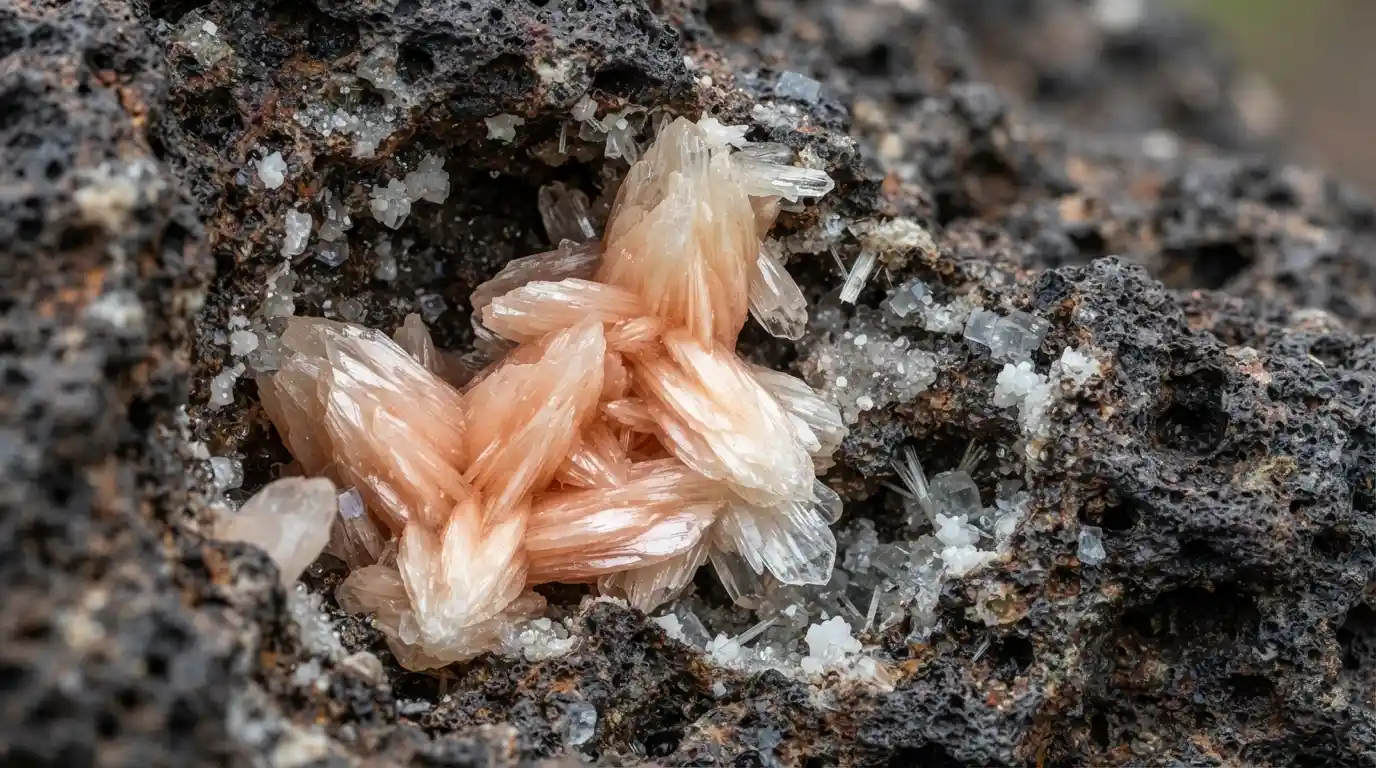
Stilbite-Ca, the form most collectors encounter, commonly appears white, colorless, cream, pale yellow, orange, pink, reddish, or light brown. It forms thin tabular crystals, bow-tie or sheaf-like aggregates, radiating groups, and rounded clusters that can look remarkably soft despite being crystalline. With Mohs hardness around 3.5 to 4 and perfect cleavage, however, stilbite is considerably more delicate than quartz and is best appreciated through careful collecting, display, study, and occasional protected ornamental use.
Modern crystal traditions add calmness, emotional reflection, spiritual awareness, sleep-related rituals, intuition, and gentle transformation to stilbite benefits. Those interpretations can give a specimen personal meaning, but stilbite has not been shown to treat anxiety, insomnia, neurological conditions, hormonal disorders, pain, or other health problems through ordinary contact.
10 Stilbite Benefits at a Glance
The ten points below separate measurable mineral qualities from modern personal traditions. Stilbite already has considerable geological and collector value, so symbolic uses do not need medical or supernatural claims to make the stone meaningful.
- Sheaf-like and radiating crystal habits give stilbite strong mineral-collection and display appeal.
- Pearly to vitreous luster creates a soft reflective appearance that distinguishes many good specimens.
- White, cream, peach, pink, yellow, orange, and pale brown colors provide attractive natural variation.
- Zeolite chemistry gives stilbite scientific value for understanding hydrated aluminosilicate frameworks and low-temperature mineral formation.
- Basalt-cavity occurrences help reveal the movement of mineral-rich fluids through volcanic rocks after lava has solidified.
- Associations with other zeolites and cavity minerals make stilbite useful for studying multi-mineral volcanic environments.
- Modern calmness and reflection traditions can provide a personal focus for meditation or journaling without implying medical effects.
- Growth and change symbolism can reflect the development of delicate crystal groups within older volcanic cavities.
- Softness and perfect cleavage teach the difference between attractive crystal form and practical durability.
- Personal stilbite benefits can come from collecting, geology, travel, décor, meditation, gifts, or an important memory without requiring one universal spiritual explanation.
Stilbite Benefits Begin With Zeolite Mineralogy
Stilbite belongs to the zeolite group, a family of hydrated aluminosilicate minerals whose framework structures contain channels and cavities occupied by water molecules and exchangeable ions. Calcium-rich Stilbite-Ca has the ideal formula NaCa4(Si27Al9)O72·28H2O, while Stilbite-Na is sodium-rich and has a different ideal composition. Both belong to the stilbite subgroup and share many visual and structural characteristics.
The water written into these formulas is structural water associated with the zeolite framework. It does not mean a stilbite crystal hydrates the human body, releases wellness water through the skin, or pulls medically defined toxins from tissues.
This chemistry is still genuinely useful. Zeolite structures have attracted scientific and industrial interest because of ion-exchange, molecular-sieving, and adsorption behavior, but results from processed or engineered zeolite systems should not automatically be transferred to a raw collector crystal sitting beside a bed or being held during meditation.
Understanding those limits makes the real stilbite benefits easier to appreciate. The mineral is scientifically interesting precisely because its structure is unusual, not because it needs to be turned into a medical treatment.
Stilbite Technical Properties
The table below summarizes the features most relevant to identification, collecting, and care.
| Property | Stilbite |
|---|---|
| Mineral family | Zeolite group |
| Common species | Stilbite-Ca, Stilbite-Na |
| Crystal system | Monoclinic |
| Mohs hardness | About 3.5–4 |
| Cleavage | Perfect |
| Typical luster | Vitreous to pearly |
| Transparency | Transparent to translucent |
| Common colors | White, colorless, cream, pink, peach, yellow, orange, light brown |
| Typical crystal habit | Thin tabular, sheaf-like, radiating, bow-tie, globular |
| Common occurrence | Cavities and fractures in volcanic rocks, low-temperature hydrothermal settings |
| Main practical caution | Soft, brittle, and easily damaged along cleavage |
These properties explain why stilbite is far more suitable for careful display than rough everyday jewelry. A good crystal cluster may look substantial on a basalt matrix while still containing thin terminations that can break from a small impact.
Sheaf-Like Crystals Give Stilbite Exceptional Collector Appeal
One of the most obvious stilbite benefits is crystal habit. Individual crystals can flatten into thin blades, while repeated growth and twinning produce fan-shaped, bow-tie, or sheaf-like groups. Some specimens develop rounded radiating aggregates that look almost floral when viewed from above.
These forms are especially attractive because they show how crystallography influences visible shape. The apparent softness of a peach-colored sheaf comes from crystal arrangement and luster rather than from physical flexibility.
Perfect cleavage contributes to the layered appearance but also creates vulnerability. A collector who grips a specimen across thin blades can split or crush crystal edges even though the specimen survived intact underground for a very long time.
Good specimens are therefore best handled by sturdy matrix whenever possible. The visual beauty comes from preserving the original terminations, not from repeatedly touching the most delicate areas.
Pearly Luster Explains the Name Stilbite
The name stilbite dates to the late eighteenth century and comes from Greek words associated with shining, glittering, or a mirror-like appearance. The reference is appropriate because good stilbite can show vitreous reflections on crystal faces and a distinctly pearly sheen along cleavage surfaces.
This luster is one reason pale crystals remain visually interesting even when their colors are subtle. A white or cream crystal group can change noticeably as the viewing angle moves and different surfaces catch light.
The effect is entirely optical. Pearly luster does not demonstrate that the mineral emits spiritual light or stores a healing vibration.
For collectors, the real benefit is simpler and more durable: stilbite can produce attractive reflective textures without needing intense color or artificial enhancement.
Volcanic Cavities Give Stilbite a Rich Geological Story
Stilbite commonly develops as a secondary mineral in cavities, fractures, and vesicles within basalt, andesite, and other volcanic rocks. These spaces may begin as gas bubbles or fractures formed when lava cools, then become pathways for later water-rich fluids carrying calcium, sodium, aluminum, and silica.
As conditions change, minerals precipitate from those fluids. Stilbite may appear alongside calcite, prehnite, quartz, heulandite, scolecite, mesolite, mordenite, or apophyllite-group minerals, creating complex cavity assemblages in which different species record different episodes of fluid movement.
The famous basalt districts of Maharashtra, India, are especially well known for beautiful zeolite specimens. In these cavities, stilbite may occur beside scolecite as well as fluorapophyllite, calcite, heulandite, and other minerals, producing some of the most recognizable collector associations in the world.
This geological setting gives stilbite benefits that have nothing to do with spirituality. A single cavity can preserve a sequence of post-volcanic chemical events long after the lava itself cooled.
India and Iceland Give Stilbite Strong Locality Interest
India’s Deccan volcanic province is one of the best-known modern sources of fine Stilbite-Ca. Maharashtra districts have produced white, cream, salmon, peach, and pink crystal groups, often on dark basalt and frequently associated with fluorapophyllite, calcite, heulandite, scolecite, cavansite, and other colorful cavity minerals.
Iceland is another classic source, with historically important stilbite from basaltic environments. Fine crystals have also been reported from the Faroe Islands, Scotland, Switzerland, the United States, and many other volcanic or hydrothermal settings.
Locality can therefore become an important part of a specimen’s value. A well-labeled crystal from Maharashtra tells a different geological story from one collected in Iceland or New Jersey.
For many collectors, provenance is one of the strongest stilbite benefits because it connects the crystal with real geography, volcanic history, and mineral associations rather than a generic commercial label.
Stilbite and Apophyllite Commonly Share Volcanic Cavities
Collectors often see stilbite paired with apophyllite because the two can grow together in basalt cavities, particularly in Indian deposits. The contrast can be striking: stilbite may form cream or peach sheaves while apophyllite produces bright blocky or pyramidal crystals with glassy reflections.
The minerals are associated geologically but are not the same species or even members of the same mineral group. Stilbite is a zeolite, while apophyllite belongs to the apophyllite group and has different chemistry and structure.
The visual appeal of apophyllite can therefore complement stilbite without making them interchangeable. A combination specimen may be valuable precisely because several distinct minerals grew together within one cavity.
Understanding the difference protects accurate identification and makes a multi-mineral specimen more interesting than simply calling every pale crystal in the cavity a zeolite.
Stilbite Benefits for Mineral Identification
Stilbite is useful for learning why several observations should be combined before identifying a mineral. Pale color alone is not enough because heulandite, scolecite, stellerite, natrolite, calcite, gypsum, and other minerals can overlap visually with certain stilbite specimens.
Crystal habit, cleavage, hardness, luster, associated minerals, locality, optical measurements, chemistry, and X-ray diffraction can all become relevant when identity matters. Stilbite-Ca and Stilbite-Na may also look extremely similar, so laboratory analysis can be necessary when the chemical species must be known precisely.
This makes the stone especially useful for serious collectors. An attractive label may be a starting point, but reliable mineral identification depends on evidence.
The lesson extends naturally into collecting habits. Keeping original labels, locality data, and any analytical information protects the scientific value of a specimen over time.
Calmness as a Gentle Modern Tradition
Calmness is one of the most familiar modern stilbite benefits. Pale peach, white, cream, and pink crystal sheaves have a soft appearance that many people find visually soothing, making the mineral a natural choice for a quiet desk, reading area, or meditation space.
A person might use stilbite while journaling at the end of the day or while taking several minutes to slow breathing and separate urgent tasks from concerns that can wait. The stone can become associated with that routine through repetition.
The mineral itself does not lower cortisol, sedate the nervous system, or treat anxiety through physical contact. Any calming response comes from the person’s environment, expectations, attention, breathing, and routine.
This distinction allows stilbite benefits to include meaningful reflective practices without turning the mineral into medicine.
Sleep Traditions Need Clear Limits
Stilbite is sometimes placed beside a bed because modern crystal traditions associate it with peaceful sleep, dreams, or mental quiet. A familiar object can certainly become part of a bedtime routine, particularly if it marks the point when screens are put away and the room becomes quieter.
There is no reliable evidence that stilbite treats insomnia, sleep apnea, nightmares, or another sleep disorder. It does not alter melatonin or brain-wave activity through ordinary proximity.
Claims surrounding stilbite healing properties should therefore be interpreted as spiritual or wellness traditions rather than clinical effects. Persistent sleep problems deserve appropriate evaluation because they can have many medical, behavioral, and environmental causes.
The specimen can remain on the bedside table if the owner enjoys it. The useful habit is the routine created around sleep, not an invisible force from the crystal.
Growth and Transformation Fit Stilbite’s Geological Setting
Growth symbolism fits stilbite naturally because delicate crystals develop inside cavities left within much older volcanic rock. A space that once contained gas can later become filled with mineral-rich fluids and eventually lined with beautiful crystals.
A person may use that geological story as a metaphor for gradual change. New abilities, routines, relationships, or goals can develop within circumstances that once seemed empty or unproductive.
The analogy remains symbolic. Mineral precipitation and human development operate through completely different processes.
Still, using a real geological process as a personal metaphor is more grounded than claiming the stone forces transformation. The specimen represents the idea while the owner makes the choices.
Stilbite Is Not a Practical Everyday Jewelry Stone
Stilbite can be mounted in highly protected artistic jewelry, but its softness, perfect cleavage, brittleness, and delicate crystal habits make it poorly suited to normal ring or bracelet wear. Even pendant use can be challenging if natural crystal clusters catch clothing or receive repeated impact.
Most good specimens are better kept as mineral displays. Their natural crystal form is the feature collectors want to preserve, and cutting or polishing often removes much of that appeal.
This distinguishes stilbite from harder gemstones whose value is commonly increased through faceting. With stilbite, untouched crystal form can be more desirable than a polished surface.
Responsible use means matching the mineral to what it physically tolerates rather than expecting every attractive crystal to function as durable jewelry.
Water and Cleaning Require a Conservative Approach
Stilbite’s hydrated zeolite chemistry does not make it a suitable drinking-water crystal. Raw specimens should not be placed in beverages for supposed detoxification, hydration, or energetic effects, especially when associated minerals, matrix, coatings, repairs, or exact chemistry are unknown.
For cleaning, gentle dry methods should be tried first. A soft artist’s brush or light air movement can remove loose dust without stressing thin terminations, while aggressive scrubbing may catch crystal edges and damage the sheaf-like structure.
Brief careful rinsing may be acceptable for some sound specimens, but prolonged soaking, acids, household cleaners, steam, ultrasonic cleaning, and abrupt heating are unnecessary. Perfect cleavage and low hardness deserve more attention than the fact that stilbite contains structural water.
Safe mineral care aims to preserve the original crystal surfaces rather than subject them to repeated cleansing rituals.
Personal Stilbite Meaning Can Add Value Without Medical Claims
The symbolism surrounding stilbite meaning often includes gentleness, patience, hope, reflection, spiritual awareness, and gradual growth. These ideas can become meaningful when linked with a particular experience rather than treated as automatic powers.
Someone may associate a peach stilbite cluster with a period of personal rebuilding or a trip to a mineral show. Another collector may care mainly about Maharashtra geology, zeolite chemistry, or the quality of the crystal habit.
Both interpretations are valid because personal value can come from memory, study, aesthetics, or ritual. The stone does not need to produce biological changes to become important to its owner.
Conclusion
Stilbite benefits include distinctive sheaf-like crystals, pearly luster, attractive pale colors, zeolite chemistry, volcanic-cavity geology, strong locality interest, and excellent educational value for mineral collectors. Calmness, reflection, sleep-related routines, growth, and spiritual awareness can provide personal symbolism, but stilbite remains a soft, brittle, perfectly cleavable zeolite that requires careful handling and should not be treated as medical therapy.
FAQs
What are the main stilbite benefits?
Stilbite benefits include collector appeal, attractive pearly luster, distinctive sheaf-like crystal growth, zeolite mineralogy, geological value, and interesting associations with volcanic cavity minerals. Modern traditions also connect stilbite with calmness, reflection, patience, and spiritual awareness.
Is stilbite a zeolite?
Yes. Stilbite-Ca and Stilbite-Na belong to the zeolite group and contain structural water within hydrated aluminosilicate frameworks.
What is the hardness of stilbite?
Stilbite is about Mohs 3.5 to 4. It also has perfect cleavage and brittle tenacity, so delicate crystals need considerably more care than harder gemstones such as quartz.
Why does stilbite look pearly?
Its crystal surfaces can show vitreous reflections, while cleavage surfaces often appear pearly. The mineral’s name itself refers historically to its shining or glittering appearance.
Where is fine stilbite found?
Important occurrences include Maharashtra in India, Iceland, the Faroe Islands, Scotland, Switzerland, and several areas of the United States. Indian basalt cavities are especially famous for attractive collector specimens.
Does stilbite help with calmness?
There is no scientific evidence that stilbite changes the nervous system or treats anxiety. It can be used as a visual focus during meditation, breathing, or journaling if the owner finds that routine meaningful.
Does stilbite help with sleep?
Stilbite has not been shown to treat insomnia or other sleep disorders. It may be kept near a bed as part of a personal bedtime routine without being treated as a medical sleep aid.
Can stilbite go in water?
A brief gentle rinse may be suitable for some sound specimens, but prolonged soaking is unnecessary. Delicate crystals, perfect cleavage, matrix minerals, and repairs make conservative cleaning preferable.
Is stilbite suitable for jewelry?
Its softness, perfect cleavage, and delicate crystal habits make it a poor choice for demanding everyday jewelry. Mineral display is usually a safer way to preserve fine specimens.
Can stilbite benefits be personal rather than spiritual?
Yes. Stilbite can represent geology, a collecting milestone, travel, a gift, personal growth, or appreciation of delicate crystal form without any metaphysical interpretation.
Disclaimer: Calmness, sleep, healing, spiritual-awareness, chakra, intuition, cleansing, and energetic descriptions of stilbite reflect spiritual beliefs and personal practices. Stilbite is not a medical or psychological treatment and should not replace professional healthcare.