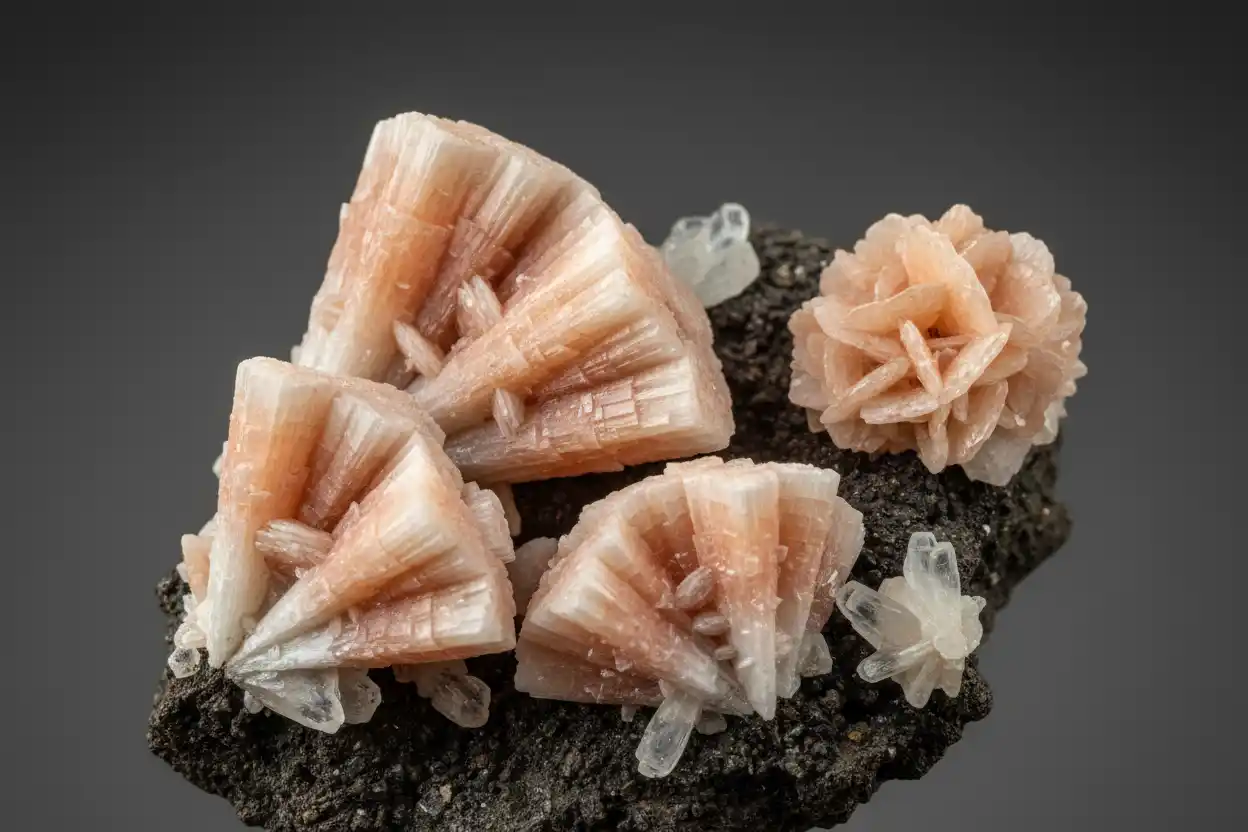
Stilbite: Meaning, Properties & Symbolism
Stilbite is a hydrated zeolite mineral best known for pearly white, cream, pink, or peach crystals that gather into sheaves, bow ties, fans, and radiating clusters. Most specimens belong to the calcium-dominant species stilbite-Ca, although visually similar sodium-dominant stilbite-Na cannot be distinguished reliably without analytical testing.
Its delicate cleavage, low hardness, and water-bearing framework make it primarily a collector mineral. Attractive crystals commonly grow inside volcanic cavities with apophyllite, heulandite, calcite, chalcedony, and other zeolites.
Stilbite at a Glance
| Property | Stilbite |
|---|---|
| Composition | Hydrated sodium-calcium aluminosilicate; stilbite-Ca commonly approximated as NaCa₄(Al₉Si₂₇O₇₂)·28H₂O |
| Group or type | Stilbite subgroup of the zeolite group |
| Color | Colorless, white, cream, pale yellow, peach, salmon, pink, orange, red-brown, light brown |
| Crystal system or texture | Monoclinic, commonly pseudo-orthorhombic because of twinning |
| Habit | Thin tabular, sheaf-like, bow-tie, fan-shaped, radiating, spherulitic, massive |
| Luster | Vitreous, strongly pearly on cleavage surfaces |
| Transparency | Transparent to translucent |
| Mohs hardness | Approximately 3.5–4.5 |
| Cleavage | Perfect in one direction |
| Tenacity | Brittle |
| Common uses | Mineral specimens, educational collections, rare cabochons or carvings, decorative clusters |
| Primary care concern | Cleavage, fragile crystal edges, low hardness, heat, soaking, repairs, and associated minerals |
What Is Stilbite?
Stilbite is a member of the zeolite group, whose minerals contain open aluminosilicate frameworks with channels occupied by water molecules and exchangeable ions.
The name comes from a Greek word meaning to shine, referring to the pearly luster visible on its broad cleavage surfaces.
Modern mineral classification divides stilbite into stilbite-Ca and stilbite-Na according to the dominant exchangeable cation. Stilbite-Ca is much more common.
The two species have nearly identical appearance, crystal habit, and physical properties. A specimen should therefore be labeled simply “stilbite” when chemical or crystallographic analysis has not established the exact species.
Stilbite is not the same mineral as stellerite, barrerite, epistilbite, or heulandite, although several belong to related zeolite structures and can appear visually similar.
It belongs within the mineral-specimen portion of types of gemstones and appears in both the crystals that start with S and gemstones that start with S directories.
Stilbite Composition and Zeolite Structure
Stilbite-Ca is a hydrated sodium-calcium aluminosilicate. Its structure contains linked silicon-oxygen and aluminum-oxygen tetrahedra forming channels and cavities.
Calcium and sodium ions balance the electrical charge created when aluminum replaces silicon in the framework. Water molecules occupy the remaining open spaces.
The water forms part of the crystal structure rather than merely coating its surface. Heating drives water from the channels and can cause structural changes.
Zeolites can exchange some of their channel ions with ions in surrounding fluids. Industrial scientists use related natural and synthetic zeolites for adsorption, catalysis, and ion-exchange applications.
A decorative stilbite specimen should not be assumed to behave exactly like a processed industrial zeolite. Mineral purity, porosity, particle size, associated minerals, and chemical treatment all affect performance.
How Stilbite Forms
Stilbite commonly forms through low-temperature hydrothermal alteration of volcanic rocks. Water circulates through basalt, andesite, gabbro, tuff, and related material, reacting with volcanic glass and feldspar.
Gas bubbles trapped in the original lava leave cavities called vesicles. Later fluids enter these spaces and deposit zeolite crystals.
Several generations of minerals may grow in one cavity. Chalcedony can line the wall, followed by heulandite, stilbite, apophyllite, calcite, or other late-stage minerals.
Burial metamorphism can also produce stilbite as volcanic rocks are heated and compressed at relatively low metamorphic grades.
Additional occurrences form in hydrothermal veins, altered dikes, sedimentary tuffs, and cavities in metamorphosed volcanic sequences.
The crystal habit depends on fluid chemistry, temperature, available space, and growth rate. Broad sheaves form when many thin crystals grow together in related orientations.
Why Stilbite Forms Bow Ties and Sheaves
Individual stilbite crystals are commonly thin, flattened, and tabular. Repeated twinning makes the group appear more symmetrical than its monoclinic structure would suggest.
When many tabular crystals grow outward from a narrow base, they form a sheaf resembling tied wheat.
Two opposed sheaves can create a bow-tie shape. Radiating growth may also produce fans, rosettes, rounded bundles, or spherulitic groups.
A broad pearly central surface often reflects light strongly. This luster comes from the perfect cleavage and layered appearance of the crystal aggregate.
Fine sheaves may end in numerous small sharp terminations. Thicker crystals can have wedge-shaped or chisel-like ends.
The habit provides a useful clue but does not prove identity. Stellerite and some other zeolites can form closely similar fans and bow ties.
Stilbite Colors
Colorless and white stilbite are common. Pale cream, straw yellow, peach, salmon, and pink specimens dominate the decorative market.
Iron oxides and hydroxides commonly produce peach, orange, red-brown, and rusty colors. The color may occur inside the crystal, as microscopic inclusions, or as a surface coating.
Manganese and other trace elements may influence pink tones in some deposits, although appearance alone cannot establish the coloring agent.
Greenish or strongly saturated blue stilbite is unusual. Such listings may involve associated minerals, surface coatings, dye, incorrect identification, or photographic editing.
Color zoning can appear along crystal edges or between generations. White cores with peach rims and darker bases are common in some Indian specimens.
The pastel tones place stilbite visually near white and pink decorative minerals, but its pearly sheaf habit remains more diagnostic than color.
Important Stilbite Localities
India supplies a large proportion of modern collector stilbite. The Deccan Traps of Maharashtra contain extensive basalt cavities filled with zeolites.
Districts around Pune, Nashik, Jalgaon, Mumbai, and Aurangabad have produced white, cream, peach, salmon, and pink sheaves, often with clear apophyllite, calcite, heulandite, and chalcedony.
Iceland is a classic historical source. Teigarhorn and other eastern Icelandic localities have produced pearly white and pale brown stilbite associated with basalt cavities.
The Faroe Islands are also historically important for stilbite and other zeolites. Old specimens from these North Atlantic localities may carry strong provenance value.
Nova Scotia’s Bay of Fundy region in Canada has yielded notable stilbite from basalt cliffs and coastal exposures. Associated minerals include heulandite, chabazite, analcime, and calcite.
New Jersey, Oregon, Washington, Colorado, and other US volcanic regions contain stilbite. Classic older specimens also come from Scotland, Italy, Norway, Germany, Russia, Australia, and New Zealand.
A country name alone is insufficient for premium valuation. Mine, quarry, district, formation, or historic collection information adds far more collector meaning.
Stilbite and Related Zeolites
Heulandite commonly forms tabular or coffin-shaped crystals with pearly cleavage. It occurs with stilbite in many basalt cavities but belongs to a different zeolite subgroup.
Scolecite usually forms slender needles and radiating white sprays. Its calcium-rich natrolite-subgroup structure differs from stilbite’s sheaf-forming framework.
Natrolite is sodium-rich and commonly develops sharper, straighter needle-like crystals. Fine examples can resemble scolecite more closely than stilbite.
Stellerite belongs to the stilbite subgroup and can create nearly identical sheaves. It is orthorhombic rather than monoclinic and requires careful crystallographic or spectroscopic separation.
Epistilbite is a distinct zeolite despite its similar name. It usually forms prismatic crystals and has different structure and optical properties.
Apophyllite frequently accompanies stilbite but is not a zeolite. Its tetragonal crystals, prominent cleavage, higher luster, and different chemistry distinguish it.
Associated Minerals
Calcite is a frequent companion and may form rhombohedra, scalenohedra, or rounded crystals among stilbite sheaves. The calcite is softer and acid-sensitive.
Chalcedony can line volcanic cavities before the zeolites grow. Its hard waxy surface often provides a contrasting base for pale stilbite.
Quartz crystals may develop in the same cavity, although high-temperature or earlier silica phases usually precede the lower-temperature zeolite assemblage.
Apophyllite can form colorless, white, green, or pinkish glassy crystals over or beside stilbite. The contrast between clear apophyllite and peach stilbite creates popular Indian display specimens.
Iron oxides may stain the matrix and crystal bases orange or brown. Clay minerals and weathered basalt can make a specimen fragile even when the stilbite itself appears intact.
How to Identify Stilbite
Visual identification begins with thin tabular crystals assembled into sheaves, bow ties, or radiating groups. Broad surfaces commonly show a pearly luster.
Stilbite has a hardness around 3.5–4.5 and can be scratched by harder steel and quartz. Scratch testing should not be performed on a collector specimen.
Specific gravity is low, commonly around 2.1–2.2. A hand-sized cluster therefore feels lighter than similarly sized calcite, barite, or metallic minerals.
Perfect cleavage creates smooth reflective surfaces. A broken crystal may split into thin plates or show stepped pearly planes.
Refractive indices fall near 1.48–1.51, although aggregate texture makes direct measurement difficult. Stilbite is biaxial.
Stilbite-Ca and stilbite-Na cannot normally be distinguished visually. Raman spectroscopy, X-ray diffraction, and chemical analysis provide the strongest species-level evidence.
The how to identify crystals guide explains how habit, association, density, cleavage, and analytical testing work together.
Common Lookalikes
Stellerite is the closest visual lookalike because it also forms white or peach sheaves and fans. Crystal symmetry and laboratory testing may be necessary.
Heulandite generally forms broader tabular or coffin-shaped crystals, though intergrown and distorted specimens can remain difficult to separate.
Scolecite and natrolite form thinner needle-like sprays. Their radiating groups can look superficially similar in small photographs.
Gypsum varieties may develop pale bladed or fibrous crystals but are softer and have different cleavage and density.
Calcite can form white, peach, or pink crystal groups. It reacts strongly with dilute acid and has different crystal forms, although acid testing should not be used on a specimen.
Resin casts and glued composites may copy bow-tie clusters. Bubbles, flexible projections, repeated identical shapes, adhesive, and plastic luster can reveal them.
Treatments, Cleaning, and Repairs
Most collector stilbite retains natural color. Heat treatment is not a routine commercial enhancement because high temperature can dehydrate and damage the mineral.
Acid cleaning may be used to remove calcite or iron staining from some specimens. This preparation can change the original mineral association and should be disclosed when extensive.
Water cleaning, compressed air, and mechanical trimming are common preparation methods. Excessive brushing can break thin crystal edges.
Glue repairs occur frequently in large or attractive clusters. Detached sheaves may be reattached to matrix, and broken pieces can be reconstructed.
Clear resin may stabilize porous matrix or fill fractures. Wax and oil are less common but can deepen color or improve surface gloss.
Dyeing is unusual, though porous pale material can absorb color. Highly saturated blue, green, violet, or hot pink should be examined critically.
The gemstone treatments explained guide provides the wider disclosure framework.
Synthetic Stilbite and Imitations
Laboratories can synthesize zeolite structures for scientific and industrial research. Commercial synthetic material is usually produced for adsorption, catalysis, or ion exchange rather than as gem or specimen stilbite.
There is no established jewelry market for laboratory-grown stilbite crystals.
Resin, glass, plaster, ceramic, and glued natural fragments provide more economical imitations. Artificial clusters may repeat the same bow-tie shape with suspicious uniformity.
Some products contain genuine crushed zeolite held in resin. They should be identified as composites rather than natural crystal clusters.
A decorative object can still have value, but it should not be represented as a naturally formed Stilbite-Ca specimen.
The lab-grown vs natural gemstones guide explains the distinction among synthetic crystals, simulants, and composites.
Cutting and Lapidary Use
Natural stilbite crystals are rarely cut because their sheaf habit carries more collector value than a polished surface.
Perfect cleavage and low hardness make faceting impractical. Transparent crystals are usually too thin, fragile, or included to yield durable gems.
Massive or compact aggregates may be shaped into cabochons, beads, carvings, or palm stones. However, commercial “stilbite cabochons” deserve verification because mixed zeolite rock, resin-stabilized material, and misidentified pale stones can enter the market.
The material can undercut during polishing. Soft zeolite, harder chalcedony, calcite, and basalt matrix may wear at different rates.
Drilling creates vibration and can split the material along cleavage. Resin stabilization may improve workability but must be disclosed.
A natural bow-tie or fan specimen should remain intact rather than be cut into jewelry unless the rough lacks meaningful crystal form.
Durability and Jewelry Suitability
Stilbite is poorly suited to everyday jewelry. Its hardness allows ordinary dust, quartz grains, and metal surfaces to scratch it.
Perfect cleavage creates a more serious weakness. A small impact can split a crystal or remove part of a sheaf.
Wire-wrapped pendants may use compact specimens, but the wrapping should support the matrix rather than squeeze individual crystals.
Rings, bracelets, and drilled bead strands face excessive impact and friction. Crystal tips can catch on fabric and break.
Heat is also undesirable because the mineral’s structural water can be driven off. Jewelers should not expose stilbite to torches, steam, or prolonged hot conditions.
Display specimens and protected collector boxes remain the safest uses.
Stilbite Value and July 2026 Asking Prices
Stilbite is common enough that many attractive specimens remain affordable. Value depends on crystal completeness, sheaf shape, luster, color, size, associated minerals, locality, preparation, repairs, and provenance.
As of July 2026, small common specimens frequently carry asking prices around $5–$30.
Attractive hand-sized Indian sheaves and clusters commonly appear around $30–$100. Pieces with clear apophyllite, chalcedony, calcite, or strong peach color may move higher.
Large display specimens and balanced multi-mineral associations often ask approximately $100–$350.
Classic Icelandic, Faroe Islands, Nova Scotian, or historic European material with precise provenance may range from $100 to $500 or more, even when physically smaller than modern Indian specimens.
Exceptional cabinet pieces, old collection specimens, rare habits, and unusually intact large clusters can exceed $500–$1,000.
Polished cabochons are commonly advertised around $15–$40 each, although identity, stabilization, and mixed composition should be confirmed before comparing value.
Buying Stilbite
The dedicated where to buy stilbite guide owns detailed seller and product selection.
For a natural specimen, request front, back, side, and base photographs. These views reveal broken sheaves, glue, trimmed matrix, and unstable attachment points.
Inspect crystal edges and terminations. Fine white chips can be difficult to see against pale material, especially in bright photographs.
Ask whether the piece has been acid-cleaned, repaired, stabilized, coated, dyed, or reattached. Preparation is common in mineral collecting, but it must be disclosed.
Obtain a precise locality. “India” is less useful than a district or quarry in Maharashtra, while “Iceland” should ideally include Teigarhorn or another documented site.
For a cabochon or carving, ask whether the material is solid stilbite, mixed zeolite rock, resin-stabilized aggregate, or composite.
Shipping quality is crucial. A specimen should be immobilized by its matrix with empty clearance around every exposed sheaf.
Cleaning and Storage
Use a rubber air blower for routine dust. A very soft artist’s brush can clean robust areas, but it should not press against thin edges.
Brief rinsing in room-temperature water may suit a stable untreated specimen. Soaking provides little benefit and can affect glue, resin, porous matrix, iron staining, or associated minerals.
The crystals you can put in water guide distinguishes short cleaning contact from prolonged immersion.
Do not use steam, hot water, acids, bleach, or abrasive powders. Heat can dehydrate the mineral, while acids may attack associated calcite.
Ultrasonic cleaning is inappropriate. The guide to gemstones in ultrasonic cleaners explains why vibration can break crystal edges and loosen repairs.
Store the specimen inside a covered case or fitted box. Support the matrix firmly without allowing padding to touch the crystal sheaves.
Stilbite Meaning and Symbolism
Stilbite has less documented ancient symbolism than quartz, jade, sapphire, or other long-used gem materials. Most interpretations associated with it developed within modern crystal traditions.
Its sheaf and bow-tie forms commonly inspire themes of cooperation, organization, shared direction, and separate elements growing into one structure.
Pale peach and pink specimens may symbolize gentleness, consideration, or emotional openness. White material is often associated with simplicity, reflection, and new beginnings.
Because stilbite forms as water-rich fluids alter volcanic rock, some people use it as a metaphor for gradual change, adaptation, and creating order inside an old structure.
Its pearly light may also serve as a reminder that subtle qualities can become visible when a surface is viewed from the correct angle.
These meanings belong to personal, cultural, and spiritual belief systems. Scientific evidence does not show that stilbite treats insomnia, anxiety, neurological disorders, or other medical conditions.
Frequently Asked Questions
1. Is stilbite one mineral species?
The name commonly covers stilbite-Ca and stilbite-Na. Stilbite-Ca is far more common, and testing is needed to separate them reliably.
2. Is stilbite a zeolite?
Yes. It belongs to the stilbite subgroup within the larger zeolite group.
3. Why does stilbite form bow-tie crystals?
Thin twinned crystals grow outward in opposing sheaves, creating fan-shaped or bow-tie aggregates.
4. What gives stilbite its pearly luster?
Light reflects strongly from broad perfect-cleavage surfaces within its tabular crystal structure.
5. Is peach stilbite naturally colored?
Yes. Natural peach, salmon, pink, yellow, and brown tones commonly result from iron-bearing inclusions or coatings.
6. Is stilbite the same as stellerite?
No. They belong to the same subgroup and can look alike, but stellerite is orthorhombic and stilbite is monoclinic.
7. How does stilbite differ from scolecite?
Stilbite typically forms tabular sheaves, while scolecite more often develops slender needle-like radiating sprays.
8. Is apophyllite a type of stilbite?
No. Apophyllite commonly grows with stilbite but belongs to a different mineral group and is not a zeolite.
9. Can stilbite be worn in a ring?
It is unsuitable for routine ring wear because of its low hardness, perfect cleavage, and fragile crystal habit.
10. Can stilbite be soaked in water?
Prolonged soaking is discouraged because repairs, matrix minerals, porosity, and iron staining may be affected.
11. Is synthetic stilbite sold as a gemstone?
Synthetic zeolites exist for research and industry, but laboratory-grown jewelry-grade stilbite is not an established market.
12. What most affects stilbite value?
Complete sheaves, strong pearly luster, attractive color, associated minerals, locality, size, condition, repairs, and provenance determine value.
The best stilbite specimens preserve the relationship between crystal form and geological cavity. An intact, well-documented sheaf on natural matrix usually offers more enduring value than a larger repaired cluster or an uncertain polished product.