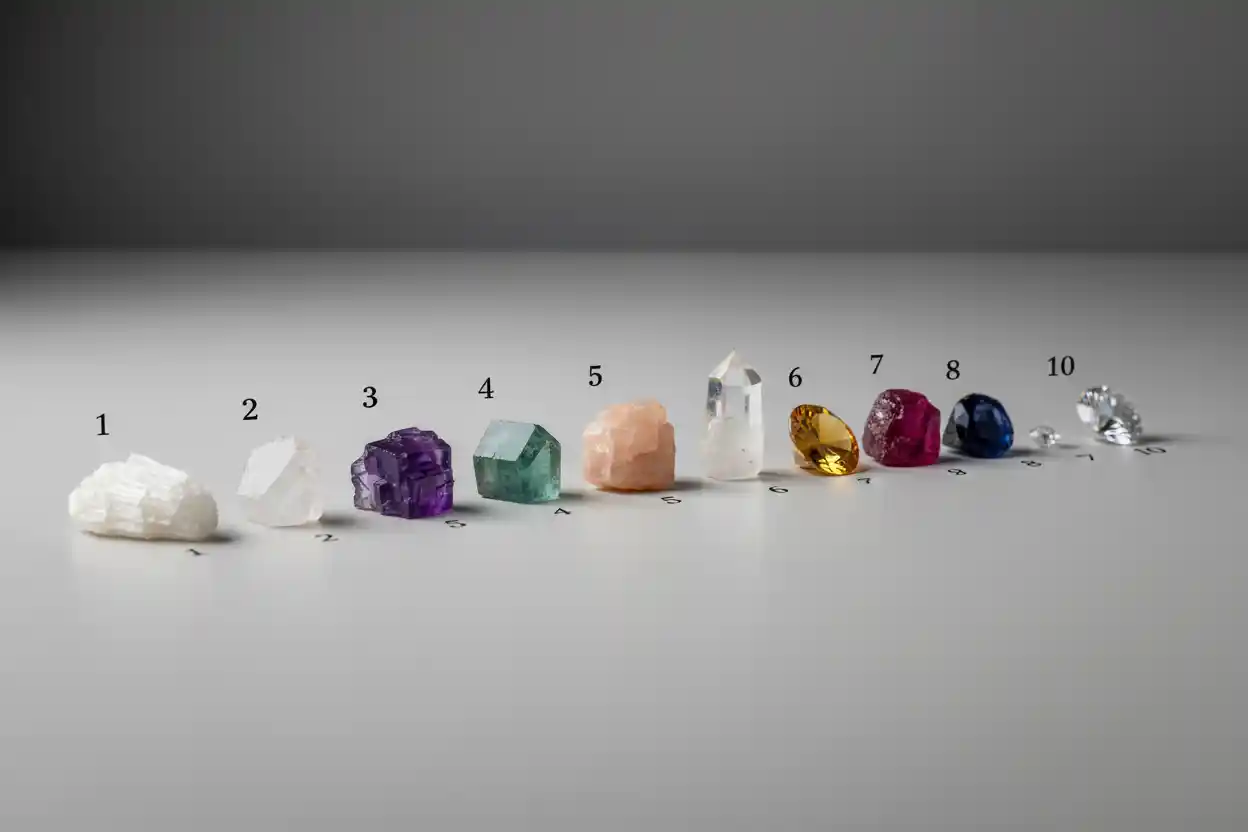
Crystal Hardness Chart: Mohs 1–10, Durability Risks & Safe Crystal Care
A crystal hardness chart ranks minerals by their resistance to scratching, using the Mohs scale from 1 for talc to 10 for diamond. The scale is extremely useful for identifying minerals, planning jewelry wear, preventing storage damage, and choosing appropriate cleaning methods, but it does not measure every part of durability. A hard crystal can still chip, split along cleavage, react with chemicals, fade in light, suffer thermal shock, or contain fractures that make it less durable than its Mohs number suggests.
The most important rule when using a crystal hardness chart is that hardness means scratch resistance. It is not the same as toughness, which describes resistance to breaking and chipping, or stability, which concerns heat, light, chemicals, moisture, and environmental conditions. Diamond illustrates this difference well: it sits at Mohs 10 and resists scratches extremely well, yet a sufficiently hard blow in a cleavage direction can still damage it.
The Mohs scale is also relative rather than evenly spaced. The difference between 9 and 10 is far greater than one simple step might imply. A crystal hardness chart should therefore be used as a comparison system, not as a linear percentage scale.
Crystal Hardness Chart From Mohs 1 to 10
The standard Mohs scale uses ten reference minerals. A harder reference mineral can scratch a softer one, while minerals with similar hardness may scratch each other or show less decisive results.
| Mohs Hardness | Reference Mineral | Familiar Crystal or Gem Examples | Practical Meaning |
|---|---|---|---|
| 1 | Talc | Talc | Extremely soft and easily scratched |
| 2 | Gypsum | Selenite, satin spar | Scratches very easily and needs gentle handling |
| 3 | Calcite | Calcite | Easily scratched by many common objects |
| 4 | Fluorite | Fluorite | Soft for jewelry and has perfect cleavage |
| 5 | Apatite | Apatite | Moderate scratch resistance but vulnerable in frequent wear |
| 6 | Orthoclase feldspar | Orthoclase; moonstone is roughly 6–6.5 | Better scratch resistance but still needs careful wear |
| 7 | Quartz | Clear quartz, amethyst, citrine; chalcedony varieties about 6.5–7 | Good scratch resistance for many everyday uses |
| 8 | Topaz | Topaz | Hard surface but perfect cleavage increases impact risk |
| 9 | Corundum | Ruby, sapphire | Excellent scratch resistance |
| 10 | Diamond | Diamond | Highest Mohs hardness, though not immune to fracture |
This crystal hardness chart gives the standard reference points, but natural stones do not always fit into one exact number. Chemical composition, crystal orientation, inclusions, weathering, aggregate structure, and testing method can produce a hardness range rather than a perfectly fixed value.
What the Mohs Scale Actually Measures
A crystal hardness chart measures relative resistance to scratching or abrasion. If mineral A reliably scratches mineral B, A is harder. Friedrich Mohs developed the familiar ten-mineral reference system as a practical way to compare mineral hardness, and it remains widely useful because the test is simple in principle.
Scratch resistance matters because harder particles can abrade softer surfaces during wear and storage. Quartz dust, which has a hardness of about 7, can scratch many softer polished stones. A diamond stored loose against almost any other gemstone can scratch it. Corundum can scratch quartz, topaz can scratch quartz, and quartz can scratch fluorite, calcite, gypsum, and many other minerals below it on the scale.
A crystal hardness chart does not mean every hard stone should be scratch-tested at home. Scratching a polished gem can permanently damage the surface, and coatings, weathered surfaces, glass imitations, or aggregate rocks can confuse the result. Identification should combine several properties rather than deliberately marking a valued specimen.
Crystal Hardness Chart vs Toughness: Why Hard Stones Still Break
One of the biggest mistakes when reading a crystal hardness chart is assuming that a higher Mohs number means a stone cannot break. Hardness and toughness describe different properties.
Topaz ranks 8, which means it resists scratching better than quartz. Yet topaz has perfect basal cleavage and can split from a sharp impact delivered in an unfavorable direction. Diamond is harder still but also has cleavage directions. Nephrite jade ranks only around 6 to 6.5 but is exceptionally tough because its interlocking microscopic structure resists fracture remarkably well.
Fluorite provides the opposite example. It ranks only 4 and also has perfect octahedral cleavage, so both scratches and impacts deserve attention. Selenite is softer at about 2 and can scratch, abrade, or cleave readily.
If you have wondered why did my crystal break, the cause may be cleavage, brittleness, an internal fracture, impact, temperature change, or structural stress rather than low Mohs hardness alone.
Why a Crystal Hardness Chart Does Not Predict Water Safety
Another common mistake is using the crystal hardness chart as a waterproofing scale. Hardness does not measure solubility, porosity, hydration, or chemical reaction with water.
Gypsum is soft and slightly soluble, while halite dissolves readily in water. Calcite does not simply dissolve in ordinary water at the speed of salt, but acids attack it readily. Turquoise may be porous or stabilized and can absorb oils or chemicals despite having moderate hardness. Opal can contain significant structural water and requires different care again.
Questions such as can you shower with crystals therefore depend on mineral chemistry, treatments, setting construction, adhesives, heat, soap, and repeated wetting rather than a single Mohs number.
Some crystals that dissolve in water require special caution even when a quick encounter with moisture does not immediately destroy the specimen. Repeated soaking can cause cumulative surface deterioration that a crystal hardness chart cannot predict.
Common Crystal Hardness Values Beyond the Ten Reference Minerals
The standard crystal hardness chart becomes more useful when familiar gemstones are placed between the ten reference minerals. Many popular stones occupy ranges rather than exact integer positions.
| Crystal or Gemstone | Approximate Mohs Hardness |
|---|---|
| Amber | 2–2.5 |
| Selenite / Gypsum | 2 |
| Calcite | 3 |
| Malachite | 3.5–4 |
| Fluorite | 4 |
| Apatite | 5 |
| Turquoise | 5–6 |
| Opal | 5–6.5 |
| Labradorite | 6–6.5 |
| Moonstone | 6–6.5 |
| Hematite | 5–6.5 |
| Pyrite | 6–6.5 |
| Jadeite | 6.5–7 |
| Nephrite | 6–6.5 |
| Agate / Chalcedony | 6.5–7 |
| Jasper | 6.5–7 |
| Amethyst | 7 |
| Citrine | 7 |
| Clear Quartz | 7 |
| Garnet | About 6.5–7.5 depending on species |
| Tourmaline | About 7–7.5 |
| Beryl, including aquamarine and emerald | About 7.5–8 |
| Spinel | 8 |
| Topaz | 8 |
| Ruby / Sapphire | 9 |
| Diamond | 10 |
These numbers are best interpreted as practical ranges. Rocks containing several minerals may behave differently across one polished surface. Treatments, coatings, fractures, and weathering can also make a finished piece less durable than the crystal hardness chart initially suggests.
Using a Crystal Hardness Chart for Jewelry Wear
Jewelry places gemstones under repeated abrasion, impact, skin contact, cosmetics, and environmental exposure. A crystal hardness chart is especially useful for estimating scratch resistance in rings because rings encounter desks, door handles, tools, countertops, bags, and other jewelry throughout the day.
Gemstones around Mohs 7 and above generally resist ordinary abrasion better than very soft stones, but the number cannot determine suitability by itself. Quartz at 7 performs reasonably well in many jewelry settings. Sapphire at 9 combines excellent hardness with generally strong durability. Topaz at 8 needs protection from hard blows because of cleavage. Emerald reaches about 7.5 to 8 but commonly contains inclusions and fractures that can reduce toughness.
Softer stones can still make beautiful jewelry when the setting and wear pattern suit them. Fluorite earrings face less abuse than a fluorite ring. Turquoise works well in protected designs when kept away from chemicals and hard abrasion. Opal requires more thoughtful care than its appearance alone suggests.
The crystal hardness chart therefore works best as the first durability question rather than the last one.
How Hard Crystals Damage Softer Crystals in Storage
A collection can damage itself when stones of very different hardness are stored loose together. Quartz is common enough that collectors sometimes underestimate its ability to scratch softer specimens. A loose quartz point rubbing against fluorite, calcite, turquoise, malachite, or selenite can permanently mark the softer surface.
Diamond, sapphire, ruby, topaz, spinel, and beryl should also be prevented from rubbing against softer polished gems. Even stones with identical Mohs numbers may abrade one another over time.
Separate compartments, fabric-lined trays, individual boxes, or soft pouches reduce direct contact. Fragile crystal clusters deserve enough space that terminations do not strike neighboring specimens. Wrapping every stone tightly is not always ideal because delicate points can catch on fabric, but stable separation is better than letting specimens move freely in one container.
A crystal hardness chart becomes particularly practical here: arrange storage so harder stones cannot grind against softer ones.
Cleavage, Fracture, and Crystal Structure Change Durability
Hardness describes a surface property, while crystal structure influences how a specimen breaks. Cleavage occurs when a mineral tends to split along crystallographic planes where bonding is relatively weaker. Fracture describes breakage that does not follow cleavage planes.
Calcite has perfect cleavage, fluorite has perfect cleavage in four directions, and topaz has perfect basal cleavage. Quartz has no true cleavage and commonly breaks with conchoidal fracture. These differences explain why two stones with respectable Mohs values can respond very differently to impact.
Crystal habit also matters. A thick polished quartz cabochon and a delicate cluster of needle-thin quartz crystals may share the same hardness but not the same physical vulnerability. Large inclusions, open fractures, cavities, and thin edges create additional weak points.
The crystal hardness chart therefore needs context from structure, shape, and condition whenever real-world durability matters.
Treatments Can Make Hardness Only Part of the Care Decision
A gemstone may have a naturally durable host crystal but a less durable treatment. Coatings can scratch away even when the stone beneath them is relatively hard. Fracture fillers may respond differently to heat, solvents, ultrasonic cleaning, or repair work. Porous stones may contain wax, resin, polymer, or dye.
Mystic topaz illustrates the principle. Topaz itself ranks 8, but the colorful appearance comes from a thin coating that requires more careful surface handling. Stabilized turquoise may resist wear better than untreated porous turquoise, yet solvents or heat can still affect the treatment.
A crystal hardness chart cannot reveal whether a stone has been dyed, coated, filled, irradiated, heated, stabilized, or assembled. Known treatment history should therefore remain part of any care decision.
How to Use a Crystal Hardness Chart Without Damaging Your Stones
Use the crystal hardness chart primarily as reference information rather than an invitation to scratch-test finished gems. If a specimen needs professional identification, hardness can be combined with refractive index, specific gravity, microscopic features, spectroscopy, crystal habit, optical properties, and other tests.
For ordinary ownership, hardness is most useful for deciding which stones need separate storage, which jewelry pieces deserve protection from abrasion, and which specimens are poor choices for rough handling. It can also explain existing wear. A polished calcite sphere may develop fine scratches much sooner than an equivalent quartz sphere simply because calcite is far softer.
Remember that one number never captures the entire care profile. Toughness, cleavage, light stability, chemical sensitivity, water behavior, treatments, porosity, and temperature response all deserve consideration alongside the crystal hardness chart.
Conclusion
A crystal hardness chart is a practical way to compare scratch resistance from talc at Mohs 1 to diamond at Mohs 10. Quartz sits at 7, topaz at 8, corundum at 9, while common softer crystals such as fluorite, calcite, and gypsum fall much lower.
Hardness alone does not tell you whether a crystal will break, dissolve, fade, react with chemicals, or survive heat. The safest care decisions combine Mohs hardness with toughness, stability, cleavage, treatment history, and the condition of the individual specimen.
FAQs
What Does a Crystal Hardness Chart Measure?
A crystal hardness chart measures relative resistance to scratching using the Mohs scale. It does not directly measure toughness, fracture resistance, water safety, or chemical stability.
What Crystal Has a Hardness of 7?
Quartz has a Mohs hardness of 7. Clear quartz, amethyst, citrine, and many chalcedony varieties fall at or close to this level.
Is Mohs 7 Hard Enough for Jewelry?
Mohs 7 provides useful scratch resistance for many jewelry applications, although toughness, cleavage, inclusions, setting style, and wear conditions still matter.
What Is the Softest Mineral on the Crystal Hardness Chart?
Talc is the standard Mohs 1 reference mineral. Gypsum follows at 2 and calcite at 3.
What Is the Hardest Crystal?
Diamond ranks 10 on the Mohs scale and has the greatest scratch resistance among the standard reference minerals.
Is Diamond Impossible to Break Because It Is Mohs 10?
No. Diamond resists scratching extremely well but has cleavage directions and can chip or fracture from a sufficiently strong, well-placed impact.
Does a Higher Mohs Number Mean a Crystal Is Water-Safe?
No. Water behavior depends on chemistry, solubility, porosity, treatments, fractures, and other factors that a crystal hardness chart does not measure.
Can Quartz Scratch Amethyst?
Quartz and amethyst have essentially the same Mohs hardness because amethyst is a variety of quartz. Pieces can abrade one another, so polished stones are still better stored without repeated rubbing.
Should I Scratch My Crystal to Test Its Hardness?
Avoid scratch-testing valuable, polished, coated, treated, or collectible specimens. Permanent surface damage can result, and one scratch test may not provide a reliable identification.
Why Does My Crystal Hardness Chart Show Ranges for Some Stones?
Some gem names represent mineral groups, rock mixtures, or species with variable composition. Natural texture, alteration, and testing direction can also produce a hardness range rather than one exact number.