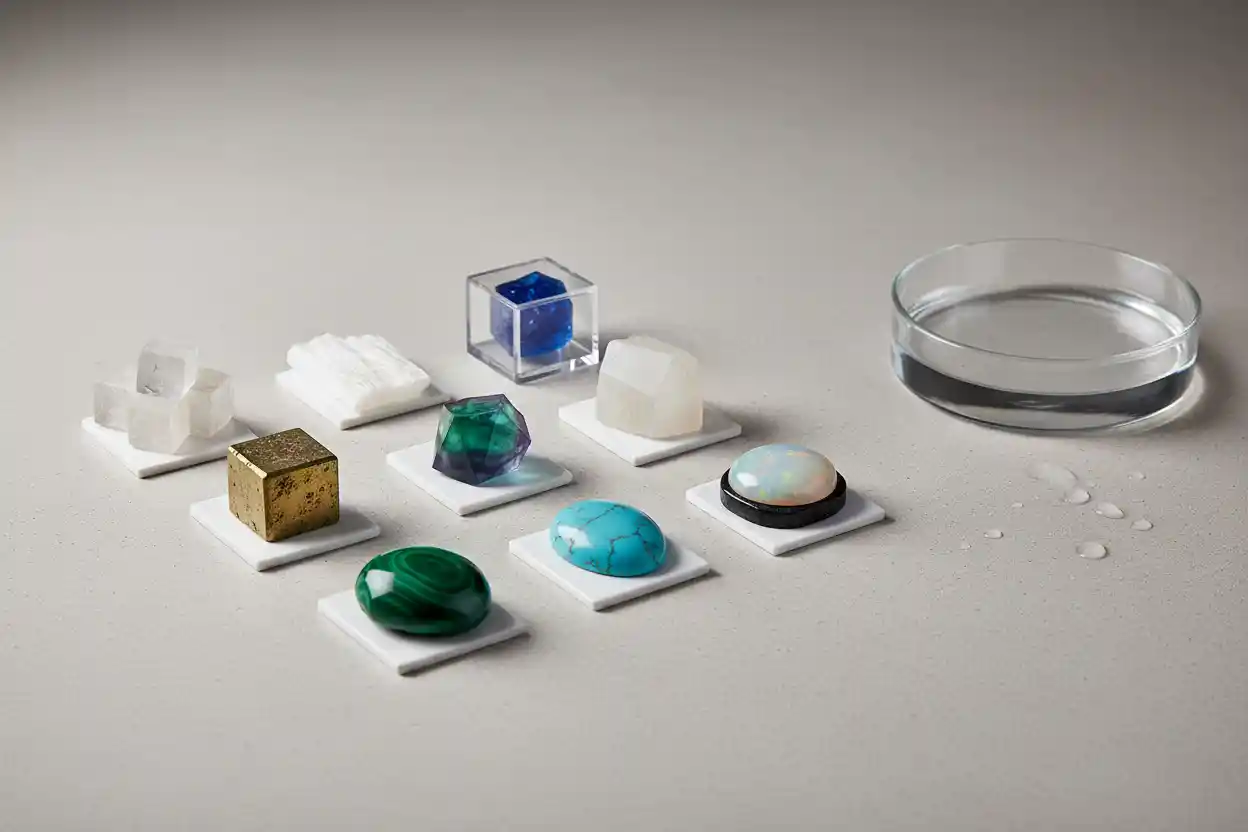
Crystals That Dissolve in Water: 11 Facts About Solubility, Damage & Safe Care
Crystals that dissolve in water include minerals whose chemical components can enter solution when exposed to water. Halite, the mineral form of sodium chloride, is the clearest everyday example because it dissolves readily. Gypsum, including transparent selenite and fibrous satin spar varieties, is only slightly soluble, but repeated or prolonged water exposure can still degrade surfaces and delicate crystal features.
Water sensitivity is more complicated than dissolution alone. Turquoise can absorb liquids because of porosity without simply dissolving like salt. Pyrite does not dissolve rapidly in clean water, yet moisture can contribute to oxidation and deterioration in susceptible specimens. Calcite survives ordinary brief water contact but reacts strongly with acids. Treated stones may contain dyes, fillers, coatings, adhesives, waxes, or resins that respond differently from the underlying mineral.
A useful discussion of crystals that dissolve in water therefore separates true solubility from porosity, chemical reaction, oxidation, cleavage, treatment instability, and simple physical fragility.
11 Facts About Crystals That Dissolve in Water
- Halite dissolves readily because it is sodium chloride, the mineral form of common salt.
- Gypsum is slightly soluble, so selenite and satin spar should not undergo routine soaking.
- Longer exposure generally creates more opportunity for soluble minerals to deteriorate.
- Water temperature and chemistry can influence dissolution rates.
- Mohs hardness does not measure water solubility.
- Calcite is not salt-like in pure water but reacts readily with weak acids.
- Turquoise can be porous and absorb liquids even though it does not simply dissolve.
- Pyrite can deteriorate under unfavorable moisture and humidity conditions through oxidation.
- Dyes, coatings, fills, adhesives, and stabilization can make a stone more water-sensitive.
- Drinking-water crystal rituals create unnecessary risk when mineral chemistry is uncertain.
- Gentle mineral-specific cleaning is safer than assuming every crystal belongs in the same water bowl.
Halite Is the Clearest Example of Crystals That Dissolve in Water
Halite is sodium chloride, NaCl, and belongs near the top of any list of crystals that dissolve in water. The mineral commonly forms cubic crystals and large evaporite deposits when saline water becomes concentrated enough for salt to crystallize.
Once halite returns to unsaturated fresh water, the process can reverse. Sodium and chloride ions move into solution, rounding edges, dulling faces, and eventually removing substantial portions of the specimen. This is why rock salt disappears in wet conditions and why halite deposits can develop natural dissolution features underground.
A quick accidental splash does not necessarily erase a large crystal immediately, but deliberate soaking is clearly inappropriate. Cleaning should rely on dry or carefully controlled methods rather than water immersion.
Crystals that dissolve in water should also remain away from humid locations where repeated condensation can gradually affect exposed surfaces.
Gypsum, Selenite, and Satin Spar Are Slowly Water-Soluble
Gypsum, CaSO₄·2H₂O, deserves special attention because many crystal owners know it under commercial names such as selenite or satin spar. True selenite is clear or transparent crystalline gypsum, while satin spar is a fibrous gypsum variety with a silky appearance.
Gypsum is only slightly soluble in water, which is very different from the rapid dissolution of halite. That does not make soaking harmless. Repeated or prolonged exposure allows gradual dissolution, while the mineral’s Mohs hardness of about 2 makes its surfaces easy to scratch or abrade.
The combination of softness, perfect cleavage, and slight water solubility means gypsum specimens deserve dry storage and conservative cleaning. Water-based rituals offer no practical benefit.
Modern spiritual discussions of selenite healing properties can remain symbolic without requiring a gypsum specimen to be immersed or washed repeatedly.
Crystals That Dissolve in Water Are Not Defined by Mohs Hardness
A common shortcut suggests that stones above a particular Mohs number are water-safe. This is incorrect because hardness measures scratch resistance, not solubility.
The crystal hardness chart places gypsum near Mohs 2 and halite around 2 to 2.5, but their low hardness does not cause their solubility. Chemical structure and interactions with water determine whether ions can move into solution.
Hardness also fails in the opposite direction. A relatively hard gemstone may contain water-sensitive treatments, open fractures, porous regions, or glue. Another soft mineral may tolerate a brief rinse better than its Mohs number seems to suggest.
Crystals that dissolve in water therefore cannot be identified with a simple hardness cutoff. Mineral identity must come first.
Exposure Time Changes What Water Does to a Mineral
A brief rinse and a twenty-four-hour soak are not equivalent. Crystals that dissolve in water lose components as fresh solution remains in contact with their surfaces, and longer exposure provides more opportunity for dissolution.
This distinction explains why a mineral might appear undamaged after one accidental splash yet develop dulled edges or etched surfaces after repeated soaking. Water movement also matters because flowing water can continually replace the solution touching the mineral.
Surface area changes the process too. Powder dissolves far faster than a large intact crystal because much more surface is exposed relative to its volume. That is another reason crushing a specimen before placing it in water creates a very different situation from owning an intact mineral.
Care instructions should therefore specify duration rather than using vague labels such as completely waterproof.
Temperature and Water Chemistry Can Change Solubility
Water itself is not always chemically identical. Temperature, dissolved salts, acidity, alkalinity, and other dissolved substances can change how minerals interact with a solution.
Halite remains highly soluble in ordinary fresh water. Gypsum has a more complicated temperature-dependent solubility. Calcite behaves differently in acidic water than in neutral water because acids react with carbonate.
Household water may also contain chlorine, hardness minerals, cleaning products, soap, shampoo, or other substances. That is why can you shower with crystals cannot be answered by considering pure water alone.
Crystals that dissolve in water are therefore only one category within a larger care problem involving solution chemistry.
Calcite Is Acid-Sensitive Rather Than Salt-Like
Calcite sometimes appears in lists of crystals that dissolve in water, but the wording needs precision. Calcite, calcium carbonate, does not behave like halite dropped into a glass of fresh water. It can persist in ordinary water, although natural groundwater chemistry can dissolve calcite gradually, particularly when carbon dioxide makes the solution mildly acidic.
Weak acids react much more readily with calcite. Vinegar can attack the surface, which is why acid testing has historically been used in mineral identification. That same property makes acidic household cleaners inappropriate for polished calcite.
Calcite is also soft at Mohs 3 and has perfect cleavage, so scratches and impacts matter independently of water chemistry.
The correct lesson is not that every calcite specimen instantly dissolves when wet. It is that water chemistry, acidity, and exposure time determine what happens.
Turquoise Can Absorb Water Without Simply Dissolving
Water sensitivity and solubility are not the same. Turquoise illustrates the distinction well. Natural turquoise can be porous, and lower-density stone may absorb water, oils, cosmetics, or other liquids into surface pores.
That can temporarily or permanently alter color and appearance. Many commercial turquoise pieces are stabilized with polymer or resin to improve durability, while other specimens may receive dye, wax, or additional treatments.
Turquoise therefore does not belong among crystals that dissolve in water in the same sense as halite. Its concern is porosity, treatment stability, chemical exposure, and discoloration.
Warm soapy water can be used carefully for appropriate turquoise cleaning, but repeated soaking and exposure to cosmetics or strong cleaners remain unnecessary.
Pyrite and Moisture Show Why Oxidation Is Different From Dissolution
Pyrite is iron sulfide, FeS₂, and does not simply disappear into clean water like salt. However, unstable pyrite specimens can oxidize in the presence of moisture and oxygen, producing sulfate compounds and acidic conditions that contribute to deterioration.
Collectors sometimes call severe deterioration pyrite decay. Cracking, powdery products, unpleasant acidic residues, and damage to neighboring objects can occur in vulnerable specimens under unfavorable humidity.
Pyrite therefore does not fit neatly into a list of crystals that dissolve in water, yet it belongs in any serious discussion of why moisture exposure matters.
Keep pyrite dry, avoid unnecessary soaking, and ensure damp stones are fully dried before shared storage. Water resistance must account for chemical change as well as simple solubility.
Treatments Can Make Otherwise Stable Crystals Water-Sensitive
A mineral can be chemically stable in water while the finished commercial stone is not. Dye may concentrate in porous structures, coatings can be vulnerable to abrasion or chemicals, fracture fillings can react differently from the host gem, and adhesives may weaken after repeated soaking.
Stabilized stones contain resins or polymers intended to improve durability. Composite gemstones may contain several layers joined together. Drilled pendants can use glued caps, while bead strings rely on cord or elastic that repeated wetting can weaken.
This is why crystals that dissolve in water are not the only stones that should stay out of soaking bowls. Unknown treatment history is enough reason to choose conservative cleaning.
The safest method generally uses the least aggressive approach capable of removing ordinary dirt.
Crystal Elixirs Create an Unnecessary Exposure Route
Some spiritual practices place stones directly into drinking water in an attempt to create crystal elixirs. This is a poor default because mineral chemistry, treatments, surface contamination, adhesives, dyes, and soluble components may be uncertain.
A toxic crystals list becomes particularly relevant when minerals contain lead, arsenic, mercury, copper, uranium, or other substances that should not be introduced deliberately into beverages. Even a beautiful collector specimen does not become food-safe because it has been polished.
Crystals that dissolve in water deserve obvious exclusion from direct elixirs, but unknown stones should also stay out of drinking water. Solubility can transfer mineral components into the liquid, which is the opposite of isolating exposure.
Spiritual symbolism does not require ingestion.
How to Clean Water-Sensitive Crystals More Safely
Start by identifying the stone. Halite and gypsum deserve dry or nearly dry care, while durable quartz can generally tolerate warm soapy water. Turquoise, pyrite, coated stones, glued jewelry, and porous or fractured specimens require more conservative decisions.
A clean soft brush, microfiber cloth, air bulb, or careful localized cleaning may be suitable depending on the specimen. Avoid aggressive scrubbing on soft minerals and never use compressed air in a way that spreads potentially hazardous dust.
Steam and ultrasonic cleaners are not universal alternatives. Vibration, heat, inclusions, cleavage, fillings, and treatments can make them unsuitable for certain stones.
Crystals that dissolve in water are best preserved by avoiding the assumption that every spiritual cleansing ritual must involve liquid.
Conclusion
Crystals that dissolve in water range from highly soluble halite to slightly soluble gypsum varieties such as selenite and satin spar. Other stones, including turquoise and pyrite, may experience water-related problems through porosity, treatments, oxidation, or chemical reaction without dissolving like salt.
Mohs hardness cannot determine water safety. Correct mineral identification, exposure time, water chemistry, treatments, and physical condition provide much better guidance for cleaning and storage.
FAQs
What Are the Main Crystals That Dissolve in Water?
Halite is highly water-soluble, while gypsum varieties such as selenite and satin spar are slightly soluble and can deteriorate with repeated or prolonged exposure.
Does Selenite Dissolve in Water?
Selenite is gypsum, which is slightly soluble in water. It does not disappear as quickly as salt, but repeated soaking can damage the crystal.
Does Halite Dissolve in Water?
Yes. Halite is sodium chloride and dissolves readily in unsaturated fresh water.
Does Calcite Dissolve in Water?
Calcite does not behave like salt in ordinary water, but mildly acidic water can dissolve it gradually, and stronger acids attack it readily.
Is Turquoise One of the Crystals That Dissolve in Water?
Not in the same sense as halite. Turquoise may be porous and can absorb liquids or suffer discoloration and treatment-related changes.
Does Pyrite Dissolve in Water?
Pyrite does not rapidly dissolve like halite, but moisture and oxygen can contribute to oxidation and deterioration in susceptible specimens.
Can Hard Crystals Still Be Water-Sensitive?
Yes. Mohs hardness measures scratch resistance, not solubility, porosity, oxidation, treatment stability, or chemical reaction with water.
Can Crystals That Dissolve in Water Be Used in Elixirs?
They should not be placed in drinking water. Dissolution introduces mineral components into the liquid, and unknown treatments or hazardous elements create additional concerns.
Is a Quick Rinse the Same as Soaking a Crystal?
No. Exposure time matters. A brief rinse may have little visible effect on some stones that can still deteriorate during repeated or prolonged soaking.
How Should Selenite Be Cleaned?
Use gentle dry cleaning such as a soft cloth or suitable soft brush rather than routine immersion.
How Do I Know Whether an Unknown Crystal Is Water-Safe?
Identify the mineral and any treatments before soaking it. When identity is uncertain, dry or minimally damp cleaning is the safer default.
Crystal water rituals are personal practices and should never justify ingesting unknown, soluble, treated, or potentially hazardous mineral components.