11 Agate Benefits: Natural Banding, Durability, Jewelry Uses & Collecting Value
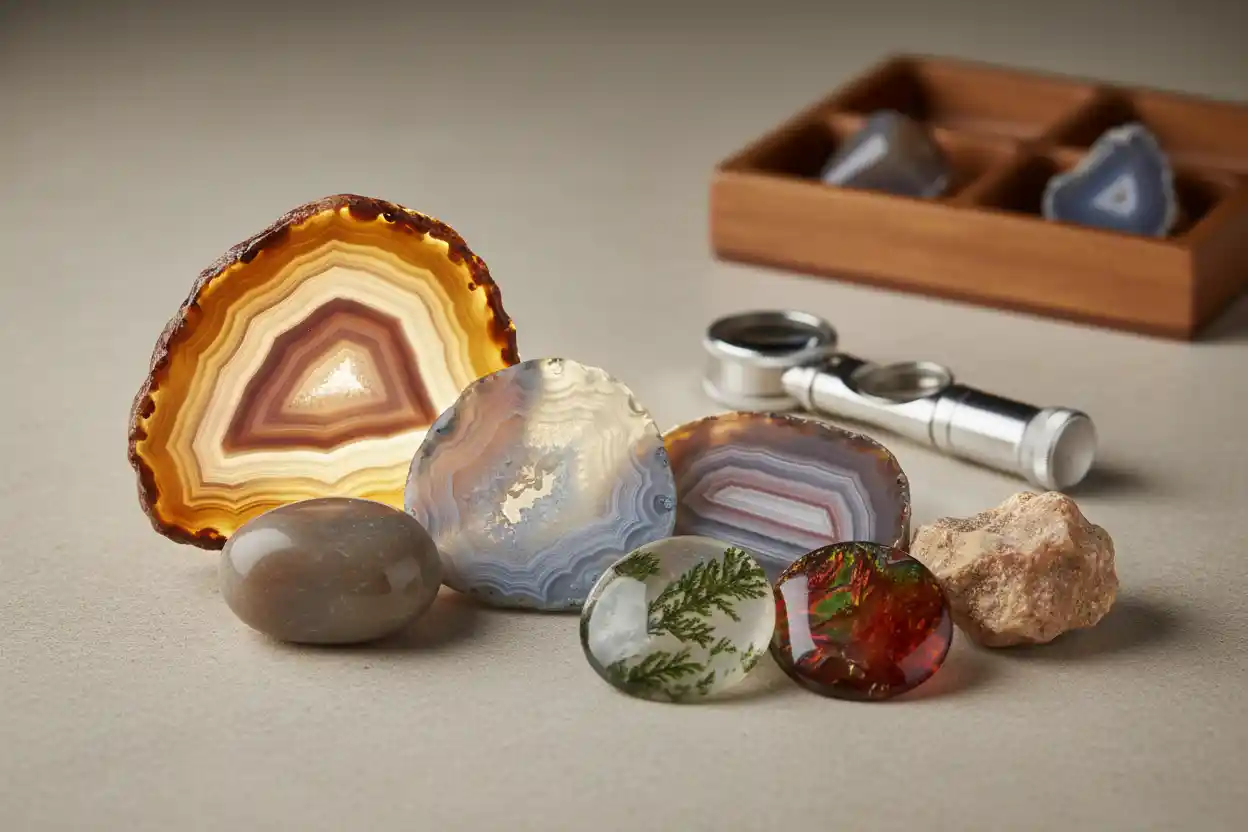
Agate benefits extend far beyond modern crystal-healing claims. Agate is a fine-grained variety of chalcedony, composed predominantly of microscopic quartz with characteristic banding or other patterned growth. Its toughness, ability to take a high polish, wide range of natural patterns, suitability for carving and jewelry, geological diversity, and relatively accessible supply have made it useful and desirable for a very long time.
Many agates form when silica-rich fluids deposit successive layers along cavities in volcanic rock, although agate can occur in other geological settings as well. Those repeated layers create concentric bands, fortification patterns, eyes, plumes, moss-like inclusions, or other features that make individual pieces visually distinctive.
The most defensible agate benefits are therefore physical, artistic, geological, historical, and practical. Agate can produce durable cabochons, beads, carvings, bowls, seals, specimen slices, and educational examples of silica deposition. Spiritual symbolism may add personal value, but agate has not been scientifically demonstrated to cure disease or produce a specific medical effect.
11 Agate Benefits for Jewelry, Collecting, Lapidary Work & Everyday Use
- Agate combines attractive patterning with useful toughness for jewelry.
- Natural banding makes individual slices and cabochons visually distinctive.
- Fine-grained chalcedony can take an excellent polish.
- Wide geographic occurrence creates many collecting varieties and local styles.
- Agate works well for beads, cabochons, carvings, seals, boxes, and ornamental objects.
- Its toughness often makes it more forgiving than many visibly crystalline gems.
- Common agate can provide attractive natural stone at relatively accessible prices.
- Agate records geological processes through bands, inclusions, cavities, and associated quartz.
- Historical use gives agate archaeological and cultural interest beyond modern spirituality.
- Its variety makes agate useful for learning identification and recognizing treatments.
- Symbolic use can support personal rituals without requiring unsupported medical claims.
Agate Benefits Begin With Tough Fine-Grained Chalcedony
One of the most important agate benefits is durability. Agate belongs to the chalcedony family and consists of extremely fine intergrowths dominated by silica phases, especially microscopic quartz. This fine-grained structure produces good toughness compared with many larger single crystals that contain obvious cleavage planes.
Agate generally sits around 6.5 to 7 on the Mohs scale, giving it useful resistance to everyday scratching. Its toughness and compact texture allow it to survive cutting, drilling, polishing, and carving relatively well.
This combination explains why agate appears so frequently in beads, cabochons, signet-style pieces, carvings, and decorative objects. It is not indestructible, but it can tolerate ordinary jewelry use better than very soft stones such as fluorite, calcite, or gypsum.
Agate benefits therefore begin with a useful balance: sufficient hardness for polish and wear, combined with enough toughness for many lapidary designs.
Natural Bands Make Every Agate Visually Distinctive
Agate’s patterns create some of its strongest visual appeal. Classic agates show concentric or parallel banding formed as silica-rich fluids deposit successive layers in cavities or fractures.
Changes in microscopic structure, impurities, iron and manganese oxides, porosity, and growth conditions can produce white, gray, brown, red, yellow, blue, green, black, or mixed bands. Some pieces display sharp fortification patterns, while others form eyes, tubes, plume-like structures, or dendritic and moss-like appearances.
Not every commercial name represents a separate mineral species. Many names simply describe pattern, locality, color, or appearance.
These natural differences are important agate benefits for collectors because two slices from different nodules can look completely unrelated while still belonging to the same general chalcedony family. A cut nodule may also reveal crystalline quartz in its center, showing a transition between compact chalcedony layers and larger visible quartz crystals.
Agate Takes an Excellent Polish
Another practical advantage among agate benefits is its response to lapidary work. The dense, fine-grained structure can develop a smooth reflective polish that intensifies color and reveals banding more clearly.
A rough agate nodule may look dull and relatively ordinary from the outside. Sawing the stone can reveal complex internal patterns that were completely hidden. Grinding and polishing then bring those bands into sharper visual contrast.
This makes agate useful for cabochons, beads, polished slices, spheres, decorative slabs, small carvings, boxes, handles, and ornamental objects. The stone can be shaped without needing faceting to reveal its main appeal.
Lapidary work still creates silica-containing dust, so dry grinding should be avoided. Wet cutting, effective dust control, eye protection, good hygiene, and suitable respiratory precautions are important when working agate professionally or as a hobby.
Agate Benefits for Jewelry Are Both Practical and Visual
Agate jewelry can display dramatic color and pattern without relying on transparency or exceptional clarity. Cabochons work particularly well because the rounded polished surface reveals banding and inclusions while preserving enough thickness for durability.
Beads are another major use. Agate can be drilled and polished into round, faceted, cylindrical, irregular, or carved beads, allowing designers to use natural pattern as part of the finished piece.
Hardness around 6.5 to 7 makes agate suitable for pendants, earrings, bracelets, and many rings, although repeated impact can still chip edges. Protective settings help pieces intended for frequent wear.
Agate benefits also include design variety. One person may prefer subtle gray bands, while another chooses strongly patterned red, brown, blue, or multicolored stone. The same gem family can therefore support very different jewelry styles.
Geological Variety Makes Agate Rewarding to Collect
Agate occurs in many regions of the world and can develop in several geological environments, although cavities in volcanic rocks are especially important. As silica-rich fluids move through openings, chalcedony and quartz can accumulate in repeated layers.
This process creates locality-specific appearances. Collectors may specialize in Lake Superior agates, Fairburn agates, Brazilian agates, Mexican varieties, plume agates, moss agates, tube agates, eye agates, or other recognized forms.
The geological diversity creates educational agate benefits because a collection can show how silica precipitation, iron staining, cavity shape, crystal growth, inclusions, and later alteration interact.
Accurate locality labels become especially useful. A patterned stone labeled only “agate” loses information that could connect it with a deposit, formation, region, or characteristic style.
Agate Has a Long History of Tools, Carving & Ornament
Agate benefits have been recognized far longer than modern metaphysical crystal culture. Chalcedony varieties were used historically for cutting tools, projectile points, containers, personal ornaments, carvings, and seals because their fine-grained structure can produce sharp edges when fractured and smooth surfaces when polished.
Over time, agate became especially associated with decorative carving, beads, seals, cameos, vessels, and jewelry. Its contrasting layers can be particularly effective in engraved or carved objects because the cutter can use natural color differences as part of the design.
This history matters because it shows that agate’s usefulness does not depend on modern claims about energy. People valued fine-grained silica for its physical properties and visual patterns long before contemporary wellness language developed.
Historical symbolism varies between places and periods, so it is better to treat specific traditions separately rather than claim one universal ancient meaning for every agate variety.
Affordable Common Agate Can Offer Strong Collecting Value
Another of the practical agate benefits is accessibility. Agate is widespread enough that attractive common specimens can often be acquired without the prices associated with rare transparent gemstones.
That does not mean all agate is inexpensive. Exceptional pattern, rare locality, very large intact nodules, unusual color, fine carving, historical provenance, or famous varieties can command significant premiums.
Still, beginners can often obtain polished slices, small nodules, cabochons, and tumbled pieces relatively easily. This makes agate useful for learning how natural pattern, cutting orientation, treatment, locality, and finishing influence appearance.
A modestly priced natural specimen can provide more geological interest than an expensive anonymous carving if the collector values formation and provenance.
Treatments Make Agate an Excellent Stone for Learning Buyer Awareness
Natural agate occurs in many attractive colors, but dyeing has a long history in the trade because chalcedony can contain porous zones that accept color. Commercial agates may therefore appear vivid blue, pink, green, purple, black, red, or other shades that were intensified or created through treatment.
Heat can also alter color in some chalcedony. Treatments are not inherently deceptive when disclosed. The problem begins when a strongly dyed or altered stone is presented as an exceptionally rare natural color.
Understanding real vs fake agate involves more than deciding whether the underlying stone is genuine chalcedony. A piece can be genuine agate and still be dyed, coated, heated, impregnated, or otherwise enhanced.
Buyer education is therefore one of the overlooked agate benefits. Because natural, treated, and imitation examples are widespread, agate teaches the importance of asking precise questions about color and treatment.
Agate Benefits for Identification and Geological Learning
A good agate specimen can teach several mineralogical concepts at once. Fine-grained quartz demonstrates that crystals do not need to be visible to the naked eye. Banding reveals repeated growth. Iron oxides can show how trace components alter color, while central cavities may preserve larger quartz crystals.
Translucent slices also allow examination under transmitted light. Thin bands that looked dark against a table may become luminous when light passes through them, revealing differences in density and microscopic structure.
Collectors can compare true banded agate with jasper, ordinary chalcedony, dyed stone, glass imitations, and patterned rocks. The exercise improves observational skills without requiring expensive specimens.
These educational agate benefits make the stone useful in classrooms, lapidary clubs, beginner collections, and geology displays.
Agate Care Is Usually Straightforward
Untreated agate is generally durable enough for ordinary wear and gentle cleaning. Warm water, mild soap, and a soft brush or cloth are suitable for many pieces. Rinse away residue and dry the stone afterward.
Dyed or coated agate deserves additional care because solvents, strong chemicals, abrasion, or prolonged intense sunlight may affect some treatments. If treatment history is unknown, conservative cleaning is preferable.
Avoid deliberately heating agate, subjecting it to abrupt temperature changes, or using aggressive chemical cleaners. Although agate is tough, thin slices and sharp edges can still break after hard impact.
Store finished pieces so harder gemstones such as sapphire and diamond do not rub against polished agate surfaces.
Modern Symbolism Can Be an Additional Personal Benefit
Modern crystal practice frequently associates agate with stability, grounding, emotional balance, protection, patience, or confidence. Those interpretations may make a stone personally meaningful, especially when a particular color or pattern becomes associated with a goal or memory.
These symbolic agate benefits should remain separate from claims that the stone treats disease, regulates hormones, improves circulation, cures anxiety, relieves pain, or changes another medical condition.
Modern agate healing properties are best understood as wellness beliefs and personal practices rather than clinically demonstrated therapeutic effects.
A polished agate kept on a desk can still act as a reminder to pause, concentrate, or follow a chosen routine. The value comes from the person’s association and behavior rather than a medically active force inside the stone.
Conclusion
Agate benefits are grounded in real qualities: toughness, natural banding, excellent polish, jewelry versatility, geological diversity, collecting potential, historical use, accessible examples, educational value, and an enormous range of patterns.
Agate also offers useful lessons about treatment disclosure because dyeing and other enhancements are common. Personal symbolism can add another layer of value, but it does not need to replace the physical and geological qualities that already make agate distinctive.
FAQs
What Are the Main Agate Benefits?
Agate benefits include durability, attractive natural patterns, strong polishing potential, jewelry versatility, collecting interest, geological variety, historical significance, and educational value.
Is Agate Good for Everyday Jewelry?
Agate’s Mohs hardness of about 6.5 to 7 and good toughness make it suitable for many jewelry styles, although hard impact and contact with harder gems should still be avoided.
Why Is Agate So Colorful?
Natural color can come from microscopic inclusions, iron and manganese oxides, structural differences, and other components within the chalcedony. Some commercial agate is also dyed or heat-treated.
Is Agate a Type of Quartz?
Agate is a variety of chalcedony, a fine-grained form dominated by microscopic quartz and associated silica structures.
Are All Agates Naturally Banded?
Classic agate is characterized by banding, but commercial naming can be loose, and moss, dendritic, plume, and other varieties may show structures that differ from obvious concentric bands.
Can Agate Be Dyed?
Yes. Chalcedony and agate have long been dyed commercially, sometimes producing colors much stronger than typical natural examples.
What Are Agate Benefits for Collectors?
Collectors can study locality, banding, inclusions, cavity growth, color, cutting orientation, quartz centers, historical specimens, and treatment differences.
Does Agate Scratch Easily?
Agate resists ordinary scratching reasonably well at about Mohs 6.5 to 7, but harder gems such as sapphire and diamond can scratch it.
How Should Agate Be Cleaned?
Warm water, mild soap, and a soft cloth or brush work for many untreated pieces. Dyed or coated agate should receive more conservative cleaning.
Are Agate Healing Benefits Scientifically Proven?
No reliable evidence establishes agate as a medical treatment. Spiritual or wellness interpretations can remain personal without being presented as therapeutic facts.
Why Has Agate Been Used for So Long?
Its combination of toughness, ability to take a high polish, attractive patterns, wide availability, and suitability for tools, carvings, seals, beads, and jewelry made it useful across many periods.
Symbolic agate benefits are personal wellness beliefs and should not replace qualified medical or mental health care.