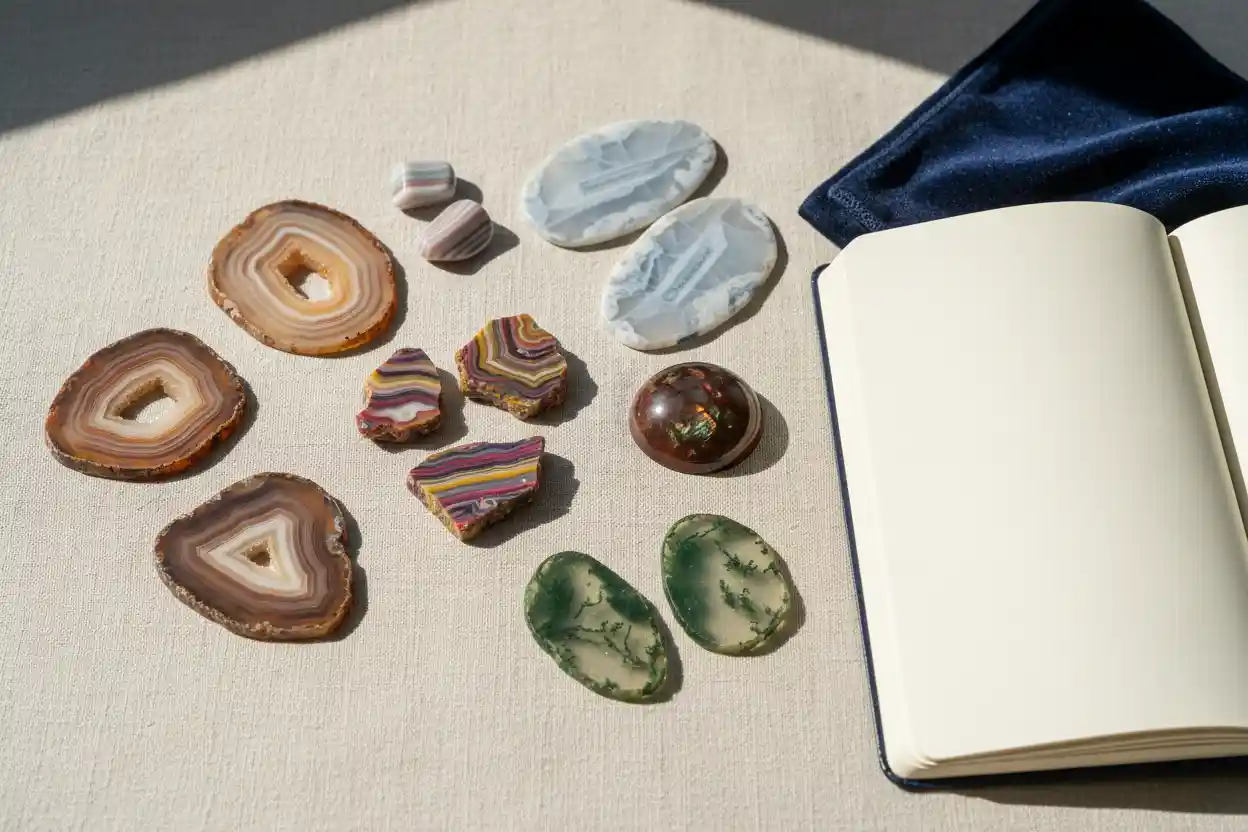
Agate Healing Properties: 10 Essential Claims, Positive Traditions & Safe Limits
Agate healing properties are traditionally associated with grounding, emotional steadiness, patience, courage, clear communication, confidence, concentration, protection symbolism, relationship harmony, and gradual personal growth. These ideas come from crystal traditions rather than established medical evidence. Agate does not treat anxiety, improve circulation, strengthen organs, detoxify the body, balance hormones, prevent illness, or replace professional health care. Its most defensible use is as a durable, visually distinctive stone that can support personal reflection, routines, reminders, and symbolic practices.
Agate itself is a banded form of chalcedony within the quartz family. Its fine-grained silica structure often produces layers, curved bands, translucent zones, inclusions, or contrasting colors that make one specimen look very different from another. Natural agates can occur in volcanic cavities and other geological settings, where silica-rich fluids gradually deposit successive layers. Because many commercial pieces are dyed or otherwise enhanced, color alone does not always reveal how a particular stone formed. The physical facts are important because agate’s real mineral identity should remain separate from claims about emotional or physical healing.
Agate Grounding, Stability, and Calm Claims Reflect Its Layered Symbolism
Grounding is probably the most common theme attached to agate. In crystal practice, the stone is often described as steadying, centering, or helping someone feel less scattered when life becomes demanding. There is no established evidence that agate alters the nervous system or directly reduces anxiety, but its appearance makes the symbolism easy to understand. Repeated bands, gradual color transitions, and compact patterns can suggest order, continuity, and patience, which gives the stone a natural role in reflective routines. Someone might keep an agate on a desk as a reminder to slow down before responding to a stressful message, complete one task before switching to another, or return attention to what can actually be controlled.
That symbolism varies with agate varieties. Botswana agate healing properties are often connected with patient adjustment and gentle grounding because the stone commonly shows subtle gray, brown, pink, or muted bands. Crazy lace agate healing properties are associated more often with optimism and flexible thinking because its looping patterns look energetic and complex. These distinctions belong to crystal tradition rather than mineral science, but they can still give a collector different visual cues for different habits. The useful part is not whether the stone sends a calming force into the body, but whether its symbolism supports a deliberate response that the person finds meaningful.
Agate is also sometimes described as emotionally stabilizing during change, conflict, or periods of uncertainty. A safer interpretation is that the stone can become a physical reminder to create structure when circumstances feel disorganized. Writing down priorities, keeping a consistent sleep schedule, preparing for an important conversation, or taking a planned break can all fit the theme of steadiness without attributing medical effects to the gemstone. The crystals for inner peace tradition can be approached in the same way: calm is best treated as a practice and environment rather than a property transmitted by a stone.
Courage, Confidence, and Protection Are Traditional Agate Meanings, Not Guarantees
Agate has long been associated in modern crystal culture with courage, confidence, resilience, and personal protection. These themes are often extended into claims that the stone shields a person from danger, hostile intentions, accidents, or unwanted energy. Such claims should remain symbolic. Agate cannot protect someone from physical harm, prevent an accident, make a risky environment safe, or replace locks, protective equipment, careful judgment, or professional support. A polished stone can represent the intention to act carefully and confidently, but the protection comes from behavior and real safeguards.
Confidence symbolism can still be useful when it is tied to specific actions. An agate ring or pocket stone can remind someone to ask a prepared question in a meeting, begin a task despite uncertainty, or speak more clearly instead of withdrawing automatically. Courage is more practical when it means doing something reasonable while nervous, not ignoring danger. Related quartz-family stones illustrate how these traditions can diverge while remaining symbolic. Carnelian healing properties are often linked with motivation and action, while agate tends to be described as steadier and more measured. Both can function as cues, but neither creates bravery through contact with the skin.
Protection symbolism also appears in jewelry because agate is reasonably durable for everyday use. As a chalcedony variety, it generally resists ordinary scratching better than many softer collector stones, although it can still chip or fracture from strong impact. This makes agate practical for pendants, bracelets, beads, and cabochons. The physical durability is real; spiritual shielding is a belief. Keeping those two ideas separate gives agate a more responsible place in everyday crystal use.
Agate Communication, Focus, and Relationship Claims Depend on the Variety
Agate is not one uniform-looking stone, and crystal traditions often assign different meanings to its varieties according to color and pattern. Blue forms are commonly associated with communication, earthy forms with grounding, brighter patterned types with optimism, and green dendritic forms with gradual growth. These distinctions can make agate feel versatile, but they should not be mistaken for scientifically distinct psychological effects.
Blue lace agate healing properties are strongly associated with measured speech, patience, and calm communication. A person preparing for a difficult conversation might use a blue lace agate stone as a reminder to slow down, listen fully, and state the issue clearly rather than reacting immediately. The stone does not change another person’s behavior or guarantee that a conversation will go well. It simply fits a communication ritual because its soft blue banding has become culturally connected with gentle expression.
Focus and concentration claims can be approached similarly. Agate does not improve memory, intelligence, attention span, or academic ability, but a desk stone can become a start cue for focused work. Turning the phone face down, defining one task, and working without unnecessary interruption are the behaviors that matter. The visual complexity of agate can also be useful during short reflective pauses because the bands and inclusions give the eye something detailed to examine without requiring another screen.
Relationship harmony claims deserve the same caution. A stone cannot repair resentment, create trust, restore affection, or make someone communicate honestly. Agate can instead symbolize consistency, patience, and the willingness to address a relationship problem gradually rather than expecting one conversation to solve everything. The distinction is important because spiritual explanations should never pressure someone to remain in a harmful relationship or accept repeated disrespect in the name of maintaining harmony.
Agate Varieties Share a Chalcedony Base but Differ Greatly in Appearance
Understanding what agate actually is helps prevent crystal claims from replacing basic gemology. Agate is generally defined by banding within chalcedony, a microcrystalline to cryptocrystalline form of silica. Its intricate patterns develop through repeated silica deposition, with differences in structure, inclusions, porosity, and trace components contributing to the visible bands. This geological process can produce concentric rings, parallel layers, fortification-like patterns, translucent zones, plumes, dendrites, and many other designs.
The connection between agate and chalcedony healing properties reflects their mineral relationship, although crystal traditions often treat the names as if they describe entirely separate energetic substances. Chalcedony is the wider quartz-family term, while agate normally refers to patterned or banded chalcedony. Carnelian is also chalcedony, while moss agate has a distinct appearance created by inclusions rather than classic regular banding. Moss agate healing properties are often linked with patience, nature, and growth, showing how visual features influence symbolic interpretation.
Color can also be misleading because agate accepts dyes relatively well. Very intense pink, purple, blue, green, or other colors may be enhanced rather than natural, depending on the specimen. Enhancement does not automatically make an agate worthless or unsuitable for decorative use, but buyers should know what they are purchasing. The symbolism remains personal regardless of color origin, while value and care decisions benefit from accurate disclosure.
For collectors interested in how agate differs from its patterned relatives, the physical facts are more useful than metaphysical claims. Crazy lace agate healing properties and Botswana agate traditions may use different emotional language, but both stones remain silica-based members of the agate family. Their differences in pattern, origin, translucency, and visual character are observable; differences in supposed healing power are not established scientifically.
Agate Does Not Treat Physical or Mental Health Conditions
Claims around agate sometimes become much stronger than simple symbolism. Online descriptions may say the stone improves digestion, circulation, eyesight, skin, fertility, sleep, immunity, blood pressure, hormonal balance, or mental health. There is no established evidence that wearing, carrying, meditating with, or placing agate on the body produces these medical effects.
This matters because agate is often marketed as a gentle stone, which can make unsupported health claims sound harmless. The risk appears when someone delays diagnosis, stops treatment, or assumes worsening symptoms are part of an energetic adjustment. Headaches, persistent digestive problems, unusual bleeding, severe anxiety, depression, unexplained fatigue, pain, or other ongoing symptoms deserve appropriate health assessment according to their severity and context.
Agate can still be incorporated into wellbeing routines without making therapeutic claims. A stone beside a water bottle can remind someone to follow their normal hydration plan. A palm stone can mark the beginning of a quiet reflection period. A bracelet can symbolize maintaining boundaries during a difficult workday. These uses preserve the personal meaning while keeping responsibility for health where it belongs.
The same principle applies to the claimed agate benefits. Symbolic benefits such as creating a ritual, marking an intention, appreciating natural pattern, or using a tactile object during reflection are different from biological effects. Keeping that distinction visible prevents the language of healing from becoming misleading.
Safe Agate Use, Cleaning, and Everyday Handling
Agate is generally suitable for jewelry and regular handling because quartz-family stones have useful scratch resistance. Even so, no gemstone is indestructible. Hard impact can chip an edge, especially on thin slices, drilled beads, carved points, or pieces with fractures. Warm water, mild soap, and a soft cloth are usually sufficient for ordinary cleaning, while harsh chemicals and unnecessary heat should be avoided when a stone’s treatments are unknown.
Dyed agate deserves extra caution because strong cleaners, prolonged soaking, or chemical exposure may affect some enhancements. Decorative geodes and thin slices should also be placed securely so they cannot fall, particularly in homes with children or pets. Small stones can become choking hazards, and heavy pieces can cause injury if placed on unstable shelves.
Crystal water is unnecessary. Even though agate itself is silica-based, a retail specimen may contain dyes, coatings, adhesives, attached metal findings, or surface contamination that is not obvious. Drinking water does not gain established healing properties from contact with agate. External use provides all the symbolism a crystal practice requires without introducing avoidable ingestion concerns.
Conclusion
Agate healing properties are best understood as traditional themes of grounding, steadiness, courage, patience, communication, confidence, focus, protection symbolism, relationship harmony, and gradual growth. Agate’s real geological appeal comes from its banded chalcedony structure, varied patterns, durability, and enormous visual diversity. It can support reflective routines and personal intentions, but it does not treat disease, change body function, control other people, or provide physical protection.
FAQs
What are the main traditional agate healing properties?
Agate is commonly associated with grounding, emotional steadiness, courage, patience, communication, confidence, focus, protection symbolism, relationship harmony, and gradual personal growth.
Is agate scientifically proven to heal the body?
No. There is no established evidence that agate treats disease, changes organ function, improves circulation, or produces other medical effects.
What is agate made of?
Agate is a banded form of chalcedony within the quartz family and consists mainly of very fine-grained silica.
Is agate good for everyday jewelry?
Agate has useful durability for many jewelry styles, although strong impacts can still chip or fracture it.
Are all agate colors natural?
No. Agate is commonly dyed or enhanced because its fine porous structure can accept color well. Very vivid shades may be treated.
Does blue lace agate have different healing properties from other agates?
Crystal traditions assign blue lace agate stronger communication and calm symbolism, but these are traditional associations rather than established physiological effects.
Can agate protect someone from danger?
No. Protection claims are symbolic. Agate cannot replace practical safety measures or prevent physical harm.
Can agate help anxiety?
Agate can serve as a personal grounding or reflection cue, but it is not an established treatment for anxiety disorders.
Is agate safe to put in drinking water?
There is no need to make crystal water. Treatments, dyes, coatings, and contamination may be uncertain, so external use is simpler.
What is the safest way to use agate spiritually?
Use it as a visual or tactile symbol for a specific intention, such as patience, communication, or focused reflection, without treating it as medical care.
Agate healing meanings are traditional or personal practices, not established treatments for physical or mental health conditions.