10 Alexandrite Benefits: Color Change, Durability, Rarity & Practical Value
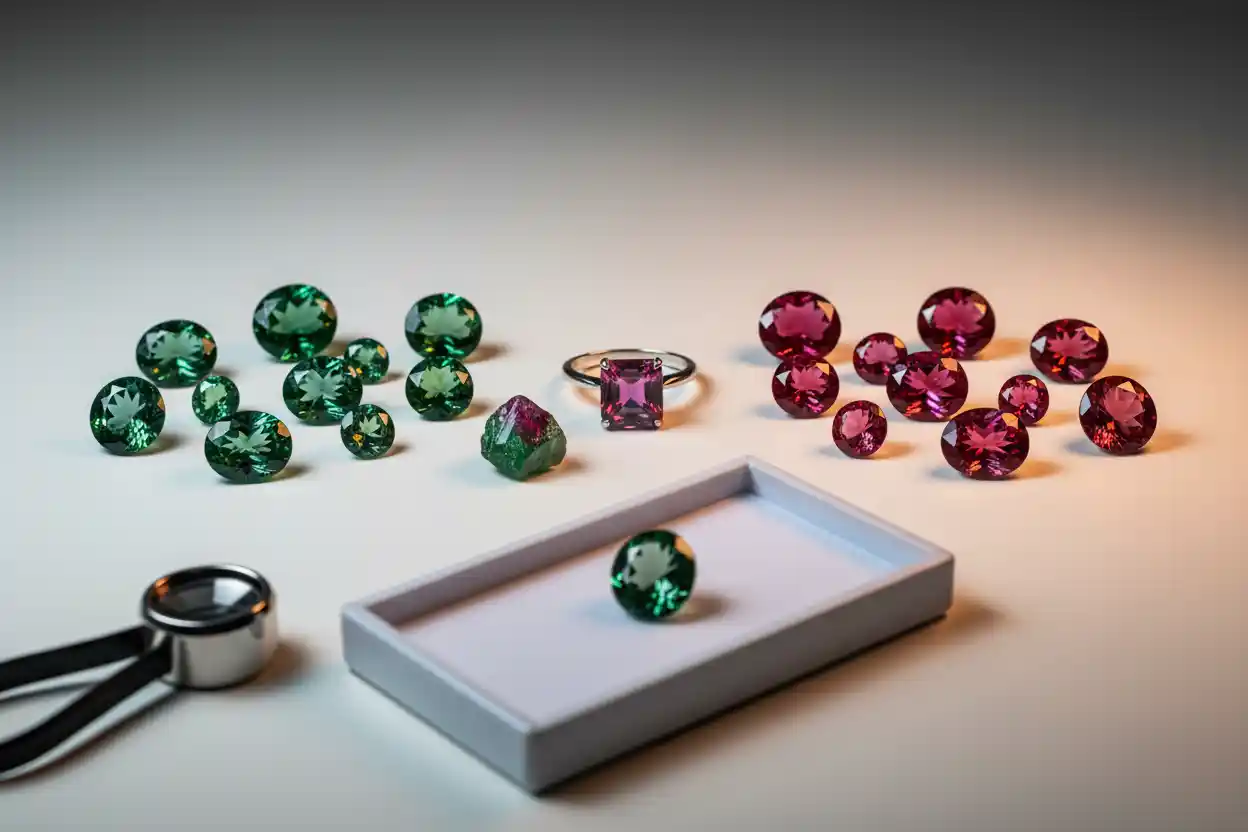
Alexandrite benefits begin with one of the most dramatic optical effects found in a natural gemstone. Alexandrite is the rare color-change variety of chrysoberyl, chemically BeAl₂O₄, whose finest examples appear green to bluish green under daylight or fluorescent illumination and red to purplish red under warmer incandescent light. The gemstone can look strikingly different without changing chemically, making light source itself part of the viewing experience.
That color change is only one reason alexandrite attracts gem buyers and collectors. The stone ranks 8.5 on the Mohs scale, has excellent toughness, and lacks cleavage, giving it stronger everyday-wear credentials than many rare colored gems. Natural alexandrite is also scarce, especially in larger sizes with vivid colors and strong change, so fine stones combine optical interest with genuine rarity.
The most defensible alexandrite benefits are therefore gemological, practical, historical, and aesthetic. Alexandrite provides distinctive jewelry, strong durability, educational value, collecting interest, birthstone significance, and remarkable visual variety. Modern spiritual associations can add personal meaning, but those beliefs should remain separate from medical claims.
10 Alexandrite Benefits for Jewelry, Collecting & Gemstone Appreciation
1. Exceptional Color Change Creates Two Distinct Appearances
The most famous of all alexandrite benefits is its ability to change apparent color under different light sources. Fine stones can shift from green or bluish green in daylight toward red or purplish red under incandescent illumination. Less dramatic stones may move through greenish, brownish, grayish, purple, or reddish tones.
The effect comes from selective light absorption associated primarily with chromium in the chrysoberyl structure. Daylight contains a different balance of wavelengths from incandescent light, so the same gemstone emphasizes different transmitted colors under each source.
This phenomenon makes alexandrite unusually interactive. A buyer does not fully understand the gem after seeing it under one lamp. The stone should be examined under daylight-equivalent and warm illumination so the strength, completeness, and attractiveness of the change become clear.
Color change also explains why photographs can misrepresent alexandrite easily. Camera processing, white balance, screen calibration, and lighting can all alter appearance. Seeing the stone under controlled lighting remains important when value is significant.
2. Alexandrite Benefits From Excellent Everyday Durability
Durability is one of the strongest practical alexandrite benefits. Chrysoberyl ranks 8.5 on the Mohs scale, placing alexandrite above quartz, tourmaline, beryl, spinel, and topaz in scratch resistance, although below corundum and diamond.
Alexandrite also has excellent toughness and no cleavage. That combination matters because a high Mohs number alone does not guarantee resistance to chipping. Topaz, for example, is hard but has perfect cleavage. Alexandrite’s combination of hardness, toughness, and structural stability makes it particularly suitable for rings, earrings, pendants, and other jewelry intended for regular use.
No gemstone is indestructible. A sufficiently hard impact can still chip or fracture alexandrite, and jewelry settings can loosen over time. Yet compared with many rare colored gems, its durability is a genuine practical advantage rather than a symbolic claim.
3. Natural Rarity Gives Fine Alexandrite Strong Collector Appeal
Rarity is another of the important alexandrite benefits. Fine natural alexandrite requires a very specific geological combination: chrysoberyl formation plus enough chromium to produce the characteristic color behavior, while still allowing attractive transparency and gem quality.
The first celebrated deposits came from Russia’s Ural Mountains, but important alexandrite has since been found in Brazil, Sri Lanka, Tanzania and other parts of East Africa, India, and additional localities. Even with these sources, fine gems showing a strong green-to-red change remain scarce.
Large stones with attractive daylight color, warm-light color, strong change, good transparency, and skilled cutting are particularly uncommon. Because these qualities do not occur independently, rarity increases sharply when several desirable features appear together.
This scarcity strongly influences alexandrite price, especially when a natural stone combines meaningful size with a vivid and balanced color change.
4. Strong Durability Makes Alexandrite Useful Across Fine Jewelry
Some rare gems are better suited to pendants or occasional wear because softness, cleavage, or poor toughness makes rings risky. Alexandrite benefits from having enough durability for a much wider range of designs.
A well-set alexandrite can work in engagement rings, anniversary jewelry, earrings, necklaces, bracelets, and heirloom pieces. Protective settings still make sense for valuable stones because rarity can make replacement difficult even when the gem itself is durable.
Alexandrite also pairs visually with different metals. White metals can emphasize cooler daylight colors, while yellow or rose gold can create contrast with both greenish and reddish appearances. Diamonds can frame the center stone without competing with its changing body color.
The gemstone’s visual transformation means the same piece can appear different in an office, outdoors, at dinner, or under warm evening illumination, adding another practical dimension to alexandrite benefits.
5. Alexandrite Demonstrates How Light Changes Gemstone Color
Educational value is one of the least appreciated alexandrite benefits. The stone provides a vivid lesson in how human color perception depends on both a gemstone’s absorption spectrum and the spectral composition of the light source.
Alexandrite is also strongly pleochroic, meaning different colors can appear when the crystal is viewed in different crystallographic directions. Pleochroism and the alexandrite color-change effect are not the same phenomenon, however. The famous daylight-to-incandescent transformation comes from the way the stone absorbs and transmits different wavelengths under different illumination.
This distinction makes alexandrite especially useful for understanding gemology. A single stone can demonstrate color change, pleochroism, trace-element coloration, optical orientation, cutting decisions, and the importance of standardized lighting.
For students and collectors, these scientific alexandrite benefits can be as interesting as the gem’s jewelry appeal.
6. June Birthstone Status Adds Personal Jewelry Significance
Alexandrite is one of the recognized birthstones for June, alongside pearl and moonstone. That association gives the gemstone an additional personal use without requiring any supernatural explanation.
Someone born in June may choose alexandrite because of its rarity and unusual color rather than because of metaphysical beliefs. It can also make a distinctive birthday gift for people who want something less common than many traditional birthstones.
Alexandrite is also associated with the fifty-fifth wedding anniversary in modern gemstone tradition. A fine color-change gem can therefore carry personal meaning through milestone jewelry, inheritance, or family history.
These alexandrite benefits come from symbolism and convention rather than physical healing, but personal significance can still be an important part of why someone chooses a gemstone.
7. Treatment Is Relatively Uncommon Compared With Many Colored Gems
Natural alexandrite is generally valued for the color and optical behavior it developed naturally. Treatments are much less routine than they are for some other colored gemstones, although fracture filling can occasionally occur and every valuable stone should still be evaluated individually.
This relative lack of routine enhancement can appeal to collectors seeking a naturally occurring color-change phenomenon. It does not mean every stone offered as alexandrite is natural or untreated. Laboratory-grown alexandrite exists, and synthetic color-change sapphire has historically been sold under misleading names suggesting alexandrite.
Identity and origin matter when you buy alexandrite, especially for expensive stones whose price depends on natural formation rather than merely displaying a red-to-green color change.
Independent gemological documentation becomes increasingly worthwhile as value rises.
8. Alexandrite Offers Several Collecting Paths Beyond Faceted Gems
Faceted alexandrite receives most of the attention, but collecting possibilities extend beyond conventional jewelry. Natural crystals, matrix specimens, locality-specific gems, historic Russian stones, cat’s-eye alexandrite, and documented estate jewelry can all appeal to different collectors.
Cat’s-eye alexandrite occurs when properly oriented needle-like inclusions produce chatoyancy, creating a moving band of light across a cabochon. When strong color change and a distinct cat’s-eye effect occur together, the result can be especially unusual.
Collectors may also focus on locality. Russian alexandrite has tremendous historical significance, while Brazilian, Sri Lankan, Tanzanian, Indian, and other stones provide opportunities to compare differences in color, inclusion patterns, and geological origin.
These varied collecting directions expand alexandrite benefits beyond simply owning one faceted ring.
9. Alexandrite Can Retain Long-Term Interest Because Its Appeal Is Observable
Many gemstones depend partly on fashion, but alexandrite’s defining feature is directly observable. The color-change phenomenon remains interesting regardless of whether metaphysical trends are popular.
That does not guarantee resale appreciation, and natural alexandrite should not be treated as a risk-free investment. Dealer margins, documentation, condition, size, origin, color quality, treatment status, and future market demand all affect resale.
Still, genuine optical rarity creates a stronger basis for collector interest than claims about vibration or healing power. A fine alexandrite can be evaluated through visible color behavior and gemological testing rather than relying on an unverifiable story.
This makes authenticity crucial. Laboratory-grown alexandrite can be beautiful and durable, but it should not carry the same natural-rarity assumptions as a mined gem.
10. Care Is Relatively Straightforward for an Exceptional Rare Gem
Ease of maintenance rounds out the practical alexandrite benefits. Natural untreated alexandrite remains stable under normal wearing conditions and is resistant to ordinary light, heat, and common chemicals encountered during normal jewelry use.
Warm water, mild soap, and a soft brush provide a reliable cleaning method. Ultrasonic and steam cleaning are usually suitable for untreated alexandrite, although fracture-filled stones deserve gentler treatment and should be cleaned with warm soapy water instead.
Store valuable alexandrite separately from diamond and corundum, which can scratch it, and avoid situations where the stone can receive strong impacts. Regularly inspect ring prongs or other settings because a lost natural alexandrite may be difficult to replace with a close match.
Simple care is a meaningful advantage for a rare gemstone intended to be worn rather than kept permanently inside a display case.
What Actually Creates the Alexandrite Color Change?
Understanding the science makes alexandrite benefits easier to appreciate. Alexandrite is chromium-bearing chrysoberyl. Chromium substitutes for some aluminum within the crystal structure and creates strong absorption in parts of the visible spectrum.
The remaining transmitted regions allow the gem to respond dramatically to the spectral balance of the light source. Daylight and fluorescent light contain relatively strong blue and green components, while traditional incandescent illumination contains much more red. Alexandrite consequently shifts its apparent color as illumination changes.
Fine stones show a pronounced transition rather than merely becoming slightly warmer or darker. Percentage of color change, saturation in both lighting environments, and whether the colors remain attractive strongly influence quality.
The effect has become so famous that similar color behavior in other gems is often described as an alexandrite effect.
Natural Alexandrite vs Laboratory-Grown Alexandrite
Laboratory-grown alexandrite can possess essentially the same fundamental chemistry, crystal structure, and color-change phenomenon as natural alexandrite. Its human-controlled growth origin is the major distinction.
Synthetic alexandrite can therefore offer attractive color change and excellent durability at a much lower cost than comparable natural stones. That affordability is a legitimate benefit when disclosed correctly.
Problems arise when laboratory-grown stones are represented as naturally mined. Synthetic color-change sapphire and other lookalikes also complicate buying because appearance alone cannot always establish identity.
For high-value purchases, professional testing provides far more confidence than home observations. Natural inclusions can offer clues, but sophisticated laboratory-grown gems may require advanced examination.
Alexandrite Benefits vs Healing Claims
Modern crystal practices may associate alexandrite with confidence, balance, transformation, creativity, good fortune, or emotional renewal. Those ideas can provide personal symbolism, but they should not be confused with the physical alexandrite benefits described by gemology.
Claims about alexandrite healing properties have not been established as medical effects. Alexandrite has not been shown to treat disease, regulate hormones, improve circulation, cure anxiety, restore vision, or produce another clinical result through skin contact or proximity.
The gemstone does not need medical claims to be exceptional. Dramatic color change, strong durability, rarity, historical interest, optical science, and jewelry versatility already provide substantial reasons for appreciation.
Conclusion
Alexandrite benefits include extraordinary color change, excellent hardness and toughness, natural rarity, jewelry versatility, collecting potential, birthstone significance, optical-science value, relatively straightforward care, and enduring visual interest.
Its greatest appeal comes from something directly observable: one natural gemstone can look strikingly different as the light changes. Fine alexandrite combines that phenomenon with genuine rarity and enough durability for meaningful long-term wear.
FAQs
What Are the Main Alexandrite Benefits?
Alexandrite benefits include dramatic color change, excellent durability, rarity, fine-jewelry suitability, collecting interest, optical-science value, June birthstone status, and relatively easy care.
Is Alexandrite Durable Enough for Daily Jewelry?
Yes. Alexandrite ranks 8.5 on the Mohs scale, has excellent toughness, and lacks cleavage, making it a strong choice for many frequently worn jewelry designs.
Why Does Alexandrite Change Color?
Chromium-related light absorption causes the gem to transmit different dominant colors depending on the spectral balance of the light source.
Is Alexandrite Rare?
Fine natural alexandrite is very rare, particularly in larger sizes with strong, attractive green-to-red color change.
Is Alexandrite a Type of Chrysoberyl?
Yes. Alexandrite is the rare color-change variety of chrysoberyl.
Can Alexandrite Be Laboratory-Grown?
Yes. Laboratory-grown alexandrite can share the fundamental chemistry, structure, and color-change phenomenon of natural alexandrite, but its origin should be disclosed.
Is Alexandrite Usually Treated?
Natural alexandrite is generally not routinely treated, although fracture filling can occasionally occur. Valuable stones should still be evaluated individually.
What Are Alexandrite Benefits for Collectors?
Collectors can pursue fine faceted stones, natural crystals, historic localities, cat’s-eye examples, estate jewelry, and documented gems from different deposits.
Is Alexandrite a June Birthstone?
Yes. Alexandrite is recognized as a June birthstone along with pearl and moonstone.
Are Alexandrite Healing Benefits Scientifically Proven?
No. Alexandrite’s verified advantages are gemological and practical rather than medical.
Symbolic alexandrite benefits are personal wellness beliefs and should not replace qualified medical or mental health care.