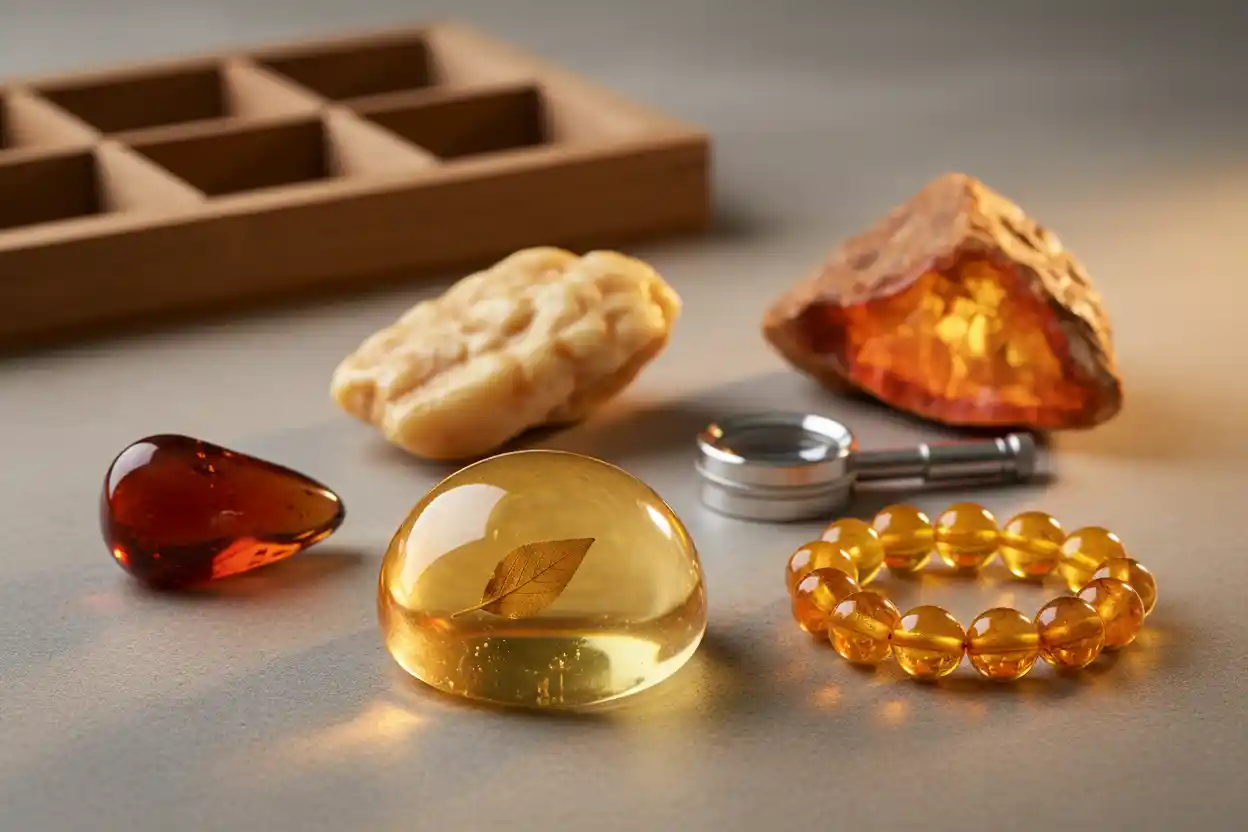
11 Amber Benefits: Fossil Resin, Ancient Inclusions, Jewelry & Collecting Value
Amber benefits come from a combination few other gems can match. Amber is fossilized plant resin rather than a mineral crystal, and some specimens preserve insects, plant fragments, pollen, feathers, and other traces of ancient ecosystems with extraordinary detail. At the same time, its warm colors, low density, relative softness, ability to take a polish, and long human history make it suitable for jewelry, carving, collecting, decorative objects, and scientific study.
Amber can range from transparent yellow and honey tones to orange, brown, reddish, cloudy, and nearly opaque appearances, with additional colors occurring naturally or through treatment. It feels surprisingly light compared with most mineral gems because its density is only slightly greater than water. That low weight allows large beads and pendants to remain comfortable even when they create substantial visual impact.
The strongest amber benefits are therefore historical, paleontological, artistic, collectible, practical, and cultural. Traditional healing beliefs exist, but amber has not been scientifically established as a treatment for pain, teething discomfort, thyroid disorders, inflammation, anxiety, or other medical conditions.
11 Amber Benefits for Jewelry, Fossil Study & Collecting
- Fossilized resin can preserve delicate insects, plants, feathers, and other ancient life.
- Warm translucent color gives amber a distinctive visual character.
- Very low density allows relatively large jewelry pieces to remain lightweight.
- Softness makes amber comparatively easy to carve and shape.
- Amber takes a warm polish suited to beads, pendants, cabochons, and decorative pieces.
- Ancient use gives amber considerable archaeological and cultural importance.
- Geographic deposits preserve information about prehistoric forests and ecosystems.
- Inclusion-bearing amber can provide scientifically valuable paleontological evidence.
- Natural variation creates many collecting styles based on color, clarity, origin, and inclusions.
- Identification teaches useful lessons about fossil resin, copal, plastic, glass, treatments, and imitations.
- Symbolic meaning can add personal value while remaining separate from medical claims.
Amber Benefits Begin With Its Identity as Fossilized Plant Resin
Amber differs fundamentally from quartz, sapphire, feldspar, and other crystalline gems. It began as sticky resin produced by ancient plants. Through burial, chemical change, and geological time, portions of that resin became the fossil substance recognized as amber.
Because amber has an organic origin, many of its properties differ from ordinary gem minerals. It is light, relatively soft, electrically charged through friction under suitable conditions, combustible at comparatively low temperatures, and vulnerable to chemicals that many harder stones tolerate.
These differences are not weaknesses in the context of amber benefits. They are part of what makes the gem distinctive. A polished amber bead represents an ancient biological secretion transformed over geological time rather than a crystal that grew from a melt or mineral-rich fluid.
Understanding that origin also prevents confusion with copal, which is younger and less polymerized fossil or subfossil resin, and with synthetic resins designed to imitate amber.
Amber Can Preserve Tiny Windows Into Ancient Ecosystems
Among all amber benefits, fossil preservation is scientifically exceptional. Sticky resin could trap small organisms or pieces of the surrounding environment before hardening and entering the fossil record.
Amber has preserved insects, mites, spiders, plant fragments, pollen, fungi, feathers, and many other delicate structures that would rarely survive as ordinary fossils. In some deposits, tiny anatomical features remain visible in remarkable detail.
These inclusions can help researchers reconstruct ancient food webs, forest habitats, behavior, evolution, and species diversity. A trapped insect is therefore not merely a decorative feature. Properly documented specimens can carry scientific information.
Not every inclusion raises scientific or commercial value equally. Common insects may occur frequently, while unusual organisms, complete specimens, rare behaviors, or combinations of organisms can attract far greater research and collector interest.
This paleontological role is one of the amber benefits no ordinary imitation can reproduce authentically.
Amber Benefits Jewelry Through Its Exceptionally Low Weight
Amber is much lighter than most mineral gemstones. Its specific gravity is close to 1.08, compared with quartz around 2.65 and many colored gems substantially above that. This gives polished amber a distinctive light feel in the hand.
Low density is particularly useful for jewelry. Large amber beads, earrings, or pendants can provide substantial visual presence without becoming uncomfortably heavy. Long necklaces containing many large beads remain much more wearable than equivalent designs made from dense mineral gems.
Weight also becomes an identification clue, although it should never be used alone. Plastics can also be light, while assembled pieces or unusual treatments may change the expected feel.
Among amber benefits, low weight combines comfort with design freedom. Jewelers can create bold forms without requiring the wearer to carry the mass associated with many similarly sized stones.
Warm Color and Transparency Give Amber a Distinctive Appearance
Classic amber ranges through pale yellow, golden honey, orange, cognac-like brown, and deeper reddish tones. Cloudy, opaque, and nearly transparent pieces can occur, and structural effects or treatments can produce additional appearances.
Light passing through transparent amber can reveal internal flow structures, tiny bubbles, plant fragments, or fossil inclusions. Opaque pieces create a different effect, emphasizing warm body color and surface polish.
Because amber is not a faceted crystal in the usual sense, its appeal rarely depends on sharp brilliance. Smooth cabochons, rounded beads, organic carvings, and freeform polishing usually suit it better.
This visual softness is one of the reasons amber benefits jewelry styles ranging from understated small pendants to large traditional bead necklaces.
Amber Is Relatively Easy to Carve, but Softness Requires Care
Amber has a Mohs hardness of only about 2 to 2.5. That softness makes it easier to cut and carve than most mineral gemstones, contributing to a long tradition of beads, figurines, amulets, boxes, decorative panels, and intricate objects.
The same property means finished amber scratches easily. Quartz dust in ordinary household dirt is far harder than amber, and careless wiping can gradually dull a polished surface. Hard jewelry stored in direct contact can also scratch it quickly.
Its toughness is not exceptional, so thin carvings and projecting details can break. High heat is dangerous because amber can soften, darken, burn, or undergo permanent change.
These characteristics show how amber benefits cutters through workability while simultaneously requiring gentler ownership than quartz, corundum, or many other common gems.
Amber Benefits Archaeology Through Its Long Human History
People have valued amber for thousands of years. Archaeological discoveries show its use in beads, pendants, ornaments, carved objects, and trade networks long before modern gemology existed.
Baltic amber became particularly important across European trade, moving far beyond the regions where it was collected. Objects made from amber have been found at archaeological sites located considerable distances from northern European sources, demonstrating the value people placed on its color, light weight, polish, and rarity.
Amber also accumulated layers of folklore and traditional medicinal belief. These historical practices are culturally interesting, but ancient use does not establish modern medical effectiveness.
The real historical amber benefits lie in what amber objects reveal about craftsmanship, exchange, status, artistic choices, and connections between distant communities.
Amber Deposits Help Scientists Reconstruct Ancient Forests
Amber’s plant origin means its chemistry and inclusions can carry information about forests that disappeared millions of years ago. Researchers study fossil resins and compare them with living plants in attempts to understand which plant groups produced particular amber deposits.
Inclusion assemblages also reveal which insects, plants, fungi, and other small organisms occupied those ecosystems. Different amber deposits preserve different ages and biological communities, making locality crucial scientifically.
Baltic, Dominican, Burmese, Mexican, Canadian, and other ambers should not be treated as one identical fossil resource. They differ in geological age, botanical source, chemistry, preservation, and characteristic inclusions.
For collectors, accurate locality therefore adds more than prestige. It creates geological context and strengthens the educational amber benefits of a specimen.
Natural Inclusions Can Increase Collecting Interest
Collectors often seek amber containing visible insects or plants, but inclusion value depends heavily on authenticity, rarity, preservation, and context. A perfectly ordinary fly is different from an unusual insect, complete flower, rare vertebrate fragment, or specimen preserving exceptional behavior.
Inclusions also create one of amber’s largest imitation problems. Insects can be embedded deliberately in modern resin or copal, and assembled pieces can place authentic inclusions inside altered or reconstructed amber.
A dramatic insect should therefore increase scrutiny rather than automatically justify a premium. Knowing real vs fake amber matters especially when an inclusion appears rare enough to influence price substantially.
Scientific specimens also require provenance. An inclusion without reliable origin information may lose research value even if the amber itself is genuine.
Amber Offers Several Collecting Paths Beyond Insects
Insect inclusions are only one way to collect amber. Some collectors specialize in geographic origin, natural color, cloudy versus transparent pieces, plant inclusions, polished historic objects, archaeological styles, or unusual oxidation patterns.
Raw pieces can preserve weathered surfaces and geological context, while polished specimens reveal internal clarity and inclusions more effectively. Antique jewelry adds craftsmanship and provenance, while modern carvings emphasize artistic use.
Color also creates collecting variety. Yellow and orange may be familiar, but pieces can range through pale transparent tones, deep reddish-brown, opaque creamy appearances, and unusual optical effects. Treatments can alter some colors, so disclosure matters when rarity or natural appearance affects value.
This variety is one reason amber benefits both gem collectors and fossil enthusiasts.
Treatment and Imitation Awareness Protects Amber Value
Amber can be heated, clarified, dyed, pressed from smaller fragments, or otherwise altered to change its appearance. Treatments are not automatically unacceptable, but they should be disclosed because they influence rarity, care, and value.
Plastic and modern resin imitations are widespread. Copal can also be sold as older amber, while reconstructed amber may combine small pieces under heat and pressure.
Simple home tests are not always definitive. Saltwater floating, static electricity, smell, ultraviolet fluorescence, hardness, and hot-needle tests all have limitations, and destructive heating tests can permanently damage genuine amber.
When value is significant, professional gemological identification is preferable. The amber price depends on factors such as authenticity, origin, color, clarity, inclusion rarity, size, treatment, workmanship, and provenance rather than metaphysical claims.
Amber Care Protects a Soft Organic Gem
Amber needs gentler care than many mineral gemstones. Its Mohs hardness of about 2 to 2.5 means hard objects can scratch it easily, while poor toughness makes hard knocks undesirable.
Warm water with mild soap provides a safe cleaning method. Use a soft cloth and avoid aggressive brushes, abrasives, ultrasonic cleaning, steam, solvents, perfume, hairspray, household chemicals, and high heat.
Prolonged strong light can darken amber, and dyed pieces may fade. Apply cosmetics and fragrance before putting on amber jewelry rather than spraying products directly onto it.
Store pieces separately from harder jewelry in a soft pouch or lined compartment. These simple precautions preserve the visual amber benefits far longer than aggressive cleansing methods.
Traditional Amber Benefits and Modern Healing Claims Need Separation
Amber has a long history in folk traditions, including beliefs about protection, warmth, pain relief, and other healing uses. Modern crystal culture has expanded those ideas into claims involving inflammation, teething, immunity, thyroid function, anxiety, and emotional balance.
The modern amber healing properties attributed to the gem have not been established as medical effects. Wearing amber does not provide a proven treatment for pain, disease, teething symptoms, hormonal disorders, infection, or inflammatory conditions.
This distinction is particularly important for amber teething necklaces. Jewelry around an infant’s neck can introduce choking and strangulation hazards regardless of whether the amber itself is genuine.
Historical traditions remain worth understanding, but medical decisions require evidence rather than the age of a belief.
Amber Benefits Can Include Personal Symbolism
Amber’s warm color, ancient origin, preserved inclusions, and relationship with prehistoric forests naturally invite symbolism. People may associate it with memory, preservation, warmth, continuity, sunlight, ancestry, or time.
These themes can add legitimate personal value. A fossil resin millions of years old containing a tiny leaf or insect is an unusually vivid reminder that small moments can survive for enormous spans of geological time.
The symbolism behind amber meaning can therefore coexist with paleontology and gemology without pretending the resin produces a medical effect.
Personal significance, scientific interest, and craftsmanship are enough to make amber rewarding.
Conclusion
Amber benefits include exceptional fossil preservation, light weight, warm color, carving potential, jewelry versatility, archaeological importance, scientific value, collecting diversity, historical trade, identification interest, and personal symbolism.
Its fossil-resin origin makes amber fundamentally different from mineral crystals. Gentle care, treatment disclosure, reliable provenance, and realistic expectations help preserve both its beauty and the information it can carry about ancient life.
FAQs
What Are the Main Amber Benefits?
Amber benefits include lightweight jewelry, warm natural color, fossil inclusions, carving potential, paleontological value, collecting interest, archaeological history, and personal symbolism.
Is Amber a Crystal?
No. Amber is fossilized plant resin rather than a mineral crystal.
Why Is Amber So Light?
Amber has a low specific gravity close to that of water, making it much lighter than most mineral gemstones of the same size.
Can Amber Contain Real Insects?
Yes. Genuine amber can preserve insects, plants, pollen, feathers, and other ancient biological remains, although fake inclusion pieces also exist.
Is Amber Good for Jewelry?
Yes, particularly for beads, earrings, pendants, and protected designs. It is soft and scratches easily, so gentle wear and separate storage are important.
How Hard Is Amber?
Amber is only about 2 to 2.5 on the Mohs scale, making it much softer than quartz and most familiar mineral gemstones.
Is All Amber Millions of Years Old?
True amber is fossil resin formed over geological time. Younger resin known as copal is less mature and should not automatically be sold as amber.
Can Amber Be Treated?
Yes. Heating, clarification, dyeing, pressing, and other processes can alter appearance. Disclosure matters when treatment affects value.
How Should Amber Be Cleaned?
Use warm water, mild soap, and a soft cloth. Avoid steam, ultrasonic cleaning, high heat, solvents, abrasives, and strong chemicals.
Does Amber Have Proven Healing Benefits?
No reliable evidence establishes amber as a medical treatment for pain, teething, inflammation, thyroid conditions, anxiety, infection, or other health problems.
Why Is Inclusion Amber Valuable?
Value can rise when authentic amber contains rare, well-preserved, scientifically interesting inclusions with credible provenance.
Traditional and symbolic amber benefits should not replace qualified medical care, especially when pain, illness, teething concerns, or other health issues require appropriate evaluation.