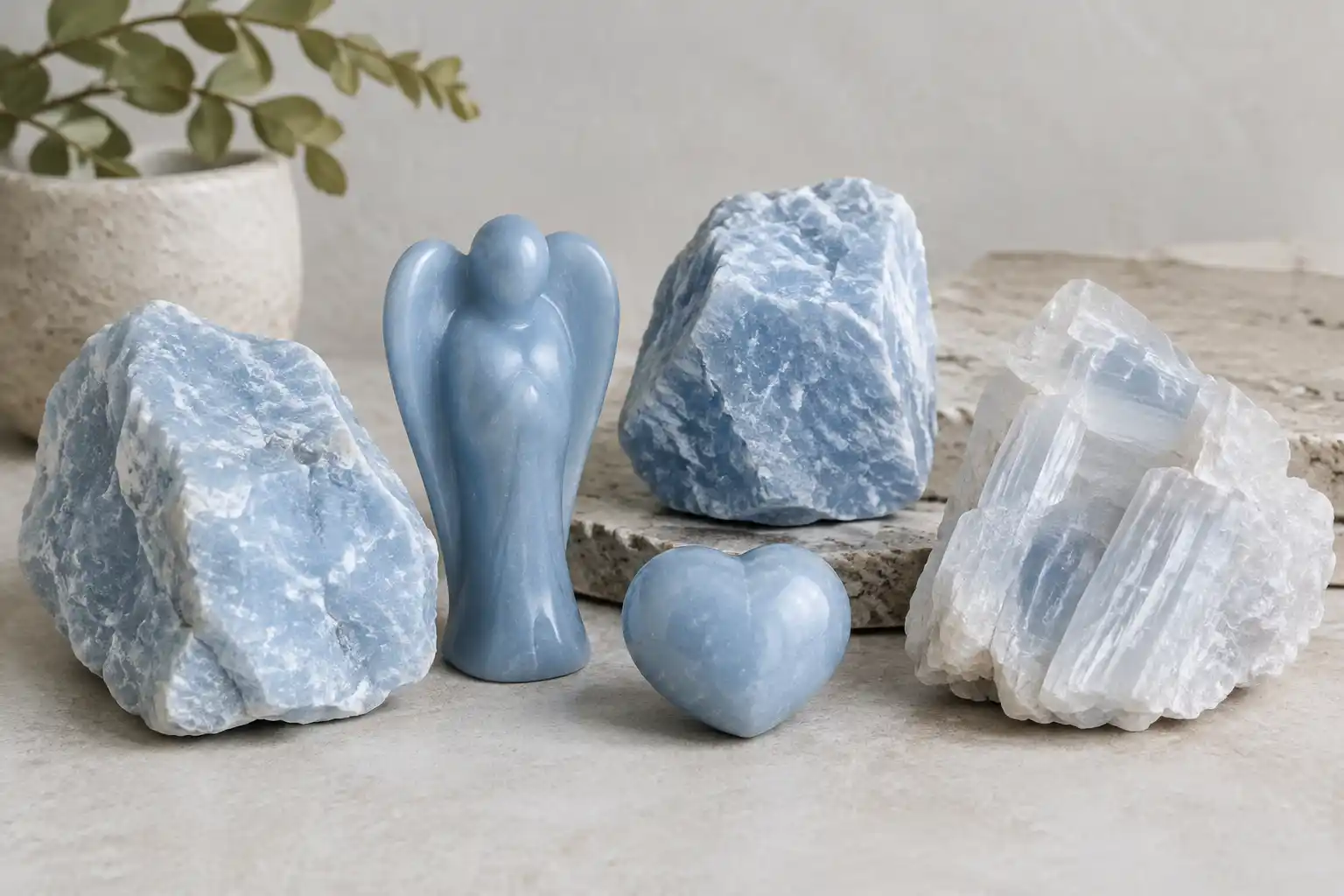
11 Angelite Benefits: Blue Anhydrite Beauty, Collecting & Practical Uses
Angelite benefits begin with its soft powder-blue to blue-gray color, smooth appearance, suitability for carvings and polished decorative objects, and interesting identity as a variety of anhydrite. Angelite is not a separate mineral species. The name is a lapidary and metaphysical trade term applied to fine-grained light blue-gray anhydrite, especially stone marketed from Peru.
Chemically, angelite is calcium sulfate, CaSO₄. Anhydrite belongs to the orthorhombic crystal system and generally has a Mohs hardness of only about 3 to 3.5. Its name literally refers to being “without water,” distinguishing anhydrite from gypsum, CaSO₄·2H₂O, which incorporates water into its crystal structure. That relationship is important for both identification and care because anhydrite can alter toward gypsum under suitable conditions.
The strongest angelite benefits are decorative, mineralogical, collectible, educational, and symbolic rather than medical. Its subdued color works well in carvings and display pieces, while its relationship with gypsum provides a useful introduction to sulfate mineral chemistry.
11 Angelite Benefits at a Glance
- Soft blue-gray color gives angelite a calm and visually distinctive appearance.
- Fine-grained texture works well for polished carvings, spheres, eggs, and decorative forms.
- Peruvian origin gives genuine angelite useful locality interest.
- Its identity as anhydrite makes angelite educational for mineral collectors.
- The calcium sulfate chemistry illustrates the difference between anhydrous and hydrated minerals.
- Mohs hardness around 3 to 3.5 makes angelite relatively easy to shape and polish.
- Its matte-to-soft luster creates a different visual effect from glassy transparent gemstones.
- Large polished pieces can provide substantial decorative presence without relying on transparency.
- Identification teaches buyers to distinguish a trade name from a recognized mineral species.
- Its water sensitivity encourages better understanding of mineral-specific care.
- Modern symbolism can add personal value without turning angelite into a medical treatment.
Blue-Gray Color Leads the Most Visible Angelite Benefits
The first of the obvious angelite benefits is color. Fine angelite commonly shows pale sky blue, blue-gray, or slightly lavender-blue tones with a soft, understated appearance.
Unlike transparent blue sapphire or aquamarine, angelite is generally opaque to semi-translucent and is appreciated for body color rather than brilliance. That makes it especially suitable for smooth surfaces where color can spread evenly across the object.
Carvings, palm stones, spheres, eggs, beads, and freeform pieces can display large areas of blue without requiring faceting. Some specimens contain lighter patches, veins, or natural variation that add visual texture.
The calm appearance also explains why the commercial name became successful in modern spiritual markets. The word angelite and the pale blue color reinforce one another visually even though the mineral itself is anhydrite.
Angelite Benefits Carving Because It Is Relatively Soft
Anhydrite typically sits around Mohs 3 to 3.5, making angelite much softer than quartz, feldspar, topaz, corundum, or diamond. This softness creates both a lapidary advantage and a durability limitation.
The stone can be shaped into rounded decorative forms without the extreme tool resistance encountered in harder gems. Polishers can produce smooth surfaces that emphasize the even blue color.
At the same time, finished angelite scratches comparatively easily. Quartz dust present in ordinary environments is much harder and can mark the surface. Rings or bracelets that experience constant rubbing are therefore less practical than pendants, earrings, carvings, or display pieces.
The crystal hardness chart helps place this property in context. Angelite should be treated more like a soft collector stone than a high-wear gem.
Peruvian Origin Adds Collecting Context
The trade name angelite became associated particularly with fine-grained blue-gray anhydrite from Peru. Local lapidary workshops fashioned the stone into polished spheres, eggs, wands, animal carvings, and other decorative forms before the name became widely familiar internationally.
This locality connection is useful because “angelite” is not simply a synonym for every anhydrite specimen on Earth. Mineralogical references generally use the name for the Peruvian blue lapidary stone rather than applying it universally to all anhydrite.
For collectors, locality preserves useful context. A piece identified as blue anhydrite from a documented Peruvian source carries more information than an anonymous blue stone sold only through metaphysical language.
When considering where to buy angelite, accurate mineral identity, locality information, realistic photographs, and disclosure of coatings or treatments matter more than claims that a particular piece has stronger spiritual power.
Angelite Shows the Difference Between a Trade Name and Mineral Species
Buyer education is one of the overlooked angelite benefits. “Angelite” sounds like a mineral name, but mineralogically the stone is anhydrite.
Anhydrite is a recognized mineral species with the formula CaSO₄. Angelite is a commercial name applied to a particular blue-gray lapidary variety. That distinction resembles many other gemstone markets where familiar trade names do not correspond to independent mineral species.
Understanding this helps buyers read listings more critically. A seller describing angelite as a completely separate mineral with a unique chemical formula is incorrect. Similarly, naming every blue calcium sulfate specimen angelite without locality or identification evidence can be overly loose.
Knowing the underlying mineral makes care, identification, and geology easier to understand.
Calcium Sulfate Chemistry Gives Angelite Educational Value
Anhydrite and gypsum provide a particularly useful mineralogical comparison. Both contain calcium and sulfate, but gypsum incorporates water into its structure while anhydrite does not.
Anhydrite has the formula CaSO₄. Gypsum is CaSO₄·2H₂O. The name anhydrite derives from a term meaning without water, directly reflecting this compositional difference.
Under suitable geological and environmental conditions, anhydrite can hydrate and alter toward gypsum. The reverse relationship also occurs under conditions favoring dehydration.
These changes show why mineral identity depends on structure and chemistry rather than color alone. Pale blue angelite can therefore become an accessible teaching specimen for understanding hydration, sulfate minerals, evaporite geology, and phase stability.
Water Sensitivity Is a Real Care Issue, Not a Spiritual Rule
One of the most practically important angelite benefits is that ownership teaches mineral-specific care. Angelite should not be routinely soaked or left in water because anhydrite and gypsum participate in a calcium sulfate-water system in which hydration and dissolution can alter the specimen.
Anhydrite does not vanish instantly in water like halite, but repeated wetting offers no preservation advantage. The stone is also soft enough that rubbing a wet surface can contribute to damage.
The distinction becomes clearer when comparing angelite with crystals that dissolve in water. Solubility, hydration, porosity, oxidation, and physical softness are separate processes even though each can make water exposure undesirable.
For routine care, a dry soft cloth or carefully controlled minimal moisture is preferable to soaking.
Angelite Has a Soft Luster That Suits Decorative Objects
Transparent gemstones often rely on brilliance, dispersion, or high surface reflectivity. Angelite offers a different visual quality. Fine-grained polished anhydrite can have a soft, smooth, almost velvety appearance rather than sharp mirror-like brilliance.
That surface character works especially well in rounded forms. A palm stone or carved object can emphasize uninterrupted areas of blue, while spheres display subtle changes in tone as light moves across the curved surface.
This makes decorative versatility one of the genuine angelite benefits. The stone does not need exceptional transparency or a complex faceting pattern to look finished.
It also pairs visually with white, gray, cream, and other pale stones in decorative arrangements, although physical compatibility should be considered if hard minerals can rub against it.
Large Polished Forms Create Visual Impact Without Faceting
Angelite often appears in relatively substantial carvings, towers, spheres, eggs, and freeforms. Because the stone is valued mainly for body color and texture, large opaque pieces can remain attractive without requiring gem transparency.
This creates a different collecting experience from faceted gemstones. Size, color consistency, polish, cracks, white patches, workmanship, and overall form may matter more than clarity.
Large pieces still deserve careful handling. Anhydrite has cleavage and relatively low hardness, so a heavy carving dropped onto a hard surface can chip or fracture.
The ability to produce substantial blue decorative pieces remains one of the practical angelite benefits, particularly for collectors who prefer sculptural stones over faceted jewelry.
Angelite Can Help Beginners Learn Mineral Identification
Angelite may be confused with blue calcite, celestite, dyed howlite, blue aragonite, turquoise-like stones, or other pale blue decorative minerals. This makes it useful for learning why color alone cannot establish identity.
Hardness, luster, cleavage, density, texture, crystal form, locality, and professional testing can all contribute to identification. Angelite’s fine-grained appearance is different from the well-formed transparent crystals often associated with celestite, although appearance alone should not be treated as conclusive.
Commercial names create additional confusion. A stone can be sold under an appealing label while its true mineral species remains something else entirely.
This buyer-awareness aspect of angelite benefits encourages more precise questions: What mineral is it? Where was it mined? Has it been dyed or stabilized? Is the identification documented?
Angelite Is Better Suited to Gentle Jewelry Than High-Wear Rings
Angelite can be fashioned into pendants, beads, earrings, and occasional-wear pieces, but its low hardness makes it less suitable for exposed rings or bracelets that repeatedly contact desks, tools, walls, and other jewelry.
Beads should be stored so harder stones do not rub against them. Quartz, topaz, sapphire, and many common gems can scratch angelite readily.
Settings that protect edges help, while pendants and earrings naturally receive less abrasion. Glued findings and drilled components also need gentle treatment because soaking can affect both the stone and jewelry construction.
These limitations do not eliminate jewelry as one of the angelite benefits. They simply determine which designs make sense for a soft sulfate stone.
Modern Angelite Symbolism Focuses on Communication and Calm
The trade name angelite emerged within modern lapidary and metaphysical markets, and spiritual interpretations became closely linked with it. Common themes include peaceful communication, compassion, reflection, spiritual connection, intuition, and angelic symbolism.
The pale blue color naturally reinforces many of these associations. Blue is frequently linked symbolically with sky, calmness, openness, and communication in contemporary wellness culture.
Someone may keep angelite on a desk as a reminder to speak carefully or use a polished piece during meditation because the visual association feels calming. Those uses belong to personal practice.
They do not establish that anhydrite transmits messages from supernatural beings or alters the nervous system through a measurable energy field.
Angelite Benefits Should Remain Separate From Healing Claims
Modern angelite healing properties sometimes include claims involving anxiety, inflammation, thyroid function, weight control, pain, circulation, sleep, or emotional trauma. Reliable medical evidence does not establish these effects.
Angelite is calcium sulfate. Wearing or holding it does not deliver a clinically useful dose of calcium, regulate hormones, repair tissue, or treat a mental health condition.
The stone can still fit into a personally calming routine. Color, tactile experience, meditation, or deliberate pauses can feel meaningful without proving that the mineral itself caused a medical change.
Keeping these categories separate makes the real angelite benefits more credible and prevents symbolism from being confused with healthcare.
Angelite Care Protects Both Color and Surface
Angelite needs gentler care than quartz, sapphire, or most common transparent gemstones. Its low hardness makes scratching a primary concern, while water exposure is unnecessary because anhydrite can alter in the presence of water under suitable conditions.
Use a dry soft cloth for routine dust removal. If moisture is necessary, keep contact minimal and dry the piece promptly. Avoid soaking, steam, ultrasonic cleaners, acids, harsh detergents, saltwater rituals, and aggressive scrubbing.
Store angelite separately in a soft pouch or lined compartment. Heavy objects should not rest on carvings, and delicate shapes should be protected from impact.
Simple conservative care preserves the soft blue appearance responsible for many of the most attractive angelite benefits.
Conclusion
Angelite benefits include distinctive blue-gray color, easy carving, Peruvian locality interest, educational anhydrite chemistry, large decorative forms, gentle jewelry possibilities, mineral-identification value, sulfate-geology lessons, straightforward display appeal, and modern personal symbolism.
Understanding angelite as blue anhydrite makes the stone more interesting rather than less mysterious. Its chemistry explains its relationship with gypsum, while its softness and water sensitivity explain why gentle care matters. Personal symbolism can add another layer without turning the stone into medicine.
FAQs
What Are the Main Angelite Benefits?
Angelite benefits include soft blue color, carving potential, decorative use, collecting interest, mineralogical education, Peru locality context, gentle jewelry applications, and personal symbolism.
What Mineral Is Angelite?
Angelite is a trade name for fine-grained pale blue to blue-gray anhydrite, with the formula CaSO₄.
Is Angelite a Separate Mineral Species?
No. Mineralogically, angelite is a variety or trade form of anhydrite rather than a separate recognized mineral species.
How Hard Is Angelite?
Anhydrite generally ranks about 3 to 3.5 on the Mohs scale, making angelite relatively soft and easy to scratch.
Can Angelite Go in Water?
Routine soaking is best avoided. Anhydrite participates in hydration reactions with water and can alter toward gypsum under suitable conditions.
Is Angelite Good for Jewelry?
It can work in protected pendants, earrings, and beads, but its softness makes exposed everyday rings and heavily worn bracelets less practical.
Where Does Angelite Come From?
The commercial trade name is particularly associated with pale blue-gray fine-grained anhydrite from Peru.
How Should Angelite Be Cleaned?
Use a dry soft cloth whenever possible. Avoid prolonged water exposure, steam, ultrasonic cleaning, abrasive products, and harsh chemicals.
Is Angelite the Same as Celestite?
No. Angelite is anhydrite, CaSO₄, while celestite is strontium sulfate, SrSO₄. Similar pale blue colors do not make them the same mineral.
Why Is Angelite Associated With Angels?
The name and pale blue appearance helped inspire modern metaphysical associations with angelic communication, peace, and spiritual connection.
Are Angelite Healing Benefits Scientifically Proven?
No reliable evidence establishes angelite as a treatment for physical or mental health conditions.
Modern symbolic angelite benefits are personal wellness beliefs and should not replace qualified medical or mental health care.