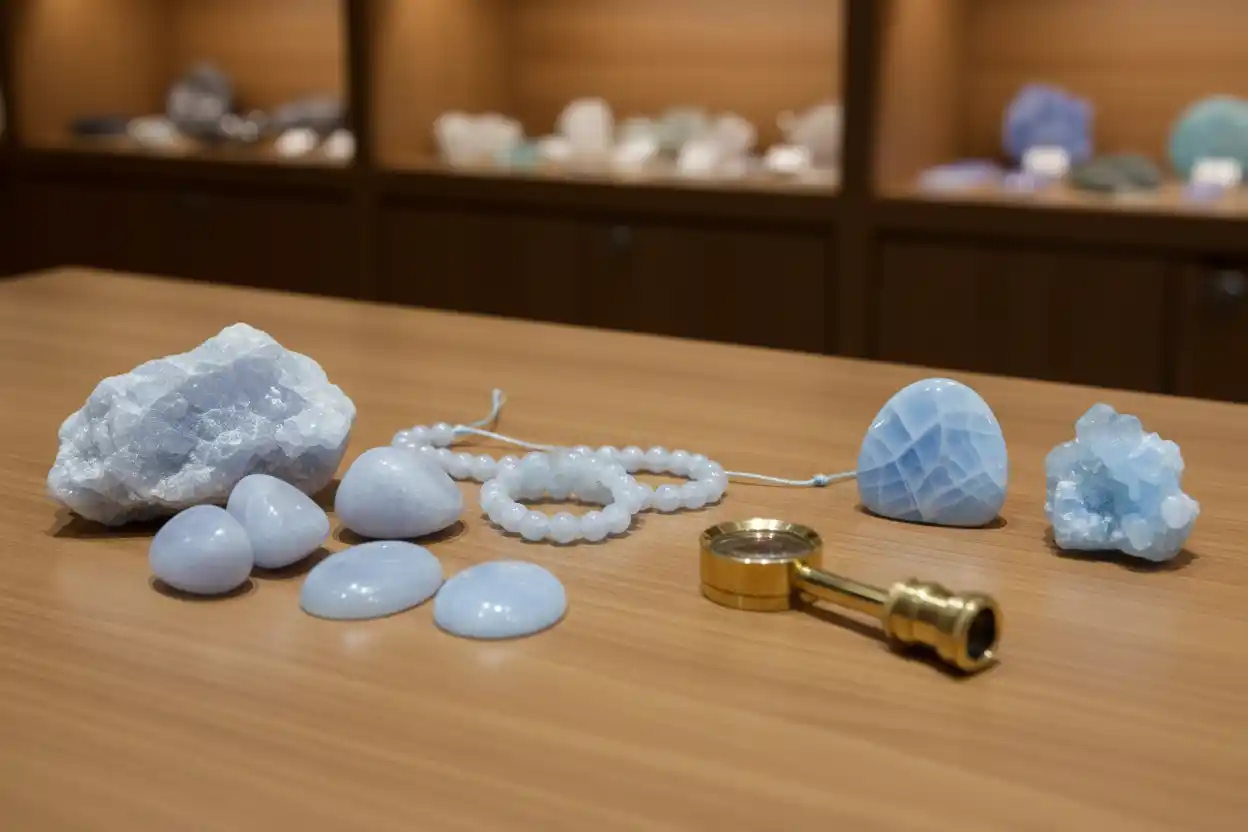
Where to Buy Real Angelite (and Avoid Fakes)
Real Angelite is usually sold through mineral specialists, established crystal shops, lapidary suppliers, bead dealers and independent jewelry makers. The material is a pale blue-gray, fine-grained form of Anhydrite associated especially with Peru rather than a separate mineral species.
Angelite is relatively soft, brittle and cleavage-prone. Therefore, a trustworthy seller should describe not only color and spiritual symbolism but also chips, cracks, coatings, repairs and the care limitations of Anhydrite.
The main buying risks are inaccurate identification, dyed substitutes, resin, glass and confusion with Blue Calcite, Celestite, Blue Lace Agate or other pale blue materials. A bright blue color alone does not prove that a stone is Angelite.
Angelite Buying Options at a Glance
| Buying source | Best for | Main caution |
|---|---|---|
| Specialist mineral dealer | Confirmed Anhydrite specimens and locality information | Fine crystal specimens may not resemble commercial Angelite |
| Established crystal shop | Tumbled stones, palm stones and beginner purchases | Metaphysical labels may replace mineral disclosure |
| Lapidary supplier | Rough, slabs, cabochons and carving material | Fractures and cleavage reduce usable yield |
| Gem and mineral show | Comparing Angelite with similar blue minerals | Temporary sellers may lack return support |
| Bead supplier | Matched strands and calibrated shapes | Dyed stone and mixed materials may be underdisclosed |
| Independent jewelry maker | Pendants, earrings and protected settings | Soft Angelite is unsuitable for many exposed designs |
| Online mineral dealer | Exact specimens and documented inventory | Shipping damage is a significant concern |
| General marketplace | Low prices and broad selection | Incorrect names and edited color are common |
| Social-media seller | One-of-a-kind pieces and live inspection | Limited policies and pressure to buy quickly |
| Estate seller | Older beads and carvings | Angelite trade terminology may be uncertain |
What Is Real Angelite?
Angelite is a trade name applied to pale blue-gray, fine-grained Anhydrite used as an ornamental stone.
Anhydrite is calcium sulfate with the formula CaSO₄. It differs from Gypsum because it lacks water in its crystal structure.
Commercial Angelite is usually opaque to semitranslucent and may show pale blue, gray-blue, white or slightly violet areas.
The completed Angelite meaning guide owns the commercial material’s history and symbolism. The completed Anhydrite guide explains the parent mineral and broader range of crystal habits and colors.
The Best Place to Buy Angelite Rough
A lapidary or mineral supplier familiar with Anhydrite is preferable to a seller who identifies material solely through color.
Rough Angelite may be sold as blocks, broken chunks, slabs or partly polished pieces.
Ask whether the material is Peruvian blue Anhydrite, whether it has been stabilized and whether the visible cracks are structural or superficial.
Dry photographs are essential. Water can deepen the blue temporarily and hide chalky surfaces.
The rough should be priced with substantial allowance for cleavage and cutting loss.
Buying Angelite at a Gem Show
A show allows direct comparison with Blue Calcite, Celestite, Sodalite and other blue minerals.
Angelite generally has a fine-grained, softly opaque appearance rather than the transparent crystals associated with many Celestite specimens.
Handle the material over a padded table because a drop can chip it.
Ask the seller to write “Angelite—blue Anhydrite” on the receipt. That wording preserves the connection between the trade name and mineral identity.
For locality claims, retain the original dealer label.
Buying Angelite From a Crystal Shop
A good crystal shop should identify Angelite as Anhydrite and explain its physical care.
Be cautious when staff claim the stone is water safe, extremely durable or appropriate for every form of jewelry.
The shop should permit inspection for chips, fillers and surface coatings.
Spiritual descriptions can accompany a mineral label, but they should not replace it.
A seller who describes the piece only as an angel communication stone without naming Anhydrite provides insufficient buying information.
Buying Tumbled Angelite
Tumbled stones are one of the most common commercial forms.
A good piece has a smooth surface appropriate to the soft material, although minor natural texture may remain.
Inspect for white bruising, flaking edges, open cracks and thick wax.
Very glossy material may be coated or impregnated. Treatment is not automatically unacceptable, but it should be disclosed.
Tumbled pieces should not be sold as natural single crystals when they are fine-grained massive Anhydrite.
Buying Angelite Palm Stones
Palm stones are larger flattened polished pieces.
Their broad surfaces make color and fracture patterns easy to inspect.
Check the perimeter carefully because thin edges chip first.
A palm stone should feel comfortable without sharp cleavage steps or repaired corners.
Larger size creates more weight and greater breakage risk during shipping.
Ask the seller to show both faces and the complete edge before ordering.
Buying Angelite Beads
Beads may be round, faceted, barrel-shaped or irregular.
Drilling a soft cleavage-prone material can create cracks around the openings.
Inspect every visible hole for white stress marks, chips and filler.
A strand should have reasonably consistent color and polish. Natural variation is acceptable, but mixed Blue Calcite, dyed Howlite or glass should not be included without disclosure.
Elastic bracelets place stress on drill holes, so strong cord and sensible bead size matter.
Buying Angelite Cabochons
Angelite cabochons are generally opaque and cut with low or moderate domes.
The back should remain flat and structurally sound.
A protective bezel is preferable to exposed prongs, particularly for rings and bracelets.
Inspect whether white patches are natural variation, bruising or fresh chips.
The polish should not depend on a thick coating.
Ask for millimeter dimensions because weight gives limited information about visible size and thickness.
Buying Angelite Jewelry
Angelite works best in pendants and earrings where it avoids repeated impact.
Bracelets and rings are more vulnerable because the stone is soft and brittle.
A full bezel or strong metal frame should protect the edges.
Drilled pendants need enough material around the hole, while bead jewelry requires smooth spacers and reliable stringing.
The maker should explain whether glue, backing or stabilization was used.
A jewelry listing should never imply that Angelite has the durability of Quartz, Sapphire or Topaz.
Buying Angelite Online
An online listing should show the exact item when size, fractures and pattern matter.
Request front, back, edge and scale photographs. For beads, ask for close-ups of drill holes.
Color should appear under neutral light. Heavy editing can turn gray-blue material into an intense artificial sky blue.
Descriptions should identify the mineral as Anhydrite and state the country only when the supply chain supports it.
Save the listing and seller claims before ordering.
Marketplace Warning Signs
Be cautious with extremely saturated blue products that look identical across hundreds of listings.
Angelite is usually soft, pastel and somewhat muted. Intense cobalt, neon or translucent aqua material may be another mineral, dyed stone, glass or edited photography.
Claims that the stone is completely waterproof or suitable for daily impact-heavy rings contradict its physical properties.
Generic descriptions copied across Celestite, Calcite and Angelite listings suggest weak identification practices.
“AAA Angelite” is not a standardized gemological grade.
What a Good Angelite Listing Includes
A useful listing should state Angelite or blue Anhydrite, dimensions, weight, product form and known locality.
It should disclose coating, stabilization, repair and backing.
Photographs should show chips and cracks clearly.
For jewelry, the seller should identify the metal, attachment and setting.
For beads, the listing should state whether the strand contains one material and whether the color is natural.
A return policy should allow condition verification unless the item was custom made or altered.
Angelite Versus Blue Calcite
Blue Calcite is calcium carbonate rather than calcium sulfate.
Both materials can be pale, opaque and softly blue.
Calcite commonly shows rhombohedral cleavage and reacts with appropriate acids during professional testing. Angelite has a different cleavage system and chemistry.
Color and touch alone cannot separate every polished piece.
Do not perform an acid test on finished jewelry or a valued specimen.
Angelite Versus Celestite
Celestite is strontium sulfate.
Commercial Celestite commonly forms pale blue transparent-to-translucent crystals in geodes or clusters. Angelite usually appears as massive fine-grained blue Anhydrite.
Polished Celestite and Angelite can overlap visually.
Density, crystal habit, cleavage, refractive properties and spectroscopy separate them.
A seller should not use Celestite, Celestine and Angelite as interchangeable names.
Angelite Versus Blue Lace Agate
Blue Lace Agate is banded blue Chalcedony.
It is substantially harder than Angelite and commonly shows white or darker lace-like bands.
Angelite is generally more uniform, softer looking and lacks characteristic Agate banding.
Dyed Chalcedony can imitate almost any blue shade.
The material should be identified through structure and properties rather than color alone.
Angelite Versus Sodalite
Sodalite usually shows a stronger blue body with white Calcite veins.
Angelite tends to be paler and more uniform.
Some low-saturation Sodalite can resemble Angelite, while dyed materials complicate visual identification.
Sodalite has different hardness, density and optical behavior.
A white-veined blue stone should not be called Angelite solely because the seller associates both with communication symbolism.
Angelite Versus Dyed Howlite or Magnesite
Howlite and Magnesite are pale porous minerals that accept dye readily.
Dyed blue material may show dark color concentrated in veins and drill holes.
A chipped section can reveal a white interior.
Angelite can contain pale areas, so one white spot is not enough to prove an imitation.
Professional Raman or infrared analysis offers a safer answer than scratch, heat or solvent tests.
Glass and Resin Imitations
Glass may show round bubbles, flow lines and mold seams.
Resin can be cast into polished shapes and colored pale blue. It may contain bubbles or appear unusually uniform.
Composite products may contain powdered stone held in resin.
These materials can be decorative when labeled accurately.
They should not be described as natural Peruvian Angelite.
Is Angelite Commonly Dyed?
Natural Angelite already has a marketable pale blue color, so dye is not required for every commercial piece.
However, substitutes can be dyed to imitate it, and weak material may be coated or stabilized.
Color concentrated in cracks or drill holes deserves closer inspection.
Very intense surface color combined with a pale chip can indicate treatment.
The seller should state whether the color is natural rather than relying only on the phrase natural stone.
Stabilized and Coated Angelite
Polymer or resin may strengthen weak, porous or fractured material.
Wax can improve luster and deepen color.
A stabilized piece can be more practical for beads and carvings, but the treatment changes care and value.
Coatings may wear at edges and scratches.
The invoice should distinguish untreated Angelite from stabilized or coated products.
High repair heat and solvents can damage fillers and surface finishes.
Peruvian Origin Claims
Angelite is strongly associated commercially with Peru.
That does not mean every pale blue Anhydrite specimen must come from one mine or that every seller has documented locality.
A credible listing should state the region or supplier chain when known.
Appearance cannot prove Peruvian origin.
A label from an established mineral dealer provides stronger support than a marketplace title using Peru as a quality adjective.
Evaluating Color
Typical commercial Angelite is pale blue, gray-blue or slightly violet-blue.
Some pieces include white, gray or colorless areas.
The color should look convincing under daylight-equivalent and ordinary indoor light.
A stone that appears vivid only in edited photographs may look much grayer in person.
Natural variation is not a defect, but muddy brown staining or extensive chalkiness may reduce appeal.
Evaluating Surface and Polish
Angelite cannot usually achieve the same durable glassy polish as Quartz.
A soft satin or moderate luster can be appropriate.
Inspect for flaking, cleavage steps, pits and wax buildup.
Fresh white marks along edges may indicate impact.
A thick glossy coating can conceal weak surface condition.
Examine the item dry and from several angles.
Evaluating Fractures
Open cracks matter because Anhydrite is brittle and cleavage-prone.
A fracture passing through the center of a palm stone or cabochon can expand after a drop.
Drill-hole fractures are particularly important in beads and pendants.
Ask whether any crack was filled or repaired.
Decorative inclusions should not be used to excuse obvious structural weakness.
Angelite Price and Value
Angelite is generally affordable.
Prices increase with size, even color, smooth finishing, unusual natural formations, locality documentation and skilled jewelry construction.
Large pieces should not receive high premiums when heavily fractured or coated.
Commercial metaphysical labels do not create mineral rarity.
Collector-grade Anhydrite crystals occupy a different market from tumbled Angelite palm stones.
Seller Questions to Ask
Ask whether the material is blue Anhydrite, whether its color is natural and whether it has been coated, waxed, stabilized or repaired.
For beads, ask about drill-hole fractures and material consistency.
For specimens, ask for locality and matrix information.
For jewelry, ask whether the stone is backed or glued and whether the setting protects its edges.
A seller should acknowledge uncertainty rather than guaranteeing unsupported mine origin.
Shipping and Packaging
Angelite requires careful packaging.
Each piece should be wrapped separately so it cannot strike another stone.
Large palm stones and specimens need padding on all sides and no empty space inside the parcel.
Bead strands should not be packed beneath heavy rough.
Photograph shipping damage immediately and retain the packaging.
Review the seller’s claims process before ordering a large or fragile item.
Water and Cleaning Concerns
Angelite should not be soaked.
Anhydrite can alter through prolonged interaction with water, and commercial items may also contain coatings, fillers, glue, cord or metal that react poorly.
Wipe the stone with a dry or barely damp soft cloth and dry it immediately.
The guide to which crystals can go in water provides broader safety context.
Avoid steam, ultrasonic cleaning, saltwater and chemical cleaners.
Sunlight and Storage
Prolonged intense light and heat are unnecessary, particularly when treatment history is unknown.
Keep Angelite in a padded compartment away from Quartz, Topaz, Sapphire and Diamond.
Its hardness of about 3–3.5 means many common jewelry materials can scratch it.
The gemstone hardness chart and gemstone toughness-versus-hardness guide explain its limitations.
The guide to crystals that fade in sunlight provides broader light-care considerations.
Spiritual Marketing Claims
Angelite is associated in modern crystal traditions with communication, peace, spiritual reflection and symbolic angel connections.
These beliefs cannot authenticate a stone and should not justify an excessive price.
The completed how to cleanse and charge Angelite guide owns spiritual care, while the completed crystals for communication guide and drafted throat chakra guide provide broader symbolic context.
The crystals for anxiety guide discusses calming rituals without presenting crystals as medical treatment.
Final Buying Perspective
The strongest Angelite seller identifies the material as blue Anhydrite, photographs its true pastel color and discusses its softness honestly.
Choose mineral dealers for documented specimens, lapidary suppliers for rough and cabochons, established bead sellers for strands and careful artists for protected pendants or earrings.
Avoid sellers who promise extreme durability, conceal chips or treat Celestite, Calcite and Angelite as the same mineral.
Angelite also appears in the blue crystals guide, blue gemstones guide, crystals beginning with A and gemstones beginning with A.
Frequently Asked Questions
1. Where is the best place to buy real Angelite?
Specialist mineral dealers, established rock shops, gem shows and reputable lapidary or bead suppliers provide the strongest options.
2. What mineral is Angelite?
Angelite is a trade name for pale blue-gray fine-grained Anhydrite, a calcium sulfate mineral.
3. Does all Angelite come from Peru?
The trade material is strongly associated with Peru, but a seller should support any specific locality claim rather than relying on appearance.
4. Is Angelite the same as Celestite?
No. Angelite is Anhydrite, while Celestite is strontium sulfate.
5. Is Angelite the same as Blue Calcite?
No. Blue Calcite is calcium carbonate and has different physical and chemical properties.
6. Is Angelite commonly fake?
Substitutes, dyed stones, glass and resin occur, although genuine commercial Angelite is also widely available.
7. What color should real Angelite be?
Typical material is pale blue, gray-blue or slightly violet-blue, often with white or gray variation.
8. Should Angelite be highly glossy?
It can accept a smooth polish, but an unusually plastic-like gloss may indicate wax, coating or resin.
9. Is Angelite suitable for rings?
It is generally better for protected pendants, earrings and occasional jewelry because it is soft, brittle and cleavage-prone.
10. Can Angelite go in water?
Soaking is not recommended. Use minimal moisture and dry the stone immediately.
11. Do I need a laboratory report?
Usually not for ordinary commercial pieces. Testing becomes useful when identity, unusual treatment or a high-value locality claim affects price.
12. What should a seller disclose?
The seller should identify blue Anhydrite, dimensions, locality evidence, chips, repairs, coating, stabilization, backing and whether photographs show the exact item.