11 Amazonite Benefits: Blue-Green Beauty, Feldspar Geology & Practical Uses
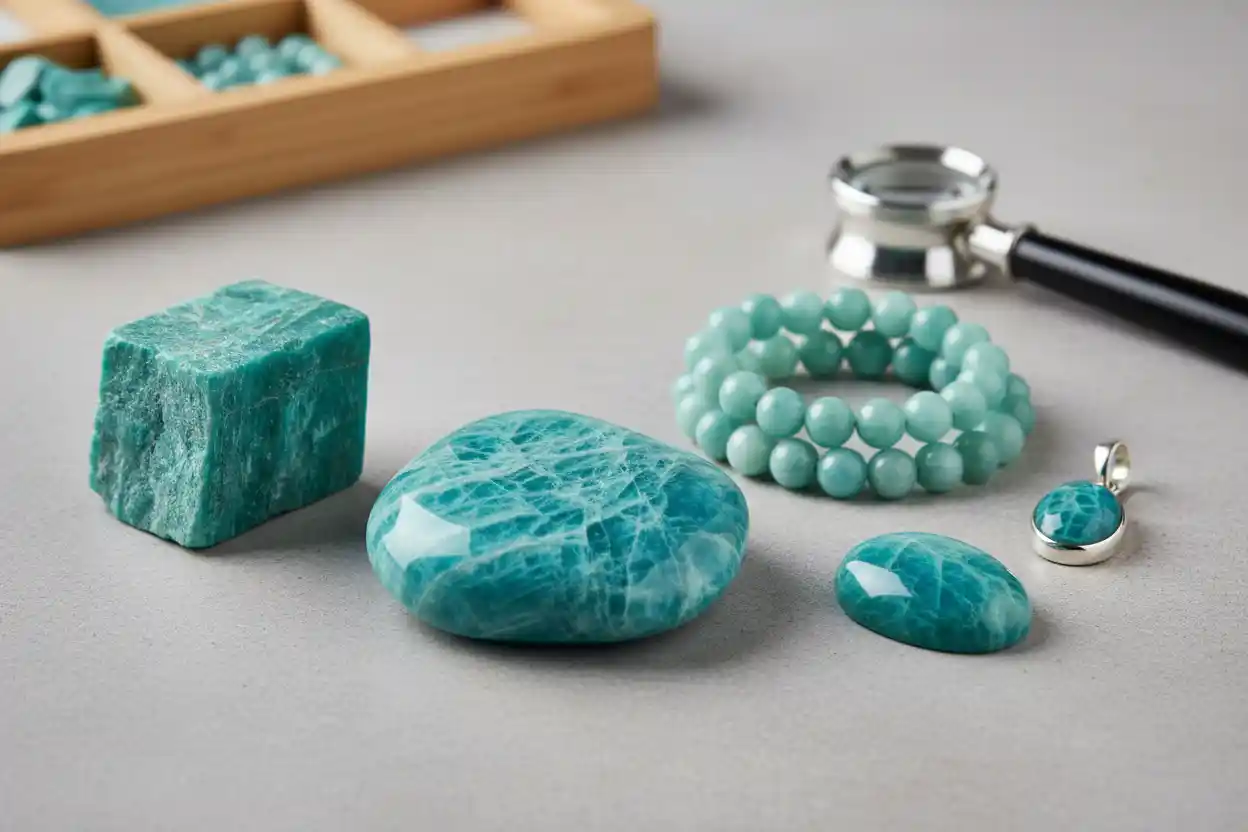
Amazonite benefits begin with its distinctive blue-green to greenish-blue color, attractive white patterning, usefulness in jewelry and carving, geological interest, and relatively accessible availability compared with many transparent gem varieties. Amazonite is not a separate mineral species. It is a green to blue-green variety of potassium feldspar, most commonly microcline, with the formula KAlSi₃O₈.
Its unusual color was misunderstood for many years. Copper was once suspected because copper commonly creates blue and green colors in minerals, but research links classic amazonite color more closely with trace lead, structural water, irradiation-related defects, and the arrangement of the feldspar structure. White streaks and mottling can come from fine intergrowths with albite, giving many pieces the characteristic appearance collectors recognize immediately.
The strongest amazonite benefits are physical, artistic, geological, historical, and practical rather than medical. The stone works well in cabochons, beads, carvings, polished freeforms, ornamental pieces, mineral collections, and educational displays. Modern symbolism can add personal meaning without turning those beliefs into health claims.
11 Amazonite Benefits for Jewelry, Collecting & Everyday Appreciation
- Blue-green color gives amazonite a distinctive appearance among common feldspars.
- Natural white streaking and mottling make individual pieces visually unique.
- Mohs hardness around 6 to 6.5 provides useful scratch resistance for protected jewelry.
- Amazonite takes an attractive polish for cabochons, beads, carvings, and freeforms.
- Its feldspar structure provides educational value for mineral collectors.
- Large crystals from pegmatites can create impressive display specimens.
- Geographic variety allows collectors to compare specimens from several important localities.
- Amazonite is generally more accessible than many fine transparent green or blue gems.
- Ancient ornamental use adds historical interest without requiring invented spiritual traditions.
- Identification teaches useful lessons about feldspar cleavage, perthite, color, and imitation.
- Modern symbolism can support personal reflection while remaining separate from medical treatment.
Amazonite Benefits Begin With Its Distinctive Blue-Green Feldspar Color
Color is the first of the obvious amazonite benefits. The stone can range from pale green and turquoise-like blue-green to stronger saturated greenish blue. Many pieces contain white streaks, irregular patches, or grid-like patterns associated with feldspar intergrowths.
Amazonite belongs mainly to microcline, a potassium-rich feldspar in the triclinic crystal system. Its color does not require copper, despite the resemblance to turquoise and some copper minerals. Trace lead combined with structural characteristics, water-related features, and naturally occurring irradiation plays an important role in classic amazonite coloration.
This unusual color mechanism adds scientific interest to the gem. A polished piece may look simple from a distance, yet its appearance records both its chemistry and structural history.
The blue-green color also gives amazonite design flexibility. It can resemble soft ocean tones, deeper teal, or pale mint depending on the specimen, allowing jewelers to use it with silver-colored or warm-colored metals.
Natural Patterning Makes Each Amazonite Piece Different
Another of the practical amazonite benefits is visual variation. Commercial pieces rarely look perfectly uniform. White albite-rich streaks, perthitic intergrowths, variations in saturation, cleavage features, and changing crystal texture create patterns from one specimen to another.
Some buyers prefer relatively uniform blue-green cabochons, while collectors may appreciate visible white intergrowths that reveal more of the feldspar’s structure. Neither appearance is automatically superior because purpose matters. A jewelry designer may prioritize saturated color, while a mineral collector may value crystal form, locality, and associated minerals.
The natural variation also helps prevent the stone from looking mechanically identical across every bead or carving. Matching several pieces closely requires selection, while deliberately mixed pieces can emphasize the geological character.
These amazonite benefits make the stone suitable for both polished decorative work and specimens intended to show natural mineral structure.
Amazonite Benefits for Jewelry Come With Real Durability Limits
Amazonite generally ranks about 6 to 6.5 on the Mohs scale, offering moderate resistance to scratching. That makes it suitable for pendants, earrings, beads, brooches, bracelets, and protected rings.
Hardness is not the complete durability story. Microcline has good cleavage in two directions close to right angles, so strong impacts can split or chip the stone even when its polished surface has resisted ordinary scratches. Rings deserve more protection than earrings or pendants because hands encounter hard surfaces frequently.
Amazonite should also be stored away from harder gems such as quartz, topaz, sapphire, and diamond, which can scratch it. Soft pouches or divided jewelry compartments reduce direct rubbing.
Among amazonite benefits, jewelry versatility is therefore genuine, but the stone performs best when designers and owners respect feldspar cleavage rather than treating Mohs 6 to 6.5 as proof that it cannot break.
Amazonite Takes a Smooth Polish for Cabochons, Beads & Carvings
Lapidary versatility adds another layer to amazonite benefits. The opaque to translucent stone usually works better as a cabochon, bead, carving, tablet, sphere, or polished freeform than as a conventional transparent faceted gem.
Polishing brings out its blue-green color and white patterning. Large pieces can become decorative objects, while smaller rough can produce beads or fitted inlays. The lack of a need for high transparency means attractive color and pattern can remain valuable even when the stone contains internal structural features.
Cutters still need to pay attention to cleavage. Orientation matters, especially when creating thin pieces or shapes with narrow projections. Strong pressure in an unfavorable direction can separate the stone along a cleavage plane.
Dry grinding should also be avoided because feldspar cutting produces mineral dust. Wet lapidary methods, effective ventilation, eye protection, good housekeeping, and appropriate respiratory precautions make cutting safer.
Amazonite Benefits Mineral Collectors Because It Reveals Feldspar Geology
Amazonite is valuable educationally because feldspars are among the most important rock-forming minerals in Earth’s crust. Collecting amazonite therefore connects gemstone interest with fundamental geology.
Many notable crystals form in granitic pegmatites, where slow cooling and late-stage fluids can allow unusually large crystals to develop. Amazonite may occur with quartz, mica, beryl, albite, smoky quartz, and other minerals depending on locality.
The combination can create spectacular mineral specimens. Colorado is especially known for associations between blue-green amazonite and dark smoky quartz, while Russia, Madagascar, Virginia, Brazil, Ethiopia, Namibia, and other regions have produced notable amazonite.
These geological amazonite benefits make labeled natural specimens particularly rewarding. Locality information tells a richer story than a polished stone identified only by color.
Large Amazonite Crystals Can Create Impressive Display Specimens
Amazonite occurs in pieces large enough to create striking natural displays. Well-formed feldspar crystals can preserve cleavage faces, crystal form, associated minerals, and variations in color that polished jewelry removes.
Display specimens often appeal to collectors for different reasons from finished gems. Damage, repairs, crystal terminations, matrix relationships, locality, size, saturation, and mineral associations can matter more than uniform polish.
Large amazonite specimens also reveal that the gem is part of a geological environment rather than simply a decorative blue-green stone. Smoky quartz, albite, mica, or other associated minerals may remain attached, providing evidence of the pegmatite in which the crystals formed.
This is one of the amazonite benefits that disappears when every specimen is evaluated only through jewelry standards.
Amazonite Offers Attractive Color at Relatively Accessible Prices
Compared with rare transparent emerald, Paraíba-type tourmaline, fine turquoise, or other coveted blue-green gems, common amazonite can offer substantial visual impact at more accessible prices.
Large polished pieces, beads, palm stones, and ordinary specimens can often be obtained without the premiums attached to fine transparent precious gems. Exceptional crystals, famous localities, strong color, collector-grade associations, historical specimens, or unusually fine lapidary work can still command higher prices.
Accessibility is useful for beginners because someone can study natural feldspar color, cleavage, intergrowths, and polishing without needing a large gem budget.
The price advantage should not encourage careless buying. Artificially colored stone, glass, mislabeled feldspar, or exaggerated locality claims can still occur. Knowing real vs fake amazonite helps distinguish genuine feldspar from lookalikes and misleading trade descriptions.
Ancient Use Adds Historical Interest, but the Modern Name Came Later
Amazonite has been used ornamentally for a very long time, including green feldspar objects associated with ancient Egypt and other early cultures. Beads, amulets, inlays, and carved objects demonstrate that people valued attractive green feldspar long before modern mineral classification existed.
However, the name amazonite is much younger. It developed from the term Amazon stone and became linked with the Amazon River even though confirmed amazonite deposits are not known from the river itself. Early green stones reported from that region may have been something else.
This mismatch is an interesting historical feature rather than a defect. The modern name should not be projected backward into ancient Egypt as though ancient craftspeople called the stone amazonite or used today’s metaphysical descriptions.
Historical accuracy adds another of the genuine amazonite benefits: the stone connects ancient ornament with the later development of mineralogy and gemstone naming.
Identification Makes Amazonite an Excellent Learning Stone
Amazonite can resemble turquoise, dyed chalcedony, green quartz, jade-like stones, glass, and other blue-green substances at first glance. Learning the differences strengthens basic identification skills.
Microcline usually falls around Mohs 6 to 6.5 and has two strong cleavage directions. Many pieces show whitish feldspar intergrowths and characteristic mottling. Professional testing can use refractive index, specific gravity, microscopy, spectroscopy, and structural methods when visual evidence is insufficient.
Color alone should never establish identity. The same principle applies to locality. A bright blue-green stone is not automatically Colorado amazonite merely because the seller uses that location in a description.
When deciding where to buy amazonite, accurate identification, honest origin information, good photographs, treatment disclosure, and realistic descriptions matter more than metaphysical promises.
Amazonite Care Is Simple When Feldspar Cleavage Is Respected
Gentle cleaning protects both color and structure. Warm water, mild soap, and a soft cloth or brush work for many intact amazonite pieces. Rinse away residue and dry the stone carefully.
Avoid steam and ultrasonic cleaning when fractures, inclusions, glued components, or unknown treatments are present. Sudden heat changes are unnecessary, and harsh chemicals should remain away from finished jewelry.
Store amazonite separately from harder gemstones. Avoid dropping carved pieces or rings onto hard floors because cleavage can turn one impact into a significant fracture.
These straightforward care habits preserve the practical amazonite benefits without requiring elaborate cleansing routines.
Modern Symbolism Can Add Personal Value Without Medical Claims
Contemporary crystal traditions commonly associate amazonite with communication, boundaries, calmness, confidence, truth, hope, and emotional balance. Its blue-green color naturally encourages water, sky, and tranquility symbolism.
Those interpretations can add personal meaning. Someone may keep an amazonite stone near a notebook as a reminder to communicate clearly or wear a pendant before a difficult conversation because the association feels useful.
Modern amazonite healing properties should still be separated from proven health effects. Amazonite has not been established as a treatment for anxiety disorders, thyroid disease, hormonal conditions, trauma, pain, heart problems, or other medical conditions.
The stone already offers enough real value through mineralogy, design, history, collecting, and craftsmanship.
Conclusion
Amazonite benefits include distinctive blue-green color, natural feldspar patterning, useful jewelry durability, lapidary versatility, geological interest, collectible crystals, historical ornament, accessible examples, educational identification, and modern personal symbolism.
Its value becomes clearer when amazonite is understood as microcline feldspar rather than a mysterious separate mineral. Good care, accurate identification, locality information, and realistic expectations make the stone more rewarding to own.
FAQs
What Are the Main Amazonite Benefits?
Amazonite benefits include blue-green beauty, useful jewelry durability, excellent polish, collectible crystal forms, geological interest, historical ornament, accessible pricing, and personal symbolism.
What Mineral Is Amazonite?
Amazonite is a green to blue-green variety of potassium feldspar, usually microcline, with the formula KAlSi₃O₈.
What Causes Amazonite’s Blue-Green Color?
Classic amazonite coloration is linked mainly with trace lead, structural water, irradiation-related defects, and feldspar structure rather than copper.
Is Amazonite Durable for Jewelry?
Amazonite ranks about 6 to 6.5 on the Mohs scale, but feldspar cleavage means strong impacts should be avoided. Pendants and earrings generally receive less abuse than rings.
Is Amazonite Really From the Amazon River?
The name is associated with the Amazon River, but confirmed amazonite deposits are not known there. The historical name probably developed from confusion involving other green stones.
Is Amazonite Expensive?
Common amazonite is generally accessible compared with many rare transparent gems. Exceptional crystals, famous localities, vivid color, or fine craftsmanship can raise value substantially.
Can Amazonite Be Carved?
Yes. Amazonite takes a good polish and is commonly fashioned into cabochons, beads, carvings, spheres, freeforms, and decorative objects.
How Should Amazonite Be Cleaned?
Warm water, mild soap, and gentle cleaning are appropriate for many intact pieces. Avoid harsh chemicals, strong heat, impacts, and unnecessarily aggressive cleaning.
Does Amazonite Have Healing Benefits?
Amazonite carries modern wellness and spiritual associations, but those beliefs have not been established as medical effects.
Is Amazonite Safe to Handle?
Ordinary intact finished amazonite can be handled normally. Cutting and grinding should use proper dust controls because lapidary work creates fine mineral particles.
Why Do Collectors Like Amazonite?
Collectors value its unusual color, feldspar structure, large pegmatite crystals, associated minerals, locality differences, and striking combinations such as amazonite with smoky quartz.
Symbolic amazonite benefits are personal wellness beliefs and should not replace qualified medical or mental health care.