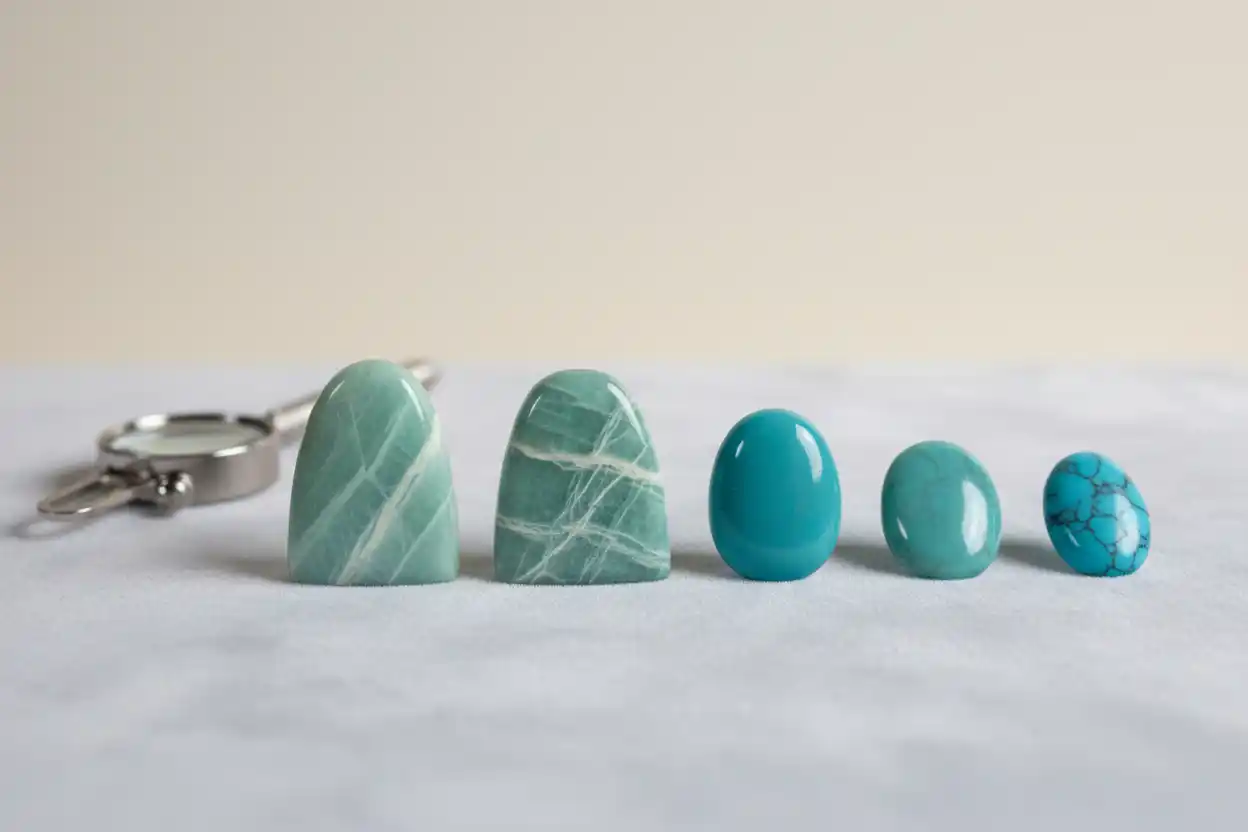
Real vs Fake Amazonite: 7 Key Differences to Identify Genuine Crystals
Real vs fake amazonite identification begins with understanding what amazonite actually is. Genuine amazonite is a green to blue-green variety of potassium feldspar, usually microcline. It is not turquoise, quartz, jade, dyed howlite, plastic, or glass, even though some substitutes can imitate its color convincingly.
Amazonite is commonly represented by the feldspar formula KAlSi₃O₈. Mindat describes it as a blue-green to green variety of K-feldspar, usually microcline, and reports that its characteristic coloration is generally associated with lead-related color centers, although iron may influence some specimens. GIA also identifies microcline as the potassium feldspar species that includes the gem variety amazonite.
The difficulty is that real amazonite varies significantly. Some specimens are intensely blue-green, others are pale green or turquoise-colored, and many contain white streaking, perthitic intergrowths, fractures, or uneven color. A perfect-looking stone is not automatically fake, while a heavily patterned one is not automatically genuine. Several observations should agree before making a confident identification.
7 Real vs Fake Amazonite Differences at a Glance
- Genuine amazonite shows feldspar structure rather than molded texture.
- Natural color usually varies subtly through the stone.
- White streaking can support identity but is not mandatory.
- Microcline hardness is around 6 to 6.5.
- Cleavage differs from glassy conchoidal fracture.
- Magnification can reveal natural feldspar features.
- Professional testing is best for valuable or uncertain specimens.
What Genuine Amazonite Actually Is
Amazonite belongs to the potassium feldspar branch of one of the most important rock-forming mineral groups.
Microcline has the same idealized chemical composition as orthoclase, KAlSi₃O₈, but differs in crystal ordering and symmetry. Amazonite is most commonly blue-green microcline, although the name has occasionally been applied to similarly colored orthoclase.
Mindat gives microcline a Mohs hardness of approximately 6 to 6.5, measured density around 2.54 to 2.57 g/cm³, perfect cleavage on one direction and good cleavage on another, with vitreous luster and a pearly appearance along cleavage surfaces.
| Identification Feature | Genuine Amazonite | Common Imitation Warning |
|---|---|---|
| Mineral identity | K-feldspar, usually microcline | Glass, plastic, resin, or another stone |
| Color | Green to blue-green | Artificially uniform or painted appearance |
| Hardness | About 6 to 6.5 | Plastic usually much softer |
| Cleavage | Strong feldspar cleavage | Glass usually lacks feldspar cleavage |
| Luster | Vitreous, pearly on cleavage | Plastic may look waxy or molded |
| Density | Roughly 2.54 to 2.57 | Depends on imitation |
| Internal texture | Natural feldspar features possible | Bubbles or manufacturing features possible |
| Final confirmation | Gemological testing | Visual resemblance alone is insufficient |
These are screening characteristics rather than absolute home rules. A sophisticated imitation may reproduce color and pattern well enough that instruments become necessary.
1. Look for Natural Feldspar Structure, Not Just Blue-Green Color
Color is the easiest amazonite feature to imitate.
Genuine amazonite can range from pale bluish green through saturated turquoise-green to deeper green. The surface may show cloudy regions, white streaks, cleavage reflections, irregular internal structure, or intergrowth patterns.
A uniform color does not automatically prove fake, but a stone that looks like colored plastic deserves closer examination.
Natural rough should show mineral structure rather than a molded exterior. Polished cabochons can hide much of that evidence, so edges, drill holes, backs, and less-polished areas are particularly useful.
The visual appearance should make sense as feldspar.
A bright turquoise color alone proves almost nothing.
2. White Streaks Can Be Helpful but Are Not a Universal Rule
Many amazonite specimens show white lines, patches, or fine streaking produced by feldspar intergrowths and related mineral textures.
These features can support identification because they are common in natural amazonite.
However, the internet often turns a useful clue into an absolute rule.
Not every genuine amazonite must have dramatic white striping, and artificial products can be manufactured with white patterns.
The pattern is more convincing when it behaves like a natural mineral intergrowth, passes through the stone, changes irregularly, and interacts naturally with cleavage and crystal structure.
Painted or printed stripes restricted to the surface should immediately raise suspicion.
3. Amazonite Color Is More Complex Than a Simple Dye Test
The cause of amazonite’s blue-green color has been studied extensively.
GIA research has connected the color with lead, structurally bound water, and irradiation-related color-center processes in potassium feldspar. Mindat likewise reports that elevated lead content is commonly involved, while some green microcline may have an iron-related contribution.
This matters because genuine amazonite can naturally display colors vivid enough to look treated.
Strong blue-green color is therefore not proof of dye.
Treatments do exist. GIA has examined unusually translucent blue amazonite that was impregnated with resin, demonstrating that genuine amazonite itself can be enhanced rather than replaced by an imitation.
That creates three distinct categories: natural untreated amazonite, treated natural amazonite, and imitation amazonite.
They should not be confused.
4. Hardness Can Expose Some Imitations, but Do Not Scratch Jewelry
Microcline has Mohs hardness around 6 to 6.5.
This means genuine amazonite is considerably harder than ordinary plastic and many soft substitutes.
Still, scratching a polished cabochon, bead, or carving is poor practice.
A destructive test may permanently damage a genuine stone while providing only limited information. Surface coatings, weathered zones, and different testing pressures can also confuse untrained users.
Hardness is best used as a professional supporting property rather than a home challenge involving knives or steel tools.
If an alleged amazonite bead develops deep scratches extremely easily during normal handling, that may justify further investigation, but it should not be the only evidence.
5. Cleavage Is One of Amazonite’s Most Important Physical Clues
Feldspar has characteristic cleavage.
Mindat describes microcline as having perfect cleavage on one plane and good cleavage on another.
This means rough amazonite can show relatively flat break surfaces and reflective cleavage planes rather than breaking entirely like glass.
Glass generally develops conchoidal fracture without feldspar’s characteristic cleavage.
The difference is useful in rough specimens, broken beads, chipped carvings, and unpolished edges.
It becomes less obvious in fully polished pieces where all surfaces have been deliberately shaped.
A buyer should never intentionally break jewelry to look for cleavage.
Use natural chips or exposed rough areas instead.
6. Magnification Can Reveal Bubbles, Mold Features, and Natural Texture
A 10x loupe is one of the safest tools for real vs fake amazonite inspection.
Glass imitations may show rounded gas bubbles or flow structures. Plastic and resin may display mold seams, surface softness, artificial swirls, or polishing behavior unlike feldspar.
Genuine amazonite may show cleavage-related features, fractures, mineral intergrowths, white feldspar areas, or natural structural variations.
None of these clues should be interpreted alone.
A rounded pit on the surface is not necessarily a gas bubble, and a clean transparent-looking area does not automatically prove glass.
Rotate the piece under good illumination and determine whether the feature is internal, surface-reaching, or simply a reflection.
7. Professional Identification Is the Best Final Test
For inexpensive amazonite beads or tumbled stones, a professional laboratory report may not be financially sensible.
For a valuable carving, unusually transparent specimen, exceptional collector crystal, or expensive piece represented as untreated amazonite from a notable locality, proper testing becomes more reasonable.
Gemologists can examine refractive behavior, density, microscopic structure, optical properties, spectroscopy, and treatment indicators.
The same principle applies to general crystal authenticity: visual clues narrow the possibilities, while instruments provide stronger identification.
No spiritual reaction, seller story, or smartphone image can replace mineral testing when certainty matters.
Amazonite Is Not Turquoise
Amazonite and turquoise can overlap visually in blue-green color, especially when both are cut into opaque cabochons or beads.
Their mineral identities are entirely different.
Amazonite is potassium feldspar.
Turquoise is hydrated copper aluminum phosphate.
Amazonite is generally harder, has feldspar cleavage, and commonly shows white feldspar-related texture. Turquoise typically has different density, hardness, structure, porosity, and host-rock matrix characteristics.
A blue-green stone therefore should not be called amazonite based only on color.
Amazonite Is Not Jade
Pale green amazonite can also be confused visually with some inexpensive jade substitutes or jade-like stones.
True jade means jadeite or nephrite, neither of which belongs to the feldspar group.
Their toughness, crystal structure, density, optical characteristics, and fracture behavior differ substantially from amazonite.
This is another reason tactile impressions such as “it feels like jade” have little diagnostic value.
Mineral names describe actual substances, not merely color families.
Can Glass Look Like Real Amazonite?
Yes.
Opaque or translucent glass can be manufactured in blue-green tones, and white streaks or swirls can be added to mimic natural feldspar patterns.
Glass may reveal rounded bubbles, smooth flow features, uniform artificial color, molded shapes, or fracture unlike feldspar cleavage.
However, higher-quality glass imitations can be visually convincing.
Density and refractive measurements become useful when appearance alone is ambiguous.
A convincing fake does not need to look obviously plastic.
Can Genuine Amazonite Be Treated?
Yes.
This distinction matters because treatment does not necessarily make the underlying stone fake.
GIA has reported resin-impregnated amazonite in which the polymer penetrated extensively through unusually translucent blue feldspar.
Impregnation can improve apparent transparency, stability, or appearance.
A seller should disclose significant treatment when known because treated and untreated collector specimens may be valued differently.
Someone purchasing amazonite specifically for natural mineral characteristics should therefore ask about treatment instead of asking only whether the stone is “real.”
Does Lead in Amazonite Make It Fake or Dangerous?
Lead is associated with the natural color mechanism of many amazonites. Mindat reports elevated lead concentrations in some specimens, while GIA research connects lead with amazonite color centers.
Its presence does not make amazonite fake.
At the same time, the existence of lead in the mineral is a sensible reason not to grind amazonite into powder, intentionally ingest it, or use unknown mineral specimens to prepare drinking-water crystal elixirs.
Normal ownership of a polished stone is very different from creating respirable dust or swallowing mineral particles.
Mineralogical facts should guide safe handling rather than exaggerated fear.
Amazonite Benefits and Authenticity Are Separate Questions
A seller may describe amazonite as calming, truthful, soothing, lucky, spiritually protective, or useful for communication.
Those claims do not establish mineral identity.
The beliefs discussed under amazonite benefits and amazonite healing properties belong to crystal traditions and personal symbolism.
A piece of glass can be advertised using identical language.
If authenticity matters, examine physical properties.
Spiritual descriptions are not gemological tests.
Where Buyers Commonly Make Mistakes
One common mistake is assuming that every inexpensive amazonite piece must be fake.
Amazonite is not automatically a high-priced gemstone, so genuine tumbled stones, beads, and cabochons can be affordable.
The opposite assumption is equally risky.
A high price does not guarantee authenticity.
Large carvings may contain lower-grade feldspar, treatments may be undisclosed, or sellers may simply charge premiums based on marketing.
Anyone deciding where to buy amazonite should focus on accurate descriptions, clear photographs, treatment disclosure, return terms, and seller knowledge rather than price alone.
Does Amazonite Always Have the Same Shade?
No.
Natural amazonite can range from pale green through blue-green to richer turquoise-like shades.
Color can vary within a single crystal.
Mindat also notes that light exposure can alter the appearance of some green microcline and that genuine amazonite may show changes in color intensity under certain conditions.
This variation means that rigid online rules such as “real amazonite must be exactly teal” are unreliable.
Mineral identity is determined by more than hue.
Why Rough Amazonite Is Easier to Judge Than Highly Polished Pieces
Polishing removes many obvious mineral surfaces.
A rough amazonite crystal may show cleavage, natural growth form, associated quartz or feldspar, crystal faces, and changes in color across the specimen.
A polished bead may reveal only color and a small drill hole.
That difference explains why collector specimens often provide more visual evidence than jewelry.
For polished stones, a seller’s provenance and the opportunity to examine drill holes, edges, and magnified internal features become more important.
Care Can Preserve Natural Identification Clues
Amazonite is durable enough for pendants, beads, earrings, and many decorative objects, but its feldspar cleavage means strong impacts can chip or split the stone.
Its hardness of approximately 6 to 6.5 also means it can be scratched by harder gems such as quartz, topaz, corundum, and diamond.
Gentle cleaning with lukewarm water, mild soap, and a soft cloth is appropriate for many untreated pieces.
Avoid aggressive chemicals, hard impact, and unnecessary prolonged soaking when treatment status is unknown.
Resin-impregnated stones may require more conservative care than untreated specimens.
Conclusion
Real vs fake amazonite identification depends on recognizing the properties of blue-green potassium feldspar rather than judging color alone. Genuine amazonite typically behaves like microcline in hardness, cleavage, luster, density, and internal structure, while glass, plastic, resin, and other imitations may reveal different physical features.
The strongest approach combines color pattern, magnification, cleavage, realistic hardness expectations, treatment awareness, and seller disclosure. Expensive or unusual specimens deserve professional testing when certainty matters. A genuine stone can still be treated, and a spiritual description can never substitute for mineral identification.
FAQs
What is the easiest way to tell if amazonite is real?
Start by examining whether the stone looks structurally consistent with feldspar. Look for natural color variation, cleavage-related features, white intergrowths, and an absence of obvious bubbles or molded plastic characteristics. No single visual sign proves authenticity.
What mineral is amazonite?
Amazonite is a green to blue-green variety of potassium feldspar, usually microcline, with the idealized formula KAlSi₃O₈.
What is the hardness of real amazonite?
Microcline has Mohs hardness of approximately 6 to 6.5. Destructive scratch testing on finished jewelry is not recommended.
Does real amazonite contain white streaks?
Many genuine specimens do, but white streaks are not mandatory. Natural feldspar intergrowths and structural features vary from one deposit and specimen to another.
Can amazonite be dyed or treated?
Yes. GIA has documented resin-impregnated amazonite, showing that genuine amazonite may be enhanced rather than completely imitated.
Why is amazonite blue-green?
Research links the classic blue-green coloration largely to lead-related color centers involving structural water and irradiation processes within the feldspar.
Is fake amazonite usually glass?
Glass is one possible imitation, but resin, plastic, dyed stones, composites, or other minerals may also be represented incorrectly as amazonite. The exact substitute must be identified rather than assumed.
Disclaimer: Spiritual, emotional, energetic, protective, communication, and healing claims associated with amazonite reflect beliefs and personal practices rather than established medical or psychological effects. Such claims cannot authenticate a stone and should not replace professional gemological identification or healthcare.