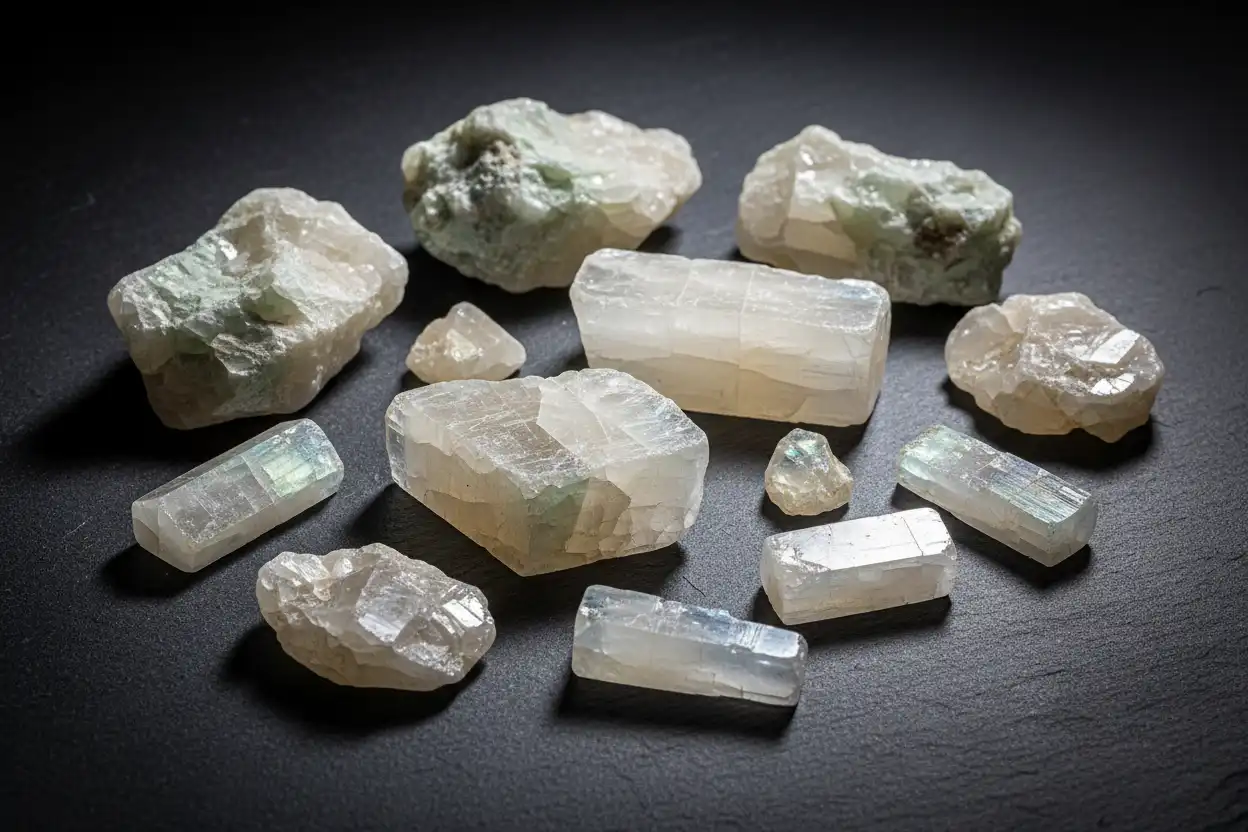
Anorthite Meaning: What This Feldspar Really Represents
Anorthite meaning begins with feldspar mineralogy. Anorthite is the calcium-rich end member of the plagioclase feldspar series, with the ideal chemical formula CaAl₂Si₂O₈. It is a tectosilicate mineral in which silicon-oxygen and aluminium-oxygen tetrahedra form a three-dimensional framework containing calcium. Natural plagioclase commonly exists between calcium-rich anorthite and sodium-rich albite rather than as chemically perfect end-member material, so an analyzed feldspar can contain a substantial anorthite component without being pure CaAl₂Si₂O₈.
Anorthite crystallizes in the triclinic system and usually appears colorless, white, grayish, or reddish rather than intensely saturated. It has a vitreous luster, typically ranges around 6–6.5 on the Mohs hardness scale, has a measured density near 2.74–2.76, and is brittle with prominent feldspar cleavage. Transparent crystals exist, but much natural anorthite occurs as grains or crystals incorporated into igneous, metamorphic, and other rocks rather than as gem rough prepared for jewelry.
Those measurable facts are the appropriate starting point for interpreting anorthite. Modern crystal traditions sometimes associate the mineral with resilience, grounding, adaptability, or personal transformation, but those themes are symbolic interpretations rather than physical properties of calcium feldspar. A scientifically defensible account keeps mineral identity, geological significance, historical naming, and modern symbolism in separate evidence categories.
Readers exploring related materials can browse the broader Gemstone Guides. This page remains focused on defining anorthite itself r
ather than duplicating the separate pages that own its optical behavior, geology, lapidary questions, specimen conservation, provenance, or other specialist subjects.
Anorthite Identity at a Glance
| Property | Anorthite |
|---|---|
| Mineral group | Feldspar group |
| Series | Plagioclase series |
| End-member role | Calcium-rich end member |
| Ideal formula | CaAl₂Si₂O₈ |
| Mineral class | Tectosilicate |
| Crystal system | Triclinic |
| Common colors | Colorless, white, grayish, reddish; additional subtle coloration may occur |
| Transparency | Transparent to translucent |
| Luster | Vitreous |
| Mohs hardness | About 6–6.5 |
| Specific gravity | Approximately 2.74–2.76 |
| Cleavage | Perfect in one principal direction, less perfect in another |
| Fracture | Uneven to conchoidal |
| Tenacity | Brittle |
| Optical character | Biaxial negative |
| Typical refractive indices | Approximately 1.573–1.590 across principal optical directions |
| Common twinning | Polysynthetic feldspar twinning is well documented |
| Main identification limit | Composition cannot be determined reliably from appearance alone |
Anorthite’s significance comes partly from its position within a continuous feldspar compositional system. The word may refer strictly to the calcium end-member species, while geologists also use “An” values to express the calcium-rich component of plagioclase compositions. A feldspar described as An-rich therefore does not automatically consist of chemically pure anorthite.
That distinction is fundamental when interpreting specimen labels, thin-section descriptions, laboratory analyses, or online claims.
Anorthite Is the Calcium End of the Plagioclase Series
Plagioclase feldspar is not one chemically fixed substance. It forms a compositional series extending between sodium-rich albite, NaAlSi₃O₈, and calcium-rich anorthite, CaAl₂Si₂O₈. Sodium and calcium substitute through a coupled structural mechanism that also changes the relative proportions of silicon and aluminium required for electrical neutrality.
This solid-solution behavior means natural plagioclase can occupy many intermediate compositions. Names used within the plagioclase system describe different compositional portions of that series, but anorthite represents its calcium-dominant end. USGS references describe plagioclase compositions spanning the sodium and calcium feldspar end members and document the mineral series as a major component of many igneous and metamorphic rocks.
For a collector, the practical implication is straightforward: a white feldspar crystal cannot be labeled pure anorthite merely because it resembles a known specimen. Determining where a plagioclase falls within the albite-anorthite series normally requires compositional or suitably diagnostic mineralogical evidence.
How Anorthite Forms
Anorthite-rich plagioclase is strongly associated with calcium-rich magmatic systems. Plagioclase is abundant in many mafic and intermediate igneous rocks, including basalt, gabbro, diabase, and related lithologies, and calcium-rich compositions are particularly important in lower-silica igneous assemblages. Crystals may grow directly from magma as the melt cools, and their composition can change during growth as temperature, melt chemistry, volatile content, and crystallization history evolve.
This changing chemistry can produce compositional zoning within a single plagioclase crystal. A core may contain more of the anorthite component than its rim, or growth may record repeated changes rather than a simple uninterrupted trend. Such zoning is valuable to petrologists because it can preserve information about the evolving magma from which the crystal grew.
Anorthite also occurs in metamorphic contexts and can participate in reactions involving calcium-rich rocks, aluminium-bearing minerals, and changing pressure-temperature conditions. Well-developed crystals are historically associated with metamorphosed limestone blocks from the volcanic environment around Mount Somma, where transparent specimens occur with other minerals.
The full petrological interpretation of magma evolution, metamorphic reactions, zoning, host rocks, and deposit environments belongs in Anorthite formation and deposit geology. For anorthite meaning, the central fact is that the mineral records real geological chemistry rather than one universal formation story.
Anorthite Beyond Earth
Calcium-rich plagioclase also has major importance in planetary geology. Anorthositic lunar highland rocks are dominated by plagioclase, and research into lunar crust formation has examined how calcium-rich plagioclase could separate from magma and contribute to a feldspar-rich early crust. NASA literature describes lunar highland rocks as strongly plagioclase-rich and discusses anorthitic plagioclase as a major constituent of this material.
That planetary occurrence is scientifically remarkable, but it should not be converted into unsupported marketing language such as “cosmic-energy anorthite” unless an actual specimen has documented extraterrestrial provenance. Earth-mined anorthite does not become lunar material because the same mineral species also occurs on the Moon.
Similarly, a generic feldspar cannot be sold responsibly as meteorite anorthite without evidence supporting the meteorite itself.
The distinction between mineral identity and specimen provenance is one of the most important recurring themes in responsible collecting.
Why Anorthite Is Usually White, Gray, or Colorless
Ideal calcium-aluminium silicate does not require a strong body color. Standard mineralogical references describe anorthite most commonly as colorless, white, grayish, or reddish, with transparent material becoming colorless in thin section.
Subtle natural colors may reflect trace impurities, microscopic mineral inclusions, structural defects, alteration products, iron-bearing material, or interactions with the surrounding rock. A reddish crystal, for example, should not automatically be interpreted as a distinct chemical variety of anorthite merely from its visible appearance.
Surface staining adds another complication. Iron oxides or alteration films on fractures and cleavage surfaces can create orange, rusty, or reddish coloration that belongs partly or entirely to secondary material rather than the feldspar lattice itself.
A responsible description therefore separates observation from mechanism. “Reddish-gray anorthite” is an acceptable visual description. “Its red color is caused by a specific trace element” requires specimen-specific analytical evidence.
Readers interested in refractive indices, birefringence, interference colors, orientation, and other physical aspects of light response should use Anorthite optical properties and color behavior rather than expecting the meaning page to duplicate that specialist material.
Anorthite’s Triclinic Structure Matters
Anorthite is sometimes encountered through the broader word “feldspar,” which can hide how structurally complex individual feldspar species are. Its triclinic symmetry means its crystallographic axes and angles do not form the simple right-angle geometry familiar from cubic minerals.
That structural fact influenced the mineral’s name. “Anorthite” derives from Greek roots associated with being oblique or not straight, referring to the mineral’s non-right-angle crystallographic character. The name therefore originated in mineral morphology and crystallography, not in symbolic ideas about following an unconventional life path.
This is a good example of how later metaphysical interpretation can accidentally grow out of a misunderstood scientific term. Describing anorthite as a stone of “breaking rules because its name means crooked” may work as modern metaphor, but it is not the historical scientific definition of a metaphysical property.
Twinning Is a Useful Feldspar Clue
Twinning is common in plagioclase feldspars, and anorthite can display repeated lamellar or polysynthetic twinning. Under a petrographic microscope, these twin relationships can form characteristic patterns that help mineralogists recognize plagioclase within a rock.
In hand specimens or fashioned material, however, twinning may not always be obvious. Fine lamellae can require polarized-light microscopy, while weathering, fractures, grain size, polish, or crystal orientation can conceal the pattern.
The presence of apparent striations or repetitive internal lines can therefore support a feldspar interpretation without proving pure anorthite composition.
A closer framework for recording twinning, inclusions, growth zoning, fractures, alteration, and associated minerals is provided in the Anorthite microscope inclusion notebook.
Diagnostic Traits of Anorthite
Anorthite combines several properties characteristic of calcium-rich plagioclase: hardness around 6–6.5, vitreous luster, transparent-to-translucent appearance, a density around 2.75, triclinic symmetry, feldspar cleavage, biaxial optical behavior, and refractive indices higher than those of sodium-rich albite.
These characteristics become useful when considered together.
A white crystal with vitreous luster and two strong cleavage directions may plausibly be feldspar. Repeated twinning can strengthen that interpretation. Refractive or petrographic measurements can narrow the identity further. Chemical analysis can then show whether the plagioclase is genuinely close to the anorthite end member or occupies an intermediate composition.
USGS reference samples demonstrate another important principle: X-ray diffraction can establish that a sample is calcic plagioclase consistent with anorthite, while compositional analysis is a separate question. Different methods answer different levels of identification.
Visual recognition should therefore be treated as an identification hypothesis rather than a chemical analysis.
Original Anorthite Specimen and Photo Evaluation Checklist
The following checklist separates what can reasonably be learned from a specimen or photograph from conclusions that require laboratory or documentary evidence.
| Observation | What it may support | What it cannot prove alone |
|---|---|---|
| White, colorless, gray, or faintly reddish crystal | Appearance compatible with anorthite | Exact feldspar composition |
| Vitreous luster | Consistent with fresh feldspar | Calcium-rich end-member identity |
| Blocky or short prismatic habit | Compatible with anorthite | Species confirmation |
| Cleavage surfaces meeting at oblique angles | Supports feldspar interpretation | Pure CaAl₂Si₂O₈ composition |
| Fine repeated striations or lamellae | Possible plagioclase twinning | Exact An content |
| Transparent crystal in volcanic matrix | Geologically plausible occurrence | Exact locality |
| Crystal in metamorphosed carbonate rock | Compatible with known anorthite environments | Formation mechanism for that specimen |
| Reddish surface areas | Visible color or staining | Specific trace-element cause |
| Seller label stating “Anorthite” | Identification claim worth preserving | Independent verification |
| Seller label stating “lunar anorthite” | Provenance claim requiring exceptional evidence | Extraterrestrial origin |
| Raman, XRD, or compositional data | Strong analytical evidence | Full collection history or locality |
| Original locality card with collection history | Provenance evidence | Chemical composition |
This checklist is deliberately conservative. It does not imply that photographs are useless; they are excellent for documenting morphology, color, matrix, damage, and associated minerals. It simply prevents a visible clue from being mistaken for information the photograph cannot contain.
Questions involving old labels, locality statements, seller records, extraterrestrial claims, or chain of custody belong in the Anorthite provenance and disclosure checklist.
Anorthite Names and Claims That Need Qualification
The feldspar group contains enough compositional terminology that apparently simple names can become misleading.
| Name or claim | Evidence assessment | More accurate interpretation |
|---|---|---|
| Anorthite | Accepted mineral name | Calcium-rich plagioclase end member |
| CaAl₂Si₂O₈ | Ideal end-member composition | Natural specimens may contain some sodium component |
| Plagioclase | Mineral series/group terminology | Includes compositions between albite and anorthite |
| “Calcium feldspar” | Broadly useful description | Should not replace precise compositional identification |
| Indianite | Historical name associated with material described before modern anorthite terminology | Best treated as historical nomenclature, not a new metaphysical variety |
| “Lunar anorthite” | Valid only with genuine extraterrestrial provenance | Earth anorthite is not lunar because the species occurs on the Moon |
| “Red anorthite” | Descriptive color phrase | Not automatically a separate mineral variety |
| “Pure anorthite” | Strong compositional claim | Requires suitable analytical evidence |
| “Anorthite crystal healing stone” | Modern belief or marketing language | Not a mineralogical property |
| “Anorthite changes your life direction” | Symbolic claim | No demonstrated physical mechanism |
The distinction between species, compositional component, variety label, locality claim, and symbolic description prevents much of the confusion surrounding less familiar feldspars.
The Documented History Behind Anorthite
Anorthite was named from material associated with Mount Somma in the volcanic complex around Vesuvius. Its name draws from Greek terminology referring to oblique or non-right-angle form, reflecting the crystallographic geometry recognized by early mineralogists.
Historical literature also records the name “indianite” for granular feldspar associated with corundum-bearing material from India before the modern anorthite name became established. That older terminology can still appear in historical mineral collections or texts.
Neither name establishes an ancient metaphysical tradition.
The documented history of anorthite is instead tied to mineral classification, crystallography, feldspar chemistry, volcanic geology, petrology, and later planetary science. Those subjects provide a stronger historical foundation than retroactively assigning the mineral an unsupported ancient healing role.
Anorthite and Anorthosite Are Not the Same Thing
The similarity between the words causes frequent confusion. Anorthite is a mineral species at the calcium-rich end of the plagioclase series. Anorthosite is a rock composed predominantly of plagioclase feldspar.
An anorthosite may contain highly calcic plagioclase, but the rock name does not mean the entire rock consists of chemically pure anorthite. Rock classification and mineral species classification answer different questions.
This distinction becomes especially important in discussions of lunar highlands, where anorthositic rocks are famous for their feldspar-rich composition. Saying that lunar highlands are anorthositic does not mean every mineral grain in them is pure anorthite.
Is Anorthite a Gemstone?
Transparent anorthite can be cut, but it is much better known as a rock-forming and collector mineral than as a mainstream jewelry gemstone. Gemological references document transparent faceted material from several localities, yet supply is limited and most consumers are far more familiar with other feldspars such as labradorite, moonstone, or sunstone.
Anorthite’s moderate hardness gives it reasonable scratch resistance, but cleavage and brittle behavior complicate jewelry use. A transparent gem may also be valued more for rarity and mineralogical interest than for brilliance or saturated color.
When suitable material is fashioned, the technical questions of rough selection, cleavage management, orientation, and polishing belong in Anorthite cutting, orientation, and polish.
The meaning page only needs to establish that gem use is possible without implying that faceted anorthite is a common commercial gemstone.
Durability Is More Than Mohs Hardness
A hardness of 6–6.5 may sound reasonably durable, but hardness measures resistance to scratching rather than resistance to breaking. Anorthite is brittle and possesses pronounced cleavage, so a sharp impact in an unfavorable direction can chip or split a crystal even when ordinary light abrasion leaves it unaffected.
This distinction matters in jewelry. A protected pendant or occasional-wear piece presents a different mechanical environment from an exposed ring that repeatedly strikes desks, doorframes, or tools.
The detailed relationship between stone shape, girdle exposure, prong pressure, bezel support, and impact direction is owned by Anorthite setting and wear engineering.
For general ownership, avoid assuming that “feldspar hardness” means “safe for every use.”
Safe Ownership of Anorthite
An intact anorthite specimen can be handled as an ordinary mineral collectible. The main practical concerns are mechanical damage, destructive testing, aggressive cleaning, and loss of specimen context rather than unusual toxicity during normal ownership.
Store important crystals so harder minerals cannot rub across fresh faces. Avoid scratch testing valuable specimens simply to confirm a textbook hardness range, and do not pry apart cleavage surfaces to see whether the mineral “breaks like feldspar.” Such tests destroy information without necessarily producing a definitive identification.
For matrix specimens, cleaning should take associated minerals into account. A method harmless to feldspar may affect a softer carbonate, clay coating, old adhesive, label, or fragile secondary mineral on the same specimen.
Long-term storage, matrix stabilization, repairs, original labels, and documentation are covered in the Anorthite specimen conservation record.
Cutting and Grinding Require Normal Mineral-Dust Controls
Owning a polished feldspar and mechanically grinding one are different exposure situations. Sawing, sanding, drilling, and polishing create fine particulate matter from anorthite and whatever minerals occur with it.
Professional lapidary practice therefore uses wet methods where appropriate, local extraction, suitable respiratory protection, and careful cleanup rather than deliberately breathing dust. This is sensible mineral-workshop hygiene, not evidence that an intact anorthite specimen is inherently dangerous to touch.
Unknown matrix material deserves particular caution because a rough specimen may contain minerals other than the feldspar being targeted.
Treatments and Repairs Need Evidence, Not Assumptions
Anorthite is not a high-volume commercial gemstone with one dominant standardized treatment narrative. That does not mean every transparent or polished piece should automatically be labeled untreated.
A specimen may have been cleaned, repaired, glued to matrix, coated, impregnated, filled, polished, or otherwise altered after collection. A faceted gemstone could also be subjected to experimental or commercial enhancement even if such practices are uncommon.
The appropriate approach is disclosure rather than guesswork. “Natural anorthite” identifies geological origin but does not automatically prove that no repair, filling, coating, or other post-mining work has occurred.
When treatment status materially affects a purchase or scientific interpretation, microscopy and other analytical techniques are more reliable than seller photographs alone.
Provenance Cannot Be Read From Color
Anorthite occurs in many geological environments and has been documented from numerous terrestrial localities as well as extraterrestrial materials. White or transparent crystals from different regions can resemble one another strongly.
Color therefore cannot establish provenance.
A specimen described as Italian, Japanese, Indian, American, lunar, or meteoritic should carry documentation proportionate to the claim. A common terrestrial locality may need only a credible collection record for ordinary collecting purposes. An extraterrestrial claim requires a substantially stronger chain of evidence because its significance and potential value are much greater.
Preserve original specimen labels even when their appearance is untidy. The information on an old card may ultimately matter more than a newly printed decorative label.
Responsible Anorthite Symbolism
Modern metaphysical interpretations sometimes connect anorthite with flexibility, resilience, adaptation, grounding, transformation, self-discovery, or working through periods of change. Some of these themes may be inspired by feldspar’s geological importance, its formation within changing magmatic systems, or its place within a compositional series.
A person can use those themes as metaphors.
For example, the albite-anorthite series provides an interesting symbolic image of continuity rather than rigid categories: natural crystals can occupy intermediate compositions rather than belonging to only one extreme. Zoning within plagioclase can also symbolize a history recorded layer by layer as conditions change.
None of this means the mineral physically causes adaptability or emotional resilience.
There is no established scientific evidence that anorthite heals disease, repairs bones, alters hormone levels, removes toxins, changes brain chemistry, attracts wealth, protects against accidents, manifests relationships, or emits a measurable therapeutic energy. Such statements go beyond mineralogical evidence.
The boundary between symbolic use and medical or supernatural claims is explained more broadly in the Gems Lore disclaimer.
Anorthite Meaning Without Invented Ancient Lore
Less familiar minerals are especially vulnerable to fabricated histories because few readers have enough background to question an authoritative-sounding claim. Statements that “ancient civilizations used anorthite for transformation,” “warriors carried it for courage,” or “traditional healers used it for calcium balance” should not be repeated without traceable historical evidence.
The absence of documented ancient symbolism is not a weakness.
Anorthite already has a substantial human story through crystallography, volcanic mineralogy, feldspar classification, metamorphic and igneous petrology, historical nomenclature, and planetary science. Those subjects are more specific—and more interesting—than generic crystal mythology copied from unrelated stones.
This evidence-first treatment follows the editorial principles described on About Gems Lore.
Anorthite and Calcium Do Not Make It a Calcium Supplement
One particularly important boundary involves chemical composition. Anorthite contains calcium as part of a strongly bonded aluminosilicate crystal structure. That fact does not make the mineral a nutritional calcium source or a treatment for calcium deficiency.
Mineral formula and biological availability are different questions.
Do not ingest powdered anorthite, add it to drinks, or prepare mineral elixirs for health purposes on the assumption that a calcium-bearing formula provides nutritional benefit. The presence of Ca in CaAl₂Si₂O₈ does not establish safety, dosage, absorption, or medical usefulness.
This is a straightforward example of why chemistry should not be translated directly into wellness claims.
Comparing Anorthite With Nearby Mineral References
Anorthite can be useful as a reference point for understanding how differently mineral identities are constructed. Anhydrite meaning concerns a calcium sulfate rather than a calcium aluminosilicate, despite both mineral names beginning similarly. Their chemistry, hardness, crystal structures, geological environments, and practical behavior are fundamentally different.
Apache Tears meaning concerns a form of volcanic glass rather than a crystalline feldspar, providing another useful contrast between a mineral species and a natural amorphous material.
Meanwhile, Apatite color meaning focuses specifically on color mechanisms and interpretation, illustrating why color deserves its own evidentiary treatment rather than being treated as proof of identity or spiritual function.
These comparisons help prevent similarity of name, color, or marketing category from replacing mineralogical classification.
Anorthite in Collections
Collectors may value anorthite for crystal form, transparency, locality, volcanic associations, matrix aesthetics, unusual composition, historic labels, or its importance as a plagioclase end member. A small crystal with strong provenance can therefore be more interesting scientifically than a larger but poorly documented feldspar.
The mineral also has educational value. It provides a tangible way to explain solid solution, feldspar twinning, compositional zoning, igneous crystallization, metamorphic reactions, and planetary crust formation using one species.
When preserving an important specimen, avoid removing matrix merely to expose more crystal unless there is a clear mineralogical or conservation reason. Matrix can contain the evidence needed to understand how and where the crystal formed.
A Practical Evidence Ladder for Anorthite Claims
Not every question requires the same level of evidence.
Level 1 — Visual observation: color, crystal habit, luster, matrix, fractures, visible twinning, and surface condition.
Level 2 — Simple mineral properties: hardness range, density, cleavage behavior, and basic optical measurements performed appropriately.
Level 3 — Petrographic evidence: twinning, birefringence, extinction behavior, zoning, and relationships with other minerals in thin section.
Level 4 — Species-level analytical evidence: Raman spectroscopy or X-ray diffraction capable of supporting feldspar identification.
Level 5 — Compositional evidence: electron microprobe or another appropriate chemical method showing how close the material lies to the anorthite end member.
Level 6 — Provenance evidence: original labels, collection records, geological context, documented chain of custody, and specialist evidence appropriate to unusual origin claims.
A claim should rise only as high as the evidence supporting it. A white crystal photograph belongs near Level 1. Calling the same object chemically pure, untreated, and extraterrestrial would require several much stronger evidence categories.
That is the analytical principle behind the workbook’s requirement for original information gain on this page.
What Anorthite Meaning Ultimately Represents
At the material level, anorthite represents the calcium-rich end of one of geology’s most important feldspar systems. Its composition links calcium, aluminium, silicon, and oxygen within a triclinic framework; its twinning and zoning can record crystal growth; and its occurrence in basaltic, gabbroic, metamorphic, anorthositic, and planetary materials makes it significant far beyond gemstone collecting.
Historically, its name records crystallographic observation rather than spiritual doctrine. Scientifically, its occurrence helps reconstruct how rocks and planetary crusts formed. Gemologically, transparent crystals can be fashioned but remain specialized rather than mainstream.
Symbolically, someone may choose to interpret anorthite as a reminder of adaptation, layered experience, or the fact that change can be recorded within structure. That interpretation can be personally meaningful while remaining clearly separate from claims about healing, energy, destiny, or supernatural effects.
Questions involving a particular specimen, uncertain label, or evidence claim can be directed through Contact Gems Lore.
Frequently Asked Questions
What is anorthite?
Anorthite is the calcium-rich end-member mineral of the plagioclase feldspar series. Its ideal chemical formula is CaAl₂Si₂O₈, and it crystallizes in the triclinic system.
Is anorthite a type of feldspar?
Yes. Anorthite belongs to the plagioclase branch of the feldspar group and represents its calcium-rich compositional end member.
Is every calcium-rich plagioclase pure anorthite?
No. Natural plagioclase commonly contains both calcium-rich anorthite and sodium-rich albite components. A calcium-rich feldspar may therefore be strongly anorthitic without having the exact ideal end-member composition.
What color is natural anorthite?
Common natural colors include colorless, white, grayish, and reddish tones. Some specimens may show additional subtle coloration from impurities, inclusions, alteration, or surface material.
What causes red or reddish anorthite?
There is no single safe explanation for every reddish specimen. Trace chemistry, inclusions, oxidation products, alteration, or surface staining can contribute. The cause should not be assigned without suitable evidence.
How hard is anorthite?
Anorthite is roughly 6–6.5 on the Mohs hardness scale. Its cleavage and brittle tenacity still make it vulnerable to chipping and breakage even though it resists scratching better than softer minerals.
Is anorthite rare?
Anorthitic plagioclase is important in many rocks, so the mineral component itself is not restricted to a single rare geological occurrence. Fine transparent crystals or facetable material with strong specimen aesthetics are much less commonly encountered in the gem trade.
Where does anorthite form?
It occurs especially in calcium-rich igneous systems, including basaltic and gabbroic rocks, but is also found in metamorphic environments and other geological settings. Its precise origin depends on the specimen and host rock.
Does anorthite occur on the Moon?
Yes. Calcium-rich plagioclase is a major component of lunar highland anorthositic rocks. That does not mean ordinary terrestrial anorthite specimens are lunar material.
Is anorthite found in meteorites?
Anorthitic plagioclase can occur in extraterrestrial materials, but a specimen should never be described as meteoritic based on mineral identity alone. Meteorite provenance requires separate evidence.
What is the difference between anorthite and anorthosite?
Anorthite is a mineral. Anorthosite is a rock composed predominantly of plagioclase feldspar. The similar names refer to different levels of geological classification.
Is anorthite the same as albite?
No. Albite is the sodium-rich plagioclase end member, NaAlSi₃O₈, whereas anorthite is the calcium-rich end member, CaAl₂Si₂O₈. Natural plagioclase commonly has compositions between them.
Can anorthite be faceted?
Transparent material can be faceted, but anorthite is a specialized collector gem rather than a common jewelry stone. Cleavage, brittleness, orientation, and rough availability affect lapidary use.
How can anorthite be identified?
Color and crystal form provide only preliminary clues. Cleavage, density, optical behavior, twinning, X-ray diffraction, Raman spectroscopy, and chemical analysis can provide progressively stronger evidence depending on the question.
Can a photograph prove a crystal is anorthite?
No. A photograph can document color, habit, luster, matrix, and visible twinning, but it cannot reliably establish exact feldspar chemistry or anorthite content.
What does anorthite symbolize?
Modern symbolic interpretations may associate anorthite with adaptation, resilience, change, grounding, or personal growth. These meanings are human interpretations rather than measurable mineral properties.
Does anorthite have healing properties?
There is no established scientific evidence that anorthite treats medical conditions or produces physiological healing. Its symbolic use should not replace evidence-based healthcare.
Does the calcium in anorthite benefit bones?
The presence of calcium in the mineral formula does not make anorthite a nutritional supplement. Its calcium is incorporated into an aluminosilicate structure, and the mineral should not be ingested for health purposes.
Is anorthite safe to handle?
Ordinary handling of an intact specimen generally requires routine mineral-collection precautions. Protect crystals from impacts and harder minerals. Sawing or grinding should use appropriate controls for mineral dust.
How should I preserve an anorthite specimen?
Keep important specimens protected from impacts and abrasion, preserve original labels and matrix when useful, document repairs, and avoid unnecessary destructive testing or aggressive cleaning.
Why is provenance important for anorthite?
Anorthite occurs in many terrestrial settings and in extraterrestrial materials, so locality cannot usually be determined from appearance. Provenance records are especially important when a seller makes unusual volcanic, historic, meteoritic, or lunar origin claims.
Can anorthite have spiritual meaning without being scientifically proven?
Yes. Someone can use a mineral as a personal symbol of adaptation, persistence, or geological change while clearly acknowledging that such symbolism is interpretive rather than a demonstrated physical effect.
Anorthite meaning is therefore strongest when the mineral is allowed to remain what the evidence shows it to be: a calcium-rich plagioclase feldspar whose chemistry, triclinic structure, cleavage, twinning, zoning, and geological occurrence connect it with fundamental processes in Earth’s rocks and the crust of other planetary bodies.
The human meanings attached to it occupy a separate layer. Its oblique crystal geometry can inspire metaphor, its compositional series can suggest continuity and adaptation, and its geological record can symbolize change over time. Those interpretations require no invented healing mechanism or ancient legend. The mineral itself already provides a substantial story.