Apatite Color Meaning: Symbolism, Uses & Color Guide
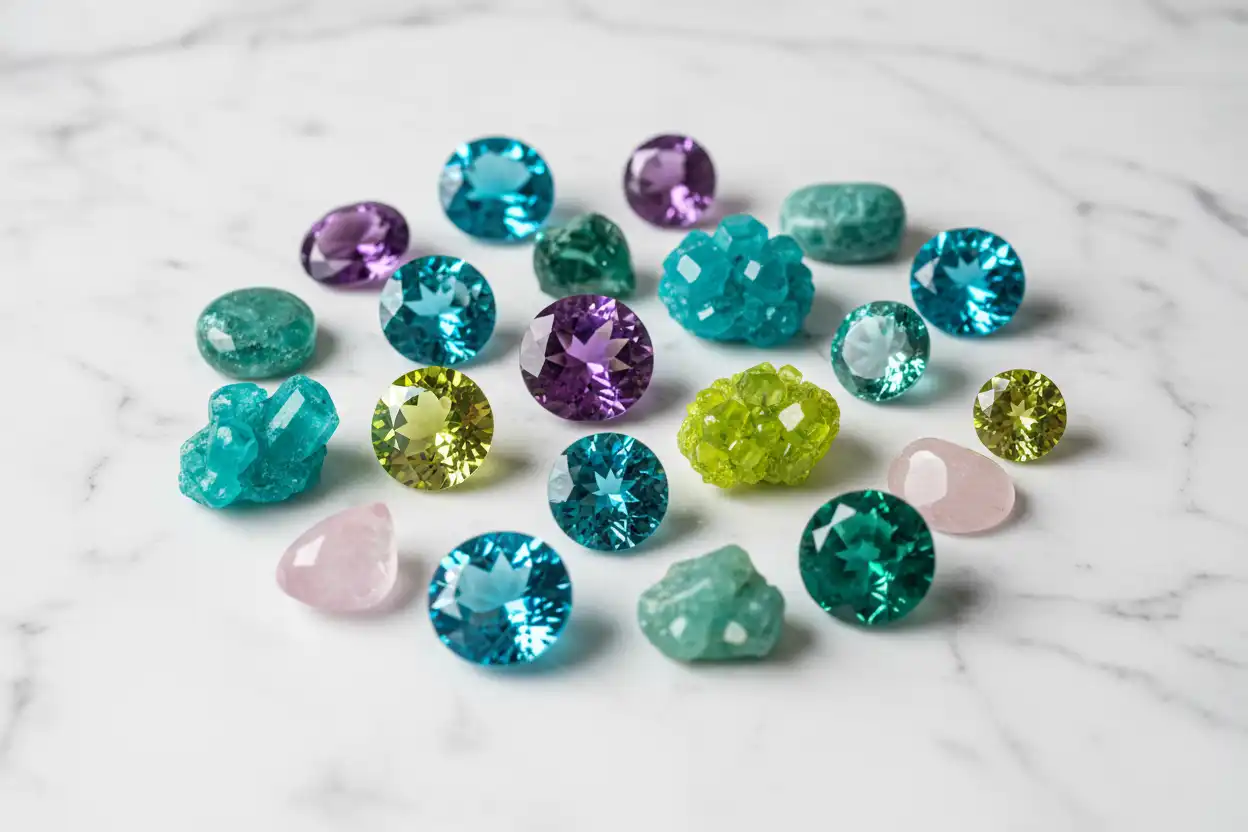
Apatite color meaning changes noticeably across the mineral group’s vivid palette, from electric blue-green gems associated symbolically with communication and directed action to green stones linked with growth, golden material connected with confidence, and less common purple or pink apatite used as symbols of reflection and individuality. Those interpretations belong to contemporary crystal traditions, while the colors themselves arise from mineral chemistry, trace elements, structural defects, oxidation states, and other processes within apatite.
Color is particularly important in apatite because the same mineral group can produce transparent gems in blue, teal, green, yellow, violet, pink, brown, and nearly colorless forms, yet appearance alone cannot tell you the exact apatite-group species, locality, treatment history, or durability of a particular stone. Most gem material sold simply as apatite is fluorapatite, and all of these attractive colors share one practical limitation: apatite ranks only about 5 on the Mohs scale, so even spectacular neon material is considerably easier to scratch than quartz, tourmaline, aquamarine, sapphire, or many conventional jewelry stones.
Understanding apatite color meaning therefore works best on two levels. First, identify what the color can tell you mineralogically and commercially; then, if symbolism matters to you, treat the color association as a personal or cultural interpretation rather than a scientifically proven effect.
Apatite Colors at a Glance
| Apatite Color | Typical Appearance | Common Symbolic Interpretation | Important Practical Point |
|---|---|---|---|
| Blue | Sky blue to saturated blue | Communication, perspective, clear expression | Can resemble aquamarine |
| Blue-green / teal | Aqua, turquoise, neon blue-green | Direction, motivation, focused action | Highly desirable color but still Mohs 5 |
| Green | Yellow-green to mint, leek green or deep green | Growth, renewal, practical progress | Color alone does not establish locality |
| Yellow / golden | Lemon, yellow-green, honey or golden | Confidence, organization, purposeful action | Can resemble beryl, scapolite or tourmaline |
| Purple / violet | Lavender to saturated violet | Reflection, imagination, independent thought | Less common in mainstream jewelry |
| Pink | Pale peach-pink to rose | Compassion, personal expression, gentleness | Uncommon and sometimes difficult to identify visually |
| Colorless | Water-clear to faintly tinted | Clarity, neutrality, observation | Easily confused with other colorless gems |
| Brown | Honey-brown to earthy brown | Stability, realism, grounded priorities | Usually lower commercial demand than vivid colors |
| Cat’s-eye | Yellow, green, blue-green or grayish with moving eye | Focus, attention, direction | Value depends heavily on sharp chatoyancy |
| Color-change | Different hues under different light sources | Adaptation, perspective | Genuine strong color change is unusual |
Apatite color meaning should never be used as an authenticity test. Blue does not automatically mean Madagascar, green does not prove untreated material, and a rare-looking purple shade does not establish that a gemstone is natural.
What Is Apatite?
Apatite is a mineral group of calcium phosphates rather than one perfectly uniform mineral species. A simplified group formula is:
Ca₅(PO₄)₃(F,Cl,OH)
Fluorapatite, in which fluorine dominates the relevant structural site, accounts for much of the transparent gem material encountered commercially. Hydroxylapatite and chlorapatite belong to the same broader structural family but differ chemically.
The main apatite meaning guide covers the mineral’s broader identity, formation, history, symbolic traditions, and general uses. This page keeps apatite color meaning separate by concentrating on why the mineral changes color, what individual colors look like, how those colors affect buying decisions, and how modern symbolism differs from gemological evidence.
Apatite typically crystallizes in the hexagonal system and may form prismatic, tabular, granular, or massive material. Transparent crystals can be faceted, while included or chatoyant pieces may be cut as cabochons.
What Causes Apatite Color?
Apatite color meaning should begin with the fact that no single ingredient creates every color in the group.
Small chemical substitutions can have a large optical effect because apatite’s structure can accommodate trace elements and defects in several ways. Manganese in different oxidation states is particularly important in some blue, greenish-blue, pink, and violet fluorapatite, while rare-earth elements, iron, radiation-related defects, and interactions among structural components can also influence absorption and fluorescence.
Blue apatite provides a good example of why simplified explanations can be misleading. Research has associated some natural deep-blue material with high-valence manganese substituting into phosphate-related structural positions, yet not every blue apatite from every locality should automatically be assigned precisely the same microscopic color mechanism.
Likewise, pink and violet colors may involve manganese in different oxidation states or structural environments, while yellow and green stones can display more complicated combinations of trace chemistry and optical absorption.
Apatite color meaning is therefore more reliable when color is described first and interpreted second. Shade can provide clues, but laboratory spectroscopy and chemistry are needed when the exact cause of color matters.
Why Lighting Changes Apatite Color
Apatite can look dramatically different between jewelry-store lighting, daylight, warm indoor illumination, and photographs.
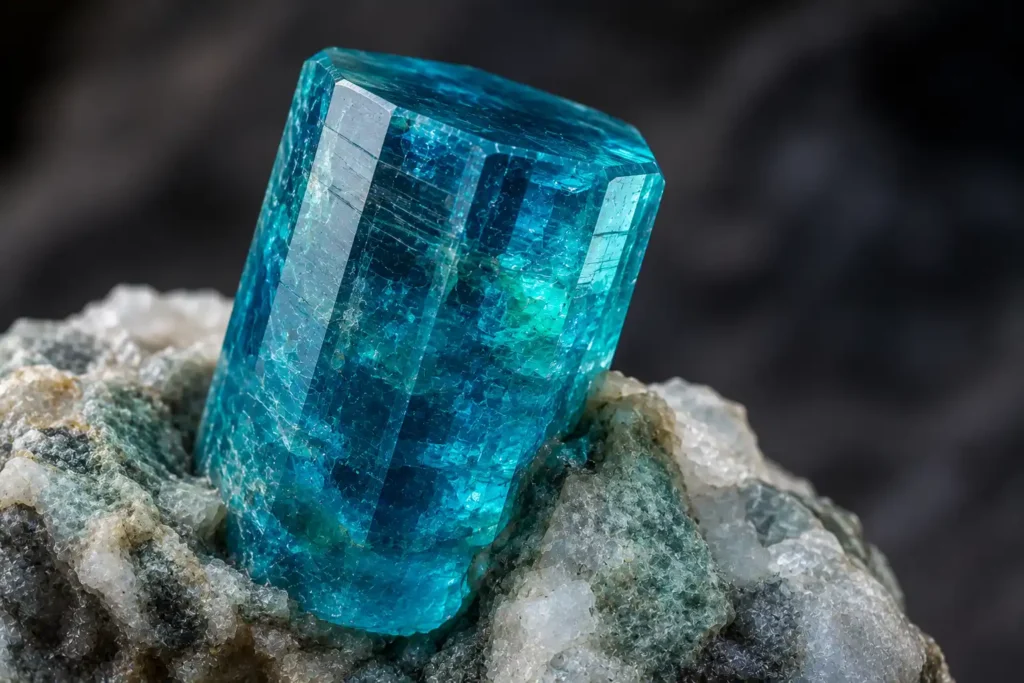
Highly saturated blue-green stones are particularly susceptible to this effect because bright, cool LED lighting can intensify their tropical aqua appearance. The same gemstone may look greener, darker, or less electric in ordinary indoor conditions.
Cut also changes the perceived apatite color meaning visually. A shallow stone may lose saturation through a large window, while a deep stone may retain more color but look dark through the center. Pleochroism can further influence face-up appearance because some apatite displays different colors or color intensities along different viewing directions.
When buying a colored apatite, ask to see it face-up in more than one normal lighting condition rather than relying only on backlit photographs.
Blue Apatite Color Meaning
Blue apatite color meaning is commonly associated with clear communication, perspective, learning, and expressing an idea without unnecessary confusion. In a practical reflective routine, a blue stone can represent the intention to choose precise words, listen before responding, or organize a complicated thought before presenting it.
Those themes are symbolic. Blue apatite has not been scientifically shown to improve speech, cognition, memory, confidence, or neurological function.
Mineralogically, blue apatite ranges from relatively soft sky blue through richer ocean blue to striking saturated shades. Some crystals appear blue in one direction and much paler or nearly colorless in another, which means cut orientation influences the finished gem.
Blue apatite can resemble several other stones at a glance, and the wider blue gemstones guide shows why color family alone is a poor identification method.
For buyers, the strongest blue apatite is not automatically the best stone. A vivid color should still be evaluated alongside clarity, cutting, treatment disclosure, durability, and whether the face-up appearance remains attractive under ordinary room light.
Blue-Green and Teal Apatite Color Meaning
Blue-green apatite color meaning combines the communication symbolism assigned to blue with the growth and forward-movement themes often assigned to green. This makes teal material commonly associated with choosing a direction, converting an idea into a specific action, and communicating that goal clearly.
The vivid neon blue-green variety is also among the most commercially recognizable apatite colors. Well-saturated gems can resemble high-color tourmaline strongly enough that sellers sometimes use marketing expressions such as “Paraíba-color apatite.”
That wording describes appearance, not identity.
Apatite is not Paraíba tourmaline, does not become tourmaline because the hue is similar, and should not automatically be assumed to come from Brazil. Copper-bearing Paraíba-type tourmaline and apatite are chemically and physically different gemstones.
This particular apatite color meaning also creates a practical trap: vivid color can make the gem look expensive and durable in photographs, while its Mohs hardness remains only about 5. A neon-blue stone still needs protection from abrasion.
Green Apatite Color Meaning
Green apatite color meaning is traditionally connected with growth, renewal, steady development, learning through experience, and making incremental progress rather than expecting an immediate transformation.
That symbolism can translate into a simple behavior. Someone working toward a long-term project might use a green apatite specimen as a reminder to review one measurable step at regular intervals instead of relying on motivation alone.
The stone does not produce growth.
Natural green apatite can range from yellowish green and olive to mint, leek green, grass green, and blue-green. Some transparent green material has historically been described commercially as “asparagus stone,” although that term does not represent a separate mineral species.
Green apatite may resemble tourmaline, peridot, chrysoberyl, green beryl, or other gems depending on shade. The broader green gemstones guide provides useful visual and durability comparisons.
For apatite color meaning, the key distinction is that green symbolism and green mineral chemistry are separate questions. A green stone can represent renewal personally without its color proving anything about emotional or physical effects.
Yellow Apatite Color Meaning
Yellow apatite color meaning is commonly associated with confidence, organization, curiosity, learning, and purposeful decision-making.
A grounded use might involve placing a yellow apatite beside a notebook while separating a decision into known facts, unanswered questions, possible actions, and consequences. In this context, the stone marks the start of the exercise rather than supplying the answer.
Yellow apatite ranges from pale lemon and greenish yellow to stronger golden or honey tones. Fine transparent material can look surprisingly similar to yellow beryl, chrysoberyl, scapolite, tourmaline, or some yellow garnets.
The dedicated yellow gemstones guide makes these similarities easier to compare without treating color as proof of identity.
Yellow apatite color meaning should also be kept separate from claims about confidence or metabolism. Wearing yellow apatite does not scientifically increase energy, improve digestion, change hormones, or create personal success.
Golden Apatite Color Meaning
Golden apatite color meaning overlaps with yellow apatite but usually carries a slightly more deliberate symbolic emphasis on direction, competence, and bringing structure to an ambition.
The richer appearance of golden stones can also create greater perceived value, although commercial quality depends on more than hue. Transparency, saturation, brightness, size, cutting, inclusions, and whether the stone becomes brown or overly dark in normal lighting all affect desirability.
A deep golden apatite that remains lively face-up may be more attractive than a lighter stone with severe windowing. Conversely, very dark honey material can lose brilliance even if photographs make thin edges appear luminous.
This is an important buying lesson throughout apatite color meaning: evaluate the stone as a three-dimensional optical object, not simply as a color swatch.
Purple Apatite Color Meaning
Purple apatite color meaning is generally associated with introspection, imagination, independent thought, and reviewing an idea from more than one perspective.
A practical symbolic exercise might involve using the stone while generating possibilities first, then deliberately switching into an evaluation stage where each idea is tested against evidence, cost, time, and consequences.
Purple apatite does not provide supernatural intuition or psychic information.
Natural purple and violet apatite can range from pale lavender to richer violet or reddish-purple shades. Strongly colored transparent material is less familiar in mainstream jewelry than blue, green, or yellow apatite, which can make unusual specimens especially interesting to mineral and gem collectors.
Visual confusion with amethyst, fluorite, purple scapolite, spinel, and other violet gems is possible. The purple gemstones guide provides a broader comparison of these materials.
Pink Apatite Color Meaning
Pink apatite color meaning is typically interpreted through themes of gentleness, thoughtful self-expression, compassion, and approaching difficult conversations without unnecessary harshness.
These ideas can be useful when treated as behavioral reminders. A person might use a pink apatite as a cue to revise the tone of an important message while keeping the actual boundary or request clear.
There is no evidence that pink apatite alters emotional chemistry, repairs relationships, or medically regulates stress.
Pink apatite is relatively uncommon compared with blue, green, and yellow commercial gem material. Color can range from subtle peach-pink through rose and reddish-pink tones, while some pinkish or violet material is linked with manganese-bearing fluorapatite.
Because buyers encounter it less frequently, unusual large or exceptionally clean pink apatite deserves careful identification rather than being accepted solely from seller terminology.
Colorless Apatite Color Meaning
Colorless apatite color meaning is usually associated symbolically with clarity, neutrality, simplification, and examining a situation without assigning meaning too quickly.
That interpretation fits the mineral particularly well because apatite itself was historically named for its tendency to resemble other minerals. A colorless piece can therefore serve as a reminder that an object or situation should be identified from evidence rather than first impressions.
Mineralogically, transparent colorless apatite can resemble quartz, beryl, topaz, scapolite, or glass after faceting.
Colorlessness removes one of the easiest visual clues, making measured properties more useful. Refractive index, specific gravity, microscopy, optical character, and spectroscopy can separate apatite from lookalikes without destructive testing.
Brown Apatite Color Meaning
Brown apatite color meaning is often connected with practicality, realism, stability, and paying attention to constraints rather than idealized possibilities.
Brown specimens may range from pale honey and tan to deeper earthy colors, sometimes modified by yellow, orange, green, or gray.
Commercial demand generally favors the vivid blue, green, and yellow portions of apatite’s palette, but attractive brown crystals can still have collector value when they show good transparency, strong crystal form, unusual locality, or interesting inclusions.
Brown does not mean low quality automatically.
A fine natural crystal specimen can be more important to a mineral collector than a brighter but ordinary faceted stone.
Cat’s-Eye Apatite Color Meaning
Cat’s-eye apatite color meaning adds symbolism of focus, direction, attentiveness, and keeping one important objective visible despite distractions.
The optical effect itself is called chatoyancy and has a physical explanation. Fine parallel inclusions, tubes, or related internal structures can reflect light as a narrow band across a properly oriented cabochon.
When the stone or light moves, the eye appears to travel across the curved surface.
Yellow, green, blue-green, grayish, and other apatite colors can show chatoyancy. The quality of a cat’s-eye depends heavily on whether the band is narrow, centered, continuous, mobile, and strongly contrasted against the body color.
This is one case where apatite color meaning and cutting are inseparable. A poorly oriented piece of identical rough may show little or no visible eye.
Color-Change Apatite
Color-change apatite is unusual enough that strong claims deserve careful documentation.
Most ordinary apatite simply looks somewhat different under warm and cool lighting because nearly all colored gemstones respond to changes in illumination, camera balance, surroundings, and viewing direction.
True color-change material shows a more distinct shift between different dominant hues under different light sources. Natural examples have been documented, including material that shifts between greenish-yellow and pinkish-orange appearances.
Apatite color meaning for such stones is often associated symbolically with adaptation and perspective because the same gemstone reveals noticeably different appearances as the lighting changes.
The symbolism is personal. The optical effect is measurable.
A seller claiming exceptional color change should provide photographs or video under clearly described light sources rather than relying on one edited comparison image.
Apatite Color Meaning vs. Types of Apatite
Color and mineral variety are related but not identical.
A blue apatite, green apatite, or purple apatite is not automatically a separate recognized species. Most gem material is fluorapatite, while precise identification of fluorapatite, hydroxylapatite, chlorapatite, or more specialized compositions may require chemical analysis.
Likewise, expressions such as neon apatite, Paraíba-color apatite, asparagus stone, and cat’s-eye apatite are descriptive or commercial labels rather than simple species names.
The types of apatite guide separates mineralogical varieties, color varieties, optical effects, and trade terminology more fully.
This distinction prevents apatite color meaning from becoming a list of invented “crystal species” based only on shade.
Can You Identify Apatite by Color?
No.
Color is useful descriptive evidence but weak identification evidence because several gemstones overlap with every major apatite color.
Blue apatite can resemble aquamarine or tourmaline. Green apatite can resemble peridot, tourmaline, or green beryl. Yellow apatite may look like scapolite or yellow beryl. Purple material can resemble amethyst or fluorite.
The problem becomes even greater in photographs because white balance, background, saturation editing, and lighting can alter hue dramatically.
Professional gemologists instead combine measurable properties. Common gem apatite typically has refractive indices in a substantially higher range than aquamarine, for example, while its specific gravity is also greater.
The dedicated apatite vs aquamarine comparison shows how those measurements separate two blue stones that may look remarkably similar.
Apatite Color, Treatments, and Disclosure
Apatite is often sold as untreated, but treatment is not impossible, and heating has been reported for some commercial material.
The important issue is disclosure rather than assuming every vivid blue or green stone was treated.
Heat may modify color in certain apatites, while coatings, filling, or other alterations are possible even when they are not the dominant treatment pattern for the species. A repaired mineral specimen is another separate situation and should not be confused with color enhancement.
The broader gemstone treatments guide explains how heating, coating, impregnation, filling, irradiation, and other processes affect disclosure and care.
For apatite color meaning, treatment does not erase personal symbolism. It does, however, matter to the commercial description, value assessment, and sometimes cleaning method.
Does Apatite Color Affect Value?
Yes, but color is only one part of value.
Vivid blue-green and neon-like apatite often receives strong commercial attention because the appearance is visually distinctive. Fine green and golden material can also be desirable, while unusual transparent purple, pink, or genuine color-change stones may interest specialist collectors because they appear less frequently in ordinary jewelry inventories.
The best color should remain attractive under realistic lighting.
A highly saturated stone that closes up into near-black areas face-up may be less attractive than a slightly lighter gem with better brightness. Likewise, an intensely colored stone with a large transparent window through the center may not display its color as effectively as well-proportioned material.
Clarity, size, cutting, treatment, provenance, optical phenomena, rarity of the specific material, and condition all interact with color.
Apatite color meaning may influence personal preference, but symbolic associations should not be used to justify inflated financial claims.
How Cutting Changes Apatite Color
Cutting orientation can determine whether an apatite appears bright, dark, uneven, or washed out.
Transparent rough may show directional color, so the cutter has to consider pleochroism while deciding how to orient the table. Maximizing carat weight at the expense of orientation can leave an otherwise attractive crystal looking less saturated from the top.
Depth also matters.
A stone that is too shallow may show a window where the viewer sees through the center rather than receiving reflected light. Excessive depth can create dark extinction and reduce face-up size.
For cat’s-eye material, orientation becomes even more critical because the inclusions responsible for chatoyancy must align correctly beneath the cabochon.
Apatite color meaning may be described in symbolic terms, but the visible beauty of the finished gem is governed largely by optics and cutting.
Choosing an Apatite Color
There is no universally “best” apatite color.
Choose based on what matters most to you.
Someone attracted to vivid appearance may prefer neon teal or blue-green. A collector interested in less common material may look for purple, pink, color-change, or unusual crystal specimens. A person using apatite symbolically might select blue for deliberate communication, green for long-term development, or yellow for structured action.
Regardless of color, examine the stone under ordinary lighting and ask for clear treatment disclosure.
For higher-value purchases, verify dimensions, weight, return terms, known locality if claimed, and whether the seller can support unusual statements about origin or rarity. The guide to buying real apatite focuses on those practical checks.
Apatite Color Meaning and Jewelry Use
Color can determine why someone wants an apatite, but durability determines how it should be worn.
Apatite ranks about 5 on the Mohs scale. The gemstone hardness chart shows how far below quartz, topaz, sapphire, and diamond that places it in resistance to scratching.
This difference matters in ordinary life because quartz-rich dust and grit can abrade polished apatite. Facet junctions may gradually become rounded, scratches can reduce luster, and a vulnerable edge may chip after impact.
Earrings and pendants generally make better long-term choices for fine colored apatite because they encounter less contact with hard surfaces.
Occasional-wear rings are possible, particularly with low protective settings, but they should not be treated like sapphire or diamond rings.
Apatite color meaning does not change this limitation. Blue, green, yellow, and purple specimens all remain apatite.
How to Clean Colored Apatite
Clean apatite conservatively regardless of color.
For a stable untreated loose gem or ordinary jewelry piece, lukewarm water, mild soap, and a soft cloth are usually sufficient. Rinse gently and dry without abrasive rubbing.
Avoid steam and ultrasonic cleaning, particularly when the gemstone contains fractures, inclusions, coatings, fillers, or uncertain treatment.
Sudden temperature changes should also be avoided.
Store apatite separately from harder gemstones, especially quartz, garnet, beryl, tourmaline, topaz, sapphire, and diamond, because those materials can scratch it.
The safest care method is based on the mineral’s physical properties and treatment history, not on apatite color meaning.
Apatite Color Meaning in Reflective Practice
Apatite color meaning can be useful when each color is connected to one specific behavior rather than a vague promise.
Blue might mark a communication routine: state the relevant fact, explain its effect, and make a clear request.
Green can represent reviewing progress toward a long-term goal.
Yellow may mark a decision-making session where assumptions are separated from confirmed information.
Purple can represent moving between imagination and critical evaluation.
Pink can serve as a reminder to combine kindness with clear boundaries.
None of these outcomes is caused by the stone. The apatite acts as an object associated with the routine, while the person performs the behavior.
At Gems Lore, apatite color meaning is most useful when the unusual mineral palette becomes a framework for intentional reflection without confusing symbolism with mineral chemistry, psychological treatment, or guaranteed results.
Frequently Asked Questions
What is the main apatite color meaning?
Apatite color meaning varies by shade. Blue is commonly associated with communication and perspective, green with growth, yellow with confidence and purposeful action, purple with reflection, and pink with gentle self-expression. These are symbolic traditions rather than scientifically proven effects.
What colors does apatite naturally occur in?
Apatite occurs naturally in blue, blue-green, green, yellow, golden, purple, violet, pink, brown, grayish, and colorless material. Cat’s-eye and rare color-change examples are also known.
Which apatite color is most popular?
Vivid blue-green and neon-like apatite is among the most recognizable commercial material because of its intense aqua or teal appearance. Popularity does not make other colors less genuine or mineralogically important.
What does blue apatite color mean?
Blue apatite color meaning is traditionally associated with clear expression, communication, learning, and perspective. A grounded use is to treat the stone as a reminder to organize thoughts or communicate deliberately rather than claiming it changes speech or cognition.
What does green apatite color mean?
Green apatite color meaning centers on growth, renewal, practical development, and steady progress. The symbolism can support goal review or planning, but the stone does not biologically cause growth or emotional change.
What does yellow apatite color mean?
Yellow apatite color meaning is associated with confidence, organization, curiosity, learning, and purposeful action. These themes are cultural and personal interpretations rather than measurable properties of the gemstone.
What does purple apatite color mean?
Purple apatite color meaning is commonly linked with introspection, imagination, reflection, and independent thought. It should not be interpreted as proof that the gemstone grants psychic ability or supernatural information.
What does pink apatite color mean?
Pink apatite color meaning is often associated with compassion, thoughtful communication, and personal expression. Pink apatite is also less common in mainstream jewelry than blue, green, or yellow material.
Why is some apatite neon blue-green?
Strong blue-green apatite color can arise from trace chemistry and structural color mechanisms within the mineral. Manganese in particular can play an important role in some blue fluorapatite, but the exact mechanism should not be assumed to be identical in every deposit.
Is Paraíba apatite the same as Paraíba tourmaline?
No. “Paraíba-color apatite” is a commercial description referring to a vivid neon blue-green appearance. Apatite and Paraíba-type tourmaline are different mineral materials with very different durability, chemistry, rarity, and market values.
Does apatite color prove where it came from?
No. Similar blue, green, yellow, or purple colors can occur in material from different localities. A locality claim requires provenance or appropriate analytical evidence rather than color alone.
Is blue apatite always untreated?
No. Natural blue apatite exists, but treatment can occur in the market. Sellers should disclose known treatment rather than allowing the buyer to assume vivid color automatically means untreated material.
Can apatite change color?
Most apatite does not show a strong true color-change effect, although unusual natural color-change material is known. Ordinary differences between daylight, LEDs, and warm indoor lighting should not automatically be marketed as a genuine color-change phenomenon.
What is cat’s-eye apatite?
Cat’s-eye apatite contains aligned internal features that create chatoyancy when cut as a cabochon. A strong stone shows a narrow moving band of reflected light across an attractive body color.
Which apatite color is best for jewelry?
Color does not change apatite’s basic Mohs hardness of about 5, so all colors require care. Earrings and pendants are usually safer than exposed daily-wear rings, regardless of whether the apatite is blue, green, yellow, purple, or pink.
Can apatite color identify the gemstone?
No. Apatite overlaps visually with aquamarine, tourmaline, beryl, scapolite, fluorite, amethyst, and other stones. Professional identification relies on measurable gemological properties rather than color alone.
Does apatite color meaning have scientific evidence?
The colors and mineral properties of apatite are scientifically measurable, but apatite color meaning in the spiritual sense is not a scientifically established force. Symbolic interpretations can be used for reflection or personal routines without presenting them as medical, psychological, or supernatural effects.
Apatite color meaning becomes most useful when color is treated as more than decoration but less than proof of supernatural power. Blue, teal, green, yellow, purple, pink, brown, colorless, chatoyant, and rare color-change apatite each provide different visual and symbolic possibilities, while the underlying mineral remains a relatively soft phosphate gemstone whose chemistry, cut, treatment, identification, and care ultimately determine how it should be bought and worn.