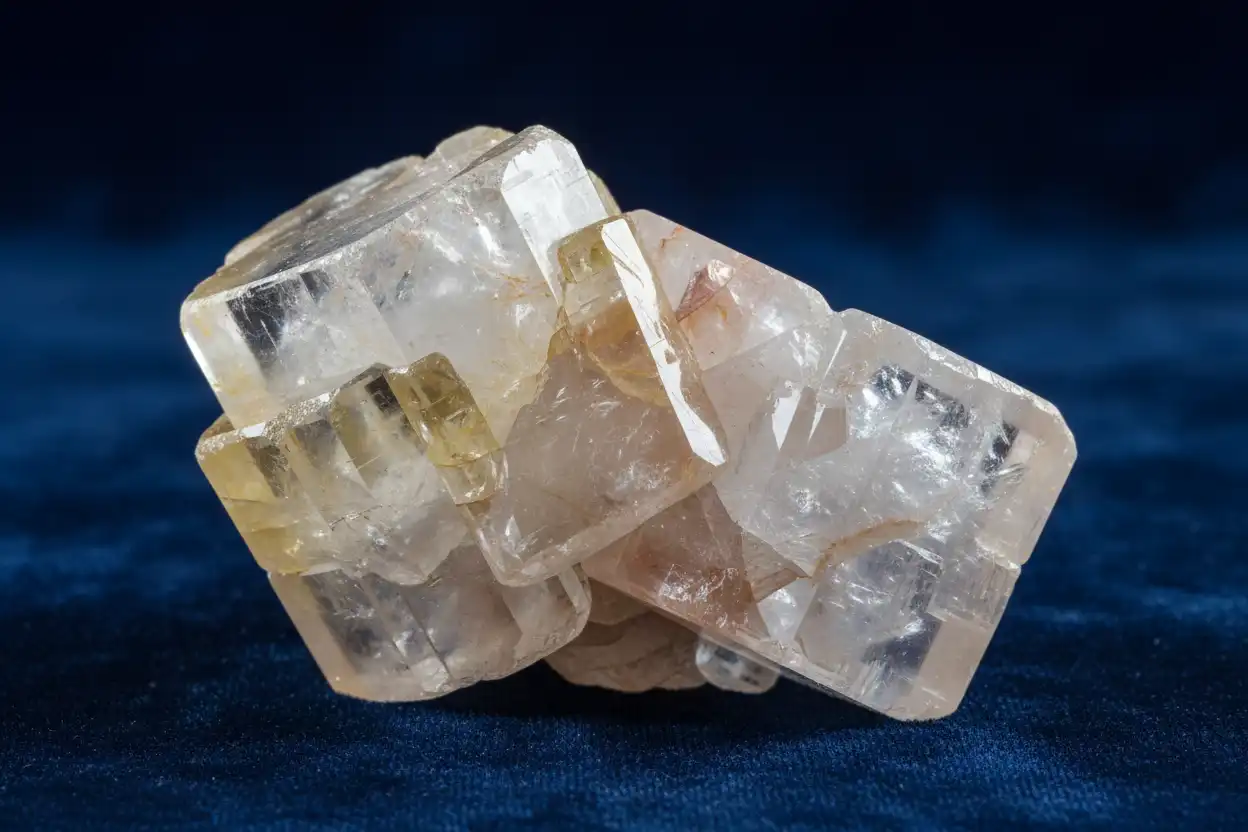
Augelite Meaning: Mineral Identity, History & Symbolism
Augelite meaning begins with a relatively uncommon aluminium phosphate mineral rather than the broader spiritual interpretations sometimes attached to pale green collector crystals. Augelite has the formula Al₂(PO₄)(OH)₃, crystallizes in the monoclinic system, and commonly occurs as transparent to translucent crystals ranging from colorless and white to pale yellow, light green, and more rarely pale rose or blue. Its Mohs hardness is approximately 4.5–5, measured specific gravity is close to 2.70, and its cleavage can produce conspicuously pearly reflective surfaces despite the more generally vitreous appearance of intact crystal faces.
These properties make augelite attractive to mineral collectors but relatively demanding as an ornamental material. It is moderately soft compared with quartz or beryl, brittle, and endowed with strong cleavage in more than one structural direction. Fine crystals can nevertheless display excellent transparency, sharp form, subtle green coloration, and a brightness that helps explain the mineral’s name.
Modern crystal traditions sometimes connect augelite meaning with clarity, personal growth, calm, intellectual focus, spiritual awareness, or emotional renewal. Those interpretations can function as personal symbolism, but they are not measurable properties of aluminium phosphate. Augelite has not been scientifically demonstrated to heal disease, modify emotions through mineral energy, activate chakras, improve cognition, attract opportunities, or create supernatural communication.
The wider Gemstone Guides collection treats these layers separately: first establish what the mineral is, then consider documented history and modern symbolism without allowing belief-based claims to replace mineralogical evidence.
Augelite Identity at a Glance
| Property | Augelite |
|---|---|
| Mineral species | Augelite |
| Chemical formula | Al₂(PO₄)(OH)₃ |
| Mineral class | Phosphate |
| Crystal system | Monoclinic |
| Common habit | Thick tabular, prismatic, occasionally acicular, massive |
| Common colors | Colorless, white, pale yellow, light green; rarer pale rose or blue |
| Transparency | Transparent to translucent |
| Luster | Vitreous; pearly on prominent cleavage surfaces |
| Mohs hardness | Approximately 4.5–5 |
| Specific gravity | Approximately 2.70 |
| Cleavage | Perfect in one principal direction, good in another, with additional weaker cleavage |
| Fracture | Uneven |
| Tenacity | Brittle |
| Optical character | Biaxial positive |
| Typical RI range | Approximately 1.574–1.588 |
| Geological setting | Metamorphosed phosphate-bearing rocks, phosphate-rich pegmatitic environments and some hydrothermal systems |
| Main ownership concern | Cleavage, brittle crystals and moderate hardness |
| Identification limit | Pale green color and vitreous luster alone cannot prove augelite |
The combination of aluminium, phosphate, hydroxyl groups, monoclinic structure, modest density and distinctive cleavage separates augelite from the many pale green stones with which it can be confused visually. Color is useful for describing a specimen, but identification rests on a larger set of physical and analytical properties.
Augelite Is an Aluminium Phosphate
Augelite belongs to the phosphate mineral class, meaning phosphorus occurs within phosphate groups as a fundamental part of its crystal structure. Aluminium and hydroxyl groups complete the principal chemistry expressed by Al₂(PO₄)(OH)₃.
This distinguishes augelite fundamentally from green silicates such as beryl, tourmaline, jade minerals, feldspar, pyroxene or amphibole. A pale green crystal can therefore look broadly similar to another gem material while having entirely different chemistry and geological significance.
The relatively simple-looking formula should not be interpreted to mean that every natural augelite crystal is chemically perfect. Trace substitutions, microscopic inclusions, defects, alteration and associated minerals can all be present without changing the basic species identity.
For collectors, that distinction is useful because specimen identity and specimen purity are not the same question. A crystal may be correctly identified as augelite while carrying inclusions, coatings or attached matrix minerals.
How Augelite Forms
Augelite is particularly associated with phosphate-rich geological environments that have undergone metamorphism or high-temperature alteration. Documented occurrences include metamorphosed phosphate-bearing rocks, phosphate-rich granitic pegmatites, phosphatic iron-rich rocks and some hydrothermal veins.
This range of settings explains why augelite can occur beside other phosphate minerals rather than as an isolated geological curiosity. Phosphorus must first become sufficiently concentrated, after which aluminium-bearing rocks or fluids and suitable pressure-temperature conditions allow augelite to crystallize or replace earlier phosphate phases.
In metamorphic environments, existing phosphate-rich material may react as temperature, pressure and fluid composition change. In pegmatitic or hydrothermal settings, late-stage fluids can concentrate phosphorus and other components into fractures, pockets or altered zones where well-developed crystals have room to grow.
The famous occurrence at its Swedish type locality is associated with a phosphate-rich iron-mineral environment where minerals such as attakolite, berlinite and lazulite also occur. This geological association is more meaningful than simply describing augelite as a “green crystal,” because it places the mineral within a specific phosphate-forming system.
The detailed relationships among metamorphism, fluid chemistry, phosphate concentration, host rocks and locality-specific paragenesis belong in Augelite formation and deposit geology.
Why Augelite Can Be Pale Green
Ideal augelite can be colorless, so pale yellow, green, rose or blue coloration reflects minor chemical variation, defects, inclusions or other departures from an optically ideal crystal rather than a requirement of the species itself. Published mineral descriptions recognize colorless, white, yellowish, pale rose and greenish material, while locality records also include rarer blue tones.
It is tempting to assign every green augelite crystal to one specific trace element, but that would exceed what appearance alone establishes. Different specimens may owe visible color to different concentrations of impurities, structural defects or microscopic inclusions.
A description such as “pale green augelite” is therefore observationally sound.
A statement such as “this specimen is green because of a specific element” requires chemical or spectroscopic evidence relevant to that specimen.
This boundary becomes particularly important with photographs. Camera white balance and background choice can make subtle yellow-green material appear strongly green, while transmitted light may make colored crystals look considerably paler.
The deeper relationships among refractive indices, birefringence, optical orientation, pleochroism where present and color behavior are developed in Augelite optical properties and color behavior.
Why Augelite Can Look Exceptionally Bright
Augelite’s name is closely tied to the brightness or luster visible on favorable surfaces. The mineral was named from a Greek-derived word referring to shine or luster, specifically in reference to the appearance of its cleavage surfaces.
That history is useful because the optical impression is real but easily misinterpreted. A smooth cleavage plane can reflect light strongly enough to appear distinctly pearly, while other faces remain vitreous. Rotating a crystal under a directional light can therefore cause individual surfaces to brighten dramatically.
This does not constitute a supernatural glow or a separate “high-vibration” variety of augelite.
The brightness arises from ordinary interactions between light and the crystal surface.
The distinction provides a natural example of how a genuine mineral property can later inspire symbolic language without proving the symbolic claim itself.
Crystal Habit Can Vary More Than Photographs Suggest
Well-developed augelite crystals may be thick and tabular, prismatic or more elongated. Mineral descriptions also record occasional acicular development and massive material. Individual faces can show striations, and combinations of forms can produce specimens that look substantially different even though they belong to the same species.
Consequently, one memorized “classic augelite shape” is not enough for identification.
A compact pale green crystal can be augelite.
A transparent tabular crystal can be augelite.
A nearly colorless prismatic specimen can also be augelite.
Morphology becomes strongest when it is considered with cleavage, density, hardness, optics, matrix and analytical evidence.
Cleavage Is One of Augelite’s Important Physical Traits
Augelite has particularly strong cleavage in one crystallographic direction, good cleavage in another and weaker cleavage along additional planes. Fresh surfaces can be smooth and reflective, helping produce the mineral’s characteristic pearly appearance.
The same property creates mechanical vulnerability.
A crystal can withstand gentle handling yet split abruptly if a force is applied in an unfavorable orientation. Size does not remove this weakness; a large thick crystal can still possess structurally preferred breakage directions.
Collectors should therefore observe existing cleavage rather than deliberately creating it. Breaking a sharp crystal to prove its identity destroys the feature that may have made the specimen valuable.
Cleavage, internal fractures, growth features, inclusions, coatings and alteration can be examined more closely through the Augelite microscope inclusion notebook.
Diagnostic Traits of Augelite
Augelite identification becomes more convincing when several observations agree. The mineral’s monoclinic crystal form, hardness around 4.5–5, specific gravity near 2.70, strong cleavage, vitreous-to-pearly luster and biaxial-positive optical character create a useful diagnostic combination. Reference optical values place its principal refractive indices roughly between the mid-1.57s and upper-1.58s.
These properties help distinguish augelite from superficially similar minerals, but they should be gathered without damaging valuable material. Scratch testing can leave permanent marks, and cleavage testing is obviously destructive. Refractive data, microscopy, Raman spectroscopy and X-ray diffraction provide better options when exact identification matters.
Visual identification can be particularly difficult with massive or polished material because cutting removes much of the natural habit and matrix context.
Original Augelite Specimen and Photo Checklist
The following checklist separates observations a collector can reasonably make from conclusions that require stronger evidence.
| Observation | What it may support | What it cannot prove alone |
|---|---|---|
| Pale green transparent crystal | Appearance compatible with augelite | Species identity |
| Colorless or white crystal | Common augelite appearance | Chemical purity |
| Thick tabular habit | Compatible crystal form | Exact composition |
| Short prismatic habit | Compatible with augelite | Geographic origin |
| Fine striations on natural faces | Useful morphological evidence | Treatment status |
| Pearly reflective cleavage | Strong supporting clue | Species identity by itself |
| Vitreous intact faces | Compatible with augelite | Exact locality |
| Pale phosphate-rich matrix | Plausible geological context | Specific deposit |
| Existing clean cleavage break | Useful structural evidence | Reason to break an intact specimen |
| Seller labels material “gem augelite” | Commercial description | Standardized gem grade |
| Seller names a famous locality | Provenance claim to document | Independent origin proof |
| Raman spectrum matching augelite | Strong identification evidence | Provenance |
| X-ray diffraction consistent with augelite | Strong structural evidence | Whether a crystal was repaired |
| Chemical analysis matching Al-phosphate chemistry | Strong species evidence when interpreted properly | Full geological history |
The checklist prevents one attractive feature from answering several unrelated questions. Pale green color can support a visual description. It cannot independently establish species, treatment, mine or symbolic properties.
Augelite Claims That Need Qualification
| Claim | Evidence-based interpretation |
|---|---|
| “Augelite is always green” | False; it can be colorless, white, yellowish, greenish and more rarely other pale colors |
| “Every pale green phosphate is augelite” | False; several phosphate minerals overlap in appearance |
| “Strong shine proves augelite” | Cleavage luster is characteristic but not unique enough to prove species |
| “Augelite is a quartz variety” | False; augelite is an aluminium phosphate |
| “Augelite is a type of jade” | False; jadeite and nephrite have unrelated compositions and structures |
| “Transparent augelite must be gem quality” | Transparency alone does not determine specimen quality or durability |
| “Augelite is durable because its crystals look solid” | Hardness and cleavage make it more delicate than appearance suggests |
| “Augelite activates higher consciousness scientifically” | No established mineralogical mechanism supports this claim |
| “Aluminium in augelite affects the brain when worn” | Wearing intact mineral material does not establish therapeutic exposure |
| “Augelite heals emotional trauma” | No clinical evidence supports a mineral-healing effect |
| “A rare mineral is automatically expensive” | Quality, size, condition, locality, aesthetics and demand still matter |
| “A locality name can be identified from color” | Provenance requires documentation rather than visual matching |
This claim matrix is especially useful for a relatively unfamiliar mineral because limited public familiarity can make confident but unsupported descriptions sound authoritative.
Augelite Is Not Aventurine
Pale to medium green polished material can sometimes be marketed imprecisely, but augelite and aventurine meaning concern fundamentally different materials. Aventurine is generally a quartz-rich material whose characteristic sparkling appearance comes from mineral inclusions, whereas augelite is an aluminium phosphate mineral.
Their durability also differs substantially. Quartz-based aventurine is harder and generally more resistant to routine scratching than augelite.
The comparison is useful only as an identification boundary. Augelite should not inherit aventurine’s physical properties, geological history or symbolic traditions merely because both can be green.
Augelite and Astrophyllite Are Chemically Unrelated
Astrophyllite meaning concerns a complex potassium-sodium-iron-titanium silicate whose bronze blades commonly occur in alkaline rocks. Augelite is an aluminium phosphate associated with phosphate-rich geological environments.
They differ in chemistry, crystal structure, appearance and geological significance.
The only useful connection is methodological: both minerals are uncommon enough that polished material is frequently identified through trade labels rather than independent testing. Preserving original mineralogical information therefore matters for both.
Augelite and Axinite Should Not Be Confused by Name
Axinite meaning concerns a different silicate mineral group with characteristic wedge-shaped crystals, greater density and different optical and structural properties. The similarity of the names provides no mineralogical relationship.
This may sound obvious, yet unfamiliar mineral names are easily confused when specimens are encountered through online shops rather than organized mineral collections.
Chemistry and structure remain the reliable anchors.
Documented Naming History
Augelite was named by mineralogist Christian Wilhelm Blomstrand from a Greek-derived term referring to shine or luster, inspired by the appearance of its cleavage surfaces. Its type locality is the Västanå Iron Mine in southern Sweden.
That naming history is physical and mineralogical rather than metaphysical.
Claims that augelite’s name means awakening, enlightenment, aura or spiritual illumination do not reflect its documented etymology. The association with light comes from reflected luster.
The distinction does not prevent modern symbolic interpretation. A reflective mineral can certainly inspire a metaphor about clarity or insight. The metaphor simply should not be presented as the historical reason for the mineral’s name.
Documented History Is Stronger Than Invented Ancient Lore
Augelite does not need to be described as an ancient sacred crystal to be historically interesting. Its scientific story includes Scandinavian phosphate mineralogy, the development of mineral nomenclature, crystallographic analysis, phosphate-rich metamorphic systems and later discoveries of excellent crystals in additional localities.
Statements claiming that ancient civilizations used augelite universally for spiritual awakening, healing, protection or prophecy require evidence specific to augelite rather than generic references to green stones.
This is particularly important because identifying pale green archaeological material without modern analytical testing would itself be difficult.
A modern spiritual association should be described as modern when historical continuity cannot be demonstrated.
Augelite as a Collector Mineral
Augelite is principally a mineral-collector species rather than a mainstream jewelry gemstone. Well-formed transparent crystals can be prized for sharp form, pale green or yellow coloration, luster, size, matrix relationships and locality.
Collector value can be concentrated in features that would disappear during cutting. A terminated crystal may preserve growth faces, striations and matrix contacts that provide mineralogical information, whereas polishing the same specimen could reduce it to an attractive but less informative stone.
For significant natural specimens, preservation is therefore often preferable to fashioning.
Storage, matrix support, repair documentation and preservation of original labels are addressed in the Augelite specimen conservation record.
Can Augelite Be Faceted?
Transparent augelite can be faceted as a collector gem, but its physical properties make the process demanding. Hardness around 4.5–5 means polished surfaces are relatively vulnerable to abrasion, while prominent cleavage creates a risk of splitting during sawing, preforming, faceting, polishing or setting.
The available rough can also be valuable as a mineral specimen, making yield only one part of the cutting decision.
A cutter must consider crystal orientation, cleavage, inclusions, fractures, color concentration, usable transparency and whether destroying the natural crystal is justified. These technical decisions belong in Augelite cutting, orientation and polish.
A successfully faceted augelite can be beautiful, but rarity of faceted examples should not be confused with suitability for everyday jewelry.
Jewelry Requires Protective Use
Augelite’s moderate hardness and cleavage make exposed daily-wear settings demanding. Facet junctions can scratch, and impact can exploit cleavage or existing fractures.
Pendants, earrings, brooches and carefully protected collector jewelry generally present lower mechanical risk than frequently worn rings or bracelets. A ring is possible, but it should be chosen with the expectation of careful use rather than treated like sapphire or spinel.
Setting pressure also matters because a jeweler can damage a cleavable stone during mounting even before the owner wears it.
The interaction between stone shape, prongs, bezel pressure, protected edges and intended wear is developed in Augelite setting and wear engineering.
Safe Ownership Favors Conservative Cleaning
Augelite should be handled as a moderately soft, brittle phosphate mineral with significant cleavage. Loose surface dust can be removed gently, but aggressive brushing, abrasive compounds, hard impacts and unnecessary heat should be avoided.
Matrix specimens deserve extra caution because associated minerals may have their own sensitivities. Repairs and adhesives can further change what cleaning methods are appropriate.
Ultrasonic and steam cleaning are poor default choices for an uncommon cleavable mineral whose internal condition may not be known. Warm or room-temperature water applied conservatively may be appropriate for sound specimens, but prolonged immersion is unnecessary and should never be treated as a universal ritual.
Preservation should take priority over dramatic cleaning.
Cutting and Grinding Change the Safety Context
Normal ownership of an intact augelite specimen is different from creating mineral dust. Sawing, grinding, drilling or sanding produces fine particles from augelite and whatever matrix accompanies it.
Appropriate wet methods, local extraction, eye protection, respiratory protection suited to the operation and careful cleanup reduce unnecessary exposure. This is sensible lapidary practice for mineral materials in general.
There is no reason to pulverize augelite for identification or metaphysical use.
Its chemistry can be studied through mineralogical methods without creating avoidable dust.
Augelite Should Not Be Ingested
Augelite contains aluminium, phosphorus, oxygen and hydroxyl groups as part of a stable crystalline mineral structure. That chemistry does not make the specimen a nutritional source of phosphorus or a therapeutic aluminium compound.
Do not grind augelite into powders, add rough specimens to drinking water for medicinal purposes or assume that elements present in a mineral become beneficial through skin contact.
Natural mineral specimens can also contain matrix material, alteration products and trace components not represented by the ideal formula.
Mineral identity is not a food-safety assessment.
Modern Augelite Meaning and Clarity
Clarity is an understandable symbolic association for transparent augelite. Clean crystals can transmit light exceptionally well, while reflective cleavage surfaces can appear bright and pearly. Someone may therefore use an augelite crystal as a reminder to examine a situation carefully, clarify a goal or separate assumptions from what can actually be observed.
The metaphor works because the person gives the object meaning.
There is no demonstrated physical process through which augelite increases intellectual clarity, improves memory, changes concentration or alters neurological function.
A mineral can symbolize clear thinking without becoming a cognitive treatment.
Augelite Meaning and Personal Growth
Modern descriptions also associate augelite with personal development, maturity, patience and moving beyond old habits. A collector may use the mineral as a tangible marker of a commitment to learning or change.
That symbolic use is compatible with evidence as long as the causal boundary remains clear.
Augelite does not force someone to change behavior, repair relationships or discover a predetermined life direction. Growth depends on decisions, circumstances, skills, support and continued action.
The stone can represent the intention rather than produce the outcome.
Augelite and Spiritual Awareness
Some metaphysical traditions connect pale green or transparent augelite with meditation, spiritual awareness, higher consciousness or subtle-energy systems.
These are belief-based interpretations.
Mineralogical instruments can measure crystal structure, optical behavior, composition, density and cleavage. They do not measure spiritual awakening, aura expansion or chakra activation.
Someone may nevertheless include augelite in meditation because they find the mineral visually calming or personally significant. Describing that experience as personal practice preserves the meaning without presenting it as a laboratory finding.
The broader boundary between mineral facts, symbolism and health claims is stated in the Gems Lore disclaimer.
Augelite Does Not Have Established Healing Properties
There is no established clinical evidence that holding or wearing augelite treats physical or mental-health conditions.
Claims involving anxiety, pain, metabolism, hormones, circulation, inflammation, neurological function, emotional trauma or other health outcomes require medical evidence rather than mineralogical analogy.
The fact that a crystal contains aluminium and phosphate does not provide a therapeutic mechanism.
A meaningful mineral can accompany reflection or recovery without being responsible for the medical outcome.
Provenance Matters More When the Mineral Is Uncommon
Because augelite is less familiar than quartz, calcite or feldspar, a strong locality label can add significant scientific and collector context. Different deposits may produce distinctive crystal habits, sizes, matrices and associations.
Appearance cannot reliably recover that provenance once the original information has been lost.
A pale green crystal should therefore not be assigned to Sweden, South America, North America or another region simply because it resembles an online photograph. Labels, collection history, supplier documentation and field records provide stronger evidence.
The dedicated Augelite provenance and disclosure checklist provides a more detailed framework for evaluating locality and seller claims.
Small-Scale Mineral Supply and Documentation
Rare collector minerals can pass through short, informal or artisanal supply chains before reaching specialist dealers. In such circumstances, precise locality information may become simplified, translated inconsistently or separated from the specimen.
Small-scale extraction can also involve legitimate questions about worker safety, land rights, environmental disturbance and whether collectors are compensated fairly. These questions cannot be answered merely from the mineral’s country name.
Traceable records are more useful than assumptions.
The wider extraction context is explored in artisanal gemstone mining.
Original Evidence Ladder for Augelite Claims
Augelite provides a useful example of how evidence should become stronger as a claim becomes more precise.
Direct observation can establish color, transparency, crystal form, luster, visible cleavage, matrix, damage and surface condition.
Basic physical examination can add hardness context, density, cleavage relationships and conventional optical measurements without sacrificing the specimen.
Microscopy can document inclusions, fractures, growth structures, coatings, repairs, alteration and crystal-to-matrix relationships.
Spectroscopy or diffraction can provide strong evidence that the analyzed material is augelite rather than a visually similar phosphate or silicate.
Chemical analysis can test whether aluminium-phosphate-hydroxyl chemistry matches the expected species and reveal minor substitutions.
Geological interpretation requires host rock, associated minerals, textural relationships and understanding of the phosphate-forming environment.
Provenance requires labels, collection records, supplier history or reliable field documentation.
Historical claims require documentary evidence that a stated use or belief actually existed.
Metaphysical claims remain belief-based even when their historical existence is documented. A record showing that someone believed a stone had a power does not demonstrate that the power physically occurs.
This evidence ladder gives augelite meaning a stronger foundation than a list of interchangeable crystal keywords.
Frequently Asked Questions
What is augelite?
Augelite is a monoclinic aluminium phosphate mineral with the formula Al₂(PO₄)(OH)₃. It is commonly colorless, white, pale yellow or light green.
What is augelite meaning?
Augelite meaning can refer to its mineral identity and documented history or to modern symbolic associations such as clarity, personal growth and spiritual reflection. The scientific and symbolic meanings should be kept distinct.
How hard is augelite?
Augelite has a Mohs hardness of approximately 4.5–5.
What is the specific gravity of augelite?
Its specific gravity is approximately 2.70.
What colors can natural augelite be?
Colorless, white, pale yellow and light green are well documented, while pale rose or blue material can occur more rarely.
Why is some augelite green?
Minor chemical variation, defects or inclusions can influence color. The exact cause in an individual crystal should not be assigned from appearance alone.
Why is augelite so shiny?
Fresh crystal and cleavage surfaces can show strong vitreous to pearly luster. The mineral’s name refers to this shining appearance.
Where does the name augelite come from?
It derives from a Greek-rooted word associated with shine or luster, referring to the appearance of its cleavage surfaces.
Is augelite a phosphate mineral?
Yes. Phosphate is an essential structural component of augelite.
Is augelite a type of quartz?
No. Quartz is SiO₂, while augelite is an aluminium phosphate with entirely different chemistry and structure.
Is augelite a type of jade?
No. Jadeite and nephrite belong to different mineral systems and have very different physical properties.
Where does augelite form?
It occurs in metamorphosed phosphate-bearing rocks, phosphate-rich pegmatitic environments, phosphatic iron-rich rocks and some hydrothermal systems.
What minerals occur with augelite?
Associations depend on locality, but phosphate minerals such as lazulite, berlinite and attakolite are documented in relevant phosphate-rich environments.
Does augelite have cleavage?
Yes. Augelite has strong cleavage, including one perfect direction, which contributes to both its attractive luster and its vulnerability to breakage.
Is augelite fragile?
It is brittle and moderately soft, and its cleavage can make well-formed crystals more delicate than their solid appearance suggests.
Can augelite be faceted?
Transparent augelite can be faceted as a collector gem, although cleavage, softness and the potential specimen value of the rough make cutting challenging.
Is augelite good for everyday rings?
It is not an ideal everyday ring stone. Pendants, earrings and protected collector jewelry usually expose the mineral to less impact and abrasion.
Can a photo identify augelite?
A photograph can support a preliminary identification by showing color, crystal habit and luster, but it cannot conclusively establish species, chemistry or provenance.
How is augelite identified?
Crystal form, cleavage, hardness, density, optical properties, microscopy, Raman spectroscopy, X-ray diffraction and chemical analysis can provide progressively stronger evidence.
Is rare green augelite automatically valuable?
No. Rarity alone does not determine value. Crystal size, transparency, damage, aesthetics, matrix, locality, provenance and collector demand all matter.
What does augelite symbolize?
Modern symbolism commonly connects augelite with clarity, personal growth, reflection, calm, awareness and spiritual development.
Does augelite improve concentration?
It may serve as a personal reminder to focus, but there is no established scientific evidence that the mineral itself improves cognitive performance.
Does augelite help with emotional healing?
There is no established evidence that augelite treats psychological or medical conditions. It can be used symbolically during reflection without being presented as therapy.
Does augelite activate chakras?
Chakra associations belong to spiritual belief systems rather than established mineralogical or anatomical science.
Is augelite a high-vibration crystal?
“High vibration” is metaphysical terminology rather than a recognized gemological property or mineral grade.
Is augelite safe to handle?
Normal handling of an intact specimen is generally straightforward. Protect it from impact, harder minerals and unnecessary destructive testing.
Can augelite be put in drinking water?
Raw mineral specimens should not be used to prepare ingestible remedies. The mineral’s chemical formula does not establish food or medical safety.
How should augelite specimens be stored?
Keep them separate from harder minerals, support matrix pieces carefully, protect cleavage-sensitive crystals from impact and preserve original locality labels.
Why is provenance important for augelite?
Augelite is comparatively uncommon, and locality can add significant scientific context. Once labels are lost, geographic origin usually cannot be reconstructed from color or shape alone.
Where can I ask about an augelite specimen?
Clear photographs, dimensions, locality labels and the exact identification question can be submitted through Contact Gems Lore.
Augelite meaning is more substantial when the mineral’s genuine identity remains at the center. It is a monoclinic aluminium phosphate whose pale colors, transparent crystals, reflective cleavage and formation in unusual phosphate-rich geological environments give it a distinctive place in mineral collections. Its moderate hardness and strong cleavage also explain why fine crystals deserve careful handling and why faceted examples are primarily collector gems rather than everyday jewelry stones.
The mineral’s name provides an especially appropriate bridge between fact and symbolism. It refers to real reflected luster, while modern readers may interpret that brightness as a metaphor for clarity, insight or personal development. The first meaning is mineralogical; the second is human.
Keeping those layers separate allows augelite to retain personal symbolism without unsupported healing or supernatural claims. Its real chemistry, geological setting, crystal structure, documented history and uncommon beauty already provide enough reason for the mineral to be meaningful.