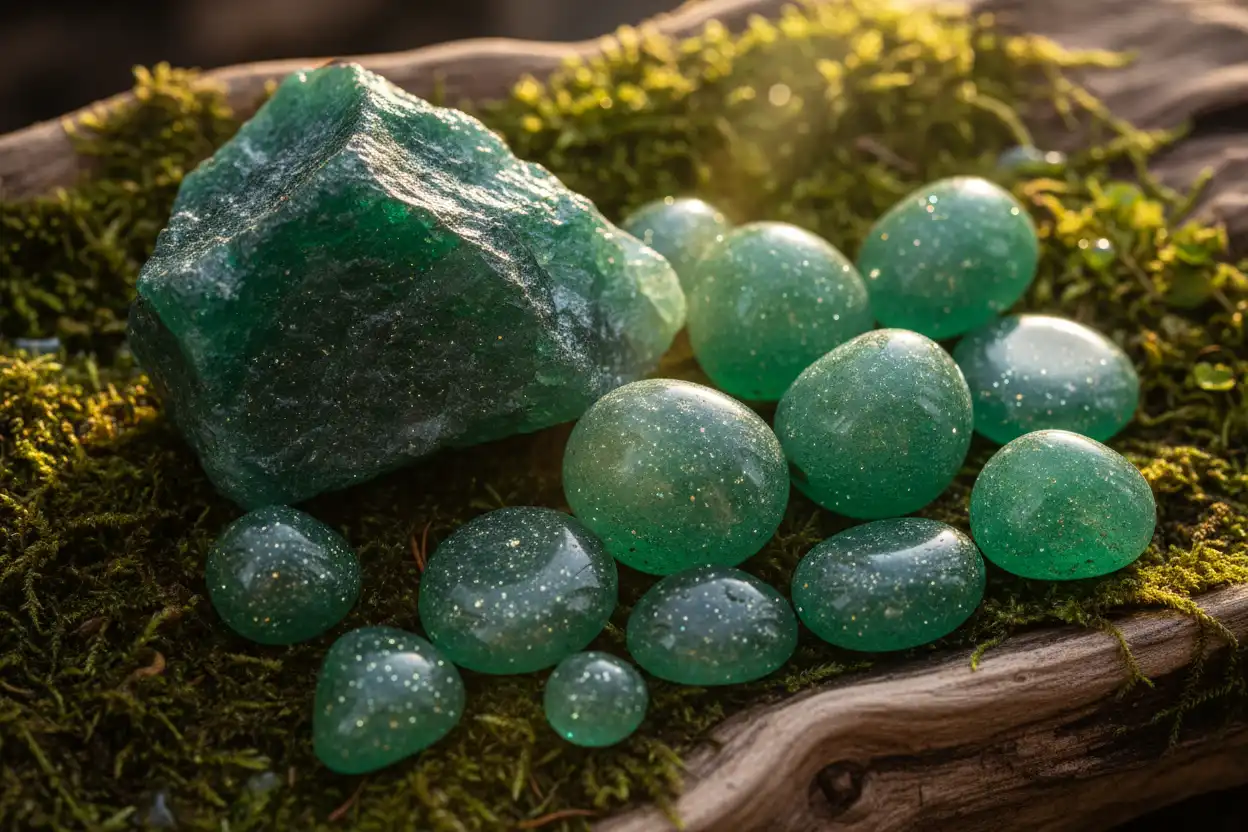
Aventurine Meaning: Quartz Identity, History & Symbolism
Aventurine meaning begins with an important identity distinction: aventurine is not a separate mineral species. The familiar gemstone is a quartz-rich material—often described as aventurine quartz and commonly occurring as quartzite or another quartz aggregate—whose defining visual feature is aventurescence, a glittering optical effect produced when light reflects from numerous visible or near-visible plate-like inclusions. Green aventurine is the best-known form, and its color and sparkle commonly come from chromium-bearing mica known as fuchsite distributed through the quartz-rich host.
This makes aventurine fundamentally different from a uniformly green transparent crystal. Its appearance depends on both the quartz host and the included minerals. Individual reflective plates catch light only at favorable angles, so the sparkle changes as the stone, observer, or light source moves. In some material the inclusions are abundant enough to influence the overall body color; in other pieces the quartz remains relatively pale while scattered reflective flakes create isolated flashes. Natural aventurine can therefore range from softly translucent and evenly green to granular, strongly included, streaked, or only weakly aventurescent.
Modern aventurine meaning commonly includes luck, opportunity, confidence, prosperity, emotional balance, growth, and optimism. These themes belong to contemporary symbolism rather than quartz physics. A reflective mica platelet can explain a flash of light, but it cannot establish that the stone attracts money, changes probability, controls another person’s decisions, heals disease, or guarantees success. Aventurine can still serve as a meaningful object when these ideas are understood as personal associations rather than measurable powers.
Readers exploring related mineral profiles can browse the broader Gemstone Guides collection.
Aventurine Identity at a Glance
| Property | Aventurine |
|---|---|
| Material identity | Quartz-rich gem material, commonly aventurine quartz or quartzite |
| Mineral species | Quartz is the dominant mineral; aventurine itself is not a separate mineral species |
| Dominant chemistry | SiO₂ from quartz |
| Defining optical feature | Aventurescence |
| Classic green inclusion | Fuchsite, a chromium-bearing mica |
| Other reflective inclusions | Hematite, pyrite, and other plate-like minerals can produce aventurescence in some quartz |
| Common colors | Green, reddish brown, orange-brown, yellowish, white or gray; other trade colors require individual identification |
| Transparency | Commonly translucent to opaque; locally more transparent |
| Luster | Vitreous from quartz, modified visually by inclusions and aggregate texture |
| Mohs hardness | About 7 for the quartz component |
| Typical specific gravity | Commonly near 2.65–2.67, with variation from inclusions and aggregate composition |
| Typical spot RI | Around 1.54 for quartz-rich aggregate material |
| Crystal structure | Dominated by trigonal quartz crystals within an aggregate |
| Common fashioned forms | Cabochons, beads, carvings, tumbled stones, spheres, slabs and decorative objects |
| Main diagnostic clue | Quartz properties combined with visible reflective inclusions |
| Main identification limit | Green color alone does not establish aventurine |
The identity distinction matters because a polished aventurine cabochon is often marketed as though the whole stone were one green mineral. In reality, its visual character may depend on millions of quartz grains plus numerous mica plates and smaller accessory minerals. The stone is compelling precisely because several components work together.
What Aventurescence Actually Is
Aventurescence is a reflective optical phenomenon produced when light encounters numerous flat interfaces or plate-like inclusions inside a transparent or translucent host. When an inclusion is oriented correctly relative to the incoming light and observer, it can produce a concentrated reflection. A group of differently oriented plates allows flashes to appear across the stone as it moves.
In classic green aventurine quartz, fuchsite mica produces much of this glitter. The tiny plates can also contribute green body color because fuchsite contains chromium. The visible result is therefore a combination of transmitted light through the quartz-rich host, absorption by included minerals, scattering from the aggregate structure, and direct reflection from flat inclusion surfaces.
Aventurescence should not be confused with asterism, chatoyancy, labradorescence, adularescence, or ordinary metallic sparkle painted onto a surface. Those effects arise from different structures. Natural aventurine’s glitter exists within the material and changes with viewing geometry rather than remaining fixed like decorative surface glitter.
Aventurine Is Not Always Strongly Sparkly
Commercial photographs often emphasize pieces with dramatic reflective flashes, which can create the impression that every genuine aventurine must glitter intensely. Natural material varies considerably.
Some aventurine contains abundant, relatively coarse reflective plates and displays obvious sparkle under ordinary light. Other material has finer, fewer, or less favorably oriented inclusions, producing a softer sheen visible mainly when the stone is rotated. A densely green piece may appear more uniformly colored than glittery because the numerous inclusions reduce transparency and scatter light.
Weak aventurescence does not automatically mean a stone is fake, just as strong sparkle does not prove that it is natural aventurine.
The distribution, shape, orientation, and mineral identity of the inclusions matter more than a simple bright-versus-dull test.
Why Green Aventurine Is Green
Green aventurine is classically associated with fuchsite, a chromium-bearing variety of muscovite mica. The chromium that gives fuchsite its green appearance contributes to the perceived body color when many flakes are distributed through quartz. Those same flat mica surfaces reflect light and produce the characteristic aventurescence.
This mechanism explains why green aventurine often looks different from uniformly colored green quartz. Color and glitter arise from included material rather than from a completely homogeneous green quartz crystal.
The concentration of fuchsite affects appearance. Sparse flakes may produce isolated green reflections in pale quartz, while abundant fine mica can create a more saturated overall green. Very dense inclusions may lower transparency and make the stone appear compact or almost opaque.
A photograph cannot reveal the exact chromium concentration or quantify the proportion of fuchsite. Those conclusions require direct mineralogical or chemical examination.
Red and Brown Aventurine Can Use Different Inclusions
Not all aventurine derives its visual effect from green mica. Quartz containing reflective hematite can show reddish, orange, brown, or metallic-looking spangles, and rare quartz can display aventurescence from other minerals such as pyrite.
This is an important identification boundary because “aventurine” describes an optical and material category more than one fixed inclusion recipe.
Two stones can both display genuine aventurescence while containing different reflective minerals.
Their color, density, internal texture, weathering behavior, and cutting response may therefore differ slightly. The quartz-rich host remains important, but the inclusions determine much of the visual personality.
Exact inclusion identification is best approached through magnification and, where necessary, analytical testing rather than assigning every metallic-looking flake to hematite or every green flake to fuchsite by sight.
The closer study of plates, grain boundaries, fractures, staining and other internal structures belongs in the Aventurine microscope inclusion notebook.
Blue Aventurine Needs More Careful Identification
The commercial name “blue aventurine” is applied to several blue quartz-rich materials, but not every blue specimen displays the classic mica-driven aventurescence of green aventurine. Blue color can be associated with other mineral inclusions, and some products marketed under the name are better described by their actual quartz-plus-inclusion composition.
For this reason, blue color should not be used to expand the definition of aventurine indefinitely.
A blue quartz material with no reflective platelets may still be attractive, but whether “aventurine” is the most accurate description depends on its structure and optical effect. The same caution applies to strongly purple, unusually bright turquoise-blue, or highly uniform material.
A trade name is most useful when it accurately describes what is physically present.
How Aventurine Forms
Aventurine quartz commonly develops where quartz-rich rocks contain platy minerals capable of surviving or forming during metamorphic and hydrothermal processes. Green aventurine is especially associated with fuchsite-bearing quartzite, where quartz grains recrystallize while chromium-bearing mica becomes dispersed through the rock.
Quartzite begins with quartz-rich material that undergoes metamorphism. Heat, pressure, deformation, fluids, and recrystallization transform the original sedimentary or vein-related textures into a stronger interlocking quartz aggregate. Where chromium is available, green mica can occur along grain boundaries, within bands, or throughout the quartz-rich rock.
The resulting material can preserve foliation, irregular inclusion concentrations, fractures, veins, and zones of different transparency. This explains why large blocks of aventurine may vary considerably from one cut surface to another. One section can show strong green glitter while another from the same rough piece appears pale or almost featureless.
Not every aventurine occurrence follows an identical geological pathway. Quartz with aventurescent inclusions can form in more than one setting, and the detailed relationships among host rocks, metamorphism, fluids, chromium sources, mineral associations, and deposit development belong in Aventurine formation and deposit geology.
Aventurine Is Usually an Aggregate, Not a Giant Green Quartz Crystal
Some illustrations depict aventurine as a transparent hexagonal crystal resembling green rock crystal. That is a poor representation of most commercial aventurine quartz.
Aventurine is commonly massive or aggregate material. Individual quartz grains may be too small to distinguish without magnification, while mica platelets interrupt the otherwise continuous quartz-rich texture. Natural broken surfaces therefore tend to look granular, uneven, or massive rather than showing the large crystal faces of a single rock-crystal specimen.
This distinction also affects fashioning. Cabochons, beads, carvings, and polished slabs are much more common than traditional transparent faceted gems because an aggregate structure displays aventurescence effectively across broad polished surfaces.
Transparent quartz crystals containing reflective inclusions certainly exist, but they should not be treated as the universal model for aventurine.
Quartz Hardness Gives Aventurine Good Scratch Resistance
Quartz defines Mohs hardness 7, which gives aventurine substantially better scratch resistance than calcite, fluorite, apatite, aragonite, or many soft collector minerals. This is one reason aventurine works well for beads, carvings, tumbled stones, pendants, and other frequently handled objects.
The hardness number still describes the dominant quartz component rather than guaranteeing that every part of a mixed stone behaves identically. Mica inclusions are softer than quartz, fractures can weaken a piece, and weathered or highly foliated areas may wear unevenly.
A strongly included stone can also develop small pits during polishing if soft inclusion-rich areas undercut more quickly than the surrounding quartz.
Aventurine is therefore durable for an ornamental material, but its internal structure still deserves consideration.
Diagnostic Traits of Aventurine
Aventurine identification usually combines quartz-like hardness and optical properties with visible platy inclusions producing aventurescence. Green material often shows mica flakes through a hand lens or microscope, while aggregate structure can distinguish it from homogeneous transparent gems.
A spot refractive-index reading near 1.54 and specific gravity around the mid-2.6 range are consistent with quartz-rich aventurine. A Mohs hardness close to 7 also fits quartz, although scratch testing should not be performed unnecessarily on a finished object.
These measurements help separate aventurine from softer imitations and some green ornamental materials, but treatment and mixed mineral content can complicate results. Polymer impregnation, dye, surface coatings, composite construction, or attached matrix can change appearance without changing the fundamental quartz identification.
When exact determination matters, microscopy, Raman spectroscopy, X-ray diffraction, or chemical analysis can identify both the quartz host and important inclusions.
Original Aventurine Specimen and Photo Checklist
A photograph can reveal useful information when observations remain separate from conclusions.
| Observation | What it may reasonably support | What it cannot prove alone |
|---|---|---|
| Translucent green quartz-rich body | Appearance compatible with green aventurine | Fuchsite as the inclusion mineral |
| Numerous reflective green plates | Strong evidence of aventurescent inclusion texture | Natural origin |
| Sparkle changes as stone rotates | Compatible with aventurescence | Exact mineral identity |
| Granular broken surface | Compatible with quartzite or quartz aggregate | Geographic origin |
| Vitreous polished surface | Consistent with quartz-rich material | Untreated status |
| Reddish metallic-looking flakes | Possible hematite or another reflective inclusion | Inclusion identity without testing |
| Extremely uniform bright green color | Possible treated material or unusual natural material | Dye by appearance alone |
| Surface-reaching green concentration in fractures | Reason to investigate dye | Proof of treatment |
| Bangle or carving resembling jade | Common aventurine use | Jade identity |
| Spot RI near 1.54 | Strong quartz-compatible evidence | Exact inclusion mineral |
| SG near 2.66 | Strong quartz-rich aggregate evidence | Geographic provenance |
| Visible mica under magnification | Strong inclusion evidence | Exact chromium content |
| Raman result confirming quartz and mica | Strong material identification | Mining locality |
| Original locality label | Useful provenance evidence | Treatment status |
The purpose of this checklist is not to make ordinary recognition impossible. Strong green aventurescence within quartz-rich material can make aventurine highly recognizable. The limitation is simply that recognition should not be stretched into unsupported claims about treatment, origin, composition, or commercial grade.
Aventurine Names and Claims That Need Qualification
| Name or claim | More accurate interpretation |
|---|---|
| Aventurine | Gem/material name for quartz-rich material showing characteristic inclusion-driven appearance |
| Aventurine quartz | Common and useful gemological name |
| Green aventurine | Usually quartz-rich material colored and aventuresced by green mica, commonly fuchsite |
| Red aventurine | Quartz material whose warm color and reflective effect may involve hematite or related inclusions |
| Blue aventurine | Trade usage varies; exact host and inclusions should be identified |
| “Aventurine crystal” | Common retail wording, but much material is polycrystalline or quartzite rather than one single quartz crystal |
| “Natural jade aventurine” | Misleading if it implies jade; aventurine quartz and jade are different materials |
| Goldstone | Manufactured glass containing reflective particles, not natural aventurine quartz |
| Sunstone | Feldspar material; aventurescent sunstone is not quartz aventurine |
| “AAA aventurine” | Seller-specific quality terminology rather than a universal laboratory grade |
| “Luck stone” | Symbolic tradition rather than evidence that probability changes |
| “Money stone” | Modern metaphysical marketing, not a financial mechanism |
| “Heart-healing crystal” | Symbolic language, not established medical treatment |
| “All green aventurine is untreated” | Unsupported; enhancement or impregnation can occur |
| “Sparkle proves natural aventurine” | False; manufactured glass and other materials can also sparkle |
This terminology is especially important because the word aventurine has been applied historically to more than one glittering material. Mineral identity should therefore accompany the name whenever confusion is plausible.
Aventurine and Goldstone Are Not the Same
Goldstone is manufactured glass containing abundant reflective metallic particles. It can display strong, highly regular sparkle and is sometimes sold under names such as aventurine glass.
Natural aventurine quartz is a geological material whose inclusions formed within or alongside quartz during natural mineral and rock-forming processes.
The distinction is visible in many specimens. Goldstone can show an unusually uniform distribution of bright metallic reflections within homogeneous glass, while natural aventurine tends to have more variable aggregate texture, inclusion concentration, color, fractures, and mineral relationships.
A beautifully manufactured goldstone is not inferior simply because it is glass. The problem arises only when it is represented as naturally mined aventurine.
Aventurine and Sunstone Share an Optical Word, Not a Mineral Species
The term aventurescence also applies to feldspar materials such as sunstone. Reflective plates inside certain feldspars can create brilliant flashes, and “aventurine feldspar” has long been used for such material.
This does not make sunstone a variety of aventurine quartz.
Quartz and feldspar have different compositions, crystal structures, cleavage, density, optical properties, and geological histories. The shared feature is the reflective optical phenomenon.
This distinction is useful because a phenomenon can cross mineral boundaries. Aventurescence describes what light is doing; it does not identify the host mineral by itself.
Aventurine and Jade Are Different Materials
Green aventurine has long been used as a jade simulant because both can be compact, green, translucent, polishable, and suitable for bangles or carvings. The similarity can be convincing in photographs, particularly when the aventurine contains fine mica rather than dramatic sparkle.
Mineralogically the materials are unrelated. Aventurine is quartz-rich, while the principal materials accepted as jade are jadeite and nephrite. Their structures, density, refractive behavior, toughness, surface texture, and inclusion patterns differ.
Polymer-impregnated aventurine quartz has also been encountered in jade-like objects, making treatment evaluation important when a piece is presented as something more valuable than quartz.
For this meaning reference, the important rule is simple: green appearance does not turn aventurine into jade, and a lack of obvious sparkle does not prove that a green carving is jade.
Treatment and Enhancement Need Separate Evidence
Natural aventurine can be attractive without treatment, but quartz-rich ornamental material is capable of being dyed, impregnated, coated, stabilized, assembled, or otherwise modified. Treatment should therefore not be dismissed simply because the base material is inexpensive.
Polymer impregnation can change transparency, surface behavior, and apparent compactness. Dye can intensify color or accumulate preferentially along fractures, pores, and grain boundaries. Surface coatings can create effects that disappear if the object is repolished.
None of these treatments should be diagnosed from one photograph alone.
Suspiciously uniform color, concentrated pigment along cracks, unusual surface luster, bubbles, inconsistent fluorescence, or discrepancies between surface and interior can justify closer examination, but analytical evidence is stronger than visual accusation.
Transaction-specific questions about disclosure and seller claims belong in where to buy aventurine.
The Name Aventurine Has an Accidental History
The word aventurine traces back to the Italian expression a ventura, meaning roughly “by chance.” The term became associated with glittering manufactured glass, traditionally linked with an accidental glassmaking discovery, and was later extended into mineralogical use for quartz-rich material containing sparkling mica.
This naming history helps explain why natural quartz and manufactured glass still share related terminology.
The glittering effect came first conceptually; the material names developed around it.
That history should not be transformed into the claim that aventurine itself creates lucky accidents. The linguistic connection between “by chance” and luck can certainly inspire symbolism, but etymology is not evidence that a stone alters probability.
Aventurine Meaning and Luck
Luck is probably the most recognizable modern aventurine meaning. Green aventurine is frequently described as a lucky stone, opportunity stone, gambler’s stone, or crystal for favorable outcomes.
As symbolism, the association is understandable. The historical word a ventura connects with chance, while green is widely associated with growth, money, renewal, and positive outcomes in modern culture.
A person might carry aventurine before an interview, competition, presentation, or new project because the object reminds them to approach uncertainty confidently.
The stone does not change mathematical probability.
It cannot make a random draw more favorable, guarantee a winning bet, influence lottery numbers, or ensure that an employer chooses one candidate over another. Games of chance remain governed by probability, and decisions involving gambling or money should never be based on crystal claims.
Luck can be a personal theme without becoming a statistical mechanism.
Aventurine Meaning and Money
Green aventurine is commonly marketed as a prosperity or money stone. Its green color makes the symbolism intuitive, particularly in cultures where green is associated with currency, growth, abundance, and financial success.
A more useful interpretation treats the stone as a prompt for financial behavior rather than a source of financial outcomes. Someone might place aventurine near a budgeting notebook as a reminder to review spending, save consistently, learn a skill, or complete a business task.
Those actions can affect finances.
The mineral itself cannot create income, remove debt, guarantee investment returns, make a business profitable, or determine market movements.
Aventurine should never be used as a substitute for financial analysis or professional advice.
Aventurine Meaning and Growth
Growth is another common symbolic theme, especially for green aventurine. The association works well at a metaphorical level because green is strongly connected with plants, renewal, development, and expanding potential.
Someone may choose aventurine to represent learning, patience, a long-term project, or personal development. Its internal mica plates can even provide a useful metaphor: small components distributed through a larger structure can change the appearance of the whole material.
The symbolism does not require a claim that aventurine physically accelerates biological growth, heals tissue, balances hormones, or changes cellular processes.
Personal growth remains a human process.
Aventurine and Heart Symbolism
Green aventurine is frequently linked with the heart chakra, emotional openness, compassion, relationships, and recovery after disappointment.
These interpretations belong to modern metaphysical systems and color symbolism rather than established anatomy.
A polished green stone can be used during meditation, reflection, journaling, or relationship-focused rituals if the practice is personally meaningful. The mineral has not been demonstrated to activate an anatomical chakra, regulate cardiac function, cure heart disease, treat grief, repair trust, or control another person’s emotions.
The distinction between symbolic practice and health claims is explained more broadly in the Gems Lore disclaimer.
Aventurine Does Not Have Established Healing Properties
Claims that aventurine treats allergies, inflammation, skin conditions, cardiovascular problems, hormonal disorders, anxiety, reproductive conditions, eye problems, or other illnesses are not established by gemological evidence.
Quartz hardness, crystal structure, chromium-bearing mica, or green color do not create a demonstrated medical delivery mechanism.
Someone may find a familiar stone comforting during a difficult period, just as another person may find comfort in jewelry, photographs, music, or another meaningful object. That personal experience should not be confused with a clinical treatment effect.
Persistent physical or mental-health concerns require appropriate qualified care rather than reliance on gemstone claims.
Safe Ownership of Aventurine
Aventurine’s quartz-rich composition gives it relatively good durability. It can be handled, worn, carved, tumbled, and polished more easily than many softer collector minerals, but the individual piece still matters. Dense compact material usually performs better than highly fractured, porous, heavily included, or strongly foliated material.
Store polished aventurine away from harder gemstones such as corundum and diamond that can scratch quartz. Avoid severe impacts on thin carvings, drill holes, sharp corners, or existing fractures. Warm soapy water and gentle cleaning are suitable conservative choices for untreated sound material, while unknown dyed, impregnated, coated, repaired, or composite pieces deserve greater caution.
Physical cleaning and symbolic cleansing methods are covered separately in how to cleanse aventurine.
The detailed relationship between durability, drill holes, ring exposure, mounting pressure, cabochon thickness, and jewelry design belongs in Aventurine setting and wear engineering.
Cutting Aventurine Is About Inclusion Distribution
Aventurine is commonly fashioned as cabochons because a broad polished dome can display reflective inclusions effectively. Beads, spheres, carvings, freeforms, slabs, and flat tablets are also common.
Orientation matters even when the inclusions are not perfectly aligned. A cutter can position attractive mica-rich bands across the face of a cabochon, remove weak fractures, avoid unsightly matrix zones, and balance maximum color with enough translucency to reveal internal sparkle.
Very dense mica concentrations can undercut during polishing because the inclusions and quartz do not wear identically. Mixed or foliated material may also chip along weak bands. A technically glossy surface can therefore conceal substantial variation beneath it.
Slab orientation, abrasive choices, edge stability, undercutting, polish and pattern retention are explored in Aventurine cutting, orientation and polish.
Collector Specimens Should Preserve Their Context
Although aventurine is best known as polished ornamental material, natural quartzite and quartz specimens can preserve useful geological evidence. Distribution of mica, foliation, veins, fractures, weathering surfaces and relationships with surrounding rock can reveal how the material formed.
Removing every piece of matrix or polishing every natural surface can erase some of that information.
Specimens with old locality labels deserve particular care because polished aventurine from different regions can look similar enough that provenance becomes difficult to reconstruct visually.
Long-term storage, label preservation, repairs and documentation are addressed in the Aventurine specimen conservation record, while locality and seller claims can be evaluated through the Aventurine provenance and disclosure checklist.
Original Evidence Ladder for Aventurine Claims
Aventurine demonstrates how quickly a simple green stone can accumulate claims far beyond what the material itself shows. A useful evidence ladder keeps those conclusions proportional.
Direct observation can establish color, translucency, visible sparkle, distribution of inclusions, fractures, grain structure, polish, carving quality, and surface condition.
Basic gemological examination can establish quartz-like hardness, spot refractive index, approximate specific gravity, aggregate behavior, and other conventional properties.
Microscopy can identify the shape and orientation of reflective platelets, reveal grain boundaries, detect fractures, document dye concentration, expose polymer-filled voids, and distinguish natural inclusions from surface decoration.
Mineral identification can confirm quartz and important inclusion phases using Raman spectroscopy, X-ray diffraction, or other suitable methods.
Chemical analysis can establish chromium in green mica or investigate other trace components when the exact color or inclusion mechanism matters.
Geological interpretation requires host-rock texture, metamorphic relationships, associated minerals, locality context, and evidence about how quartz and inclusions formed together.
Provenance requires original labels, supplier records, collection history, or field documentation.
Historical symbolism requires traceable cultural evidence showing that a particular meaning was actually used. Modern repetition alone does not establish antiquity.
Metaphysical effect remains a belief claim even when its cultural history is documented. Evidence that people associate aventurine with luck is not evidence that the mineral changes random outcomes.
This hierarchy gives aventurine meaning a stronger foundation than simply assigning every green stone the same list of benefits.
Aventurine Between Augelite and Axinite
A ugelite meaning concerns a comparatively uncommon aluminium phosphate whose pale green crystals are much softer and more cleavable than quartz-rich aventurine. Similar green color therefore conceals major differences in mineral identity and durability.
Axinite meaning concerns a separate mineral group known for wedge-shaped crystals, strong pleochroism in some material, and very different chemistry. It likewise demonstrates why color should never substitute for mineral identification.
Aventurine’s key distinction remains the combination of quartz-rich structure and reflective inclusions rather than one particular shade of green.
What Aventurine Meaning Can Responsibly Represent
Aventurine has several genuine properties that lend themselves naturally to personal symbolism. Its numerous reflective inclusions can represent noticing opportunities that are visible only from certain perspectives. Its quartz-rich aggregate structure can symbolize how many small components build a larger whole. Green material can represent growth or renewal through widely understood color associations, while the historical connection of the name with chance provides an obvious basis for luck symbolism.
These meanings are created through interpretation.
They do not require aventurine to manipulate probability, attract money, control relationships, or heal illness. Someone can use the stone as a reminder to notice opportunities and still recognize that opportunities become useful only through judgment and action.
That distinction makes aventurine meaning more practical rather than less meaningful.
The evidence-led principles used throughout Gems Lore are described on About Gems Lore. Specific questions about an aventurine specimen can be submitted through Contact Gems Lore.
Frequently Asked Questions
What is aventurine?
Aventurine is a quartz-rich gem material, commonly quartzite or another quartz aggregate, containing reflective inclusions that can produce aventurescence.
Is aventurine a mineral?
Aventurine itself is not a separate mineral species. Quartz is the dominant mineral in aventurine quartz, while mica or other inclusions create much of its characteristic appearance.
What is aventurescence?
Aventurescence is a glittering optical effect produced when light reflects from numerous plate-like or flat inclusions within a transparent or translucent material.
What causes green aventurine to sparkle?
Green aventurine commonly contains reflective fuchsite mica platelets. Their flat surfaces reflect light and produce the characteristic glitter.
What makes aventurine green?
Chromium-bearing fuchsite mica commonly contributes both green color and reflective inclusions to classic green aventurine quartz.
Is all aventurine green?
No. Quartz with aventurescent inclusions can appear reddish, brown, orange, pale or other colors depending on the host material and included minerals.
Is blue aventurine real?
Blue quartz-rich materials are sold as blue aventurine, but the trade term is applied broadly. The host material, inclusion mineral and presence of true aventurescence should be evaluated rather than relying on the name alone.
Is aventurine the same as jade?
No. Aventurine is quartz-rich, while jade refers principally to jadeite or nephrite. Their structures, toughness, density and gemological properties differ.
Is aventurine the same as sunstone?
No. Sunstone is feldspar. Some sunstone displays aventurescence, but the host mineral is different from quartz aventurine.
Is goldstone natural aventurine?
No. Goldstone is manufactured glass containing reflective particles. Its historical association with the word aventurine does not make it natural quartz.
How hard is aventurine?
The quartz-rich component is approximately Mohs 7, giving dense aventurine good resistance to ordinary scratching.
What is aventurine’s refractive index?
Quartz-rich aventurine commonly gives a spot refractive-index reading around 1.54.
What is aventurine’s specific gravity?
Typical quartz-rich aventurine is near the mid-2.6 range, although inclusions and aggregate composition can produce variation.
Where does aventurine form?
Classic green aventurine is strongly associated with quartz-rich metamorphic rocks containing green chromium-bearing mica. Other aventurescent quartz can develop in additional geological settings.
Can a photo identify aventurine?
A photograph can show green color, aggregate texture, and aventurescence, but it cannot reliably establish exact inclusions, treatment, purity, or geographic origin.
How can aventurine be identified?
Quartz-like hardness and optical properties, aggregate texture, reflective mineral inclusions, microscopy, spectroscopy and mineral analysis can provide increasingly strong evidence.
Is every sparkly green stone aventurine?
No. Glass, feldspar, mica-rich rocks, composites and other materials can also display reflective sparkle.
Can aventurine be dyed?
Quartz-rich ornamental materials can be dyed or otherwise enhanced. Uniform color or pigment concentrated in fractures can justify closer examination, but treatment should not be diagnosed from appearance alone.
Is aventurine durable?
Dense aventurine quartz is relatively durable for beads, carvings, cabochons and many jewelry applications because quartz is hard. Fractured, porous or strongly foliated pieces require more care.
Can aventurine be worn in a ring?
Yes, particularly when the material is compact and the setting protects edges. Existing fractures and weaker inclusion-rich zones can still affect durability.
What does aventurine symbolize?
Modern aventurine meaning commonly includes luck, opportunity, growth, confidence, optimism, prosperity and emotional balance.
Is aventurine really a lucky stone?
It has a strong modern symbolic association with luck, but there is no evidence that aventurine changes probability or guarantees favorable random outcomes.
Does aventurine attract money?
Aventurine can serve as a symbolic reminder of financial goals, but it has not been demonstrated to create income, eliminate debt, guarantee profits or influence markets.
Does aventurine help with gambling?
There is no evidence that carrying aventurine changes the mathematical odds of a game of chance. Gambling decisions should not be based on gemstone claims.
Does aventurine have healing properties?
There is no established scientific evidence that aventurine treats disease or creates physiological healing.
Is aventurine associated with the heart chakra?
Green aventurine is frequently connected with the heart chakra in modern metaphysical practice. This is spiritual symbolism rather than established anatomy or gemology.
Can aventurine help with emotional healing?
A meaningful object can be used during reflection or meditation, but aventurine has not been demonstrated to treat psychological conditions or independently repair emotional trauma.
How should aventurine be cleaned?
Sound untreated aventurine can generally be cleaned conservatively with warm soapy water and a soft cloth or brush. Treatment, fractures, repairs and mixed mineral content can require greater caution; detailed methods are covered in how to cleanse aventurine.
Where can I buy aventurine?
Identity, treatment disclosure, seller photographs, condition and provenance should be checked before purchase. Those transaction-specific decisions are covered in where to buy aventurine.
Aventurine meaning becomes more useful once the material’s famous sparkle is understood physically. Aventurine is a quartz-rich aggregate whose reflective inclusions create aventurescence; in classic green material, chromium-bearing fuchsite can contribute both color and glitter. Other inclusions can create different colors and reflective effects, which means aventurine is better understood as a material defined by host, texture and inclusions than as one chemically uniform green mineral.
Its history also provides a natural bridge to symbolism. The name’s association with chance helped make luck and opportunity enduring themes, while green color encouraged later connections with growth, prosperity and emotional renewal. These ideas can remain meaningful as human interpretations without being mistaken for evidence that quartz changes probability, finances, health or another person’s behavior.
Aventurine’s real identity—quartz, reflective inclusions, metamorphic history, optical behavior and practical durability—already explains why the material has remained distinctive in jewelry, carving and mineral collections.