11 Azurite Benefits: Deep Blue Color, Copper Geology & Historic Pigment Value
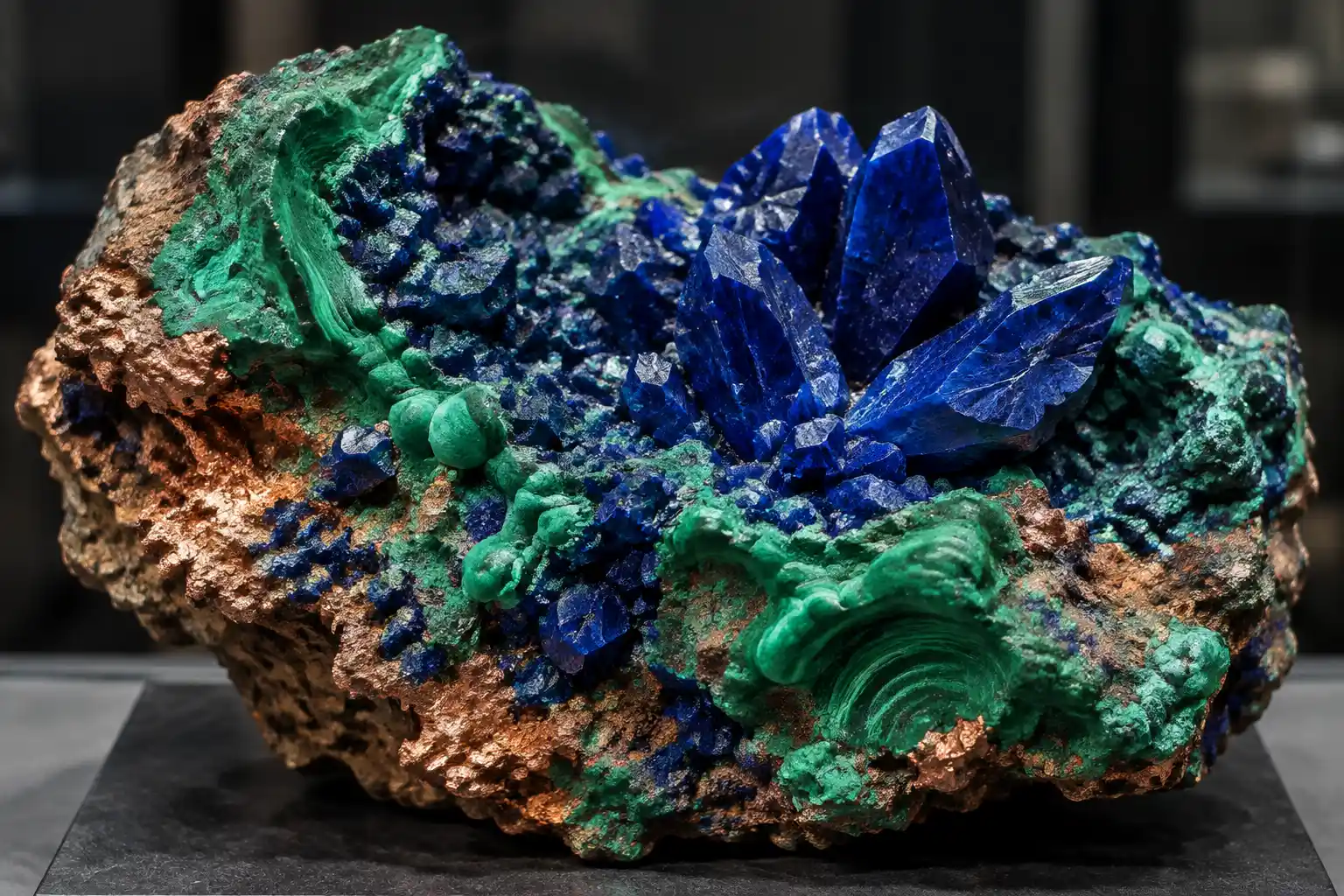
Azurite benefits begin with one of the richest natural blue colors in the mineral world. Intense azure, royal blue, and deep midnight-blue crystals can develop in the oxidized zones of copper deposits, often beside bright green malachite. The contrast between the two minerals can create specimens that are immediately recognizable even to beginning collectors.
Azurite is a copper carbonate hydroxide with the formula Cu₃(CO₃)₂(OH)₂. It crystallizes in the monoclinic system and commonly occurs as prismatic crystals, tabular forms, rosettes, nodules, massive aggregates, and earthy coatings. With a Mohs hardness around 3.5 to 4, it is considerably softer than quartz and requires more careful handling than many familiar jewelry gemstones.
The strongest azurite benefits are visual, historical, geological, collectible, artistic, and educational. Its blue color made finely ground azurite an important historic pigment, while its relationship with malachite provides a clear lesson in copper mineral oxidation and alteration. Proper safety and care are important because azurite contains copper and can produce hazardous dust if cut, ground, or ingested.
11 Azurite Benefits at a Glance
- Intense natural blue color makes azurite one of the most visually distinctive copper minerals.
- Historic use as a blue pigment connects mineralogy with painting and cultural heritage.
- Association with copper deposits makes azurite useful for understanding ore-zone geology.
- Natural combinations with green malachite create highly collectible contrasting specimens.
- Crystal forms, rosettes, nodules, and massive pieces offer substantial collecting variety.
- Polished azurite and azurite-malachite can produce striking cabochons and decorative objects.
- Its softness and acid sensitivity provide useful lessons in mineral-specific care.
- Azurite’s alteration toward malachite demonstrates how minerals change under environmental conditions.
- Its distinctive chemistry and color make it valuable for mineral-identification education.
- Documented localities add geological and collector value to well-labeled specimens.
- Modern symbolism can add personal meaning while remaining separate from medical claims.
Deep Natural Blue Leads the Most Obvious Azurite Benefits
Color is the defining feature behind most azurite benefits. Few common minerals develop such an intense natural blue. Fine crystals can range from medium azure to extremely dark blue that appears almost black until strong light reveals saturated color.
The blue results from copper in the mineral structure interacting with visible light. Azurite and malachite both contain copper, yet their structures produce dramatically different appearances: azurite blue and malachite green.
This difference makes copper mineralogy visually accessible. A collector can see immediately that the presence of the same major coloring element does not guarantee the same color in different crystal structures.
Azurite’s saturated blue also explains its long decorative and artistic history. Before modern synthetic pigments became widely available, naturally occurring blue minerals were valuable resources for artists.
Historic Blue Pigment Is One of the Most Important Azurite Benefits
Ground azurite served as an important blue pigment in paintings and decorative art for centuries. Artists and craftspeople processed selected mineral into particles that could be mixed with suitable binders to produce blue paint.
Particle size influenced appearance. Coarser azurite could produce stronger blue, while excessive grinding could result in paler or less desirable tones. Preparation therefore required skill.
Historic paintings containing azurite also demonstrate an important limitation: the mineral can alter under certain environmental and chemical conditions, sometimes producing changes in appearance over long periods.
This artistic history makes pigment science one of the most significant azurite benefits. The mineral connects geology with conservation, chemistry, art history, and the practical challenges faced by painters before modern industrial pigments.
Modern collectors should not grind specimens casually to reproduce pigment. Mineral dust containing copper compounds should not be inhaled or ingested.
Azurite Reveals the Oxidized Zones of Copper Deposits
Geological context provides another major group of azurite benefits. The mineral commonly develops as a secondary copper mineral where copper-bearing ore deposits interact with oxygen-rich water and carbonate-bearing conditions near Earth’s surface.
Primary copper sulfides buried deeper in a deposit can undergo chemical alteration when exposed to groundwater and oxygen. Under appropriate conditions, secondary minerals such as azurite and malachite form in the weathered or oxidized zone.
This process means azurite can provide information about the alteration history of a copper deposit.
Historically, brightly colored secondary copper minerals could also draw attention to copper-bearing ground. A vivid blue coating on rock was far more noticeable than many dull host minerals.
For collectors, retaining some host rock can therefore preserve geological context that a fully polished piece removes.
Azurite and Malachite Create Exceptional Natural Color Contrast
Azurite and malachite frequently occur together because both can form in oxidized copper deposits. Their saturated blue and green colors produce some of the most recognizable mineral combinations.
The association is more than aesthetic. Azurite can alter toward malachite under suitable conditions, meaning the two minerals may represent different stages or chemical conditions within the same weathering system.
Some specimens show distinct blue crystals on green malachite. Others contain intricate mixed patterns that cutters polish as azurite-malachite cabochons.
This combination adds to azurite benefits because one specimen can demonstrate mineral chemistry, alteration, collector aesthetics, and lapidary design simultaneously.
The relationship also gives useful context to azurite meaning, where blue and green color transitions sometimes inspire later symbolism around change and perception.
Natural Crystal Forms Give Azurite Strong Collector Appeal
Azurite can occur in well-developed crystals, radiating groups, rosettes, nodules, stalactitic forms, massive aggregates, and earthy deposits. This variety gives collectors several different ways to appreciate the mineral.
Sharp individual crystals may display vitreous luster and intense blue color, while rosettes create more sculptural arrangements. Massive material can reveal patterns suitable for polishing, and matrix specimens preserve relationships with malachite, calcite, limonite, or other associated minerals.
Quality depends on intended use. A mineral collector may value undamaged crystal faces and provenance, while a lapidary may prefer solid massive rough capable of taking a stable polish.
These different standards are part of the azurite benefits because the same mineral can interest specimen collectors, gem cutters, art historians, and geology students for completely different reasons.
Azurite Can Produce Attractive Cabochons and Decorative Pieces
Although azurite is too soft for demanding everyday jewelry, dense massive pieces can be polished into cabochons, beads, carvings, and decorative objects. Mixed azurite-malachite is particularly popular because its blue and green patterns create strong visual contrast.
The stone’s Mohs hardness of roughly 3.5 to 4 limits high-wear use. Exposed rings can scratch relatively quickly, while impacts may damage brittle areas. Pendants, earrings, brooches, and display objects are generally more practical.
Cabochons also avoid the need for the transparency required by conventional faceting. Color and pattern become the primary attractions.
When deciding where to buy azurite, consider whether a piece is a natural crystal specimen, solid massive azurite, azurite-malachite, reconstructed product, dyed imitation, or another blue mineral. Accurate identity matters more than an appealing trade description.
Softness Makes Azurite an Excellent Mineral-Care Lesson
Azurite’s low hardness reinforces an essential gemological principle: strong color does not imply strong durability. At about Mohs 3.5 to 4, it can be scratched by many common objects and by harder minerals in a specimen drawer.
The crystal hardness chart places azurite far below quartz at 7, which explains why quartz dust or direct contact with quartz specimens can damage polished azurite surfaces.
Azurite is also sensitive to acids because it is a carbonate mineral. Acidic household cleaners, vinegar, and similar substances can attack the surface.
This makes conservative care important. Natural crystals should be handled minimally, protected from abrasion, and stored so heavier or harder specimens cannot press against them.
Azurite’s Change Toward Malachite Demonstrates Mineral Transformation
One of the most scientifically interesting azurite benefits is its capacity to alter toward malachite under suitable environmental conditions.
Azurite and malachite are both copper carbonate minerals but differ in composition and crystal structure. Changes in water, carbon dioxide, and local chemical conditions can favor one phase over the other.
This transformation has implications for geology and historic pigments. A blue azurite-bearing surface may gradually develop green malachite under particular alteration conditions, changing both mineral identity and visible color.
For students, this demonstrates that minerals are not necessarily permanent under every environment. A crystal can be stable enough to survive for long periods yet still react when conditions change.
The lesson is especially useful because the change can be visible without advanced instrumentation.
Documented Locality Adds Scientific and Collector Value
Azurite occurs in copper districts around the world, and locality can strongly influence collector interest. Famous deposits have produced different habits, crystal sizes, associations, and shades of blue.
A well-labeled specimen preserves geological information that may be impossible to recover once provenance is lost. The name of a mine, district, region, and country can connect the specimen to a known ore body and mineral assemblage.
This is one reason anonymous decorative pieces and documented collector specimens should not automatically be valued by the same standards.
A modest crystal with precise provenance can be scientifically more useful than a visually larger piece whose origin has been forgotten.
Azurite Provides Useful Mineral Identification Lessons
Azurite’s blue color is distinctive, but color alone should never establish mineral identity. Lapis lazuli, sodalite, lazurite, dyed howlite, glass, chrysocolla, and other blue substances can look superficially similar in polished form.
Azurite’s hardness, carbonate chemistry, density, luster, crystal habit, associations, and professional analytical properties provide more reliable evidence.
Destructive acid tests should not be performed on valuable specimens merely to confirm a suspected carbonate. A collector can use safer observations or professional testing instead.
Identification becomes especially important for polished pieces where natural crystal form has been removed. Blue color by itself is never enough.
Safe Handling Matters Because Azurite Contains Copper
Ordinary handling of an intact azurite specimen is very different from grinding, cutting, crushing, or ingesting it. The greatest avoidable risk comes from creating dust or deliberately placing copper-containing mineral particles into food, drinks, or homemade elixirs.
Lapidary work should use wet cutting, effective dust control, eye protection, appropriate respiratory protection, and careful cleanup. Dust should not be blown around a living space or handled where food is prepared.
Azurite should never be ground for casual ingestion. Water used to soak the mineral should not be treated as a wellness drink.
These precautions do not make a cabinet specimen inherently dangerous to own. They simply reflect sensible exposure control for a copper-bearing mineral.
Azurite Benefits Modern Symbolism Without Proving Healing Effects
Modern crystal traditions commonly associate azurite with insight, perception, intuition, communication, concentration, meditation, and seeing a problem more clearly. The intense blue color and historical association with pigment likely reinforce some of these themes.
Someone may keep a specimen near a desk because it symbolizes careful observation or creative thought. That personal association can be meaningful without assuming copper carbonate changes neurological function.
Claims about azurite healing properties should remain separate from verified azurite benefits. Azurite has not been scientifically established as a treatment for neurological disorders, pain, anxiety, memory problems, liver disease, detoxification, or other medical conditions.
Its real value through mineralogy, color, art history, copper geology, collecting, and education is already substantial.
Conclusion
Azurite benefits include extraordinary natural blue color, historic pigment use, copper-deposit geology, striking associations with malachite, diverse crystal forms, lapidary potential, mineral-care education, observable alteration, locality value, identification training, and modern personal symbolism.
Its softness and copper content call for sensible handling, particularly during cutting or grinding, but intact specimens remain remarkable objects for study and display. Few minerals connect geology, art history, chemistry, and color as naturally as azurite.
FAQs
What Are the Main Azurite Benefits?
Azurite benefits include intense natural blue color, mineral collecting, historic pigment use, copper-geology education, lapidary work, identification practice, and artistic history.
What Is Azurite Made Of?
Azurite is a copper carbonate hydroxide with the formula Cu₃(CO₃)₂(OH)₂.
How Hard Is Azurite?
Azurite generally falls around 3.5 to 4 on the Mohs scale, making it much softer than quartz.
Why Is Azurite Blue?
Copper within the mineral structure produces strong absorption of portions of visible light, resulting in its characteristic intense blue appearance.
Was Azurite Used as Paint?
Yes. Ground azurite was historically used as an important blue mineral pigment.
Is Azurite Related to Malachite?
Yes. Both are secondary copper carbonate minerals commonly found together, and azurite can alter toward malachite under suitable conditions.
Is Azurite Good for Jewelry?
Protected pendants, earrings, brooches, and cabochons can work, but softness and brittleness make exposed daily-wear rings less practical.
Is Azurite Safe to Handle?
Normal handling of intact specimens is different from creating dust. Avoid inhaling cutting or grinding dust, ingesting particles, or using azurite in drinking-water elixirs.
Can Azurite Be Cleaned With Vinegar?
No. Azurite is a carbonate mineral and acidic cleaners can damage it.
Why Do Collectors Value Azurite?
Collectors appreciate its deep color, crystal habits, associations with malachite, locality, copper-deposit geology, and historical importance.
Are Azurite Healing Benefits Scientifically Proven?
No reliable evidence establishes azurite as a medical treatment.
Modern symbolic azurite benefits are personal wellness beliefs and should not replace qualified medical or mental health care.