Azurite Meaning: Copper Mineral, History & Symbolism
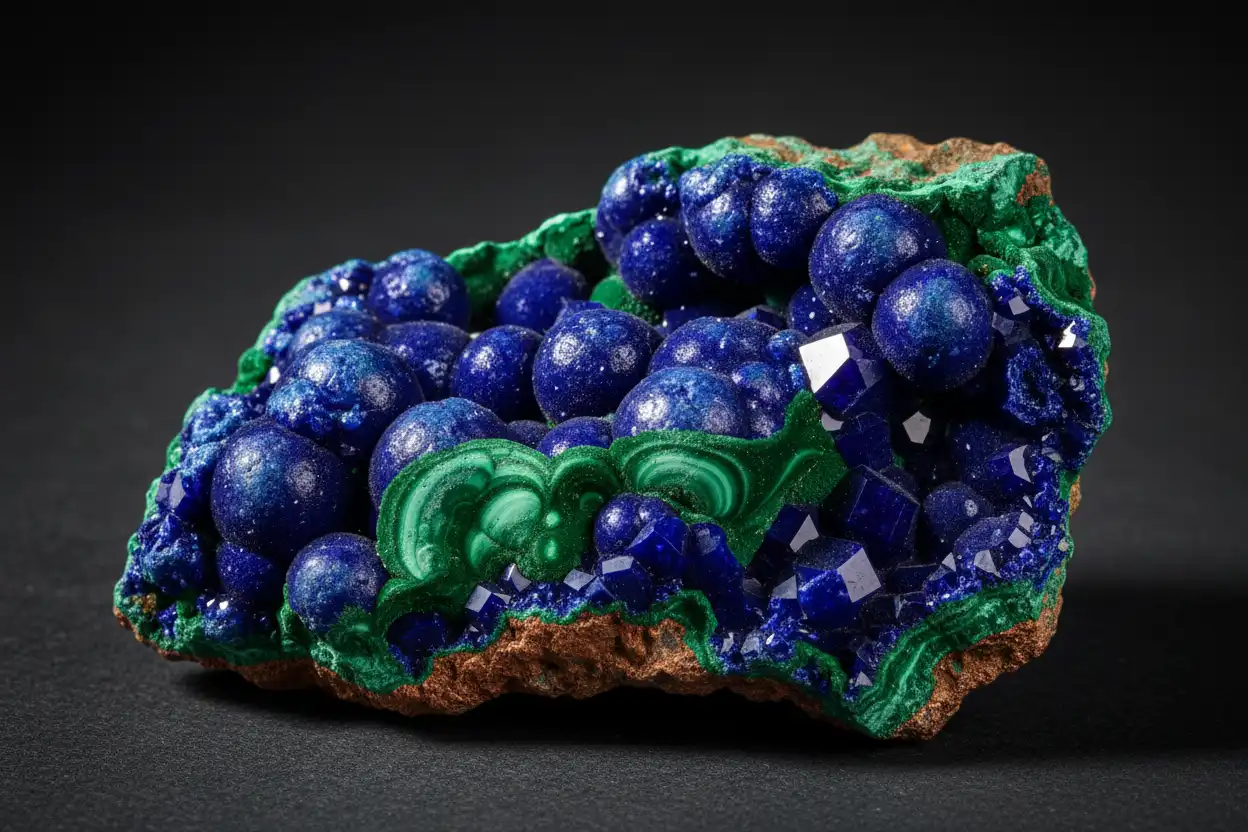
Azurite meaning begins with copper mineralogy. Azurite is a basic copper carbonate mineral with the formula Cu₃(CO₃)₂(OH)₂, recognized for an unusually intense blue that can range from medium azure through deep royal blue to nearly black-blue in thick crystals. It crystallizes in the monoclinic system and develops prismatic, tabular, bladed, stalactitic, botryoidal, fibrous, earthy, and massive forms. Its strong color is not a mystical emission or surface dye in ordinary natural specimens; it arises from the interaction of light with copper ions arranged within the mineral’s crystal structure.
Azurite is moderately soft, usually around 3.5–4 on the Mohs scale, with specific gravity close to 3.7–3.9. It is brittle, has recognizable cleavage, and can occur as transparent material in thin crystals while most collector specimens are translucent to opaque. These characteristics make fine azurite visually exceptional but mechanically less suitable for hard everyday wear than quartz, beryl, topaz, spinel, sapphire, or other common jewelry stones.
The mineral is also geologically dynamic. Azurite forms mainly in the oxidized zones of copper deposits, where copper-bearing solutions react with carbonate-rich conditions near the surface. It frequently occurs beside malachite, another basic copper carbonate, and azurite may gradually alter into malachite when environmental conditions favor the greener mineral. This natural relationship between intense blue and green has contributed to azurite’s visual appeal in mineral collections, ornamental stone, pigments, and later symbolic traditions.
Modern azurite meaning commonly includes insight, intuition, communication, concentration, self-reflection, spiritual awareness, and mental clarity. These themes can be meaningful as personal symbolism, but they are not measurable properties of copper carbonate. Azurite has not been demonstrated to improve intelligence, activate psychic abilities, treat disease, alter brain chemistry, open anatomical chakras, or reveal supernatural information.
Readers exploring other evidence-led mineral references can browse the broader Gemstone Guides.
Azurite Identity at a Glance
| Property | Azurite |
|---|---|
| Mineral species | Azurite |
| Chemical formula | Cu₃(CO₃)₂(OH)₂ |
| Mineral class | Carbonate |
| Essential coloring element | Copper |
| Crystal system | Monoclinic |
| Typical color | Azure blue, royal blue, deep blue, dark blue |
| Common habits | Prismatic, tabular, bladed, botryoidal, stalactitic, fibrous, massive, earthy |
| Transparency | Transparent in some thin crystals; commonly translucent to opaque |
| Luster | Vitreous on crystals; less lustrous in earthy or massive material |
| Mohs hardness | Approximately 3.5–4 |
| Specific gravity | Approximately 3.7–3.9 |
| Cleavage | Distinct to good |
| Tenacity | Brittle |
| Streak | Light blue |
| Typical geological setting | Oxidized zones of copper deposits |
| Common association | Malachite and other secondary copper minerals |
| Important alteration | Can transform or alter toward malachite under suitable conditions |
| Main ownership concerns | Softness, brittleness, heat sensitivity, acid sensitivity and preservation of color/surface |
| Identification limit | Deep blue color alone does not prove azurite |
These properties give azurite meaning a clear material foundation. It is a copper-bearing carbonate produced under particular geological conditions, and its softness, chemistry, color stability, and alteration behavior explain many of the practical decisions collectors make when handling it.
Why Azurite Is So Blue
Azurite’s blue color is one of the strongest natural blues found among common collector minerals. Copper ions are essential to that appearance. Their electronic structure interacts selectively with visible light, absorbing portions of the spectrum while allowing the remaining wavelengths to create the characteristic blue seen by the observer.
The exact appearance changes with crystal thickness, orientation, transparency, inclusions, surface quality, lighting, and aggregation. Thin transparent edges can appear considerably lighter than thick central areas, while large crystals may look almost black-blue until strong light reveals their internal color. Earthy azurite can appear softer or chalkier because tiny particles scatter light differently from smooth crystal faces.
This is why a photograph can make azurite look dramatically different from the same specimen in hand. Increased saturation, cool white balance, intense backlighting, or a dark background can turn a naturally rich blue specimen into an unrealistically electric image.
Color should therefore be described from controlled viewing rather than exaggerated for effect.
Detailed absorption, optical behavior, directional color, refractive properties, and color mechanisms are explored in Azurite optical properties and color behavior.
How Azurite Forms
Azurite is most strongly associated with the oxidized portions of copper deposits near Earth’s surface. Primary copper minerals deeper in a deposit can weather and react with oxygen-bearing groundwater. Copper released during this alteration moves through fractures and porous rock, where changing acidity, carbonate availability, carbon dioxide conditions, water chemistry, and local mineral reactions allow secondary copper minerals to precipitate.
Azurite is favored within part of this near-surface chemical environment. Calcite, limestone, dolomite, or other carbonate-bearing rocks can provide especially favorable conditions because carbonate is required in the azurite structure. Copper solutions entering cavities or fractures may crystallize as individual blue crystals, coat surfaces, form rounded botryoidal masses, or become intermixed with other secondary minerals.
The resulting assemblage can be visually complex. Azurite may occur with malachite, chrysocolla, cuprite, native copper, calcite, cerussite, smithsonite, limonite, and other oxidation-zone minerals depending on deposit chemistry.
The detailed sequence of copper oxidation, groundwater movement, host-rock reaction, carbonate availability, and mineral replacement belongs in Azurite formation and deposit geology.
Why Azurite and Malachite Occur Together
Azurite and malachite are chemically related copper carbonate minerals. Azurite has the formula Cu₃(CO₃)₂(OH)₂, while malachite is Cu₂CO₃(OH)₂. Because both form in oxidized copper deposits, they frequently appear together and can replace one another as environmental conditions change.
Azurite can alter to malachite through reactions involving water and carbon dioxide. On a specimen, this may produce green coatings, rims, patches, pseudomorphic replacements, or mixed blue-green masses. Some specimens preserve the outward form of earlier azurite crystals while much of the original material has changed to malachite.
That transition is geological rather than symbolic.
It does, however, provide a natural metaphor for change because two visibly different minerals can emerge from closely related copper-carbonate chemistry under different conditions.
A blue-and-green specimen should not automatically be described as partially altered azurite without examination, because several green secondary copper minerals can occur in the same deposits. Mineral identification remains necessary.
Azurite Can Form Crystals, Nodules, Rosettes, and Massive Material
Well-developed azurite crystals can be spectacular, but crystal form is only one expression of the mineral. Prismatic and tabular crystals may occur singly or in dense groups, while bladed aggregates can develop into rosettes. Botryoidal specimens form rounded surfaces resembling clusters of grapes, and stalactitic growth can develop where mineral-bearing solutions repeatedly deposit material along cavities.
Massive azurite lacks easily visible crystal faces yet remains the same mineral species when its structure and chemistry are preserved.
Fine earthy azurite is particularly important historically because it could be ground into a blue pigment. The powdered form looks much lighter than a thick crystal because particle size changes how light is scattered and absorbed.
This range of habits means that one memorized shape cannot identify azurite reliably.
Azurite’s Deep Color Can Hide Transparency
High-quality crystals can be transparent or translucent, yet thick azurite often looks opaque because its blue absorption is so strong. Shining light through a thin edge may reveal unexpectedly vivid transmitted blue.
This creates an important distinction between physical transparency and apparent darkness.
A crystal can be structurally transparent enough for light transmission while its intense absorption prevents much light from crossing a thick section. Faceted azurite is therefore possible in selected material, but cutters must work with the combined challenges of strong color, modest hardness, brittleness, cleavage, and limited suitable rough.
Transparent collector crystals are often more valuable preserved in their natural form than sacrificed for cutting.
Diagnostic Traits of Azurite
Azurite’s intense blue color is highly suggestive, but identification becomes stronger when color is combined with crystal habit, relatively high density, light-blue streak, carbonate chemistry, optical behavior, and geological context.
Specific gravity around the upper 3s makes azurite substantially heavier than many blue silicates of similar volume. Its hardness around 3.5–4 is far below quartz and can also help distinguish it from harder blue gemstones, although scratch testing should not be performed casually on finished or collectible material.
Acids react with carbonate minerals, but direct acid testing damages azurite and is unnecessary when nondestructive analytical methods are available. Raman spectroscopy and X-ray diffraction can distinguish azurite from other blue copper minerals without sacrificing an important specimen.
Microscopy can reveal growth zones, fractures, malachite replacement, associated minerals, surface coatings, polish features, repairs, and alteration textures. Those observations are explored more closely in the Azurite microscope inclusion notebook.
Original Azurite Specimen and Photo Checklist
A useful photograph can support several observations while leaving chemical and provenance questions open.
| Observation | What it may reasonably support | What it cannot prove alone |
|---|---|---|
| Intense royal-blue crystal | Strong visual compatibility with azurite | Definitive species identity |
| Light-blue streak on an existing rough area | Compatible physical property | Reason to damage a finished specimen |
| Prismatic monoclinic crystal habit | Supporting morphological evidence | Geographic origin |
| Rounded botryoidal blue surface | Common azurite habit | Pure azurite composition |
| Blue crystal with green alteration rim | Possible azurite-malachite relationship | Malachite without identification |
| Deep blue center and lighter transmitted edge | Compatible strong absorption | Treatment status |
| Brown iron-oxide matrix | Plausible oxidized-deposit context | Specific mine |
| Carbonate host rock | Geologically plausible association | Exact formation sequence |
| Fine blue powder on damaged area | Compatible with azurite streak | Pigment-grade material |
| Seller says “natural untreated azurite” | Disclosure claim | Independent confirmation |
| Seller names a famous copper mine | Provenance claim | Proof of locality |
| Raman spectrum matching azurite | Strong identification evidence | Provenance |
| X-ray diffraction matching azurite | Strong structural evidence | Whether a specimen was repaired |
| Original mine label | Important provenance evidence | Species confirmation |
The checklist deliberately separates what the eye can observe from what a laboratory or documentation trail must establish. Deep blue color makes azurite recognizable, but recognition is not permission to infer mine, treatment, history, or metaphysical properties.
Locality claims, repairs, seller descriptions, coatings, composites, and documentation can be evaluated through the Azurite provenance and disclosure checklist.
Claims About Azurite That Need Qualification
| Claim | More accurate interpretation |
|---|---|
| “Every deep blue copper mineral is azurite” | False; several copper minerals can be blue |
| “Azurite and malachite are the same mineral” | False; they are distinct but chemically related copper carbonates |
| “Azurite instantly turns green” | Alteration to malachite depends on environmental conditions |
| “All green areas on azurite are malachite” | Other green copper minerals can occur and require identification |
| “Azurite never changes” | It can alter chemically and its surface can be affected by heat, acids, moisture conditions and handling |
| “Azurite is safe in every cleaning solution” | Carbonate chemistry makes acidic cleaning inappropriate |
| “Blue color proves a famous locality” | Color cannot establish provenance |
| “Azurite was universally sacred in all ancient cultures” | Cultural use varied and should be documented specifically |
| “Azurite improves intelligence” | No established evidence supports a cognitive effect from the mineral |
| “Azurite opens the third eye scientifically” | Chakra language belongs to spiritual belief systems |
| “Copper in azurite heals the body when worn” | Mineral copper is not delivered as a controlled therapeutic dose through skin |
| “Azurite water is medically beneficial” | Raw mineral specimens should not be treated as ingestible remedies |
Azurite meaning becomes clearer once statements are sorted into measurable mineral facts, documented cultural history, and modern symbolism.
Azurite Has an Important Pigment History
Long before modern synthetic blue pigments became common, finely ground azurite was used as a blue pigment in painting and decorative work. The mineral’s intense natural color made it valuable wherever blue was visually important but other blue materials were scarce, expensive, or unavailable.
Grinding changes the appearance considerably. A dark crystal becomes a lighter blue powder because small particles scatter light differently. Painters and pigment makers could manipulate particle size and preparation to influence the resulting shade.
Azurite pigment was used in several regions and artistic traditions, but historical claims should be tied to documented objects and contexts rather than converted into one universal ancient narrative. Mineral pigments traveled through trade, changed names across languages, and could be confused with other blue substances.
Its artistic significance is nevertheless substantial. Azurite was not merely decorative crystal material; it was also a technologically useful source of blue.
Azurite and Lapis Lazuli Were Historically Distinct Blue Materials
Azurite is sometimes casually grouped with lapis lazuli because both supplied historic blue pigments. Mineralogically they are unrelated.
Azurite is a copper carbonate mineral.
Lapis lazuli is a rock composed principally of lazurite with varying amounts of calcite, pyrite, and other minerals.
Their pigment behavior, chemistry, geological origin, availability, and historical trade differed. Confusion between them can occur when old terminology uses broad color-based names instead of modern mineral classifications.
This reinforces a useful historical principle: a written reference to a “blue stone” does not automatically identify azurite.
Azurite Has Been Used Ornamentally, but It Is Soft for Daily Jewelry
Azurite can be polished into cabochons, beads, carvings, inlay, and decorative slabs, particularly when massive material occurs with malachite. Its rich blue color can make even a small polished piece visually powerful.
Durability remains the limiting factor. Hardness around 3.5–4 means a polished surface can scratch much more readily than quartz or beryl, while brittleness and cleavage increase the risk of chips. An exposed ring is therefore substantially more demanding than a pendant, brooch, earring, or protected inlay.
Mixed azurite-malachite material can also polish unevenly because textures and degrees of alteration vary across a single piece.
Stone orientation, fragile zones, polishing behavior, color preservation, and structural weaknesses are covered in Azurite cutting, orientation and polish.
Mounting pressure, edge protection, ring exposure, backing, adhesive use, and long-term wear are addressed separately in Azurite setting and wear engineering.
Azurite Requires More Care Than Its Dense Appearance Suggests
A dark, compact azurite specimen can look extremely solid, but surface hardness and chemical sensitivity matter more than visual weight. Fine crystal faces can scratch, thin blades can break, and botryoidal surfaces can be damaged by aggressive brushing.
Acidic household cleaners are unsuitable because azurite is a carbonate mineral. Strong heat should also be avoided, particularly because copper carbonates can undergo chemical changes when heated sufficiently. Steam cleaning is therefore unnecessary, and ultrasonic cleaning is a poor default for fractured, cleavable, repaired, or matrix specimens.
Gentle dry dusting or carefully controlled cleaning is preferable for valuable natural crystals. Polished untreated material can tolerate somewhat easier handling, but unknown repairs, coatings, mixed minerals, or stabilization should be considered before immersion.
Detailed physical and symbolic cleaning options are covered in how to cleanse azurite.
Sunlight and Color Preservation
Azurite’s color is fundamentally mineralogical rather than a delicate organic dye, but prolonged uncontrolled environmental exposure is still unnecessary for collector specimens. Heat, moisture cycles, dust, chemical pollutants, unstable matrix, and surface alteration can affect specimens over time even when the blue crystal structure itself remains intact.
A display location should therefore prioritize stable conditions over dramatic direct sunlight.
Museum-style preservation is not about treating azurite as impossibly fragile. It is about avoiding conditions that offer no benefit while increasing long-term risk.
Repairs, labels, matrix stability, environmental storage, and documentation belong in the Azurite specimen conservation record.
Copper Content Does Not Make Azurite a Medicine
Azurite is copper-rich. That fact is essential to its chemistry, color, density, and geological formation.
It does not mean wearing azurite provides nutritional copper.
Copper required by the human body must be supplied in biologically appropriate forms and controlled amounts. A mineral crystal touching skin does not establish dose, absorption, efficacy, or safety.
Similarly, copper chemistry should not be used to claim that azurite treats inflammation, arthritis, neurological conditions, circulation, infections, pain, or other health problems.
The mineral formula explains the stone.
It does not prescribe treatment.
Do Not Use Raw Azurite for Ingestible Crystal Remedies
Azurite specimens should not be ground into powders for ingestion or deliberately placed in drinking water as a health remedy. Natural material may contain other copper minerals, matrix, alteration products, dust, adhesives, stabilizers, contaminants, or surface treatments in addition to azurite.
Even a chemically pure specimen would not become medically appropriate simply because its composition is known.
This boundary is especially important with copper minerals because ingestion and unnecessary exposure should not be encouraged through metaphysical practices.
Symbolic use does not require the mineral to enter the body.
Normal Handling and Mineral Dust Are Different Exposure Situations
Handling an intact specimen for viewing or placing a polished stone in jewelry is different from grinding, cutting, sanding, or crushing it. Mechanical processing generates fine mineral dust and increases the opportunity for particles to be inhaled or transferred to the mouth.
Lapidary work should therefore use wet methods where appropriate, local extraction, eye protection, suitable respiratory controls, and careful cleanup. Eating or drinking in dusty work areas is poor practice.
These controls are proportionate workshop measures, not a reason to fear an intact specimen on a shelf.
Wash hands after extensive handling of rough copper-mineral specimens, particularly before eating.
Buying Azurite Requires Attention to Condition
Azurite’s value can be strongly influenced by crystal form, color, luster, aesthetics, locality, matrix, damage, repairs, associated minerals, and provenance. A large blue mass may be less desirable than a smaller specimen with sharp undamaged crystals and excellent matrix contrast.
Polished material has a different value structure. Color pattern, proportion of azurite to malachite, stability, craftsmanship, repairs, and whether the piece is natural or assembled become more important.
The transaction-specific questions of seller disclosure, restoration, locality documentation, photography, and value comparison belong in where to buy azurite.
A high price should never substitute for identification.
The Historical Meaning of Azurite Is More Specific Than “Ancient Psychic Stone”
Azurite’s documented history includes pigment production, decorative use, mineral collecting, copper geology, and cultural appreciation of blue. These uses provide real evidence that people valued the mineral.
Modern statements sometimes claim that ancient cultures universally used azurite to develop psychic powers, contact spirits, or open the third eye. Such claims should be treated individually rather than repeated as a single global tradition.
A blue mineral found archaeologically must first be identified accurately. Even when azurite is confirmed, the object’s context must show how it was used. Pigment on a wall, powder in a workshop, a bead, and a ritual object do not all carry the same meaning.
Documented cultural use should therefore be preserved without filling historical gaps with modern metaphysical assumptions.
Modern Azurite Meaning and Insight
Insight is one of the most intuitive modern themes associated with azurite. The mineral’s deep blue color has become linked with contemplation, knowledge, inward attention, and mental depth in contemporary crystal traditions.
A person may place azurite near a notebook while working through a complicated decision or use it as a visual prompt to question assumptions before acting. In that role, the mineral becomes an intentional cue.
The reflective process belongs to the person.
Azurite has not been demonstrated to transmit information, reveal hidden truths automatically, or improve reasoning ability through an energetic field.
Azurite Meaning and Communication
Blue stones are often associated with speech and communication, partly through modern chakra systems and broader color symbolism. Azurite is consequently described as helping people express truth, communicate clearly, or overcome fear of speaking.
The symbolic interpretation can be translated into practical behavior. Someone might use the stone as a reminder to prepare carefully before a difficult conversation, listen actively, speak precisely, or write down what they need to communicate.
Those actions can improve communication.
There is no established evidence that azurite alters vocal function, language processing, social confidence, or another person’s receptiveness through mineral energy.
Azurite and the Third Eye
Azurite is frequently linked with the third-eye chakra in contemporary metaphysical practice because of its intense blue to blue-violet visual range. In those traditions, it may symbolize intuition, perception, imagination, or spiritual awareness.
Chakras belong to spiritual and cultural systems rather than mineralogical anatomy.
A mineralogist can measure azurite’s crystal structure, copper content, absorption spectrum, density, hardness, and optical properties. Those methods do not demonstrate an anatomical energy center being opened by contact with the stone.
Someone can still use azurite during meditation if the practice is meaningful to them. The experience should be described as personal or spiritual rather than as a scientifically proven effect.
Claims About Psychic Ability Need a Clear Boundary
Azurite is sometimes marketed as a stone for clairvoyance, telepathy, prophetic dreams, spirit communication, or enhanced intuition.
No established mineralogical mechanism supports those claims.
A person may experience vivid thoughts or dreams while using a meaningful object because attention, expectation, memory, and personal belief can shape subjective experience. That does not establish that information originated from the mineral.
Important decisions involving health, money, safety, relationships, or legal matters should therefore not be based on claims that azurite provides supernatural certainty.
The broader distinction between symbolism, spiritual belief, and evidence is explained in the Gems Lore Disclaimer.
Azurite Does Not Have Established Healing Properties
Azurite is sometimes assigned healing claims involving the brain, nervous system, joints, bones, detoxification, thyroid function, memory, anxiety, pain, inflammation, or cellular repair.
These statements are not established medical effects of the mineral.
The presence of copper does not provide a valid treatment mechanism through wearing or holding a specimen, and blue color does not create a neurological therapy.
Someone can value an azurite specimen while receiving appropriate medical or mental-health care. Personal symbolism and healthcare do not need to compete as long as the mineral is not presented as a replacement for diagnosis or treatment.
Azurite’s Change to Malachite Offers a Better Symbol of Transformation
If azurite is used symbolically, its actual mineral behavior provides a stronger metaphor than invented healing claims. Under suitable geological conditions, blue azurite can alter toward green malachite while remaining within the broader chemistry of secondary copper minerals.
That natural transformation can represent adaptation, changing conditions, or the idea that identity is partly shaped by environment.
The geological process does not imply that wearing azurite transforms a person’s life.
It provides a real natural phenomenon that a person may choose to interpret metaphorically.
This distinction preserves both scientific accuracy and symbolic freedom.
Azurite Alongside Nearby Mineral References
Axinite meaning concerns a borosilicate mineral group rather than a copper carbonate. Its brown, yellow, violet, or pale crystals have very different chemistry, hardness, density, and geological formation.
Barite meaning concerns barium sulfate, another comparatively dense collector mineral whose high specific gravity arises for a completely different chemical reason.
These neighboring references illustrate why collector minerals should not be grouped scientifically by metaphysical themes such as “intuition stones” or “grounding crystals.” Mineral classes are defined by structure and chemistry.
Original Evidence Ladder for Azurite Claims
Azurite is visually distinctive enough to encourage overconfidence, so an evidence ladder is particularly useful.
Direct observation can establish blue color, transparency, crystal habit, luster, matrix, green alteration, fractures, surface damage, restoration, and visible associations.
Basic mineral examination can add density, hardness context, streak, optical behavior, cleavage, and other physical properties without unnecessarily damaging the specimen.
Microscopy can reveal growth structures, alteration to other copper minerals, coatings, repairs, polishing compounds, inclusions, fracture fillings, and relationships with the matrix.
Mineral identification can be confirmed through Raman spectroscopy, X-ray diffraction, or another suitable structural method.
Color interpretation can be connected confidently with copper-based absorption once the material is established as azurite, while unusual surface colors or coatings may require additional examination.
Geological interpretation requires host-rock evidence, mineral associations, replacement textures, oxidation-zone relationships, and local deposit context.
Provenance requires labels, collection records, supplier documentation, or reliable field information. Blue color cannot establish a mine.
Historical-use claims require archaeological, documentary, artistic, or scientific evidence linking identified azurite to the stated practice.
Metaphysical claims remain belief-based even when historically documented. Evidence that people attributed a power to azurite does not demonstrate that the claimed power physically occurs.
This hierarchy allows azurite meaning to include mineral science, history, and symbolism without treating all three as the same type of evidence.
What Azurite Meaning Can Responsibly Represent
Azurite already offers several natural metaphors. Its deep blue can symbolize contemplation or depth. Its use as a pigment can represent expression and creativity. Its formation in weathered copper deposits can represent the emergence of something visually remarkable through chemical change. Its relationship with malachite can symbolize transformation under new conditions.
A person may use these themes intentionally. An azurite specimen can become a reminder to think before speaking, examine a difficult question more deeply, document ideas, or accept that changed circumstances sometimes require a different response.
The mineral does not need to predict the future or alter the brain for those meanings to matter.
The evidence-led approach used across Gems Lore is described on About Gems Lore. Questions about a particular specimen can be submitted through Contact Gems Lore.
Frequently Asked Questions
What is azurite?
Azurite is a basic copper carbonate mineral with the formula Cu₃(CO₃)₂(OH)₂. It is famous for its intense blue color.
What is azurite meaning?
Azurite meaning can refer to its mineral identity and historical use or to modern symbolic themes such as insight, communication, intuition, reflection, and transformation. Scientific and symbolic meanings should be kept distinct.
Why is azurite blue?
Copper ions within the mineral’s crystal structure selectively absorb portions of visible light, producing azurite’s characteristic intense blue.
Is azurite naturally blue?
Yes. Natural azurite is intrinsically blue because of its copper-bearing crystal chemistry.
What colors can azurite be?
Its characteristic range extends from medium azure and royal blue to very dark blue. Fine powder and earthy material can appear noticeably lighter than thick crystals.
Is azurite the same as malachite?
No. Both are basic copper carbonates, but they have different chemical formulas, crystal structures, and colors.
Can azurite turn into malachite?
Azurite can alter or be replaced by malachite under suitable environmental conditions. This is a geological process rather than an instant change during normal handling.
Why do azurite and malachite occur together?
Both form in oxidized copper deposits and are stable under overlapping but different chemical conditions, allowing them to occur together or replace one another.
How hard is azurite?
Azurite is approximately 3.5–4 on the Mohs hardness scale.
Is azurite fragile?
It is relatively soft, brittle, and cleavable, so sharp crystals and polished surfaces require more care than harder gemstones.
Is azurite heavy?
Azurite is relatively dense, with specific gravity commonly around 3.7–3.9.
Where does azurite form?
It commonly forms in oxidized zones of copper deposits where copper-rich solutions interact with carbonate-bearing conditions near the surface.
What minerals occur with azurite?
Malachite is one of the most familiar associates, while other secondary copper minerals, calcite, iron oxides, cuprite, chrysocolla, and additional minerals may occur depending on the deposit.
Can azurite be transparent?
Yes. Fine thin crystals can be transparent, although strong blue absorption makes thicker material appear translucent or opaque.
Can azurite be faceted?
Transparent material can be faceted as a collector gem, but modest hardness, brittleness, cleavage, and specimen rarity make faceted azurite uncommon.
Is azurite good for rings?
It is not an ideal everyday ring stone because it scratches and chips relatively easily. Protected occasional-wear designs are more appropriate than exposed daily settings.
Was azurite used as a pigment?
Yes. Ground azurite has an important history as a natural blue pigment in art and decoration.
Does powdered azurite look different from crystals?
Yes. Fine powder generally appears lighter blue because particle size changes how light is scattered and absorbed.
Can a photograph prove a specimen is azurite?
No. A photograph can strongly suggest azurite from color and habit, but exact identity, treatment, provenance, and associated minerals may require additional evidence.
How is azurite identified?
Useful evidence includes color, streak, density, hardness context, crystal habit, optical properties, microscopy, Raman spectroscopy, and X-ray diffraction.
Should azurite be tested with acid?
Direct acid testing can damage the mineral and is unnecessary when nondestructive methods are available.
Can azurite be cleaned with vinegar?
No. Vinegar is acidic and can attack carbonate minerals such as azurite.
Is azurite safe to handle?
Normal handling of an intact specimen is different from ingesting or grinding it. Handle rough copper minerals sensibly, wash hands after extensive contact, and avoid creating unnecessary dust.
Can azurite go in drinking water?
Raw azurite should not be used to prepare ingestible crystal remedies. Its copper content and natural specimen impurities make that an inappropriate use.
Does azurite provide copper to the body?
Wearing or holding azurite does not provide a controlled nutritional copper dose.
What does azurite symbolize?
Modern symbolism commonly connects azurite with insight, intuition, communication, mental clarity, contemplation, spiritual awareness, and transformation.
Is azurite a third-eye stone?
It is commonly described that way within modern chakra traditions. This is a spiritual association rather than a recognized anatomical or mineralogical property.
Does azurite improve intuition?
A person can use it as a symbolic reminder to reflect carefully, but no established evidence shows that the mineral itself increases intuition or supplies supernatural information.
Does azurite have healing properties?
There is no established scientific evidence that azurite treats disease or produces physiological healing.
How should azurite be stored?
Protect it from harder minerals, impact, acidic materials, unnecessary heat, unstable humidity, and aggressive handling. Preserve original specimen labels and repair information.
Where can I buy azurite?
Identity, specimen condition, repair disclosure, locality documentation, photography, and purchasing considerations are covered in where to buy azurite.
Azurite meaning becomes stronger when its extraordinary blue color is understood as mineral chemistry before it becomes symbolism. Azurite is a monoclinic copper carbonate produced mainly in oxidized copper deposits, where groundwater chemistry, carbonate availability, and weathering create environments capable of forming intense blue crystals, botryoidal masses, and mineral replacements. Its close relationship with green malachite documents real chemical transformation within those environments.
Its history also extends beyond mineral collecting. Azurite’s use as a blue pigment connects the mineral with artistic expression and material technology, while its visual intensity naturally supports modern metaphors involving depth, communication, insight, and reflection.
Those symbolic associations can remain personally meaningful without turning azurite into a medical treatment, psychic instrument, or source of supernatural certainty. The mineral’s genuine chemistry, geology, optical behavior, pigment history, and relationship with malachite already provide a substantial foundation for understanding why azurite has attracted attention for so long.