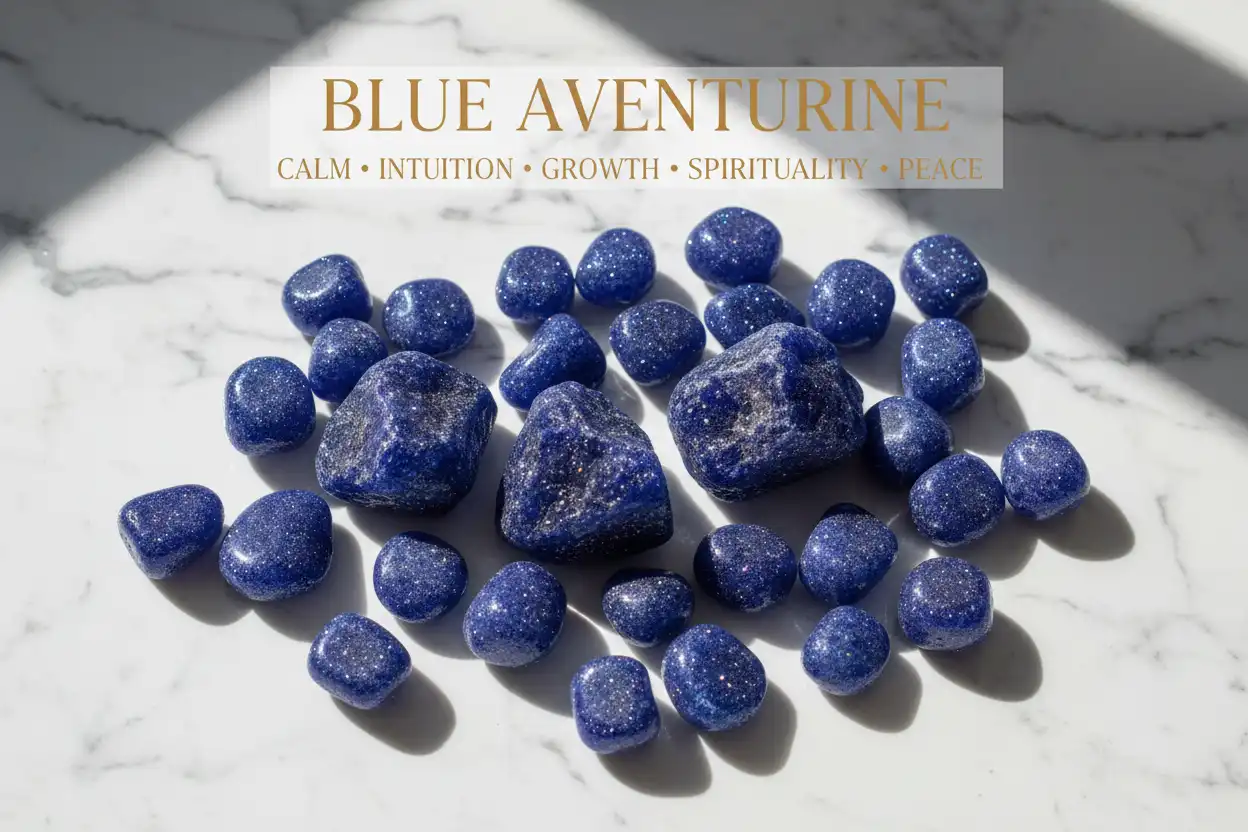
Blue Aventurine Meaning: Identity, History & Symbolism
Blue aventurine meaning is often described through ideas such as calm communication, self-discipline, confidence, mental clarity, or emotional steadiness, but those interpretations make sense only after the material itself has been identified correctly. “Blue aventurine” is a commercial gem and lapidary name applied to blue quartz-rich material, yet the label is less mineralogically straightforward than familiar green aventurine. Genuine aventurine quartz is distinguished by aventurescence—the glittering reflection produced by numerous small plate-like inclusions—while some blue quartz sold under the blue aventurine name may show little obvious aventurescence or may owe its color to different included minerals.
That ambiguity is important. Blue color alone does not establish aventurine, and a polished blue stone cannot safely be identified from a product name, photograph, or metaphysical description. Quartz containing fine blue dumortierite inclusions is a documented cause of blue coloration in some natural quartz, while classic aventurine quartz derives its sparkling appearance from reflective inclusions rather than from the quartz lattice simply being “blue.” GIA describes aventurescence in quartz as reflection from abundant plate-like inclusions and separately documents blue coloration in quartz caused by dumortierite inclusions.
For broader material-focused references, the Gemstone Guides organize stones by identity rather than relying on color or metaphysical labeling.
What Is Blue Aventurine?
Blue aventurine is best treated as a descriptive lapidary or trade material rather than a separate mineral species. Its principal host is quartz, SiO₂, commonly occurring as a fine-grained quartz aggregate or quartz-rich material containing microscopic to visible inclusions. When those inclusions are sufficiently reflective and appropriately oriented, they produce the optical phenomenon known as aventurescence.
This definition creates an immediate diagnostic boundary. A piece of natural blue quartz can be genuine quartz without necessarily being genuine aventurine in the strict phenomenal sense. Conversely, a stone can contain strongly reflective inclusions yet show uneven blue color. The name used by a retailer does not resolve that distinction.
| Property | Blue aventurine context |
|---|---|
| Material type | Quartz-rich ornamental material / aventurine quartz when aventurescence is present |
| Separate mineral species | No |
| Principal chemistry | SiO₂ host |
| Typical appearance | Pale to medium blue, blue-gray or unevenly blue quartz-rich material |
| Defining aventurine effect | Aventurescence from reflective inclusions |
| Possible blue-color contributor | Fine included blue minerals such as dumortierite in some quartz |
| Crystal system of quartz host | Trigonal |
| Mohs hardness | Approximately 7 for quartz-rich material |
| Typical luster | Vitreous on polished quartz surfaces, with possible sparkling reflections |
| Transparency | Commonly translucent to opaque depending on inclusions and texture |
| Common forms | Tumbled stones, cabochons, beads, carvings and decorative pieces |
| Identification from color alone | Not reliable |
The table deliberately separates host identity, body color, and aventurescence. Those are related observations, but they are not interchangeable.
Why the Name “Blue Aventurine” Requires Care
Green aventurine provides the familiar model for the name: quartz containing abundant reflective inclusions, commonly chromium-bearing mica, that can contribute both sparkle and apparent green coloration. GIA describes green mica spangles in aventurine quartz as producing the characteristic glittery effect and sometimes contributing to perceived body color.
Blue material is less uniform in the marketplace. Some specimens display a recognizable quartz texture with fine reflective inclusions and genuine aventurescence. Others resemble dumortierite-bearing blue quartz more than classic aventurine. Still others may be dyed, polymer-treated, manufactured glass, or simply labeled “blue aventurine” because the term is commercially familiar.
The safest material description therefore records what can actually be observed. If a specimen is blue quartz with obvious aventurescence, “blue aventurine quartz” can be a useful description. If it is blue quartz without evident aventurescence and its coloring inclusions have not been identified, a more conservative description may be appropriate until additional testing is available.
A Source-Comparison Framework for Blue Aventurine Names
Blue aventurine meaning becomes much clearer when the different types of claims surrounding the name are separated by evidence.
| Name or claim | Evidence level | Practical interpretation |
|---|---|---|
| “Blue aventurine is quartz.” | Generally supported for natural aventurine material | Quartz is the principal host material |
| “All blue aventurine contains dumortierite.” | Too absolute | Dumortierite can produce blue color in quartz, but the coloring phase should not be assumed for every specimen |
| “Aventurine must display aventurescence.” | Strong mineralogical/gemological basis | The name traditionally refers to quartz showing a glittering inclusion-related optical effect |
| “Any blue quartz is blue aventurine.” | Unsupported as a strict identification rule | Blue quartz can exist without meaningful aventurescence |
| “Sparkles automatically prove natural aventurine.” | Insufficient | Manufactured glass can also contain reflective particles |
| “Uniform intense blue proves high quality.” | Unsupported | Strongly uniform color can occur naturally in some materials but can also result from treatment or manufacture |
| “Blue aventurine is a mineral species.” | Incorrect | It is a variety or trade description involving quartz-rich material |
| “Blue aventurine has an ancient tradition of chakra use.” | Requires specific historical evidence | Modern spiritual associations should not automatically be projected into antiquity |
| “Blue aventurine heals anxiety or neurological conditions.” | Unsupported medical claim | No gemological property establishes such therapeutic efficacy |
| “Blue aventurine improves communication energy.” | Modern symbolic interpretation | It can be used as a personal metaphor or reflective object, not as a scientifically established mechanism |
The key issue is not that every commercial use of the name is deceptive. It is that the name covers material whose exact inclusions and optical character can vary, so precise claims require specimen-specific evidence.
How Natural Blue Quartz Material Forms
Quartz forms in a wide range of geological environments, including hydrothermal veins, pegmatites, metamorphic rocks and silica-rich systems. Aventurine quartz commonly represents quartz-rich material in which platy mineral inclusions became incorporated during geological growth or recrystallization. The inclusions can influence both appearance and the way light reflects from the finished surface.
Some blue quartz owes its color to microscopic or finely distributed blue minerals. Dumortierite inclusions are a documented mechanism for blue coloration in quartz, demonstrating why the apparent color of a quartz aggregate can originate from included material rather than a simple color center within pure quartz.
The exact sequence varies with the deposit, host rock and included phases, which is why a geological interpretation should not be invented from a polished bead. Readers who want the geological context without expanding this meaning page into a deposit monograph can continue to blue aventurine formation and deposit geology.
What Causes the Blue Color?
There is no responsible one-sentence rule that says every blue aventurine is colored by the same mineral. Fine dumortierite inclusions are one recognized cause of blue quartz, while other inclusion assemblages may occur in different blue quartz materials. Identification of a coloring phase is strongest when microscopy, Raman spectroscopy, X-ray methods, or suitable chemical analysis support the conclusion.
That distinction matters because blue aventurine is sometimes described online with extremely specific inclusion claims that are repeated from seller to seller without analytical support. A blue stone cannot reveal “dumortierite,” “crocidolite,” “mica,” or another named inclusion merely through the intensity of its color.
A more detailed treatment of light interaction, scattering, translucency and reflective inclusions is available in blue aventurine optical properties and color behavior.
What Is Aventurescence?
Aventurescence is the glittering or sparkling optical effect created when light reflects from numerous small mineral platelets or other reflective inclusions inside a gem material. In aventurine quartz, the reflective particles are distributed through the quartz-rich host, producing flashes that shift as the stone, viewer or light source moves.
The effect should be distinguished from simple surface glitter. A metallic coating, foil backing, glitter paint or manufactured glass containing reflective crystals can sparkle without being natural aventurine quartz. Natural aventurescence arises from inclusions incorporated within the material.
The strength of the effect can also vary. One stone may show obvious glitter across much of its face, while another displays only localized flashes because inclusion density, size, orientation, cutting direction and translucency differ.
A Blue Aventurine Specimen and Photo Checklist
A photograph cannot establish exact composition, but careful observation can prevent several common misidentifications. Use the checklist cumulatively rather than treating any single item as proof.
Confirm that the material has a quartz-like host texture rather than assuming identity from blue color.
Observe the specimen under diffuse white light and then under a small directional light source.
Rotate the stone to determine whether internal reflections move with viewing angle.
Distinguish internal reflective particles from glitter applied to the surface.
Look for natural variations in blue intensity rather than expecting perfectly uniform color.
Examine fractures and cavities for unusually concentrated color that could suggest dye penetration.
Inspect thin edges for changes in translucency and body color.
Look for white, gray or colorless quartz-rich areas that may reveal the host more clearly.
Under magnification, distinguish flaky reflective inclusions from round gas bubbles typical of many glasses.
Look for mold seams or an unnaturally homogeneous glassy structure in manufactured objects.
Check whether the seller distinguishes natural quartz from synthetic glass or treated material.
Record weight and dimensions before performing any physical testing.
Avoid destructive scratch testing on polished or collector-quality pieces.
Do not assign a specific blue inclusion mineral without evidence supporting that identification.
Treat locality and mine names as provenance claims rather than visual properties.
For magnified textures, inclusion morphology, treatment clues and the limits of microscopic identification, use the dedicated blue aventurine microscope inclusion notebook.
Hardness Helps, but It Does Not Solve the Naming Problem
Quartz has a Mohs hardness of approximately 7, so genuine quartz-rich blue aventurine should resist scratching better than many softer blue ornamental materials. Hardness is useful for narrowing possibilities, especially when distinguishing quartz from noticeably softer stones, but it does not determine whether a quartz specimen deserves the aventurine name.
Two different blue quartz specimens can have nearly identical hardness while only one exhibits strong aventurescence. A piece of dyed quartz may also retain quartz hardness because treatment alters color rather than the underlying host.
That is why hardness should be combined with optical observation, magnification, density where useful, and instrumental testing when identification has financial or scientific importance.
Blue Aventurine Is Not Blue Calcite
Blue aventurine and blue calcite can overlap in broad color impressions, especially in softly lit retail photographs, yet they represent very different materials. Quartz-rich aventurine is significantly harder and has different crystal chemistry, fracture behavior and optical properties from calcite.
A full comparison is unnecessary here because the purpose of this page is blue aventurine meaning rather than a two-stone identification guide. Readers encountering a softer, typically waxier-looking pale blue material can use blue calcite meaning to establish that material’s separate identity before comparing labels.
The same rule applies to dark gems. The black opal meaning reference illustrates why a trade color or appearance should never substitute for mineralogical identity.
Natural Aventurine Versus Manufactured Sparkling Glass
One particularly important confusion is the assumption that any sparkling blue object called “aventurine” must be natural quartz. Decorative glass can be manufactured with abundant reflective particles, producing a dramatic glittering appearance that may be much more uniform than natural aventurine.
Historically, the word aventurine itself became associated with sparkling glass before being applied to natural quartz displaying a comparable visual effect. The similarity of appearance therefore helps explain the terminology but also creates a modern identification trap.
Natural quartz and glass can be separated through a combination of microscopy, refractive properties, density, internal structure and spectroscopy. Perfectly even glitter, obvious round bubbles, molded shapes or an exceptionally homogeneous glass body can justify closer examination, although none of those observations should be interpreted without context.
Treatments and Enhanced Material
Quartz-rich ornamental materials can be dyed, impregnated or otherwise altered, and aventurine quartz is not exempt from treatment. GIA has documented polymer impregnation in aventurine quartz, showing that a natural quartz host can be modified after formation and that advanced methods such as FTIR and Raman spectroscopy can reveal treatment or confirm material identity.
For blue material, strong color concentrated along fractures or porous zones can justify suspicion of dye, but visual inspection is not always definitive. A natural stone can also show irregular color zoning, while sophisticated treatment may be difficult to detect without instruments.
Treatment should therefore be described from evidence rather than inferred from whether a color looks attractive or intense.
The History Behind Aventurine
The historical story of aventurine is primarily the story of the sparkling appearance and its name, not a documented ancient tradition specifically devoted to blue aventurine. The word is commonly connected with the Italian expression a ventura, meaning roughly “by chance,” associated with the accidental or experimental production of sparkling glass. Natural quartz showing a similar glittering effect subsequently inherited the aventurine name.
This distinction is important because modern accounts sometimes give blue aventurine an elaborate ancient spiritual biography without identifying historical objects, texts or terminology that can actually support it. Aventurine quartz has a legitimate lapidary history; specific claims that ancient cultures used “blue aventurine” for modern chakra systems require evidence beyond repetition on contemporary crystal websites.
When provenance rather than symbolism is the issue, use the blue aventurine provenance disclosure checklist to separate documented source information from unsupported locality storytelling.
Blue Aventurine Meaning in Modern Symbolism
Modern blue aventurine meaning commonly emphasizes calm communication, discipline, self-control, mental organization, confidence and deliberate decision-making. The blue color encourages symbolic connections with calmness and communication, while the stone’s quartz identity and subtle sparkle make it visually suitable for reflective rituals or personal reminders.
Someone might keep a piece near a workspace as a reminder to think before responding, use it during journaling about communication habits, or carry it as a physical cue to remain composed during an important conversation. These are personal uses based on attention and symbolism rather than measured energy transfer.
The distinction allows a person to value the ritual without claiming that a quartz aggregate changes neurotransmitters, treats anxiety, controls compulsive behavior or medically improves communication disorders.
Throat Chakra Associations
Blue aventurine is frequently associated in contemporary metaphysical practice with the throat chakra because of its blue color and symbolic emphasis on communication. Chakra systems are spiritual and philosophical frameworks rather than mineralogical classifications, so the association should be described as a modern interpretive practice.
No gemological instrument measures whether blue aventurine opens, clears, balances or activates a chakra. Likewise, identifying dumortierite or mica inclusions inside quartz would not demonstrate a biological chakra mechanism.
A user who finds chakra language meaningful can employ the stone as a reflective symbol for speaking clearly or listening deliberately. That is a different claim from saying that the mineral produces a clinically measurable physiological effect.
Does Blue Aventurine Have Healing Properties?
There is no established medical evidence that wearing, carrying or placing blue aventurine treats disease. Claims that it cures anxiety, improves eyesight, corrects hormone function, treats addiction, alters metabolism, heals the nervous system or changes blood chemistry should not be presented as consequences of quartz mineralogy.
Quartz has measurable physical properties, and its inclusions can be studied using gemological and mineralogical methods. Those properties do not demonstrate that a polished stone transmits a therapeutic dose of energy into the human body.
A person can still describe feeling calmer while using a familiar object during meditation or breathing exercises. The appropriate explanation is that the object may participate in a personally meaningful routine, not that its mineral chemistry has been shown to provide medical treatment.
Symbolism Versus Measurable Properties
| Statement | Type of statement | Evidence boundary |
|---|---|---|
| Blue aventurine is quartz-rich material | Material claim | Testable |
| Aventurescence comes from reflective inclusions | Optical claim | Testable |
| Some blue quartz is colored by dumortierite inclusions | Mineralogical claim | Documented for appropriate material |
| Every blue aventurine contains the same inclusion mineral | Overgeneralization | Requires specimen-specific evidence |
| Blue aventurine symbolizes calm communication | Modern symbolism | Subjective/cultural |
| It is associated with the throat chakra | Spiritual interpretation | Not a gemological property |
| It absorbs negative thoughts | Metaphysical claim | Not established scientifically |
| It treats anxiety or addiction | Medical claim | Unsupported by mineral identification |
| It improves self-discipline | Personal symbolic interpretation | Can be used as a reminder, not established mineral efficacy |
| It provides electromagnetic protection | Physical-health claim | Requires actual shielding evidence, not crystal symbolism |
Keeping the categories separate prevents a genuine physical property from being used to justify an unrelated metaphysical claim.
Cutting Changes the Appearance of Aventurescence
The direction in which aventurine rough is cut can strongly affect how reflective inclusions appear. A surface oriented favorably to platy inclusions may display much stronger sparkle than a surface cut across them at an unfavorable angle. Polishing also increases surface clarity, allowing reflected flashes within the material to become easier to see.
This means two pieces cut from the same rough can look surprisingly different. One may appear bright and lively, while another looks comparatively flat because inclusion orientation and surface geometry differ.
Lapidary orientation, polish quality, fracture management and material yield are covered in blue aventurine cutting, orientation and polish rather than being repeated as a complete cutting guide here.
Jewelry Durability
Quartz’s approximate Mohs hardness of 7 provides reasonable resistance to ordinary scratching, making sound aventurine material suitable for beads, pendants, cabochons and many other jewelry applications. Hardness, however, does not make every piece immune to damage.
Fractures, heavily included zones, thin edges and carved projections can chip under impact. A ring also experiences a much harsher mechanical environment than a pendant, so design and setting protection matter.
Detailed decisions about exposed edges, bezel protection, impact zones and wear frequency belong in blue aventurine setting and wear engineering.
Provenance Cannot Be Read From Blue Color
Blue quartz-rich material can occur in different geological settings and can enter the trade through cutting centers far from its original deposit. A seller’s statement that a stone came from a particular country or mine should therefore be treated as a provenance claim rather than a diagnostic color feature.
Documentation can include original labels, supplier records, mine information, collection history and a traceable chain of custody. The stronger the commercial or scientific importance of the claimed locality, the stronger the documentation should be.
A blue tone resembling material commonly sold from one region is not enough to establish origin.
Buying Context Without Turning Meaning Into a Shopping Page
Understanding blue aventurine meaning can help a buyer recognize what the name should describe, but choosing a seller involves additional questions such as natural versus manufactured material, treatment disclosure, photography, dimensions, return terms, provenance and whether aventurescence is actually visible.
A product description that focuses almost entirely on healing promises while omitting material identity provides little gemological evidence. Conversely, a seller who clearly describes the quartz host, treatment status, dimensions and limitations of the trade name gives the buyer more useful information even if the stone is modest in appearance.
The dedicated where to buy blue aventurine guide owns that purchasing decision rather than this meaning reference.
Safe Ownership
Normal handling of an intact blue aventurine cabochon, bead, carving or specimen does not require special alarm. The important distinction is between possessing solid quartz-rich material and creating fine mineral dust during cutting, grinding or drilling.
Respirable crystalline silica is a serious occupational hazard when airborne dust is generated and inhaled. Lapidary work should therefore use suitable wet methods, local extraction, eye protection and appropriate respiratory controls rather than uncontrolled dry grinding.
The presence of quartz does not mean a polished stone sitting on a shelf is equivalent to breathing silica dust. Exposure route and physical form matter.
Blue aventurine should not be powdered or ingested, and crystal elixirs should not be used as a route for consuming mineral material. Symbolic practice does not require ingestion.
For important specimens, record condition, fractures and storage history using the blue aventurine specimen conservation record.
A Practical Evidence Ladder
When evaluating a statement about blue aventurine, ask what evidence could actually support it.
Direct observation: body color, sparkle, translucency, fractures, polishing, visible inclusions, weight and dimensions can be recorded directly.
Basic gemological testing: hardness behavior, specific gravity and refractive properties can help determine whether quartz is plausible.
Microscopy: inclusion shape, fracture filling, bubbles, dye concentrations and reflective particles can strengthen or weaken an identification hypothesis.
Spectroscopy and structural analysis: Raman, FTIR, X-ray techniques and related methods can distinguish quartz, glass, treatments and some inclusion minerals more reliably.
Chemical or inclusion-specific analysis: exact identification of a blue mineral phase may require targeted analytical work.
Documentary evidence: locality, ownership history and historical claims require records rather than a laboratory identification alone.
Symbolic interpretation: calmness, communication, chakra associations and personal meaning belong to belief or reflective practice and cannot be upgraded into mineralogical facts by adding more laboratory tests.
This ladder prevents two opposite mistakes: dismissing every cultural association simply because it is not mineralogy, and presenting a cultural association as established science because the underlying stone is real.
What Blue Aventurine Meaning Can Reliably Tell You
Blue aventurine meaning has three useful layers. The first is material: a blue quartz-rich ornamental stone whose aventurine identity depends on the presence of reflective inclusions and aventurescence rather than blue color alone. The second is historical: the aventurine name belongs to a genuine history of sparkling glass and natural quartz, but elaborate ancient traditions specifically assigned to modern blue aventurine should be supported before being repeated as fact. The third is symbolic: contemporary users associate the material with calm communication, reflection, self-control and deliberate expression.
Those layers can coexist without being confused. Mineralogy can determine whether an object is quartz and investigate its inclusions. Historical evidence can establish when particular names or beliefs were actually documented. Personal symbolism can explain what a stone represents to an individual. None requires the others to prove something they cannot.
Gems Lore explains its material-first approach on the About page. Limits concerning health, spiritual and informational claims are set out in the Disclaimer, factual corrections can be submitted through Contact, and site data practices are described in the Privacy Policy.
A careful reading of blue aventurine meaning therefore begins not with a promised effect but with a question: what material is actually in front of you? Once quartz identity, aventurescence, coloring inclusions and any treatment have been considered, its historical and symbolic associations can be explored without turning uncertainty into fact. That makes the stone more intelligible as both a geological material and a human object of interpretation.