10 Hidden Blue Lace Agate Benefits: Gentle Uses, Hidden Facts & Responsible Use
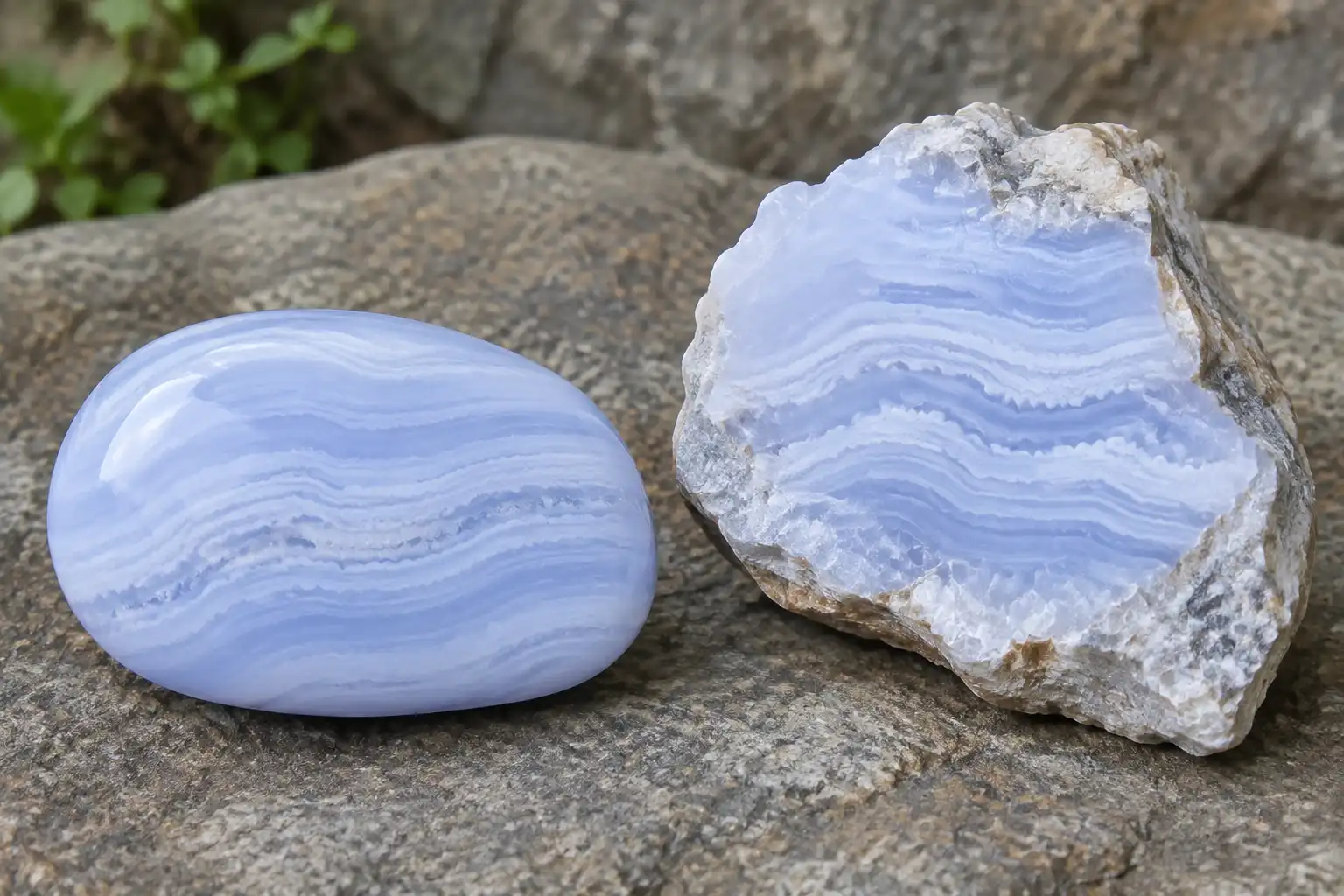
Blue lace agate benefits begin with an appearance that is immediately recognizable. The stone is a pale blue banded variety of agate, itself a form of chalcedony in the quartz family. Fine specimens display delicate white, blue, gray, and sometimes nearly colorless bands that curve across the stone in patterns resembling lace, waves, clouds, or fine contour lines. Mindat identifies blue lace agate as pale blue banded agate with a Mohs hardness of about 7.
That combination of beauty and quartz-family durability gives blue lace agate benefits in jewelry, collecting, lapidary work, decorative carving, geological education, and gemstone identification. Unlike transparent faceted gems whose appeal often depends on clarity and brilliance, blue lace agate is valued for pattern. Bands, cloudy zones, subtle translucency, and color variation are part of the attraction rather than flaws that must always be removed.
Modern crystal traditions frequently add symbolism involving calmness, communication, patience, emotional balance, and gentle self-expression. These ideas can function as personal reminders, but they are not established medical effects. Blue lace agate does not treat anxiety disorders, cure throat problems, regulate hormones, improve neurological function, or produce emotional stability through quartz chemistry.
10 Blue Lace Agate Benefits at a Glance
- Pale blue and white banding gives each specimen an individual natural pattern.
- Quartz-family hardness provides useful resistance to everyday scratching.
- Dense chalcedony structure makes the stone suitable for cabochons, beads, and carvings.
- Lapidaries can use band orientation to create visually balanced finished pieces.
- Collectors can study agate banding, chalcedony growth, translucency, and pattern variation.
- Jewelry designers gain a soft blue stone that pairs easily with many metals and other gems.
- Gemstone identification encourages buyers to distinguish natural agate from dyed or mislabeled stones.
- Decorative objects can display banding on larger surfaces where patterns become more visible.
- Modern symbolism can represent calm communication or patience without requiring medical claims.
- Straightforward care makes stable untreated pieces practical for long-term ownership.
Natural Banding Is the Most Distinctive Blue Lace Agate Benefit
The defining feature of blue lace agate is its banding. Mindat classifies it as a pale blue banded variety of agate and therefore part of the chalcedony and quartz family.
Agate bands form as silica-rich fluids deposit successive layers within cavities, fractures, or other available spaces in rock. Differences in impurities, microscopic structure, growth conditions, and later geological changes can create visible layers with contrasting color and translucency.
Blue lace agate benefits greatly from this process because pattern becomes the stone’s central visual feature. A cabochon may contain nearly parallel bands, sweeping arcs, irregular loops, or tightly folded lace-like zones. Cutting a few millimeters deeper into the same rough can reveal a completely different pattern.
This individuality makes the stone attractive to collectors and jewelry owners who prefer natural variation. Perfectly uniform color is not the goal. The interaction between pale blue zones and lighter bands gives each piece its identity.
Pattern can also affect how a finished stone feels visually. Narrow repeated bands may appear delicate and intricate, while large sweeping bands create a softer, more spacious effect. Neither is inherently better. The strongest design depends on balance, polish, and personal preference.
Quartz-Family Hardness Makes Blue Lace Agate Practical for Jewelry
Durability is one of the most useful blue lace agate benefits. Chalcedony generally falls around 6.5 to 7 on the Mohs scale, while Mindat lists blue lace agate at approximately 7. Chalcedony also has a compact microcrystalline structure and lacks obvious cleavage, although strong impacts can still cause chips or fractures.
These properties make blue lace agate practical for pendants, earrings, rings, bracelets, beads, brooches, and other jewelry. Cabochon cuts are especially common because a smooth dome reveals the banding without breaking the pattern into numerous facets.
Rings still require sensible care. Quartz-family hardness gives useful scratch resistance, but a hard strike against stone, metal, or concrete can damage an exposed edge. Protective bezel settings can reduce risk, particularly for larger cabochons.
Pendants and earrings are easier to protect because they experience fewer impacts during ordinary wear. Beads can also perform well when stringing holes are properly finished and the jewelry is not subjected to unnecessary tension.
These practical blue lace agate benefits help explain why agate has remained a popular lapidary stone for so long. It offers enough durability for regular use while preserving highly individual natural patterns.
Lapidary Cutting Can Transform Banding into the Main Design
Blue lace agate benefits cutters because orientation can dramatically change the appearance of a finished stone. When rough is sliced across or along the banding, the resulting surfaces may display completely different shapes and rhythms.
A skilled cutter studies the rough before deciding where to saw. The goal may be to place sweeping lines across the center of a cabochon, preserve a particularly attractive lace pattern, or create a pair of stones with visually related designs.
Cabochons often show the stone at its best because a broad uninterrupted face allows the bands to remain visible. Beads, freeforms, small carvings, spheres, and decorative slabs can also emphasize pattern.
Polishing quality matters. A poorly finished surface can obscure delicate bands, while an even polish makes subtle differences in translucency and color easier to see. Pits, fractures, and undercutting may occur where different zones respond slightly differently during finishing, so patient polishing produces better results.
These blue lace agate benefits highlight the relationship between natural geology and human craftsmanship. The stone provides the pattern, but cutting determines which portion becomes visible and how effectively it is presented.
Collecting Blue Lace Agate Encourages Attention to Natural Variation
Collectors often appreciate blue lace agate because no two specimens show exactly the same combination of bands, color intensity, translucency, and shape. Rough pieces preserve natural surfaces and geological relationships, while polished slabs reveal structures that may have been hidden inside.
A collection can include specimens with wide soft bands, extremely fine lace-like patterns, nearly white sections, stronger blue zones, or associations with other minerals. Mindat records calcite, chalcedony, quartz, siderite, and other minerals among photographed associations with blue lace agate specimens.
Locality information adds another layer when it is reliable. Similar-looking banded chalcedony can occur in different places, so buyers should not assume a specific origin simply because a seller uses the blue lace agate name.
Collectors may also value unpolished specimens because they reveal how agate occurs naturally rather than only after cutting. A rough surface may look less dramatic than a polished slab, but it can preserve geological context that finished jewelry no longer shows.
These collecting blue lace agate benefits remain meaningful even when a stone is inexpensive. Educational and aesthetic value do not depend entirely on market price.
Blue Lace Agate Offers an Accessible Introduction to Chalcedony Geology
Another important source of blue lace agate benefits is mineral education. Agate belongs to the chalcedony family, and chalcedony is composed largely of microscopic quartz structures, often with some moganite present. Unlike a large quartz crystal, the internal structure is so fine that individual components are not visible to the unaided eye.
This fine structure explains the dense appearance and smooth polish characteristic of agate. It also demonstrates how closely related silica varieties can look dramatically different depending on crystal size, inclusions, impurities, and growth history.
Blue lace agate makes banding especially easy to observe because pale blue and white zones create clear contrast. A polished slice can therefore become a useful teaching specimen for discussing repeated silica deposition, cavity filling, mineral growth, and the relationship between microscopic structure and visible pattern.
The stone also helps challenge the idea that inclusions or pattern variations automatically reduce quality. In agate, irregularity often creates beauty. A band, cloud, or contrasting zone that would be unwanted in a transparent faceted gem may be the feature that makes an agate desirable.
That educational role is one of the most durable blue lace agate benefits because it does not depend on changing fashion or metaphysical belief.
Jewelry Design Benefits from Soft Color Rather Than Intense Saturation
Blue lace agate offers a quieter visual effect than intensely saturated blue sapphire, turquoise, or lapis lazuli. Pale blue and white patterns can work especially well in jewelry intended to feel subtle, airy, or understated.
White metals such as silver, platinum, or white gold can reinforce the cool palette, while yellow or rose gold creates warmer contrast. The stone also pairs naturally with clear quartz, pearl, moonstone, blue chalcedony, darker gems, and neutral-colored beads.
The banding means designers do not have to rely on brilliance for visual interest. A simple bezel can frame an intricate pattern without competing with it. Larger cabochons are particularly effective because they provide enough surface area for the lace-like lines to become visible.
Matching pairs can be challenging because natural patterns vary. Earrings may therefore be matched by color and overall movement rather than expecting perfectly identical banding. This slight asymmetry can become part of a handmade design’s appeal.
These aesthetic blue lace agate benefits make the stone useful across both traditional and modern jewelry styles.
Identification and Treatment Awareness Protect Buyers
Blue lace agate is recognizable when its natural banding is strong, but buyers should still pay attention to identification and treatment. Chalcedony and agate can be dyed because microscopic porosity and fractures may allow coloring agents to enter the stone. GIA notes that chalcedony and quartz are among gems that have been dyed commercially.
Artificial color does not automatically make a stone unsuitable for jewelry, but treatment should be disclosed when it affects buyer expectations. Extremely intense or unnaturally uniform blue, color concentrated around fractures, or suspicious surface zoning may justify further investigation, although visual clues alone cannot prove treatment in every case.
A person deciding where to buy blue lace agate should look for clear photographs, accurate dimensions, treatment disclosure, realistic color representation, and reliable locality information when origin is part of the selling point.
Identification becomes especially important when a seller charges a significant premium for supposed rarity, origin, or untreated status. A poetic spiritual description does not prove any of those claims.
One of the practical blue lace agate benefits is therefore the opportunity to develop better gemstone-buying habits.
Decorative Carving and Display Give the Pattern More Space
Blue lace agate is not limited to jewelry. Larger slabs, freeforms, small carvings, spheres, eggs, decorative dishes, and display pieces can show complex banding across a wider surface.
This is especially effective when the pattern contains several directions or changes in band width. A small ring stone may reveal only one section, while a larger polished object can display how multiple zones interact.
Carving requires attention to fractures and band orientation. Although chalcedony is reasonably durable, narrow carved projections can still chip, and internal cracks may become more obvious during shaping.
For collectors, a simple polished slab may sometimes show the stone more honestly than an elaborate carving because less of the geological pattern is removed. Others may prefer sculptural forms because craftsmanship becomes part of the appeal.
These decorative blue lace agate benefits offer several ways to appreciate the stone depending on whether the owner values geology, polish, pattern, or artistic workmanship most.
Modern Symbolism Can Represent Calm Communication Without Medical Claims
Modern crystal traditions often describe blue lace agate benefits in terms of peaceful communication, calmness, patience, reassurance, emotional balance, and gentle self-expression. The stone’s pale blue color and flowing bands make those associations visually understandable.
Someone may use a blue lace agate pendant as a reminder to pause during tense conversations or keep a polished stone near a workspace to represent patience. Another person may associate the repeated bands with approaching a problem gradually rather than expecting an instant answer.
These uses place responsibility with the individual. The gemstone does not create communication skill or emotional control automatically.
Claims about blue lace agate healing properties sometimes extend into throat health, anxiety, sleep, hormones, inflammation, or nervous-system effects. Such interpretations belong to spiritual and wellness traditions rather than established clinical evidence.
Symbolic blue lace agate benefits remain perfectly meaningful when they support personal intentions without being promoted as medical treatment.
Responsible Care Preserves Color, Polish, and Banding
Stable untreated blue lace agate is relatively easy to care for. Lukewarm water, mild soap, and a soft cloth or brush are usually appropriate for routine cleaning. The stone’s quartz-family hardness gives it useful resistance to ordinary scratching, although harder gems can still mark the polished surface.
Hard impacts should be avoided because agate can chip or fracture. Rings should be removed during heavy manual work, while carved pieces deserve protection from drops onto tile, concrete, or stone.
Treatment status can affect care. Dyed stones may be more sensitive to certain chemicals, prolonged sunlight, or aggressive cleaning depending on the coloring process. When treatment is unknown, gentle cleaning is the sensible default.
Separate storage helps preserve polish and prevents repeated contact with harder jewelry. Individual pouches or lined compartments work well.
Lapidary work also requires proper dust control because agate is silica-rich. Cutting, drilling, or grinding should use appropriate wet methods, ventilation, eye protection, and professional workshop precautions rather than creating airborne silica dust.
These practical limits support long-term enjoyment and keep blue lace agate benefits rooted in responsible ownership.
Conclusion
Blue lace agate benefits include distinctive natural banding, useful quartz-family hardness, good lapidary potential, jewelry versatility, collecting interest, geological education, identification practice, decorative carving, and personal symbolism. Its pale blue and white patterns give the stone an individuality that cannot be reduced to color alone.
Modern themes of calmness, communication, and patience can remain part of the experience when they are treated as symbolism rather than medicine. The strongest blue lace agate benefits come from understanding the stone as patterned chalcedony, appreciating its natural structure, choosing honestly represented specimens, and caring for the quartz according to its real physical properties.
FAQs
What are the main blue lace agate benefits?
The most verifiable blue lace agate benefits include jewelry use, quartz-family durability, distinctive banding, carving, collecting, lapidary work, mineral education, identification practice, and personal symbolism.
What is blue lace agate made of?
Blue lace agate is a pale blue banded variety of agate, which belongs to chalcedony in the quartz family and consists primarily of silica.
Is blue lace agate naturally blue?
Natural blue lace agate does occur, but agate and chalcedony can also be dyed. Treatment disclosure matters when natural color is important to the buyer.
Is blue lace agate durable enough for jewelry?
Yes. It has quartz-family hardness around 6.5 to 7 and is suitable for many jewelry styles with reasonable protection from hard impacts and harder gemstones.
What creates the lace pattern?
Repeated bands of chalcedony form during silica deposition, creating pale blue and lighter layers whose shape depends on the space and geological conditions in which the agate developed.
Is every blue banded stone blue lace agate?
Not necessarily. Accurate identification should consider chalcedony structure, banding, physical properties, treatment, and seller disclosure rather than color alone.
What does blue lace agate symbolize?
Modern symbolism commonly connects it with calm communication, patience, listening, reassurance, and gentle self-expression. These are cultural or personal interpretations.
Does blue lace agate help with anxiety?
There is no established clinical evidence that blue lace agate treats anxiety disorders. Some people use it symbolically during calming or reflective practices, but professional care remains appropriate for persistent mental-health concerns.
Can blue lace agate heal the throat?
There is no reliable evidence that the stone treats throat disease, voice problems, infections, or other medical conditions.
How should blue lace agate be cleaned?
Use lukewarm water, mild soap, and a soft cloth or brush for stable pieces. Avoid strong impacts, harsh chemicals, and aggressive cleaning, especially if treatment status is uncertain.
Blue lace agate benefits described as healing, emotional, chakra, or physical effects reflect spiritual and personal belief and should not replace qualified medical or mental-health care.