Where to Buy Real Blue Lace Agate and Avoid Dyed Fakes
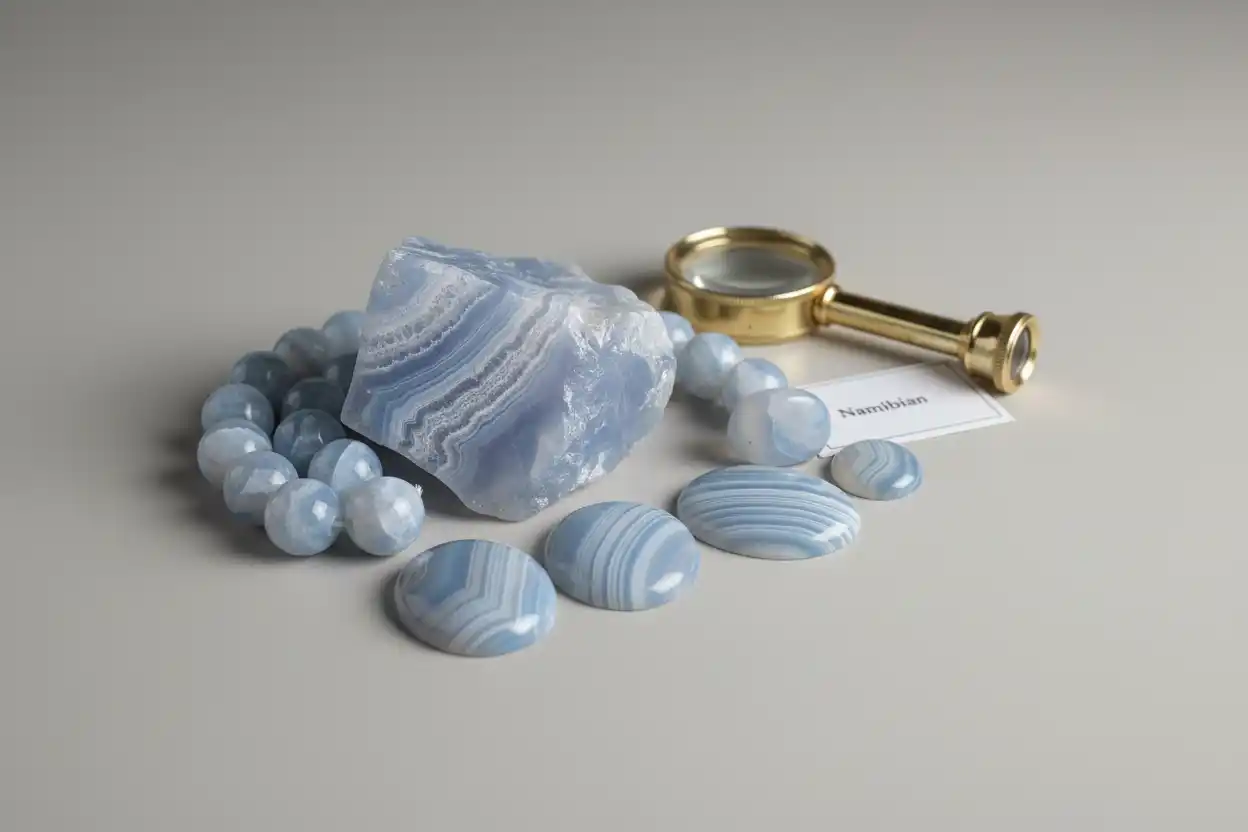
Real blue lace agate is recognized by soft blue chalcedony crossed by delicate white, pale gray or deeper blue bands. The pattern may resemble ripples, loops, scallops, clouds or fine lace, but it should remain part of the stone rather than sit as a printed or painted surface design.
Blue lace agate is commonly linked with the Ysterputs area of southern Namibia, an important documented locality for the material. That association makes locality labels commercially valuable, yet it also encourages unsupported “old-stock Namibian” claims.
The blue lace agate meaning and properties guide covers its identity and traditional symbolism. This buying guide concentrates on band quality, natural versus dyed color, seller documentation, lapidary condition and the distinction between blue lace agate and related blue stones.
Understand the Material Before Comparing Listings
Agate is a banded form of chalcedony within the microcrystalline quartz family. Blue lace agate earns its commercial name from blue body color combined with fine, decorative banding.
Not every pale blue chalcedony is blue lace agate. A mostly uniform blue stone may be better described as blue chalcedony, while a vivid electric-blue banded slice may be dyed agate.
The agate meaning guide covers the wider agate family. The chalcedony guide explains the parent microcrystalline silica material.
The types of agate guide and types of chalcedony guide help separate lace, dendritic, moss-like, fortification and uniformly colored varieties.
Choose the Right Product Form
| Product | Best source | Main issue |
|---|---|---|
| Natural rough | Mineral or lapidary supplier | Weak internal banding, surface color and origin claims |
| Slab | Lapidary supplier | Dye concentration, fractures and low cabochon yield |
| Cabochon | Gem dealer or lapidary | Pattern placement, backing, filling and polish |
| Beads | Established bead supplier | Dyed agate, mixed strands and drill-hole fractures |
| Tumbled stone | Reputable crystal shop | Generic blue chalcedony or dyed stone substitution |
| Sphere or carving | Lapidary retailer | Filled cavities, color enhancement and poor pattern distribution |
| Jewelry | Jeweler with treatment disclosure | Closed backing, glue and exaggerated rarity |
| Collector specimen | Mineral dealer with locality records | Unsupported Ysterputs or old-stock claims |
Rough buyers need evidence that lace bands continue into the material. Jewelry buyers need exact-item photographs because every pattern is different.
Where to Buy Genuine Blue Lace Agate
Specialist lapidary suppliers
Lapidary suppliers are often the strongest source for rough, slabs and cabochons. An experienced seller should show the stone dry, wet and in transmitted light when appropriate.
Dry photographs reveal the actual surface and color. Wet images can help predict polish, although they may conceal scratches and deepen weak color.
Ask whether test cabochons have been cut from the same parcel. Their appearance provides better evidence of internal banding than a weathered rough exterior.
Mineral dealers
A mineral dealer is useful when locality matters. Request the country, mine or farm designation, original specimen label and collection history.
Ysterputs in southern Namibia is an important documented blue lace agate locality. However, the pattern alone does not prove that a commercial cabochon came from that occurrence.
Older labels can add value, but copied labels and vague “estate stock” language should not receive the same weight as a traceable collection record.
Gem and mineral shows
Shows let you compare natural pale banding with dyed agate. Examine the stone over white paper and under neutral daylight.
A loupe can reveal color concentrated along cracks, pits and drill holes. Additionally, dyed porous bands may appear much darker than neighboring dense layers.
Do not use chemicals to test the color. Even when a solvent removes dye, it can damage the stone, setting or seller’s property.
Established online shops
An online seller should show the exact item or explain the degree of batch variation. One premium cabochon should not represent a parcel of ordinary tumbles.
The online gemstone buying guide covers seller identity, protected payment and return procedures.
For blue lace agate, request photographs against white and neutral gray backgrounds. Strongly warm or cool backgrounds can change the apparent blue.
Independent jewelry makers
A jewelry maker who cuts the stone can often explain its source and treatment more clearly than a reseller. Ask to see the cabochon before setting when the purchase is expensive.
Closed-back settings may deepen color or conceal backing. A transparent photograph of the loose stone reduces uncertainty.
What Genuine Blue Lace Agate Looks Like
Natural blue lace agate commonly has pale sky-blue, gray-blue or lavender-blue chalcedony with white or slightly darker curving bands. Some pieces are translucent at thin edges, while others are largely opaque.
The bands can be parallel, looping, irregular or scalloped. They may change thickness and spacing across the stone.
Natural patterns should continue around edges or through the interior where visible. A design that ends sharply at the polished surface may be painted, printed or coated.
Small cavities, crystalline quartz pockets and associated minerals can occur in rough material. Their presence does not automatically increase value; condition and pattern remain more important.
Blue lace agate often looks gentle rather than intensely saturated. Bright neon blue is not impossible in treated stone, but it is atypical of the traditional natural appearance.
Blue Lace Agate Versus Blue Chalcedony
Blue chalcedony can have a soft, uniform blue glow without obvious lace banding. Blue lace agate is a banded chalcedony variety.
The blue chalcedony meaning guide covers the more uniform variety. The completed guide to buying blue chalcedony addresses natural color, filling and dyed imitations.
Some stones fall between the two descriptions. Fine bands may become visible only under magnification or transmitted light. In borderline material, a seller should show the actual structure rather than rely on the more marketable name.
Blue Lace Agate Versus Botswana Agate
Botswana agate commonly displays fine gray, brown, pink, white or muted multicolored bands. Occasional bluish-gray zones can resemble blue lace agate.
However, Botswana agate usually has a broader neutral palette and different overall pattern. Locality also matters because the trade names reference different source histories.
The next dedicated buying page will evaluate Botswana agate’s own color and source claims without merging the two markets.
Blue Lace Agate Versus Crazy Lace Agate
Crazy lace agate typically shows energetic loops, eyes and complex bands in cream, red, yellow, brown and gray. Blue lace agate usually has a calmer blue-and-white palette.
Dyed crazy lace agate can be turned bright blue and sold under confusing labels. Therefore, pattern style alone does not establish natural color.
Blue Lace Agate Versus Dyed Agate
Dyed agate is the most important treatment concern. Chalcedony’s porosity and microscopic structure can allow colorants to enter selected layers, cracks and drill holes.
Strong blue around holes or fractures deserves scrutiny. Likewise, dense electric-blue bands next to nearly colorless layers may reflect selective dye absorption.
Some dyed products are attractive and durable enough for ordinary use. The issue is disclosure, not whether a treated stone may be enjoyed.
The real-versus-fake agate guide explains the difference between natural agate, manufactured substitutes and altered natural stone. The treated-agate guide covers dye and other enhancements in greater detail.
Blue Lace Agate Versus Blue Calcite
Blue calcite is much softer and commonly shows cloudy color, cleavage and white carbonate areas. Blue lace agate has greater hardness and fine chalcedony banding.
Do not use an acid or scratch test to separate finished pieces. A gemologist can distinguish carbonate from silica through refractive index, specific gravity and spectroscopy.
Blue Lace Agate Versus Blue Aventurine
Blue aventurine should show reflective inclusions or a subtle aventurescent effect. Blue lace agate has bands rather than platy sparkle.
A low-resolution photograph can flatten both textures. Request a moving-light video and close-ups of the internal structure.
Blue Lace Agate Versus Larimar
Larimar is blue pectolite associated with the Dominican Republic. It often displays white cloud-like patterns that can resemble lace.
Larimar’s pattern tends to be more blocky, fibrous or web-like, while blue lace agate shows chalcedony banding. Their hardness, internal structure and origin also differ.
A seller using both names in one title should identify the actual material.
Glass, Resin and Printed Imitations
Blue glass can imitate translucent agate cabochons. Round bubbles, flow lines and mold seams support a manufactured origin.
Resin may contain printed layers, stone powder or colored swirls. Repeated patterns across several pieces can reveal molded production.
Some decorative slices use a printed or transferred pattern beneath a clear dome. Check the edge to see whether the “bands” continue through the stone.
The fake-crystal guide provides a broader approach to glass, resin, coatings and composites.
Treatments Beyond Dye
Blue lace agate may also be waxed, oiled, resin-filled, coated or backed. Cavities can be filled with clear epoxy, while a pale cabochon may receive a blue or reflective backing.
Wax and oil can deepen color temporarily. A thick clear coating may improve gloss but can scratch differently from chalcedony.
Ask the seller to separate natural color from structural treatment. A stone can be naturally blue and still contain resin-filled cavities.
The gemstone treatments guide explains how color treatment, filling and backing affect value differently.
How to Evaluate Rough
Look for visible blue and white banding on a sawn face rather than relying solely on the outer rind. Natural weathering can hide good material, but a seller should provide enough evidence to estimate the interior.
Request dimensions and weight. Thin slabs may produce small cabochons even when their face area looks large.
Inspect fractures, cavities and color penetration. Surface-only blue should prompt questions about dye or coating.
For claimed Namibian material, ask whether the seller has locality labels or supplier records.
How to Evaluate Slabs
A good slab should show bands that continue across both faces and along the edge. Pattern distribution matters because only part of the slab may produce classic lace cabochons.
Backlighting can reveal translucent zones and hidden fractures. However, extreme light may make ordinary pale material appear richer than it will in jewelry.
Resin-filled cavities can show a different luster or trapped bubbles. Ask whether the slab was stabilized before purchase.
How to Evaluate Cabochons
A well-cut cabochon frames the lace pattern intentionally. The bands should cross the face in a balanced way rather than disappearing around the girdle.
The dome needs a smooth polish, clean outline and stable edges. Inspect the back for dye concentration, backing or epoxy.
Thin cabochons can appear brighter over a white background, while dark settings may make them look gray. Consider the intended metal and backing before choosing the stone.
Buying Beads
Natural strands should show related but nonidentical patterns. Some beads may contain more white, while others display stronger blue.
Inspect drill holes for chips and concentrated color. Dye can enter the hole and produce a dark ring around it.
Ask whether the strand contains only blue lace agate or includes generic dyed blue agate for color matching.
Buying Spheres and Carvings
A sphere should display lace bands across more than one face. Request a complete rotation because one dramatic section may hide large plain areas.
Carvings should have stable details without fractures crossing thin points. Deep recesses can conceal polishing compound, pigment or filler.
Large decorative objects are often priced heavily for cutting labor. Pattern coverage should remain strong enough to justify the blue lace name.
Buying Jewelry
Blue lace agate is relatively practical for pendants, earrings, brooches and many rings. Chalcedony’s fine-grained structure generally provides good toughness.
The gemstone hardness chart places chalcedony near 6.5 to 7. The toughness-versus-hardness guide explains why thin edges and existing fractures can still chip.
A bezel protects the perimeter better than high prongs. Closed backs should be disclosed because they may alter apparent color.
Locality and Provenance
The Ysterputs occurrence in southern Namibia is strongly associated with blue lace agate. Documented specimens from the locality may also occur with calcite, fluorite and other minerals.
However, not every polished blue lace agate has retained mine-level records. Country-level information may be the realistic limit for ordinary commercial beads.
Treat “old stock” as a provenance claim requiring evidence. The phrase should not automatically multiply the price.
Price and Value
Value depends on natural color, lace definition, contrast, translucency, pattern placement, size, condition, treatment and provenance.
Fine cabochons show delicate bands across most of the face without becoming visually crowded. Large plain blue areas may be attractive but belong more closely to the blue chalcedony market.
Natural-color material with credible Namibian provenance can command more than common dyed agate. Nevertheless, arbitrary labels such as “AAA old-stock” have no value unless the seller explains the criteria.
The completed general agate buying guide provides broader market context.
Questions to Ask the Seller
Ask whether the blue color is natural, dyed or uncertain. Determine whether the item is blue lace agate, uniform blue chalcedony or dyed banded agate.
Request locality information and the basis for any Ysterputs or Namibian claim. Confirm whether resin, wax, oil, coating, backing or repairs are present.
For rough, request dry sawn-face images. For cabochons, ask for front, back and edge photographs. For beads, request close-ups of drill holes.
Finally, obtain a return period that allows examination under normal and magnified light.
Professional Testing
A gemologist can confirm chalcedony through refractive properties, specific gravity, microscopy and Raman spectroscopy.
Visible and infrared spectroscopy can support investigations of color origin. Microscopy may reveal dye concentrations, polymer-filled cavities and glass bubbles.
Professional testing is most useful for expensive natural-color parcels, matched jewelry suites and material carrying a strong provenance premium.
Responsible Buying
Ask sellers to distinguish verified locality from wholesaler tradition. Full mine-level traceability may not survive through bead manufacturing, but a retailer should not invent details.
The ethical crystal sourcing guide provides realistic questions about legal collection, labor and environmental claims.
Cleaning and Storage
Clean untreated blue lace agate with lukewarm water, mild soap and a soft cloth. Rinse briefly and dry thoroughly.
Avoid prolonged soaking when the stone is dyed, filled, backed or glued. Strong chemicals can affect colorants, resin and metal settings.
Ultrasonic cleaning should be avoided for heavily fractured, filled or assembled pieces. Store jewelry away from harder gems that may scratch the polish.
Frequently Asked Questions
1. Is blue lace agate naturally blue?
Yes. Naturally blue banded chalcedony exists, although dyed blue agate is also common.
2. Where does blue lace agate come from?
Southern Namibia, particularly the Ysterputs area, is an important documented source. A seller should provide evidence for a precise locality claim.
3. Is blue lace agate the same as blue chalcedony?
Blue lace agate is a banded blue chalcedony variety. Uniform blue chalcedony may lack the lace pattern.
4. How can I recognize dyed blue lace agate?
Look for unusually intense color concentrated in cracks, porous bands and drill holes. Advanced dye may still require laboratory testing.
5. Is bright blue material always fake?
No. Strongly colored natural chalcedony can exist, but neon saturation is a reason to request treatment evidence.
6. Is blue lace agate the same as Botswana agate?
No. They are separate commercial varieties with different characteristic palettes and source associations.
7. Can blue lace agate contain epoxy?
Yes. Cavities and fractures can be filled with clear or colored epoxy. Filling must be disclosed.
8. Is it suitable for everyday rings?
Sound chalcedony is reasonably durable, although thin edges and fractured stones benefit from protective settings.
9. Does white banding prove authenticity?
No. Dyed agate and manufactured imitations can also show white patterns. Banding must be evaluated with material identity and treatment.
10. Does “old-stock Namibia” guarantee value?
No. Old-stock value depends on credible labels, collection history, pattern quality and condition.
11. Do ordinary beads need certificates?
Usually not. Treatment disclosure, exact photographs and return rights are more practical for inexpensive strands.
12. What is the strongest warning sign in a listing?
Be cautious when intensely colored “untreated Namibian” material has no edge views, no locality documentation and no return option.
Buy the Lace, Not the Story
Blue lace agate is most convincing when its pale color and fine bands remain visible under neutral light and continue naturally through the stone. Dramatic rarity claims cannot replace a clear view of the material.
The types of gemstones guide, B crystal directory and B gemstone directory provide broader comparison points. Choose the piece whose pattern, color origin and provenance can be explained without exaggeration.