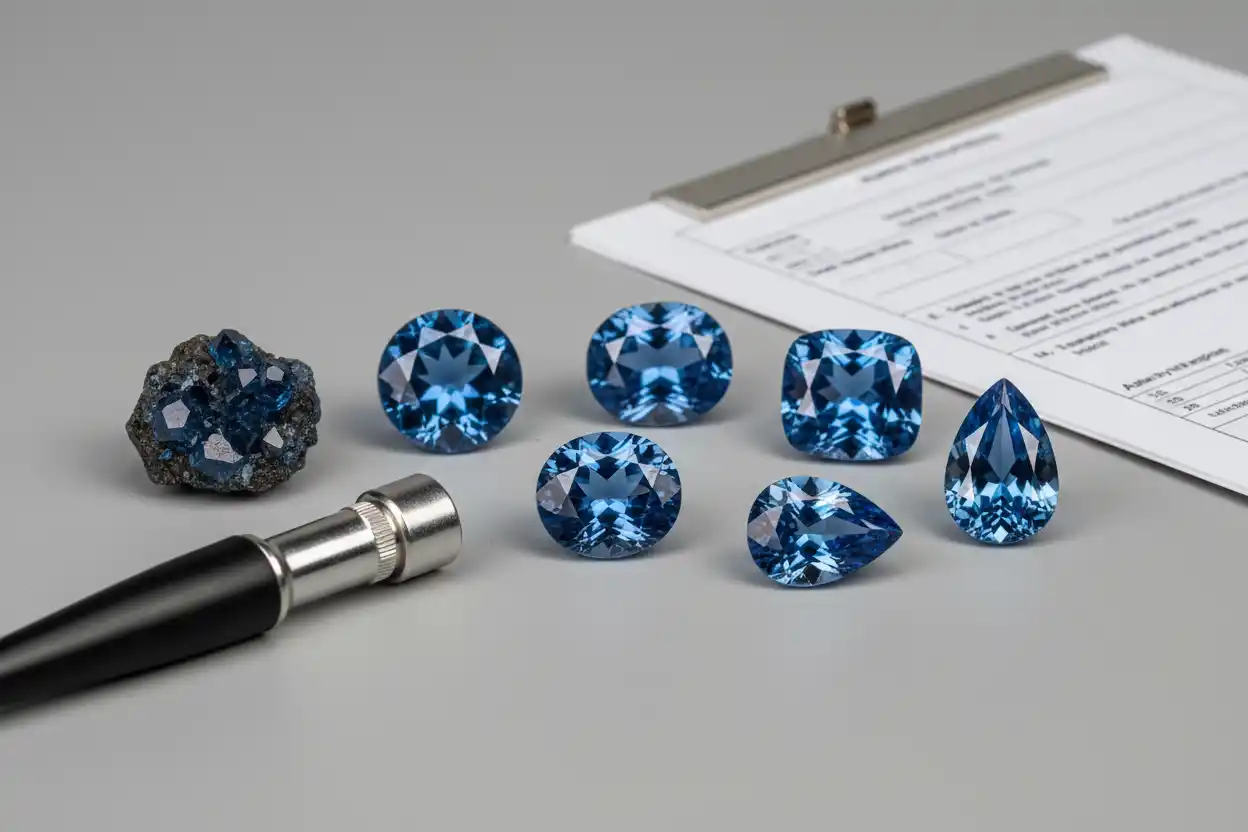
Buy Benitoite: Smart Buying, Origin, Quality & Red Flags
To buy benitoite well, begin with identity and evidence rather than rarity claims. Benitoite is a distinct barium titanium silicate mineral known for high refractive indices, strong dispersion, and most famously a vivid blue appearance. GIA’s research reports that commercial quantities of gem-quality benitoite are associated with the Benitoite Gem mine in the New Idria district of San Benito County, California, while other occurrences have produced far less gem material.
That restricted supply makes fine benitoite genuinely collectible, yet rarity should increase the buyer’s demand for verification rather than reduce it. A seller may describe a stone as California benitoite, museum quality, investment grade, AAA, or exceptionally rare, but none of those phrases independently proves identity, provenance, quality, or fair value. The safest purchase comes from combining observable gem quality with credible documentation, full disclosure, appropriate return rights, and a seller who can explain exactly what is known about the stone.
Buy Benitoite At a Glance
| Buying Factor | What to Check | Why It Matters |
|---|---|---|
| Identity | Evidence that the material is benitoite | A blue look-alike is not automatically benitoite |
| Natural Status | Natural versus any laboratory-created or imitation material | These categories have different origins and markets |
| Color | Hue, tone, saturation, evenness | Attractive blue is one of benitoite’s strongest visual qualities |
| Size | Carat weight and millimeter dimensions | Fine benitoite becomes notably scarce at larger faceted sizes |
| Clarity | Transparency and visible inclusions | Inclusions can affect beauty, brilliance, and sometimes durability |
| Cut | Brilliance, dispersion, symmetry, windowing, polish | Strong cutting can reveal benitoite’s distinctive optical character |
| Origin Claim | California/San Benito claim and supporting evidence | Seller origin claims should be separated from documented provenance |
| Treatment | Written disclosure of known or detected enhancement | Treatment status can affect comparison and buyer preference |
| Condition | Chips, abrasion, scratches, repolishing | Rare does not mean damage should be ignored |
| Documentation | Laboratory report, invoice description, provenance records | Documentation reduces uncertainty but does not guarantee price |
| Seller Terms | Return period, inspection rights, report verification | Important when purchasing an uncommon and expensive gem |
| Price | Compare equivalent stones rather than weight alone | Size, color, cut, documentation, and rarity interact |
Understand What Benitoite Is Before You Buy It
Benitoite is its own mineral species, not a variety of sapphire, zircon, beryl, spinel, or diamond. Its chemical composition is barium titanium silicate, and GIA documents high refractive indices, strong dispersion, vitreous luster, and strong dichroism among its characteristic properties. Those optical qualities help explain why a well-cut blue benitoite can appear exceptionally lively.
Visual resemblance still cannot establish identity. A blue gemstone might resemble benitoite in an online photograph while belonging to an entirely different species. Price also proves nothing: an expensive stone can be misidentified, while a genuine small or lower-quality benitoite can be relatively modestly priced compared with exceptional collector material.
GIA’s historical literature even records experimental hydrothermal synthesis of benitoite, demonstrating that “natural,” “laboratory-created,” and “imitation” are conceptually distinct categories. This does not mean laboratory-grown benitoite is a routine commercial jewelry product. It means serious buyers should rely on gemological identification rather than assuming natural origin from appearance or seller language.
California Origin Is Central to the Benitoite Market
Benitoite’s commercial gem history is closely linked to California. The California Geological Survey states that gem-quality benitoite occurs in a small area of San Benito County and recognizes benitoite as California’s official state gemstone. GIA likewise reports that although benitoite has been discovered in small amounts elsewhere, the California occurrence has produced the greatest number and best-quality crystals.
That history helps explain why locality information can matter to collectors, but buyers should distinguish a seller’s origin statement from documented provenance. An invoice saying “California” is useful, yet an old collection label, mine documentation, previous ownership records, photographs, or other traceable evidence may provide stronger provenance for a collector-quality stone or mineral specimen.
There is another important laboratory nuance. GIA’s current published Colored Stone Identification & Origin Report service lists geographic-origin reporting for a defined group of gemstones, and benitoite is not among those listed materials. A buyer should therefore not assume that an ordinary GIA identification report automatically proves a San Benito County origin. Read the actual report rather than relying on a seller’s summary of what it supposedly establishes.
Color Deserves Close Examination
Blue is the appearance most buyers associate with benitoite. GIA’s historical review notes that properly cut blue benitoite can show striking color and brilliance, while the detailed New Idria study describes benitoite as typically colorless to blue.
When you buy benitoite, evaluate the face-up color rather than a promotional adjective. Rich blue material can attract strong demand, but the stone should remain lively and visually balanced. Dark areas caused by extinction should not be mistaken for superior saturation, and heavily edited photographs can exaggerate intensity.
Ask for video and still images under more than one normal lighting environment when the purchase is significant. Neutral backgrounds help, as do side views that reveal depth and transparency. If color zoning is present, determine whether it remains noticeable face-up or has been minimized effectively by the cutting.
Size Is Particularly Important Because Large Faceted Benitoite Is Scarce
Benitoite is one of the colored gemstones for which size can become a powerful scarcity factor. GIA’s colored-stone value research specifically notes that some gems, including benitoite, are rarely encountered above a couple of carats. Separate GIA reporting on the secondary market described a 5.06-carat faceted benitoite as exceptionally large and noted that commercially available finished stones from the historic mine commonly occupied a much smaller size range.
That does not mean every larger benitoite deserves a huge premium. Color, clarity, cut, condition, and documentation still matter. A deep stone may retain extra carat weight without delivering equivalent face-up size, while a poorly proportioned larger gem can look less attractive than a smaller well-cut example.
Whenever size materially influences the asking price, compare carat weight with millimeter measurements. If a supposed exceptionally large benitoite is simultaneously offered at a surprisingly low price and without credible identification, stronger verification is warranted.
Cut Quality Can Reveal Benitoite’s Optical Strength
Benitoite has strong dispersion, meaning it can break white light into spectral colors and display flashes of fire when cutting, lighting, and body color permit. GIA specifically highlights its strong dispersion and high refractive indices.
A skilled cut should make the most of those properties without creating distracting windowing, excessive extinction, uneven symmetry, or unnecessary depth. Because the rough is rare, cutters may accept compromises to preserve weight, but buyers should still evaluate the finished result rather than paying solely for the amount of rough retained.
Face-up beauty, dimensions, symmetry, polish, and pattern matter together. A custom or precision cut can deserve an additional premium when the workmanship clearly improves the stone, but a famous cutter’s name and gem identity remain separate forms of value.
Clarity Should Be Evaluated for Beauty, Not by Diamond Rules
Transparent benitoite suitable for faceting can contain inclusions, and GIA has documented minerals such as neptunite occurring as inclusions within benitoite. Such features can be scientifically interesting and, in some circumstances, attractive to collectors, but the commercial effect depends on visibility, placement, and influence on brilliance or durability.
Do not apply diamond clarity grades automatically to benitoite unless a seller explicitly defines a private descriptive system. Colored stones vary widely in normal inclusion patterns, and there is no universal benitoite clarity scale equivalent to the standardized diamond system.
A small inclusion near the edge may have little effect on appearance, while a prominent reflective feature beneath the table may dominate the stone. Surface-reaching fractures deserve particular attention because they may affect durability or setting decisions.
Confirm What the Laboratory Report Actually Says
For a meaningful purchase, an independent colored-stone identification report can reduce uncertainty. GIA states that its Colored Stone Identification Report identifies and describes gem material and lists detectable treatments; reports also include characteristics such as shape, cutting style, measurements, weight, color, and a photograph.
That does not make the report an appraisal. Laboratory identification establishes gemological facts within the scope of the service. It does not automatically determine fair retail price, resale value, historical provenance, or future appreciation.
Check the report number directly with the issuing laboratory whenever possible. Make sure the measurements, weight, shape, color, and photograph correspond to the stone being offered. A screenshot of a report is less useful if the seller cannot show that the physical stone actually matches it.
The same documentation discipline applies when buying other uncommon colored gems. Gems Lore’s guides on how to buy alexandrite and how to buy andalusite emphasize that laboratory evidence should be read according to what it truly establishes rather than treated as a blanket guarantee of quality or price.
Separate Natural, Laboratory-Created, and Imitation Material
A natural benitoite formed through geological processes. Laboratory-created material, where manufactured, is produced artificially but intended to reproduce the mineral itself. An imitation or simulant merely resembles benitoite visually while belonging to another material.
These categories should never be collapsed into one “real versus fake” label. An imitation can be a legitimate product when disclosed accurately, while an undisclosed substitute is a representation problem. Likewise, laboratory-created material is not the same thing as a blue glass or synthetic sapphire look-alike.
If a seller cannot explain whether the stone is natural or how that conclusion was reached, the uncertainty should influence both the purchase decision and the price you are prepared to pay.
Treatment Disclosure Should Be Explicit
Even when a particular enhancement is uncommon, buyers should ask about treatment rather than assume untreated status. GIA’s report services are specifically designed to identify detectable treatments where applicable.
The seller should state known treatment information in writing, ideally on the invoice. “Natural” does not automatically mean “untreated,” because natural origin and treatment status answer different questions.
If an unusual color, exceptional appearance, or unusually low price depends on enhancement, appropriate disclosure becomes even more important. Any treatment should be evaluated according to stability, detectability, effect on appearance, and market acceptance rather than through unsupported blanket claims.
Condition Matters Even When the Stone Is Rare
Scarcity does not erase damage. A rare benitoite can still lose desirability through chips, abrasion, scratches, worn facet junctions, repolishing, or setting damage. Examine the table edge, girdle, corners, culet, and areas around prongs under magnification when possible.
Mounted gems create additional uncertainty because the setting can hide portions of the girdle or pavilion. Ask whether the reported weight is measured directly or estimated from dimensions. If the seller states that the gem was previously removed and examined, request documentation where the value justifies it.
An older stone with minor wear can still be historically or aesthetically desirable. Condition is not necessarily a reason to reject a benitoite; it is a factor that should be described honestly and reflected in price.
Do Not Confuse Mineral Specimen Value With Faceted Gem Value
Benitoite is also highly collectible as a mineral specimen, particularly when attractive blue crystals occur on contrasting matrix with associated minerals. The criteria used for a natural crystal specimen differ substantially from those applied to a faceted gemstone.
Specimen collectors may consider crystal form, termination quality, matrix composition, associated minerals, damage, repairs, preparation, locality documentation, aesthetics, and historic provenance. A faceted-gem buyer focuses more heavily on color, transparency, cut, weight, face-up size, condition, and jewelry usability.
Trying to calculate a mineral specimen’s value by dividing its price by an estimated number of gem carats is usually meaningless.
Compare the Seller’s Price With Comparable Benitoites
A fair comparison requires similar stones. Compare benitoites that are reasonably aligned in weight, dimensions, color, clarity, cut quality, condition, documentation, and provenance. If one stone is significantly more expensive, determine whether the premium comes from larger size, finer color, stronger transparency, superior cutting, historic provenance, or better documentation.
If the seller relies mainly on broad rarity language, compare that claim with the actual physical quality. Gems Lore’s rarest gemstones in the world guide explains why scarcity and monetary value should not be treated as identical concepts. The most expensive gemstones guide likewise shows why exceptional record-setting stones do not establish ordinary retail prices.
Red Flags When You Buy Benitoite
Several patterns deserve additional scrutiny:
An unusually large benitoite offered without independent identification.
A very low price paired with extraordinary size and color claims.
Heavy photo editing or refusal to provide neutral-light video.
No millimeter dimensions for a loose stone.
Vague language such as “certified” without naming the laboratory or report number.
Claims of California origin presented as laboratory-proven when the document does not state origin.
“AAA,” “museum grade,” or “investment grade” used without defined criteria.
Guaranteed appreciation or guaranteed resale claims.
Refusal to disclose known treatment information.
No meaningful return or inspection period for an online purchase.
Pressure to complete a high-value transaction before independent verification.
None of these signals alone proves misconduct, but several occurring together should materially raise the buyer’s caution.
Loose Benitoite Versus Finished Jewelry
A loose benitoite is generally easier to inspect because its dimensions, girdle, pavilion, inclusions, and condition remain accessible. Independent laboratory submission is also more straightforward, although many laboratories can examine mounted material within service limitations.
Finished jewelry adds another value layer. Precious metal, accent stones, craftsmanship, design, maker reputation, age, and condition all affect total price. An antique or designer benitoite jewel therefore should not be evaluated by dividing the total purchase price by the center stone’s carat weight.
Choose according to purpose. A collector focused on gem quality may prefer a loose documented stone, while someone who wants wearable design may reasonably pay more for an expertly made finished piece.
How Much Documentation Should You Require?
Documentation should scale with the financial and rarity claims involved. A very small stone from a trusted specialist may not justify the same testing expense as a large, unusually fine benitoite offered for a substantial amount.
For a significant purchase, the strongest documentation package can include independent identification, accurate dimensions and weight, a detailed invoice, treatment disclosure, traceable report verification, high-quality photographs, and any genuine provenance records supporting California locality or historic ownership.
Documentation cannot make an unattractive stone beautiful, but it can reduce uncertainty. In the benitoite market, that reduction in uncertainty can be highly valuable.
Conclusion
The smartest way to buy benitoite is to treat its rarity as a reason for careful verification. Confirm identity first, then evaluate color, clarity, size, cutting, condition, treatment disclosure, documentation, provenance, seller reputation, and return rights. GIA and the California Geological Survey both document the exceptional importance of the San Benito County occurrence, while GIA’s value research confirms that larger faceted benitoites belong to an especially scarce size category.
A high-quality benitoite does not need exaggerated language to justify attention. Its physical beauty, documented identity, scarcity, and history are already compelling. Buyers who distinguish evidence from marketing are better positioned to select a stone whose price, quality, and provenance make sense together.
Frequently Asked Questions
What should I check first when I buy benitoite?
Confirm the stone’s identity before evaluating price. After identity, compare color, carat weight and dimensions, clarity, cut quality, condition, treatment disclosure, provenance, laboratory documentation, seller reputation, and return rights.
Where does gem-quality benitoite come from?
Commercial gem-quality benitoite is strongly associated with the New Idria district of San Benito County, California. GIA reports that the California occurrence produced the greatest number and best-quality crystals even though benitoite has been found in small quantities elsewhere.
Is benitoite rare?
Yes. Gem-quality benitoite is genuinely scarce, and GIA specifically identifies benitoite as a gemstone rarely encountered above a couple of carats. Rarity does not automatically establish the value of a specific stone, however; quality and documentation still matter.
Are large benitoites especially valuable?
Large fine examples can attract substantial premiums because increasing size while maintaining strong color, clarity, and cutting is uncommon. GIA has described a 5.06-carat faceted benitoite as exceptionally large for the deposit. A large stone still needs strong identity and quality evidence.
Can a GIA report prove that benitoite came from California?
Do not assume so. GIA offers identification reports broadly, but its published list of gemstones eligible for its geographic-origin report service does not include benitoite. Read the exact report and distinguish identification from locality provenance.
Can benitoite be laboratory-created?
Experimental hydrothermal synthesis of benitoite has been documented in the scientific literature indexed by GIA. That does not imply synthetic benitoite is common in ordinary retail. Appropriate identification remains the safest way to establish what a stone is.
Is blue sapphire an imitation of benitoite?
Sapphire and benitoite are different mineral species. A blue sapphire sold honestly as sapphire is simply another gemstone, not an imitation. It becomes a representation problem only if a different material is presented or sold as benitoite.
Should I buy benitoite without a laboratory report?
A small lower-cost stone from a trusted specialist may not always justify laboratory expense, but independent identification becomes increasingly valuable as size, price, rarity, or provenance claims increase.
Is benitoite a good guaranteed investment?
No gemstone should be sold with a guaranteed appreciation claim. Benitoite is scarce and collectible, but future resale depends on quality, market demand, documentation, liquidity, condition, and transaction costs.