Buy Boulder Opal: Smart Buying, Quality, Disclosure & Price
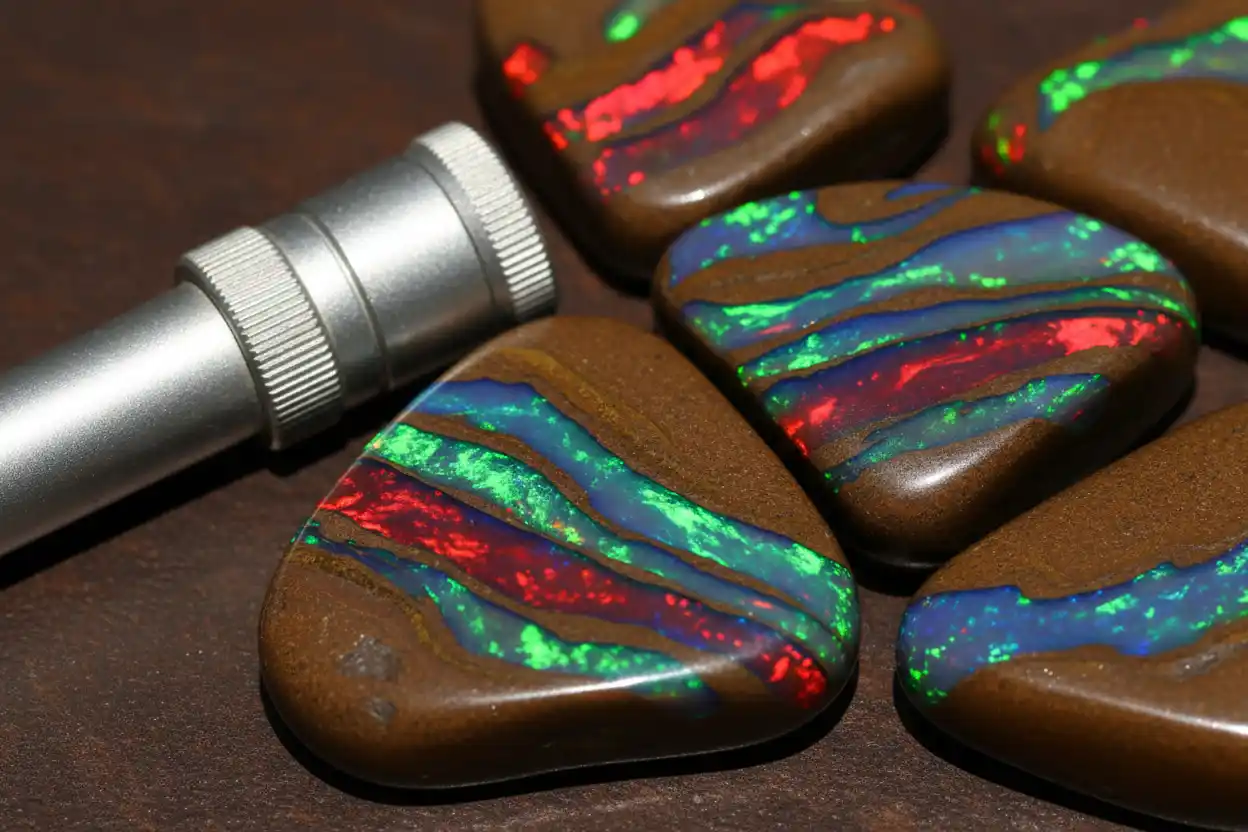
To buy boulder opal confidently, first understand that the brown or dark host rock visible in a genuine specimen is not automatically a defect or an artificial backing. Boulder opal forms as precious opal within or along natural ironstone host rock, and cutters commonly retain that matrix because the opal seams can be too thin or irregular to separate safely. GIA’s Queensland field research describes boulder opal as opal naturally associated with its ironstone host and explains that cutters often follow the contours of those seams when shaping finished stones.
That natural relationship between opal and matrix makes boulder opal fundamentally different from an opal doublet or triplet, where separate materials have been bonded together. It also changes how the buyer should think about weight, cut, pattern and price. Carat weight includes ironstone as well as opal, so dividing a boulder opal’s price by total carats can be misleading unless the comparison stones have similar construction, dimensions, color coverage and matrix proportions. Before shopping solely by weight, focus on the face-up beauty and the structural integrity of the natural opal seam.
Buy Boulder Opal At a Glance
| Buying Factor | What to Examine | Why It Matters |
|---|---|---|
| Identity | Natural boulder opal versus assembled doublet/triplet or imitation | Natural host rock is integral to boulder opal, while assembled stones are bonded products |
| Play-of-Color | Brightness, coverage, color range and movement | The strongest visual quality driver |
| Pattern | Opal veins, broad flashes, pictures and natural matrix design | Distinctive patterns can create collector and design appeal |
| Matrix | Natural ironstone distribution and structural role | Matrix is expected in boulder opal and can enhance appearance |
| Opal Thickness | Thickness and continuity of precious opal layer | Thin seams may be beautiful but require appropriate support |
| Cut | Orientation, freeform outline, polish and contour | Fine cutting should follow natural color while preserving stability |
| Stability | Cracks, crazing, loose seams and fractures | Structural damage can reduce durability and value |
| Treatment | Dye, smoke, sugar, resin, oil or other enhancement | Treatment affects disclosure, care and comparison |
| Construction | Natural opal-on-host rock versus glued backing | Essential distinction for correct identification and price |
| Origin | Queensland provenance and supporting evidence | Queensland is the classic commercial source of boulder opal |
| Weight | Total carats include both opal and matrix | Price-per-carat comparisons require caution |
| Documentation | Laboratory report, seller invoice and return terms | Reduces uncertainty on valuable pieces |
Boulder Opal Is Naturally Attached to Its Host Rock
GIA’s Australian research describes boulder opal as precious opal occurring in thin veins, seams and patches within ironstone concretions in Queensland. The opal forms in cracks and spaces in the host rock, and cutters frequently leave the ironstone attached because removing it would destroy or weaken the thin precious-opal layer.
This structural relationship is central to boulder opal’s identity. Brown, reddish, black or patterned ironstone visible on the back or even across parts of the face should not automatically be interpreted as low quality. In some pieces, the matrix creates dramatic natural landscapes or abstract patterns that collectors value as part of the gem’s character.
Matrix becomes detrimental only when it reduces the desired appearance, weakens the stone, overwhelms the play-of-color or creates structural problems. GIA’s general opal guidance specifically notes that matrix can reduce value in some opals but is an expected and integral part of boulder opal.
Do Not Confuse Boulder Opal With an Opal Doublet
The back of boulder opal can look dark and solid enough that inexperienced buyers mistake it for an assembled stone. The difference is geological rather than merely visual. In boulder opal, precious opal and ironstone occur together naturally. In a doublet, a thin opal layer has been intentionally bonded to a separate backing after mining and cutting.
GIA defines a doublet as an assembled stone containing two joined portions and explains that opal doublets commonly use a thin layer of natural opal cemented to dark backing material. Triplets use an additional transparent top layer.
Examine side views for a perfectly straight glue line or abrupt material boundary. Natural boulder opal commonly shows irregular penetration, veins, undulating seams and transitions that follow geological fractures rather than a manufactured bonding plane. A laboratory can provide stronger evidence when visual examination is uncertain.
Queensland Is the Classic Source of Boulder Opal
GIA identifies the Queensland opal fields as the home of Australian boulder opal and documents major fields including Koroit, Yowah and Quilpie. The material’s formation within ironstone concretions gives Queensland boulder opal a highly distinctive structure and appearance.
Origin can add historical and collector interest, but a Queensland label should not substitute for gem quality. A poorly colored, cracked stone does not become exceptional simply because it comes from a recognized field. As with black opal, buyers should separate the quality of the individual gem from the reputation of the mining district.
For a higher-value purchase, ask what supports the locality statement. Seller records, mine information, provenance documentation and laboratory reporting can carry different evidentiary weight.
Play-of-Color Is Still the Core Quality Factor
Boulder opal is structurally different from solid black or white opal, but the quality of precious opal remains central. GIA identifies play-of-color as opal’s most important quality factor and evaluates its brightness, color range, pattern and distribution.
The finest boulder opal can display intense spectral color against dark ironstone, creating exceptional contrast. GIA’s Queensland research specifically notes the strong play-of-color possible in boulder material and the visual appeal created by the interaction between precious opal and host rock.
Judge how much of the face displays active color, how bright the flashes remain in ordinary lighting, and whether the color appears from useful viewing angles. A thin line of exceptionally vivid red and green may be more visually compelling than a broader but dull opal area, so coverage should not be considered without brightness.
Matrix Can Add Beauty Rather Than Reduce It
Traditional gemstone thinking often treats host rock as unwanted material, but boulder opal is an important exception. Ironstone can create contrast, natural pattern and visual depth, while the opal follows veins and fractures through the matrix. This structure gives many pieces a landscape-like or abstract appearance that would disappear if cutters attempted to remove all host rock.
For jewelry, decide whether you prefer a stone dominated by bright opal or one where opal and ironstone share the composition. Neither preference is inherently more correct. Collector demand can support both styles when the pattern is attractive and the workmanship is strong.
Inspect matrix for structural weakness, however. Natural fractures, crumbly areas, open cavities or unstable transitions between opal and host rock may affect setting and long-term wear.
Carat Weight Requires Special Caution in Boulder Opal
Total boulder opal weight includes both precious opal and ironstone matrix. A thirty-carat boulder opal does not contain thirty carats of precious opal in the same sense that a thirty-carat solid opal might. This makes simple price-per-carat comparisons particularly unreliable.
Dimensions provide much more useful context. A large face-up piece with thin opal veins can be visually impressive even though much of its mass is ironstone. Another stone may contain a greater proportion of precious opal but have smaller overall dimensions.
Buy the appearance and construction rather than the number on the scale. This principle resembles the caution required in the Gems Lore black opal price guide, but it is even more important in boulder opal because matrix is an intentional part of the natural finished gem.
Pattern and Natural “Pictures” Can Influence Collector Appeal
Boulder opal often forms irregular veins, pools, lines and patches through ironstone. Cutters can use these structures to create finished stones resembling landscapes, coastlines, abstract paintings or branching patterns. Such appearances do not constitute a standardized laboratory grade, but they can create genuine collector demand when the visual composition is compelling.
Pattern should still be judged with discipline. An imaginative trade name should not automatically increase value. Ask whether the piece remains attractive without the seller’s story. Brightness, color, balance, proportions and craftsmanship should support the premium.
If the pattern depends heavily on one viewing orientation, inspect the stone in person or through a full-motion video before buying.
Cutters Often Use Freeform Shapes for Good Reason
GIA notes that boulder opal often follows irregular seams in ironstone and is commonly fashioned in freeform shapes that preserve the natural color-bearing areas. A calibrated oval or round may require removing too much valuable color, so asymmetry is not automatically a cutting flaw.
Good freeform cutting should still look intentional. Edges should be polished appropriately, the face should showcase the strongest color, and structural weak points should be minimized. Excessive dead matrix that adds weight without contributing to the design can reduce efficiency, although some collectors deliberately prefer substantial natural host rock.
Examine the side profile to understand opal thickness and to see whether the color seam remains well supported by matrix.
Thickness of the Precious Opal Layer Matters
Boulder opal can contain very thin but exceptionally bright precious-opal seams. GIA’s field research explains that these thin layers are one reason cutters retain ironstone rather than separating the opal completely.
A thin layer is not automatically low quality. Brightness and beauty can compensate for limited thickness, particularly when the matrix provides natural structural support. The practical issue is whether the seam is stable, continuous and protected from chipping or separation.
Ask for side photographs on higher-priced pieces. Face-up images may conceal how thin the precious-opal layer is and how much of the stone consists of host rock.
Check for Crazing, Cracks and Structural Separation
Opal can be vulnerable to cracking and crazing, while ironstone-opal boundaries can create additional structural complexity. GIA notes that opal has variable hardness around 5 to 6.5 and very poor to fair toughness, and that heat or sudden temperature changes can cause fractures.
Inspect the polished face, edges and matrix transitions under magnification. A natural ironstone line should not automatically be mistaken for a crack, but actual fractures crossing the opal layer can affect durability and value.
For rings, protect thin exposed opal seams and vulnerable corners. Boulder opal is often excellent for pendants and statement jewelry because larger freeform shapes can be displayed without the same level of repeated impact encountered in everyday rings.
Treatment Must Be Disclosed Clearly
Known opal enhancements include oil, wax and plastic impregnation as well as sugar and smoke treatment. Dyeing and resin treatment have also been documented in opal research.
Boulder opal’s naturally dark ironstone can create very strong contrast without artificial treatment, but buyers should still ask whether the opal, matrix or surface has been dyed, impregnated, coated or otherwise enhanced. Treatment can affect value, care requirements and the fairness of comparisons.
A seller who uses the term “natural” should clarify whether it refers only to geological origin or also means no detected or known treatment.
Synthetic Opal and Imitations Are Separate From Boulder Opal
Synthetic opal is laboratory-grown to reproduce opal’s essential structure and optical behavior, while imitations use other materials to mimic opal’s appearance. Neither should be confused with natural boulder opal simply because the item shows multicolor flashes on a dark background.
Manufacturers can also mount or assemble opal-like materials against dark substrates, creating a superficial resemblance to natural opal on ironstone. The geological relationship between the precious opal and matrix is therefore important.
For a substantial purchase, independent identification can be more reliable than visual testing alone.
A GIA Report Identifies Opal but Does Not Assign a Universal Quality Grade
GIA states that it evaluates opal but does not grade it. A Colored Stone Identification Report can describe the material and identify natural or laboratory-grown status and detectable treatments within the scope of the service.
That report should not be mistaken for an appraisal. It does not establish what a particular boulder opal should cost, and it does not replace evaluation of pattern, play-of-color, ironstone composition, workmanship and market demand.
For valuable material, report verification can still add substantial confidence, particularly where construction or treatment is uncertain.
Compare Boulder Opal With Boulder Opal, Not With Solid Black Opal by Carat
A boulder opal and a solid black opal may both present dark backgrounds and bright color, but their structures and weight distributions differ. The ironstone component of boulder opal means that carat-for-carat comparisons can be fundamentally misleading.
Instead, compare similar boulder opals according to face-up dimensions, brightness, color coverage, pattern, proportion of visible matrix, opal seam thickness, condition, cut and documentation.
The Gems Lore buy black opal guide provides the appropriate framework for solid dark-body opal, while black opal price explains why even within one opal category a universal per-carat benchmark remains unreliable.
Boulder Opal Versus Ammolite: Similar Visual Excitement, Different Materials
Buyers drawn to dynamic color may also encounter materials such as ammolite, which shows iridescent colors through an entirely different geological and structural mechanism. Gems Lore’s buy ammolite guide explains its own treatment, durability and construction issues.
The comparison is useful only from a buying-discipline perspective. Boulder opal is hydrated silica associated with ironstone, while ammolite originates from fossil ammonite shell material. They should never be treated as gemological equivalents simply because both can display dramatic color.
In both markets, however, buyers benefit from examining construction, treatment, condition and documentation rather than choosing on color alone.
Seller Photos Should Show More Than the Best Angle
Boulder opal is particularly easy to photograph selectively because the play-of-color can vary dramatically with angle. Request full-motion video that tilts the stone through different directions and shows it under more than one lighting condition.
Side and back images are also essential. They reveal matrix thickness, opal seams, natural contours and possible assembly. A listing containing only one face-up photograph provides insufficient information for a significant purchase.
Color editing should remain minimal. If the seller’s photographs look unusually saturated, ask whether the images were adjusted and request an unedited phone video under neutral lighting.
Red Flags When You Buy Boulder Opal
A strong seller should be able to explain the difference between natural matrix and manufactured backing. Additional caution is sensible when a listing combines a spectacular face-up photograph with no side view, vague treatment language, no dimensions, unexplained “AAA” grades or claims that every gram of the stone is precious opal.
Other warning signs include a perfectly uniform bonding plane represented as natural ironstone, obvious glue between layers, a transparent cap not disclosed as part of a triplet, cracks hidden by the setting, or extraordinary locality and value claims unsupported by documentation.
A low price does not necessarily prove a problem, and a high price does not prove quality. Evidence should support either conclusion.
Retailer Grades Are Not Universal Boulder Opal Standards
Terms such as AAA, museum grade, picture opal, top gem and investment grade may be useful descriptions within a seller’s own inventory, but GIA does not assign a universal opal grade.
Translate every grade into observable features. Ask how much of the face shows play-of-color, how bright it is, which colors dominate, whether cracks are present, how much matrix is visible, how thick the precious-opal seam is and whether any treatment or assembly has been detected.
A well-documented stone with no grandiose grade can be a safer purchase than one carrying an impressive label with little supporting information.
How to Compare Boulder Opal Listings
For meaningful comparisons, examine:
Natural boulder structure versus assembled construction.
Brightness and coverage of play-of-color.
Range and intensity of spectral colors.
Pattern and interaction with ironstone.
Face-up dimensions rather than carat weight alone.
Amount and distribution of visible matrix.
Precious-opal seam thickness and continuity.
Cut orientation, contour and polish.
Cracks, crazing and edge damage.
Treatment disclosure.
Geographic provenance.
Laboratory documentation when warranted.
Seller inspection and return rights.
These variables provide a much stronger basis for buying than total carat weight or an undefined quality label.
Conclusion
To buy boulder opal well, recognize that the ironstone is part of the gem’s natural identity rather than an automatic defect. Queensland boulder opal forms as precious opal within its host rock, and cutters preserve that matrix both for structural support and for the distinctive visual patterns it creates. GIA’s field studies document this natural relationship throughout the Queensland opal fields.
The strongest purchase combines vivid play-of-color, attractive pattern, stable opal seams, thoughtful cutting, sound condition, accurate treatment disclosure and clear identification. Carat weight deserves secondary emphasis because much of the mass can be ironstone. Buyers should also distinguish natural boulder opal from doublets, triplets, synthetic opal and imitations, and should never assume that an impressive seller grade or locality name replaces direct examination of the stone.
Frequently Asked Questions
What is boulder opal?
Boulder opal is precious opal naturally associated with its ironstone host rock. GIA’s Queensland research describes opal forming in cracks, seams and spaces within ironstone concretions, with cutters commonly leaving the matrix attached to support the precious-opal layer.
Is the brown backing on boulder opal fake?
Not when it is the stone’s natural ironstone host. Natural matrix is an integral part of genuine boulder opal. A manufactured backing bonded to a thin slice of opal is instead characteristic of an assembled doublet or triplet.
How can I tell boulder opal from a doublet?
Natural boulder opal usually shows irregular geological transitions between precious opal and ironstone, while a doublet often has a relatively distinct bonding plane between the opal layer and an intentionally attached backing. Visual inspection can be difficult in mounted stones, so valuable pieces may justify professional gemological testing.
Does more ironstone make boulder opal less valuable?
Not automatically. Matrix is expected in boulder opal and can contribute attractive natural patterns and contrast. Value depends on how effectively the ironstone and precious opal work together visually, as well as brightness, color coverage, stability, size, cut and collector demand.
Why is price per carat difficult to use for boulder opal?
The reported carat weight includes natural ironstone matrix as well as opal. Two stones of equal weight can therefore contain very different proportions of precious opal and present very different face-up sizes and color coverage. Dimensions and visual quality are more informative starting points.
Where does boulder opal come from?
Queensland, Australia, is the classic commercial source. GIA field research documents major Queensland boulder-opal regions such as Koroit, Yowah and Quilpie and describes their characteristic ironstone-hosted opal deposits.
Is boulder opal usually treated?
Natural boulder opal does not require treatment to display play-of-color, but opal in general can be treated through impregnation, dyeing, smoke, sugar and other processes. Buyers should request explicit treatment disclosure rather than assuming untreated status.
Does GIA grade boulder opal?
No. GIA states that it evaluates opal but does not assign an overall opal grade. Its laboratory reports can identify and describe opal and disclose detectable treatments within the report’s scope.
Is boulder opal suitable for rings?
It can be, but setting design and lifestyle matter. Opal ranges around 5 to 6.5 on the Mohs hardness scale and has variable toughness, so exposed edges and thin seams benefit from protection. Pendants and earrings can reduce impact exposure for especially delicate pieces.
Is boulder opal a guaranteed investment?
No. Fine boulder opal can be rare and collectible, but future resale depends on quality, demand, provenance, condition, treatment disclosure and market liquidity. A seller’s “investment grade” label cannot guarantee appreciation.