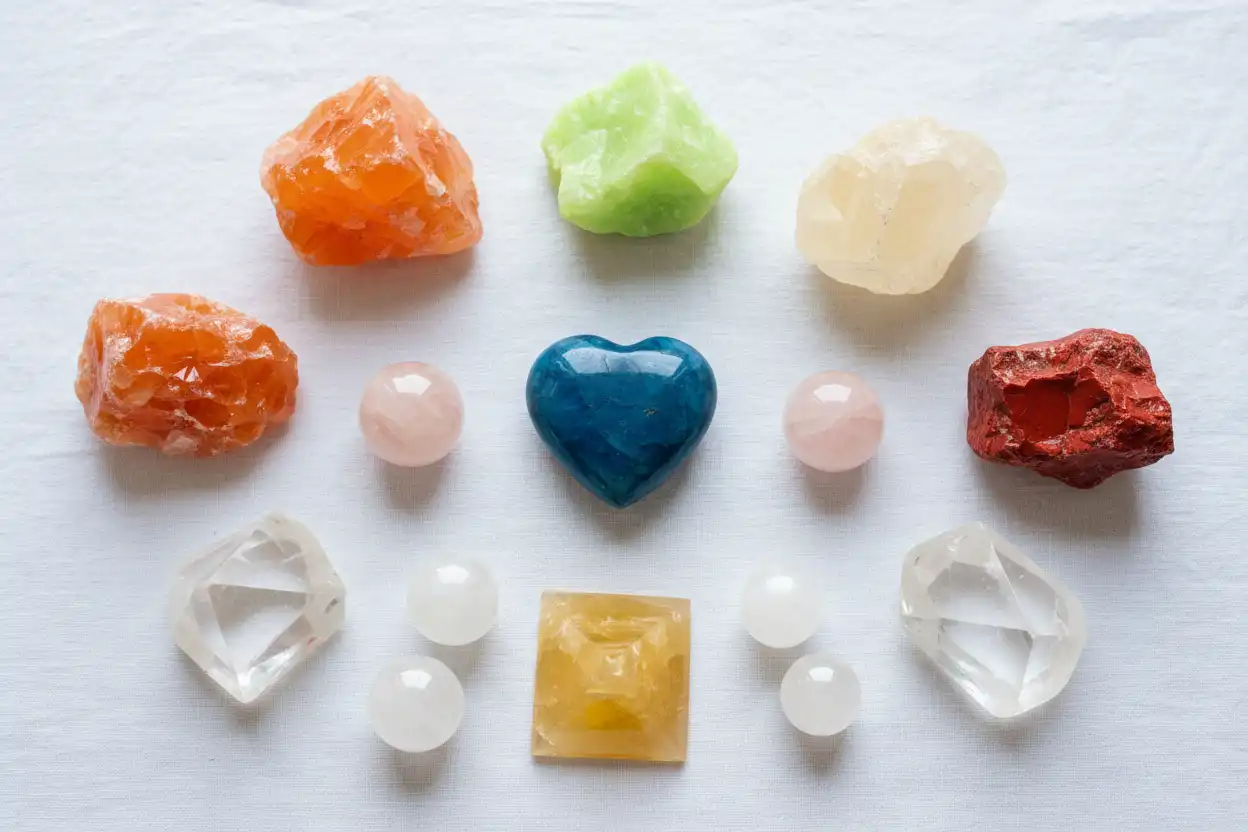
Calcite Color Meaning: Symbolism, Uses & Color Guide
Calcite color meaning changes dramatically from clear and white crystals to blue, green, yellow, honey, orange, red, pink, purple, brown and nearly black material, yet every genuine specimen begins with the same fundamental mineral: calcium carbonate, CaCO₃. Pure calcite is colorless, while trace-element substitutions, microscopic mineral inclusions, lattice defects, organic material, iron staining, internal scattering and occasionally artificial treatments create the remarkable range of colors seen in natural and commercial specimens.
Understanding calcite color meaning therefore requires two separate perspectives. Mineral science explains why a particular specimen looks blue, pink or golden and whether that color is intrinsic, inclusion-related, surface-derived or treated. Symbolic traditions interpret those colors through themes such as clarity, communication, growth, motivation, creativity, direct action, emotional openness or practical grounding, but those associations are cultural and personal rather than scientifically demonstrated properties of calcium carbonate.
Color also does not create a new mineral species. A blue specimen remains calcite, an orange specimen remains calcite and a transparent optical rhombohedron remains calcite, provided the material actually has the CaCO₃ composition and trigonal crystal structure characteristic of the mineral. The broader calcite meaning guide covers the species-level mineralogy, whereas this calcite color meaning guide concentrates specifically on what different colors can indicate scientifically and what people commonly associate with those colors symbolically.
The most useful approach is not to assume that one color always has one chemical cause or one universal spiritual meaning. Instead, calcite color meaning becomes clearer when you evaluate the exact specimen, its locality, inclusions, transparency, treatment history and personal significance together.
Calcite Colors at a Glance
| Calcite color | Possible natural coloring factors | Common modern symbolic themes | Typical uses |
|---|---|---|---|
| Clear or colorless | High purity, limited light-scattering inclusions | Perspective, objectivity, clarity | Optical specimens, collections, meditation objects |
| White | Internal scattering, fractures, microscopic inclusions, porous texture | Simplicity, reset, organization | Carvings, spheres, specimens |
| Blue | Trace chemistry, structural defects, scattering and deposit-specific factors | Calm communication, reflection, patience | Palm stones, carvings, specimens |
| Green | Trace elements, inclusions, mixed mineral phases or staining | Growth, adjustment, renewal | Decorative objects, carvings, specimens |
| Yellow | Iron-related impurities, inclusions, organic material, defects or staining | Learning, planning, optimism | Carvings, crystals, collector gems |
| Honey | Warm yellow-brown coloration, often iron-related or inclusion-related | Skill building, persistence, practical confidence | Polished pieces, crystals, collector gems |
| Orange | Iron-rich inclusions, staining, trace chemistry and internal texture | Creativity, enthusiasm, experimentation | Towers, spheres, carvings |
| Red | Iron oxides, manganese, hematite inclusions or staining | Direct action, priorities, persistence | Collector pieces, carvings |
| Pink | Manganese commonly contributes; composition varies | Gentleness, support, emotional honesty | Polished stones, specimens |
| Magenta / cobalt-bearing | Cobalt substituting for calcium | Appreciation, warmth, strong boundaries | Mineral specimens, collector pieces |
| Purple / lavender | Trace elements, defects and inclusions | Reflection, belief review, imagination | Collector and decorative material |
| Brown | Iron, manganese, clay, organic or carbonaceous material | Practicality, patience, realism | Decorative pieces, specimens |
| Gray | Fine inclusions, internal scattering, carbonaceous material | Neutrality, uncertainty management, perspective | Decorative material |
| Black / nearly black | Heavy inclusions, carbonaceous matter, mixed rock, dye in some commercial pieces | Privacy, boundaries, difficult-information processing | Decorative carvings, specimens |
| Banded / multicolor | Changing growth conditions and impurity concentrations | Integration, transition, complexity | Slabs, carvings, display pieces |
This table summarizes calcite color meaning without implying that every blue crystal has identical chemistry or every orange stone carries the same symbolism. Exact color causes can differ substantially among deposits.
Why Does Calcite Come in So Many Colors?
Calcite is fundamentally colorless when chemically pure and structurally transparent, but natural crystals rarely grow in perfectly isolated laboratory-like conditions. Fluids moving through rocks contain dissolved metals, suspended particles, organic compounds and other chemical components that can become incorporated into a growing crystal or trapped between successive growth layers.
Trace ions can substitute for small amounts of calcium. Manganese and cobalt are particularly important in many pink calcites, while iron frequently contributes to yellow, orange, red and brown appearances. Copper, magnesium and other elements can occur in some colored material, although one element should not be assigned as the universal explanation for a particular color.
Microscopic inclusions create another pathway. Fine iron oxides, clay, carbonaceous material or other minerals can alter calcite color meaning visually even when the calcite lattice itself contains little of the coloring substance.
Crystal defects also matter. Research on blue calcite demonstrates that its coloration can involve a complicated relationship among lattice distortion, defects, scattering and trace-element substitution rather than one simple “blue element.” Two blue specimens from unrelated geological environments may therefore look similar while reaching that appearance through different mechanisms.
Surface effects create another layer. Iron staining can make an otherwise pale crystal appear yellow, orange or brown, while commercial dye can penetrate cleavage cracks and porous massive calcite. The same visible color may therefore have several possible origins.
Calcite Color Meaning Versus Calcite Variety
A color label and a mineral variety are not always the same thing.
“Blue calcite” usually means exactly what the name suggests: calcite whose visible body color is blue. It does not require one fixed chemical substitution.
“Mangano calcite,” by contrast, carries a stronger compositional implication because manganese is part of the reason the calcite is being distinguished.
“Cobalt-bearing calcite” likewise refers to cobalt substituting for some calcium and commonly producing strong pink-to-magenta coloration.
“Honey calcite” is mainly an appearance-based trade term rather than a formally bounded chemical variety.
“Optical calcite” describes unusually transparent material suitable for demonstrating birefringence rather than a separate chemical composition.
The types of calcite guide separates chemical varieties, habits, optical material, trade names and decorative forms more completely. For calcite color meaning, the practical lesson is that a color name describes appearance first unless the terminology explicitly carries a compositional definition.
Clear and Colorless Calcite Color Meaning
Clear calcite reveals the mineral’s optical character more directly than any strongly colored variety. High-quality transparent rhombohedrons can show dramatic double refraction, causing printed text or a line beneath the crystal to appear duplicated because calcite splits incoming light into ordinary and extraordinary rays.
Scientifically, clear material does not need a coloring impurity because pure calcite is naturally colorless. Greater transparency generally means fewer light-scattering inclusions, grain boundaries and internal fractures, although transparent crystals can still contain fluid inclusions, growth zoning or cleavage features.
Calcite color meaning for clear material commonly centers on objectivity, seeing a situation from more than one perspective and distinguishing observation from interpretation. The symbolism is particularly intuitive because double refraction literally produces two visible images.
A useful way to apply this calcite color meaning is during decision-making. Write down what you know, what you believe, what remains uncertain and what additional evidence would change your conclusion.
The mineral does not create mental clarity, but its optical behavior can provide a memorable metaphor for examining more than one interpretation.
White Calcite Color Meaning
White calcite ranges from translucent milky material to dense opaque masses and cream-colored crystals. The white appearance normally comes from internal scattering caused by tiny inclusions, fractures, grain boundaries, porous textures or fine intergrowths rather than a white-producing chemical element replacing calcium throughout the crystal.
The dedicated white calcite guide covers its mineral forms and identification in greater depth.
Calcite color meaning for white material often includes simplicity, clearing unnecessary distractions, creating a deliberate reset and organizing priorities. White is frequently associated culturally with blank space, clean surfaces and fresh beginnings, making these symbolic themes understandable even though they are not physical effects of calcite.
A practical symbolic use is to keep a white specimen beside a planning area and connect it with one question: what can be removed, simplified or postponed so the most important task becomes easier to see?
Blue Calcite Color Meaning
Blue calcite commonly appears powder blue, sky blue, gray-blue, blue-green or muted pastel blue. Transparent strongly colored crystals are less common than translucent massive material used for spheres, towers, carvings and palm stones.
The science behind blue coloration deserves caution. Modern analytical work shows that natural blue calcite can involve lattice distortion, structural defects, trace substitutions and optical scattering in combinations that differ among deposits. It is therefore too simplistic to claim that one element always makes calcite blue.
The blue calcite guide addresses the variety in greater mineralogical detail.
Calcite color meaning for blue material commonly emphasizes communication, patience, listening before responding and deliberately choosing language. Rather than claiming that a blue stone physically alters the throat or nervous system, a grounded symbolic practice uses the color as a reminder to slow a conversation down.
Before replying to something difficult, ask:
What was actually said?
What am I assuming?
What response would communicate my point without adding unnecessary conflict?
That behavioral use captures blue calcite color meaning without turning symbolism into physiology.
Green Calcite Color Meaning
Green calcite ranges from pale mint and seafoam through yellow-green, gray-green and deeper mossy colors. Trace chemistry, microscopic inclusions, associated minerals and surface effects can all influence the green appearance.
The material is commonly translucent and massive rather than highly transparent. Because calcite has Mohs hardness 3, polished green pieces can develop scratches much faster than jade, quartz or many harder green gemstones.
The full green calcite guide explains its mineral characteristics, lookalikes and care.
Modern calcite color meaning for green specimens commonly focuses on gradual growth, reviewing routines, adaptability and creating sustainable rather than dramatic change.
A practical interpretation is to connect green calcite with habit review. Instead of asking whether a routine is “good” or “bad,” ask whether it is producing the result you want and what small adjustment would make it more effective.
This keeps green calcite color meaning connected to intentional behavior rather than guaranteed healing or transformation.
Yellow Calcite Color Meaning
Yellow calcite can range from nearly colorless lemon and straw shades to stronger golden, mustard and yellow-brown material. Iron-related impurities, iron oxides, structural defects, organic compounds and surface staining can all contribute, but exact color mechanisms vary among deposits.
The yellow calcite guide covers those distinctions more completely.
Calcite color meaning for yellow material often emphasizes learning, organization, curiosity, confidence based on preparation and selecting a practical next step.
This symbolism works particularly well for studying because yellow is widely associated with visibility and attention. Someone might keep a piece near notes and use it as a cue to stop rereading passively and instead summarize the material from memory.
The stone does not improve intelligence or memory biologically.
The useful part of yellow calcite color meaning comes from linking an object with a deliberate learning behavior.
Honey Calcite Color Meaning
Honey calcite describes warm golden-yellow, amber, caramel or brownish-yellow material, frequently with attractive translucency and internal cleavage reflections. The commercial boundary between honey and ordinary yellow calcite is subjective, so one seller’s honey calcite may be another seller’s golden calcite.
The dedicated honey calcite page explains that overlap in more detail.
Calcite color meaning for honey-colored material commonly emphasizes sustained effort, skill building, applying knowledge and confidence earned through repeated practice.
This makes it especially suitable as a symbolic reminder during long projects where improvement happens gradually rather than through one dramatic breakthrough.
A useful question is:
What skill would make this task easier if I practiced it consistently?
Honey calcite does not create competence.
The symbolism encourages a process that can.
Orange Calcite Color Meaning
Orange calcite ranges from pale peach and apricot through tangerine, pumpkin, amber-orange and reddish orange. Iron-rich inclusions, iron staining, trace chemistry and internal texture can all contribute to the appearance.
Commercial orange material is abundant enough to be carved into towers, spheres, bowls, hearts and decorative shapes, while transparent orange crystals suitable for collector faceting are less common.
The orange calcite guide covers the variety’s mineral properties and identification separately.
Orange calcite color meaning commonly centers on creativity, experimentation, enthusiasm and restarting activity after momentum has been lost.
A grounded symbolic practice is to use an orange stone during brainstorming while deliberately suspending evaluation for a short period. Generate several possible approaches first, then decide which one is realistic.
The creative value comes from the exercise.
Calcite color meaning provides the visual theme.
Red Calcite Color Meaning
Red calcite includes salmon-red, brick-red, rusty red, orange-red and brownish-red material. Iron oxides, manganese, hematite inclusions and surface staining are among the possible contributors, although the exact cause depends on locality and specimen.
The red calcite guide addresses its identification and related red carbonate lookalikes more deeply.
Calcite color meaning for red material often emphasizes direct action, recognizing immediate priorities, commitment and steady effort under pressure.
A practical use is prioritization. When several tasks compete for attention, identify which one becomes more expensive, difficult or risky if ignored.
Red does not generate physical energy or alter circulation.
Its symbolic value comes from association with urgency and action.
Pink Calcite Color Meaning
Pink calcite commonly receives part of its color from manganese, particularly in pale blush, rose and salmon material. However, not every pink specimen contains identical manganese concentrations, and inclusions, additional elements and growth zoning can modify both visible color and fluorescence.
The term “pink calcite” is broader than one precise chemical variety.
Calcite color meaning for pink material usually involves kindness, emotional honesty, accepting support and responding gently without avoiding necessary boundaries.
A grounded use is to connect the stone with communication during emotionally difficult situations. Before speaking, distinguish what you feel from what you want another person to do.
That separation can make communication clearer.
Pink calcite color meaning does not imply that the mineral treats grief, trauma, depression or heart disease.
Mangano Calcite Color Meaning
Manganoan or manganese-bearing calcite commonly appears pale pink, peach-pink, soft rose or salmon and may display strong fluorescence under ultraviolet illumination depending on trace chemistry.
The mangano calcite guide focuses on this manganese-bearing material specifically.
Mangano calcite should not automatically be equated with every pink calcite, nor should pink color alone establish manganese concentration.
Its symbolism overlaps with broader pink calcite color meaning but often emphasizes compassion balanced with emotional realism.
A useful interpretation is allowing yourself to acknowledge a difficult feeling without treating that temporary emotion as a permanent fact about the future.
Cobalt-Bearing Calcite Color Meaning
Cobalt-bearing calcite commonly produces stronger rose, raspberry, magenta, hot-pink and purplish-pink colors because Co²⁺ can substitute for Ca²⁺ within the calcite structure.
The mineral remains calcite rather than becoming a separate species merely because cobalt is present. Very cobalt-rich carbonates can also overlap visually with spherocobaltite, which makes analytical identification important for valuable specimens.
The dedicated cobaltocalcite guide explains these distinctions.
Calcite color meaning for vivid cobalt-bearing pink material often centers on expressing appreciation openly, celebrating important relationships and combining warmth with clear boundaries.
This is a symbolic interpretation inspired partly by intense color.
It does not indicate that cobalt-bearing calcite has stronger emotional or healing power than pale pink material.
Purple and Lavender Calcite Color Meaning
Purple and lavender calcite occur less commonly than white, yellow or orange material. Trace chemistry, structural defects, inclusions and mixtures with other minerals can influence the color, while some commercial purple decorative pieces may also be dyed.
Because purple calcite can overlap visually with fluorite, banded carbonate material and mixed mineral rock, exact mineral identification becomes particularly important when the color is unusually strong.
Modern calcite color meaning for purple material commonly emphasizes examining beliefs, separating imagination from evidence, reflection and willingness to revise an interpretation.
That symbolism can be useful during journaling.
Choose one strongly held assumption and ask what evidence would cause you to change your mind.
The gemstone does not reveal hidden truths.
It can serve as a reminder to remain intellectually flexible.
Brown Calcite Color Meaning
Brown calcite can range from beige and caramel to coffee, chocolate and nearly black. Iron, manganese, clay, organic compounds, bituminous material, mixed mineral inclusions and surface alteration can all contribute.
Some honey calcite grades naturally into brown, which illustrates why retail color names have flexible boundaries.
Calcite color meaning for brown material often includes practicality, patience, working within real limitations and paying attention to material responsibilities.
A grounded symbolic practice is to use brown calcite as a cue for tasks involving budgets, schedules, maintenance, organization or other concrete obligations.
The symbolism focuses on reality rather than wishful thinking.
Gray Calcite Color Meaning
Gray calcite often receives its appearance from fine inclusions, carbonaceous matter, internal light scattering or mixed mineral components.
The color can range from pale silver-gray to charcoal.
Gray calcite color meaning is commonly associated with neutrality, uncertainty management and delaying judgment until enough information is available.
This symbolism is especially useful because gray literally sits between visual extremes.
A practical question is:
Which part of this issue is genuinely uncertain rather than merely uncomfortable?
Recognizing uncertainty accurately is often more useful than forcing an immediate yes-or-no conclusion.
Black Calcite Color Meaning
Nearly black calcite can occur where heavy dark inclusions, carbonaceous material, organic matter or mixed mineral components strongly absorb light. Commercial black decorative pieces can also be dyed, so an extremely uniform black appearance deserves treatment scrutiny.
Black material should not automatically be described as rarer, stronger or more protective than lighter calcite.
Calcite color meaning for black material commonly includes privacy, boundaries, restraint and approaching difficult information without unnecessary dramatization.
A practical symbolic use is to connect black calcite with information boundaries: which details genuinely need to be shared, with whom and for what purpose?
The stone does not create supernatural protection.
The symbolism can remind someone to establish deliberate boundaries.
Banded and Multicolor Calcite Color Meaning
Calcite frequently records changes in fluid chemistry during growth. One specimen may contain white, yellow, orange, brown, red or transparent layers produced during different mineralizing episodes.
Banded massive material can also contain aragonite, limestone, other carbonates or associated minerals, so not every multicolored decorative object consists entirely of calcite.
Calcite color meaning for multicolor material commonly emphasizes integration, changing circumstances and understanding how separate experiences contribute to a larger pattern.
The symbolism fits the geology particularly well.
Different layers do not erase earlier growth.
They preserve evidence that conditions changed.
Does Calcite Color Change Its Mineral Properties?
Natural color normally does not change the fundamental identity of calcite.
Blue, green, yellow and pink calcite remain CaCO₃ with the same trigonal crystal framework, approximately Mohs 3 hardness and characteristic rhombohedral cleavage.
However, practical properties can vary because colored material often contains different inclusions, porosity, fractures or treatments.
A massive orange carving filled with iron-rich inclusions may behave differently during polishing from a transparent clear rhombohedron.
A resin-stabilized dyed blue piece can react differently to cleaning than an untreated natural crystal.
Therefore, calcite color meaning should never become a shortcut for care instructions.
Treatment and physical condition matter more than symbolism.
Calcite Color Meaning and Hardness
Every genuine calcite variety remains comparatively soft.
Mohs hardness 3 means quartz-rich household dust, metal edges and most common jewelry gemstones can scratch polished calcite.
Color does not make blue calcite harder than orange calcite or pink calcite softer than clear calcite in a meaningful mineralogical sense.
A polished object may feel more durable if resin stabilization has strengthened pores or fractures, but the natural calcite itself has not transformed into a harder mineral.
This matters particularly for rings, bracelets and frequently handled carvings.
Calcite Color Meaning and Cleavage
Calcite has perfect rhombohedral cleavage in three directions.
That property is independent of color.
A thick red calcite cabochon, a blue carving and a clear optical rhombohedron can all split along cleavage planes if struck unfavorably.
Consequently, color symbolism should never be used to imply physical resilience.
A stone associated with “strength” metaphorically can still be mechanically fragile.
Calcite Colors and Double Refraction
Transparent calcite has exceptionally strong birefringence, with refractive indices near 1.486 and 1.658 and birefringence around 0.172.
Clear material demonstrates this most dramatically because objects viewed through the crystal can appear doubled.
Colored transparent calcite can display the same optical effect, although inclusions, cloudiness and strong body color may make it less obvious.
This optical property provides one of the most scientifically interesting foundations for calcite color meaning related to perspective.
The mineral literally demonstrates that one object can produce two visible images depending on how light travels through the crystal.
Calcite Color Meaning and Chakra Associations
Modern crystal practices frequently connect different calcite colors with chakra symbolism.
These associations are spiritual frameworks, not anatomical or medical findings.
| Calcite color | Common chakra association | Grounded symbolic interpretation |
|---|---|---|
| Clear / white | Crown | Reflection, perspective, simplification |
| Blue | Throat | Deliberate communication and listening |
| Green / pink | Heart | Relationships, support, habits and emotional honesty |
| Yellow / honey | Solar plexus | Planning, competence, confidence through preparation |
| Orange | Sacral | Creativity, experimentation, flexibility |
| Red / brown / black | Root | Priorities, boundaries, practical responsibilities |
| Purple | Third eye / crown | Reviewing beliefs and examining interpretations |
Calcite color meaning within chakra practice can remain personally meaningful without claiming that placing a mineral on the body changes an organ, endocrine gland, nerve pathway or medical condition.
Which Calcite Color Is Best for Meditation?
There is no scientifically superior meditation color.
Choose according to the theme you want to explore.
Clear calcite suits perspective.
Blue calcite suits communication.
Green calcite suits gradual change.
Yellow calcite suits planning.
Honey calcite suits skill building.
Orange calcite suits creative experimentation.
Red calcite suits immediate priorities.
Pink calcite suits supportive communication.
Purple calcite suits belief review.
Brown or black calcite suits practical boundaries.
The most useful calcite color meaning is the one that supports a clear reflective practice rather than promising automatic results.
Which Calcite Color Is Best for Studying?
Yellow and honey calcite are commonly chosen symbolically for studying because their modern interpretations center on learning, organization and applying knowledge.
The stone itself does not improve memory, concentration or intelligence.
A productive use is behavioral: place the specimen beside study materials and treat it as a cue to use active recall, practice questions or structured summaries rather than passive rereading.
This distinction keeps calcite color meaning supportive without making unsupported cognitive claims.
Which Calcite Color Is Best for Communication?
Blue calcite is the most common symbolic choice because blue is widely linked with communication themes.
A grounded approach uses blue calcite as a reminder to listen fully, separate facts from interpretation and decide what outcome you want from a conversation before responding.
No evidence demonstrates that blue calcite biologically improves speech or treats communication disorders.
Which Calcite Color Is Best for Creativity?
Orange calcite is the most common symbolic choice, while yellow and multicolored pieces can also fit creative routines.
Use the stone as a visual signal that idea generation and idea evaluation should happen in separate stages.
Create several possibilities before judging them.
This simple process gives orange calcite color meaning a practical role without claiming the mineral generates creativity.
Which Calcite Color Is Best for Confidence?
Yellow, honey and golden calcite are most frequently associated with confidence.
A useful distinction is between confidence based on preparation and confidence based on wishful certainty.
Keep the stone beside a presentation outline, practice schedule or project plan and let it represent the preparation that makes confidence more realistic.
Calcite does not guarantee successful performance.
Which Calcite Color Is Best for Emotional Symbolism?
Pink and green calcite are commonly used for themes involving relationships, emotional honesty, adjustment and support.
Neither color is a treatment for depression, grief, trauma, anxiety or other psychological conditions.
Their symbolic use can instead involve journaling, setting boundaries, identifying what support is needed or communicating feelings more precisely.
Which Calcite Color Is Best for Grounding?
Brown, gray, red and black calcite are often connected symbolically with grounding themes.
A practical interpretation means returning attention to immediate responsibilities, physical surroundings, finances, schedules or concrete next steps.
Touching or viewing a familiar stone can function as a sensory cue during mindfulness, but the effect comes from the attention exercise rather than a measured grounding energy emitted by calcite.
Calcite Color Meaning and Healing Claims
Color-specific calcite pages are frequently accompanied by claims that blue material heals the throat, green material heals the heart, orange material improves reproductive health, yellow material strengthens digestion or red material affects circulation.
These claims are not established by clinical evidence.
Calcite is calcium carbonate, but touching a calcite crystal is not equivalent to receiving dietary calcium or medical treatment.
The color of a mineral does not create a medically targeted pathway to a similarly colored or symbolically associated body system.
Calcite color meaning is best understood through personal symbolism, reflection and cultural association rather than disease treatment.
Can Calcite Color Reveal Trace Elements?
Sometimes, but not reliably enough for visual chemistry.
Strong magenta calcite can suggest cobalt.
Pale pink material can suggest manganese.
Yellow, orange, red and brown can suggest iron-related influences.
Yet color alone rarely proves the exact coloring agent.
One specimen can contain several trace elements, and a visually important color may actually come from microscopic inclusions or surface staining rather than substitution within the calcite structure.
Laboratory analysis is necessary when exact chemistry materially affects identification or value.
Fluorescence and Calcite Color Meaning
Calcite can fluoresce in many colors under ultraviolet light.
Manganese is a well-known activator of orange-red fluorescence, while other trace elements can enhance or suppress luminescence.
Visible body color and fluorescence are separate properties.
A pale pink stone may fluoresce strongly.
A vivid colored stone may be relatively inert.
A fluorescent response does not automatically prove natural color, manganese content, locality or rarity.
For calcite color meaning, fluorescence is scientifically interesting but should not be turned into a spiritual-strength ranking.
Does Locality Determine Calcite Color?
Locality can influence color because each geological deposit has different fluid chemistry, associated minerals and growth conditions.
Certain mining regions become famous for recognizable calcite styles, including transparent golden crystals, cobalt-rich magenta crusts, blue massive material or unusual fluorescent specimens.
However, country names should not be used as automatic color explanations.
Similar-looking calcite occurs in unrelated deposits.
Exact mine provenance, chemical testing and mineral association provide stronger evidence than statements such as “all blue calcite comes from one place.”
Natural Calcite Color Versus Dye
Calcite accepts dye relatively easily because massive material can contain pores, grain boundaries, fractures and cleavage planes that allow pigment to penetrate.
Dyed blue, green, purple, pink, red and black material appears regularly in the decorative market.
When evaluating calcite color meaning in a commercial piece, inspect:
- Drill holes.
- Surface pits.
- Cleavage fractures.
- Saw-cut bases.
- Chips.
- Color concentration around cracks.
- Areas hidden beneath metal findings.
- Unnaturally uniform neon saturation.
Pigment collecting in these features can suggest dye.
The how to spot dyed crystals guide provides a broader treatment-screening framework.
Do not rub valuable stones with solvents, scrape the surface or deliberately break a specimen to test color.
Surface Coatings and Aura Calcite
Metallic, rainbow, iridescent or strongly enhanced calcite can receive artificial surface coatings.
The underlying mineral may still be natural calcite, but the visible effect does not represent natural body color.
Coatings can wear at edges, scratch or react differently to cleaning.
A coated product can be attractive decorative material when disclosed honestly.
Calcite color meaning should distinguish a naturally purple crystal from a coated rainbow calcite because the geological origin of the color is fundamentally different.
Resin, Wax and Stabilization
Fractured or porous calcite may be impregnated with resin to strengthen the material and improve polish.
Wax and oil can deepen color temporarily and reduce the visibility of scratches.
These treatments can make decorative objects more practical, but they influence value, care and color appearance.
A polished blue or orange carving should therefore not be judged on saturation alone.
Ask whether the color is natural and whether resin, wax, oil or dye is present.
How to Identify Naturally Colored Calcite
Begin by establishing that the material is calcite before interpreting the color.
Useful calcite characteristics include:
- Chemical composition CaCO₃.
- Mohs hardness 3.
- Perfect rhombohedral cleavage.
- Strong double refraction in transparent material.
- Specific gravity around 2.71.
- Trigonal crystal structure.
- Vitreous to pearly luster.
- Strong reaction with dilute acids.
Acid reaction is diagnostically useful in mineralogy, but acids permanently etch calcite and should not be applied casually to polished, collectible or valuable specimens.
Professional methods such as Raman spectroscopy, infrared spectroscopy, X-ray diffraction and chemical analysis can establish identity without relying on color.
Color Alone Cannot Authenticate Calcite
Many other materials overlap with individual calcite colors.
White calcite can resemble howlite, magnesite, gypsum or aragonite.
Blue calcite can resemble blue aragonite, dyed carbonate, celestite or other pale-blue minerals.
Green calcite can resemble fluorite, prehnite, serpentine, dyed carbonate or other green decorative stones.
Yellow calcite can resemble citrine, fluorite, aragonite and scapolite.
Pink calcite can resemble rhodochrosite, rhodonite and dyed carbonate.
Purple calcite can resemble fluorite.
Black massive calcite may be difficult to distinguish visually from other dark carbonate-rich rocks.
Calcite color meaning should therefore follow mineral identification rather than replace it.
How Calcite Color Affects Value
Color can influence value, but it rarely acts alone.
Common orange, white, yellow, blue and green massive calcite is abundant enough that ordinary pieces usually remain accessible. Exceptional transparency, crystal form, fluorescence, locality, matrix association, unusual color zoning or craftsmanship can increase value substantially.
Cobalt-bearing magenta specimens can command strong collector premiums because vivid well-formed crystals occur in a narrower geological context.
Fine optical calcite can also be valuable when exceptionally transparent and supported by historic provenance.
The most important value factors include:
- Natural color.
- Color saturation.
- Transparency.
- Crystal form.
- Condition.
- Luster.
- Fluorescence.
- Matrix.
- Locality.
- Provenance.
- Treatment.
- Size.
- Craftsmanship.
No calcite color has a universally fixed price hierarchy independent of those qualities.
How to Choose a Calcite Color
Choose a calcite color first according to why you want the specimen.
For mineral collecting, prioritize crystal form, locality, unusual chemistry and provenance.
For decorative use, choose the color and pattern you find visually appealing.
For symbolic practice, choose a calcite color meaning that connects naturally with a behavior or value you actually want to reinforce.
For jewelry, prioritize structural condition and protection because calcite remains soft and cleavable regardless of color.
For educational use, clear optical calcite can demonstrate birefringence especially well.
The strongest purchase is the one whose mineral quality, treatment status and intended use all make sense together.
Buying Calcite by Color
If you are purchasing colored calcite, ask for neutral-light photographs of the exact piece. Warm lighting can intensify yellow, honey, orange and red material, while cool lighting can make blue and green appear cleaner or more saturated.
Inspect the base, sides and back.
Ask whether color is natural, dyed, coated or stabilized.
For expensive pink material, clarify whether the seller means ordinary pink calcite, manganese-bearing calcite, cobalt-bearing calcite, rhodochrosite or another carbonate.
For collector specimens, retain original locality labels.
The where to buy calcite guide covers transaction-focused checks more fully.
Does Calcite Color Change in Sunlight?
Many naturally colored calcites remain reasonably stable under normal indoor conditions, but there is no universal rule covering every color mechanism, inclusion and treatment.
Dyes can fade.
Resins can discolor.
Coatings can deteriorate.
Organic components can change.
Some defect-related coloration may respond differently to prolonged strong light.
The safest general display strategy is moderate indirect illumination rather than leaving a colorful specimen in a hot, intensely sunlit window.
Can Calcite Colors Go in Water?
Brief contact with clean lukewarm water may be acceptable for many intact untreated calcite specimens, but prolonged soaking is unnecessary.
Dyed, resin-filled, glued, coated, porous or matrix-bearing material can respond differently.
Acidic liquids are especially inappropriate because calcite reacts readily with acids.
Avoid vinegar, lemon juice, descalers, acidic bathroom cleaners and fizzy beverages.
A color’s symbolism does not change those chemical facts.
How to Clean Every Calcite Color
Use a soft dry cloth or exceptionally soft brush whenever possible.
For more persistent residue, use a small amount of mild soap with lukewarm water, rinse briefly and pat dry.
Avoid:
- Vinegar.
- Lemon juice.
- Acidic cleaners.
- Bleach.
- Abrasive powders.
- Stiff brushes.
- Steam.
- Ultrasonic cleaning.
- Aggressive polishing compounds.
- Prolonged soaking.
For symbolic maintenance, the gentle practices in how to cleanse calcite can be kept separate from physical cleaning requirements.
How to Store Colored Calcite
Store calcite separately from harder gemstones and minerals.
Quartz, feldspar, topaz, spinel, sapphire, ruby and diamond can all scratch calcite.
Use a padded compartment or specimen box.
Support large crystal groups from stable matrix rather than fragile projecting points.
Avoid stacking polished pieces directly against each other.
The care requirements remain essentially the same whether calcite color meaning is associated symbolically with communication, confidence or grounding.
Frequently Asked Questions
What does calcite color meaning refer to?
Calcite color meaning refers to both the scientific reasons calcite develops different colors and the symbolic associations people commonly assign to clear, white, blue, green, yellow, orange, pink, red, purple, brown and black specimens.
What is calcite’s natural color?
Chemically pure calcite is colorless. White and colored appearances result from internal scattering, trace-element substitutions, inclusions, defects, organic material, staining or treatments.
Why does calcite come in so many colors?
Calcite grows in many geological environments where fluids contain different trace elements, mineral particles and organic compounds. Structural defects, inclusions and surface alteration add further variation.
Does every calcite color have a different chemical formula?
No. Genuine colored calcite still has the basic formula CaCO₃, although trace elements can substitute for small amounts of calcium.
What is the most common calcite color meaning for clear calcite?
Clear calcite commonly symbolizes perspective, objectivity and separating evidence from assumption, partly inspired by its strong double refraction.
What does white calcite symbolize?
White calcite commonly represents simplification, organization, fresh starts and reducing unnecessary clutter.
What does blue calcite symbolize?
Blue calcite color meaning commonly emphasizes patient communication, thoughtful listening and creating space before responding.
What does green calcite symbolize?
Green calcite commonly represents gradual growth, adapting routines, renewal and making sustainable changes.
What does yellow calcite symbolize?
Yellow calcite color meaning commonly centers on learning, organization, curiosity, planning and selecting a practical next step.
What does honey calcite symbolize?
Honey calcite commonly represents skill building, persistence, practical confidence and applying knowledge through repeated effort.
What does orange calcite symbolize?
Orange calcite color meaning commonly includes creativity, experimentation, flexibility and restarting projects that have lost momentum.
What does red calcite symbolize?
Red calcite commonly represents immediate priorities, deliberate action, persistence and directing effort toward urgent responsibilities.
What does pink calcite symbolize?
Pink calcite color meaning commonly includes emotional honesty, gentleness, support and compassionate communication.
What does cobalt-bearing calcite symbolize?
Vivid cobalt-bearing pink or magenta calcite is commonly associated symbolically with appreciation, warmth, meaningful relationships and clear boundaries.
What does purple calcite symbolize?
Purple calcite commonly represents reflection, examining beliefs, questioning assumptions and separating imagination from evidence.
What does brown calcite symbolize?
Brown calcite color meaning commonly includes practicality, patience, realism and attention to material responsibilities.
What does gray calcite symbolize?
Gray calcite commonly represents neutrality, working with uncertainty and delaying judgment until enough information is available.
What does black calcite symbolize?
Black calcite color meaning commonly emphasizes privacy, boundaries and approaching difficult information without unnecessary dramatization.
Which calcite color is best?
There is no universally best color. Mineral collectors, jewelry buyers, decorators and people interested in symbolism all use different criteria.
Which calcite color is rarest?
Rarity depends on exact crystal quality, transparency, chemical cause, locality and specimen form. Fine cobalt-bearing magenta crystals and unusual transparent colors can be comparatively scarce, but no simple color ranking applies to every market.
Is blue calcite naturally blue?
Yes, natural blue calcite exists. Its color mechanism can vary among deposits and may involve structural defects, trace substitutions and scattering rather than one universal coloring element.
Is green calcite naturally green?
Yes. Natural green material exists, although dye can also produce green calcite commercially.
Is orange calcite naturally orange?
Yes. Natural orange calcite is common, but dyed products also exist.
What makes calcite pink?
Manganese frequently contributes to pale pink material, while cobalt can create more saturated rose, raspberry and magenta colors.
Is cobaltocalcite a separate mineral?
Cobaltocalcite is generally used for cobalt-bearing calcite rather than a separate approved mineral species. The underlying structure remains calcite.
Does darker calcite have stronger properties?
No. Darker color does not prove greater mineral strength, rarity, healing ability or symbolic effectiveness.
Does calcite color affect hardness?
Not significantly in ordinary natural specimens. Genuine calcite remains around Mohs hardness 3 regardless of color, although inclusions and treatments can affect practical durability.
Does calcite color affect cleavage?
No. Calcite retains perfect rhombohedral cleavage regardless of whether it is clear, blue, green, orange, pink or another color.
Can calcite be dyed?
Yes. Porous and fractured calcite accepts dye readily, especially in decorative massive material.
How can I spot dyed calcite?
Look for pigment concentrated in drill holes, cracks, pores, saw-cut bases and chipped areas, along with unnaturally uniform neon saturation. Do not use destructive solvent testing on valuable pieces.
Can calcite be coated?
Yes. Metallic and iridescent surface coatings can create decorative colors that are not natural body coloration.
Can calcite be resin stabilized?
Yes. Resin may strengthen porous or fractured material and can also alter apparent translucency and color depth.
Is colored calcite safe to touch?
Ordinary handling of intact calcite is generally appropriate, but specimens can contain associated minerals, dyes, coatings or matrix materials that require additional caution. Avoid grinding or ingesting mineral material.
Can calcite go in drinking water?
Calcite should not be used to prepare drinking-water infusions. Treatments, surface contamination and associated minerals introduce unnecessary uncertainty.
Can calcite go in an ultrasonic cleaner?
Ultrasonic cleaning is inappropriate because calcite has perfect cleavage and may contain fractures, repairs or treatments.
Can calcite be steam cleaned?
Steam should be avoided because heat and rapid temperature change add unnecessary structural stress.
Which calcite color is associated with the heart chakra?
Green and pink calcite are commonly linked symbolically with heart-chakra themes, although chakra associations are spiritual rather than anatomical.
Which calcite color is associated with the throat chakra?
Blue calcite is the most common symbolic association.
Which calcite color is associated with the solar plexus chakra?
Yellow and honey calcite are commonly associated symbolically with solar plexus themes.
Which calcite color is associated with the sacral chakra?
Orange calcite is the most common symbolic association.
Which calcite color is associated with the root chakra?
Red, brown and black calcite are frequently connected symbolically with root-chakra themes.
Does calcite color meaning have scientific evidence?
The physical causes of color can be studied scientifically. Symbolic meanings and chakra associations are cultural or personal interpretations and are not demonstrated physical effects of the mineral.
Does calcite have medical healing properties?
There is no established clinical evidence that wearing, holding or placing colored calcite on the body treats disease or alters physiological function.
Can calcite color meaning still be useful without healing claims?
Yes. Color symbolism can function as a personal reminder during journaling, meditation, study, communication, goal setting or habit review without claiming that the mineral itself causes the outcome.
How to Use Calcite Color Meaning Practically
The easiest way to make calcite color meaning useful is to connect each color with one specific behavior rather than a vague promise.
Use clear calcite to check assumptions.
Use white calcite to simplify a plan.
Use blue calcite before an important conversation.
Use green calcite while reviewing habits.
Use yellow calcite during active study.
Use honey calcite when practicing a skill.
Use orange calcite while generating ideas.
Use red calcite while choosing an immediate priority.
Use pink calcite when preparing a supportive but honest conversation.
Use purple calcite while reviewing a belief.
Use brown calcite while organizing practical responsibilities.
Use black calcite as a reminder to maintain deliberate information or personal boundaries.
The object creates a consistent visual cue. Your actions create the result.
Final Calcite Color Meaning Guide
Calcite color meaning is most useful when color science and symbolism are kept distinct rather than blended together. Scientifically, every genuine calcite color begins with calcium carbonate in the trigonal calcite structure, while impurities, inclusions, defects, staining, scattering and treatments determine why an individual specimen appears clear, white, blue, green, yellow, honey, orange, red, pink, purple, brown, gray or black.
Pure calcite is colorless, which means every colored specimen tells part of a geological story. Manganese can contribute to pale pink, cobalt can create saturated pink-to-magenta material and iron-related influences are common in warm yellow, orange, red and brown pieces, yet simple one-element explanations should be avoided because color mechanisms vary among deposits.
Symbolically, calcite color meaning can provide a practical language for reflection. Clear can represent perspective, blue communication, green gradual growth, yellow learning, honey skill building, orange creativity, red priorities, pink supportive honesty, purple belief review and darker earth tones practical boundaries.
These themes are optional interpretations rather than mineralogical forces.
When buying colored calcite, prioritize authentic mineral identity, natural versus treated color, crystal form, transparency, condition, locality, provenance and craftsmanship before paying for a spiritual or rarity claim. Dyed material, coatings, resin and mixed carbonate rock can all appear in the decorative market, so color alone should never prove authenticity.
For physical care, every calcite color deserves the same basic respect. Mohs hardness 3 makes the surface easy to scratch, perfect cleavage creates impact vulnerability and acids can rapidly etch the mineral. Gentle cleaning, separate padded storage and limited exposure to harsh chemicals preserve the specimen far better than aggressive cleaning methods.
The best calcite color meaning is ultimately the one that reflects both the real mineral in front of you and a personal interpretation that encourages useful action. Science explains why the stone has its color; symbolism explains what you choose to let that color represent. The wider Gemstone Guides collection follows the same distinction between observable mineral properties and personal meaning.