Where to Buy Real Celestite and Avoid Dyed or Glass Fakes
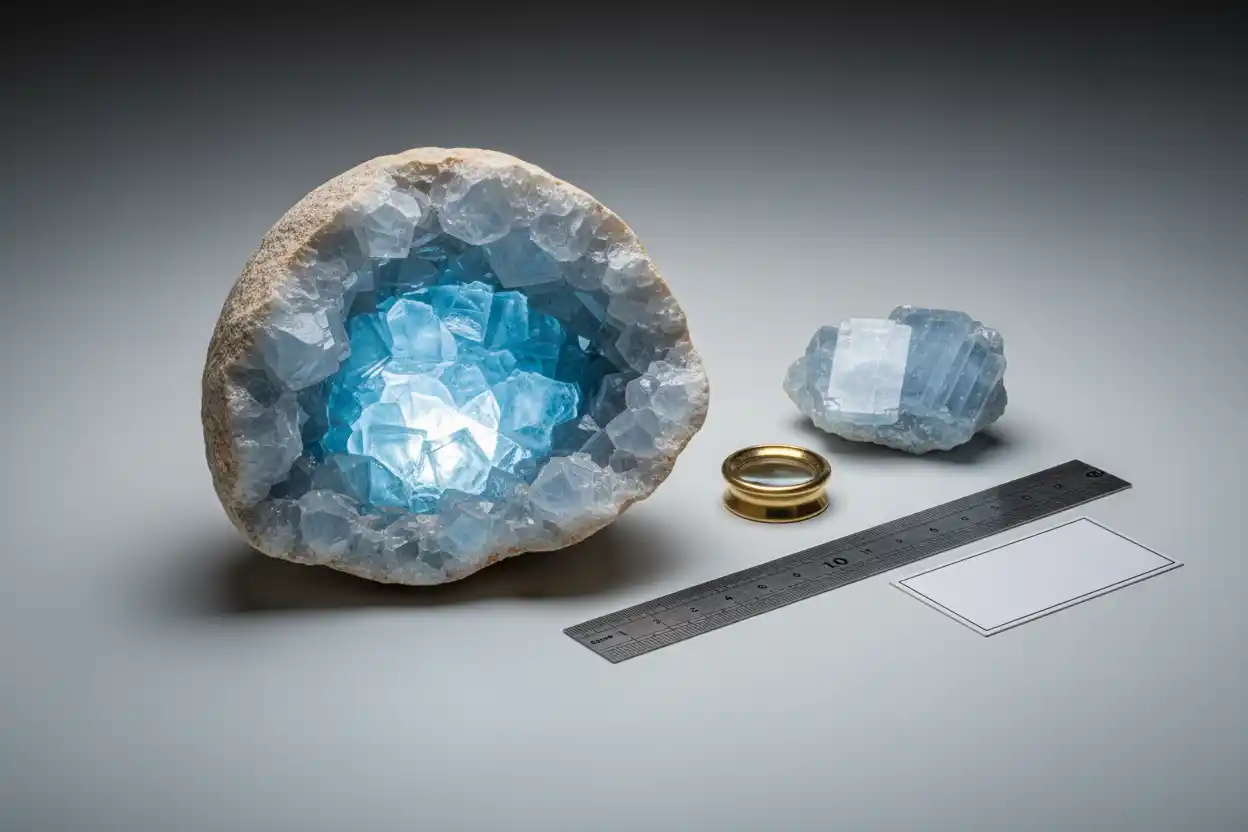
Real celestite is usually sold as pale blue crystal clusters, geodes, tabular crystals, nodules and matrix specimens. It may also appear as white, colorless, pink, greenish or brown material, although blue remains the best-known commercial color.
The mineral is also called celestine. Both names refer to strontium sulfate, SrSO4, rather than separate species or quality grades.
Celestite is comparatively heavy, soft, brittle and strongly cleavable. Those properties affect shipping, handling and cleaning more than they affect ordinary visual appeal. A large blue geode can look sturdy while containing loose crystals, weak matrix and hidden repairs.
The celestite meaning and properties guide covers the mineral’s identity and traditional symbolism. This page focuses on sellers, natural color, locality, geode construction, treatments, lookalikes and specimen quality.
Celestite and Celestine Mean the Same Mineral
Celestine is widely used as the formal mineral name, while celestite remains common in retail and collector language.
The mineral belongs to the barite group and forms a compositional series with barite. Its relatively high density comes from strontium, which makes a small celestite specimen feel heavier than many similarly sized quartz or gypsum pieces.
Celestite crystallizes in the orthorhombic system. Common habits include tabular, bladed, lath-like and prismatic crystals, as well as fibrous, massive and granular forms.
Mohs hardness is approximately 3 to 3.5. Perfect cleavage in one direction, additional cleavage in other directions and brittle tenacity make crystal edges vulnerable to handling damage.
Choose the Product Form Before Shopping
| Celestite product | Best source | Main issue |
|---|---|---|
| Madagascar-style geode | Experienced mineral dealer | Loose crystals, repaired matrix, hidden cavities and source claims |
| Individual crystal | Specialist mineral dealer | Cleavage damage, locality and surface alteration |
| Crystal cluster | Mineral shop or collector dealer | Reattachment, unstable base and coated color |
| Matrix specimen | Specialist dealer | Correct associated-mineral identification and structural stability |
| Massive or polished piece | Lapidary supplier | Misidentification, resin and loss of natural crystal evidence |
| Carving or sphere | Experienced lapidary retailer | Filler, fractures and substitution with blue calcite or glass |
| Jewelry | Specialist maker | Cleavage, softness, glue and unrealistic daily-wear claims |
| Educational sample | Mineralogical supplier | Accurate species label and measurable physical properties |
Celestite is primarily a specimen mineral. Large bead strands and everyday rings are unusual forms and deserve stronger verification.
Where to Buy Genuine Celestite
Specialist mineral dealers
A mineral dealer is normally the strongest source for well-formed crystals, locality material and geodes.
Listings should include dimensions, weight, country or mine, condition and repair history. Since celestite is dense, weight and size should both appear; photographs alone can make a small geode look substantial.
Request images of the base and exterior matrix, not only the blue crystal cavity. Repairs and artificial supports often remain hidden underneath.
Gem and mineral shows
Shows allow direct comparison with blue calcite, angelite, gypsum and fluorite.
Pick up the specimen only with permission and support it from the base. Celestite’s density can surprise buyers, while fragile crystals may detach if the piece is lifted by the cavity rim.
Use a loupe to inspect cleavage chips, glue and surface coating. Do not scratch or chemically test the specimen.
Established online mineral stores
An online seller should show the exact item from every side. Geodes vary too much for one stock photograph to represent an entire shipment.
The online gemstone buying guide explains seller identity, payment protection and return terms.
For celestite, request a video in ordinary room light. Pale blue crystals can appear strongly saturated when photographed under cool lighting or edited heavily.
Lapidary sellers
Celestite is not a routine lapidary material because its softness and cleavage complicate cutting. A polished sphere, tower or carving should therefore prompt questions about identity and stabilization.
Ask whether the object is solid celestite, celestite-bearing rock, blue calcite or another sulfate or carbonate material.
Older collections and estate sales
Historic labels can add scientific and collector value. Compare the label with the specimen and ask whether the locality has been verified.
Estate sellers may repeat handwritten names without checking them. A blue crystal marked “celestite” decades ago can still turn out to be calcite, fluorite or barite.
What Natural Celestite Looks Like
The best-known celestite is pale sky blue, blue-gray or lavender-blue. Color may be stronger at crystal tips, along zones or in thicker portions.
Natural specimens can also be colorless, white, pink, pale green, brown or nearly black. Therefore, blue is typical rather than mandatory.
Luster is vitreous, becoming pearly on cleavage surfaces. Crystals are transparent to translucent, although inclusions, fractures and thick growth can make them appear cloudy.
Tabular crystals are common. Some clusters contain broad flat blades, while others have elongated or more equant crystals.
Fresh cleavage produces flat reflective surfaces. Numerous smooth parallel breaks may indicate handling damage rather than natural terminations.
Madagascar Celestite Geodes
The Sakoany deposit near Mahajanga in Madagascar is a major source of blue celestite geodes and clusters in the retail market.
These specimens commonly have a rough pale or brownish outer matrix and a cavity lined with blue crystals. Size ranges from small hand specimens to large display geodes.
A natural geode does not need a perfectly symmetrical opening. The cavity may be irregular, partly filled or surrounded by fragile matrix.
Sellers sometimes cut a base so the geode stands securely. Sawing is acceptable when disclosed and does not intersect major crystals.
Large geodes require inspection for repairs, filled matrix fractures and loose crystal plates. The exterior should not be ignored simply because the cavity is attractive.
Other Important Localities
Fine celestite has also come from Sicily in Italy, several localities in Ohio and other parts of the United States, Mexico, Canada, England, Germany, Egypt and additional regions.
Different localities can produce distinctive habits and associations. However, pale blue color alone does not establish origin.
A premium locality claim should come with an original label, collection history or reliable dealer documentation.
Country-level information may be sufficient for common decorative geodes, while scientifically important crystals deserve more precise locality data.
Celestite Versus Blue Calcite
Blue calcite is a calcium carbonate mineral with lower density and different cleavage.
Both materials can be pale blue and transparent to translucent. However, blue calcite often appears cloudier and may show rhombohedral cleavage or massive carved forms.
Celestite generally feels unusually heavy for its size, but hand feel is only supporting evidence. A thick matrix can distort weight comparisons.
The completed guide to buying genuine blue calcite covers dyed carbonate, Caribbean blue calcite and calcite-specific care.
Celestite Versus Angelite
Angelite is a trade name commonly used for blue anhydrite.
Angelite usually appears opaque and massive, with a relatively uniform powder-blue or gray-blue body. Celestite more commonly forms transparent to translucent crystals.
The completed guide to buying real Angelite covers anhydrite, dye and carved products.
A polished blue object without visible crystal form can be difficult to classify from a photograph. Professional spectroscopy may be required.
Celestite Versus Gypsum
Gypsum is calcium sulfate dihydrate and is much softer than celestite.
Clear or pale-blue gypsum crystals can resemble celestite, especially when broken or coated. Gypsum generally has different cleavage, flexibility in thin plates and much lower density.
Do not use fingernail or knife scratching as a home identification method. The result damages the specimen and may test an altered surface rather than fresh mineral.
Celestite Versus Barite
Barite is barium sulfate and belongs to the same mineral group as celestite.
Both are dense, orthorhombic sulfate minerals and can share crystal habits. Barite may be colorless, white, blue, yellow, brown or other colors.
Density alone may not separate them confidently because both feel heavy. Raman spectroscopy, X-ray diffraction or chemical analysis provides a stronger answer.
Some natural specimens contain compositions between the two end members. Therefore, exact identification can require more than visual inspection.
Celestite Versus Fluorite
Fluorite can form pale blue crystals and transparent clusters.
Fluorite commonly forms cubes or octahedral cleavage fragments, whereas celestite more often forms tabular or bladed orthorhombic crystals. Still, damaged specimens can lose their obvious geometry.
Fluorite is slightly harder and has lower density. Professional gemological or mineralogical testing remains safer than scratching.
Celestite Versus Apophyllite
Apophyllite can occur as colorless, white, greenish or occasionally pale-colored transparent crystals.
Apophyllite commonly forms square-looking prismatic crystals or pyramidal terminations and may occur with zeolites in basalt cavities. Celestite has different crystal symmetry, density and associations.
A low-resolution photograph can flatten those distinctions, so request several angles.
Glass, Resin and Dyed Imitations
Blue glass can imitate individual crystals, carvings and polished objects. Round bubbles, flow lines, mold seams and conchoidal chips support manufacture.
Resin may copy a geode cavity by embedding blue fragments or glitter within a molded shell. Repeated crystal shapes, soft scratches and a uniform artificial base are warning signs.
Pale crystals can also be coated or dyed. Color concentrated on surfaces, in cracks or around the matrix contact deserves investigation.
A real celestite geode may be mounted on a resin base for stability. That does not make the crystals fake, but the construction should be disclosed.
The fake-crystal buyer’s guide provides a broader framework for glass, resin, coatings and assembled specimens.
Glued and Reconstructed Geodes
Broken geodes may be repaired with adhesive, while loose crystals can be reattached to the cavity.
Limited restoration can preserve a specimen. However, a geode built from unrelated shell pieces or filled with crystals from another specimen is reconstructed.
Inspect the exterior for straight joins, color-matched filler and glossy adhesive. Inside the cavity, look for crystals that sit above the natural growth surface or have visible glue around their bases.
Ask whether the specimen broke during extraction, preparation or shipping. Repair history should be part of the invoice description.
Treatments and Surface Enhancement
Celestite can be coated, dyed, waxed, stabilized or repaired. Matrix may also be consolidated with resin to prevent crumbling.
A clear coating can deepen blue color and increase gloss, but it may yellow or scratch over time. Colored coating can make pale crystals appear more saturated.
Resin stabilization of the exterior matrix may be practical for a large geode. The treatment should not be confused with a completely natural untouched specimen.
The gemstone treatments guide explains the distinction among coating, filling, stabilization and assembly.
How to Judge a Celestite Geode
Crystal coverage
Strong geodes have attractive crystal coverage across the cavity rather than one small blue patch surrounded by damaged matrix.
Crystal form
Look for recognizable tabular or bladed crystals with natural variation. Identical repeated shapes can indicate manufactured components.
Color
Evaluate pale blue color under neutral light. Excessively saturated photographs may not match the delivered specimen.
Condition
Check for cleavage chips, missing crystal plates and loose fragments. A few minor contacts are normal, but widespread fresh damage should reduce value.
Cavity depth
Deep cavities can create dramatic displays but are harder to inspect and clean. Ask for video showing the interior.
Exterior matrix
The shell should be stable enough to support the dense crystals. Large cracks and loose matrix require disclosure.
Base
A cut base is practical when cleanly prepared. A thick resin platform or concealed repair should be described separately.
How to Judge Individual Crystals and Clusters
A quality individual crystal should have attractive form, luster and condition. Complete terminations are desirable, although natural contacts can truncate one side.
Because celestite cleaves readily, inspect flat reflective breaks along edges and corners.
Clusters should balance crystal arrangement with structural stability. One large crystal leaning from a weak base may be vulnerable even when undamaged.
A specimen label should name the mineral and locality. For older pieces, retain every label because provenance can contribute significantly to value.
Buying Polished Celestite
Polished celestite is uncommon. Its softness, cleavage and density make it a challenging choice for spheres, towers and carvings.
A polished blue object may instead be calcite, angelite, fluorite or glass. Ask how the seller confirmed celestite.
Inspect for filled fractures, resin backing and coating. Mixed matrix may polish unevenly and leave pits.
Avoid paying a rarity premium when the seller cannot provide mineralogical testing or credible rough provenance.
Buying Celestite Jewelry
Celestite is generally unsuitable for rings, bracelets and other high-impact jewelry. Its low hardness and cleavage create both scratching and breakage risks.
The gemstone hardness chart places celestite around Mohs 3–3.5. The toughness-versus-hardness guide explains why brittle cleavage matters separately from scratches.
A protected pendant or collector brooch may be possible, although the setting should avoid concentrated pressure.
Raw crystal pendants often rely on adhesive caps. Ask whether the glue can be inspected and whether the crystal has pre-existing cleavage.
Price and Value
Celestite value depends on color, crystal form, luster, size, condition, cavity coverage, locality, provenance and restoration.
Common small Madagascar geodes are generally accessible. Larger geodes rise in price because of size, weight, shipping risk and display impact.
A smaller specimen with sharp undamaged crystals can be more desirable than a large pale geode with extensive repair.
Individual locality crystals can occupy a specialist collector market where labels and crystal form matter more than blue color alone.
The gemstone pricing guide explains why weight, scarcity, workmanship and documentation interact differently across mineral specimens.
Seller Questions
Ask whether the seller uses celestite and celestine as names for the same mineral.
Request the exact locality and the basis for that claim. Determine whether the geode, crystal or matrix has been dyed, coated, stabilized, repaired, glued or assembled.
Ask for dimensions and weight, plus front, back, side and base photographs. For deep geodes, request a moving video of the cavity.
Confirm whether any crystals are loose and how the specimen will be packaged. Finally, obtain a return policy that allows magnified inspection.
Professional Identification
Raman spectroscopy and X-ray diffraction can identify celestite and distinguish it from barite, gypsum, anhydrite, calcite, fluorite and glass.
Specific gravity can be useful because celestite is dense, but matrix and cavities complicate whole-specimen measurements.
Chemical analysis can confirm strontium and sulfur. However, intermediate barite-celestite compositions may require quantitative work rather than a simple elemental presence test.
The crystal identification guide explains why measurements and crystal habit should support one another.
Shipping and Returns
Celestite’s density creates special shipping risk. A heavy geode can break through weak packaging or damage its own crystals as the matrix shifts.
The seller should immobilize the specimen inside a rigid inner box, support the exterior rather than the cavity and place that container within a cushioned outer carton.
Never pack loose material directly against crystal faces. Individual crystals need separate boxes so they cannot strike one another.
Photograph the parcel while opening it. Small cleavage fragments may otherwise be mistaken for pre-existing debris.
Ethical and Responsible Buying
Ask whether the specimen was collected legally and whether the locality claim is documented.
The ethical crystal sourcing guide provides questions about mining, labor, legal extraction and supply-chain transparency.
A common commercial geode may have only country-level provenance. A premium mine claim should have stronger records.
Cleaning and Storage
Do not soak celestite geodes. Water can enter matrix fractures, affect adhesives and leave deposits between crystals.
Use a hand air blower or very soft dry brush. Avoid canned compressed air, which can propel liquid or create enough force to dislodge crystals.
The planned crystal water-safety guide provides broader material guidance. Celestite’s softness, cleavage and matrix construction make dry cleaning the safer default.
Avoid steam and ultrasonic cleaning. The planned ultrasonic-cleaner guide explains why vibration can extend cleavage and detach repairs.
For traditional symbolic practices, the completed celestite cleansing and charging guide offers non-destructive options without treating spiritual beliefs as scientific effects.
Store the specimen on a stable shelf away from vibration, direct knocks and harder minerals.
Frequently Asked Questions
1. Are Celestite and Celestine the same mineral?
Yes. Both names refer to strontium sulfate, SrSO4. Celestite is common in retail language, while Celestine is widely used mineralogically.
2. Is Celestite always blue?
No. It can also be colorless, white, pink, pale green, brown or black, although pale blue is the best-known color.
3. Why does Celestite feel heavy?
It contains strontium and has a specific gravity close to 4, making it denser than quartz, calcite and gypsum.
4. Does heavy weight prove a stone is Celestite?
No. Barite and other dense minerals can feel similar. Matrix and resin can also change the apparent weight.
5. How is Celestite different from blue calcite?
Celestite is strontium sulfate and is denser. Blue calcite is calcium carbonate with different cleavage and chemical behavior.
6. Is Angelite the same as Celestite?
No. Angelite is a trade name for blue anhydrite, while Celestite is strontium sulfate.
7. Can Celestite geodes be repaired?
Yes. Broken matrix and loose crystals may be glued or stabilized. Repairs should be disclosed.
8. Is strongly blue Celestite always dyed?
No. Natural crystals can show notable blue color. However, surface concentration and excessive uniformity justify treatment questions.
9. Is Celestite suitable for jewelry?
It is generally too soft, brittle and cleavable for exposed daily-wear jewelry. Protected collector pieces are more realistic.
10. Can I wash a Celestite geode?
Routine washing is not advisable. Water can enter matrix cracks, loosen repairs and leave residues between crystals.
11. Do ordinary geodes need laboratory reports?
Usually not. Clear locality, condition and repair disclosure are more practical. Testing is useful for unusual polished objects or disputed specimens.
12. What is the biggest warning sign in a listing?
Be cautious when a vivid blue “Madagascar Celestite” geode has no exterior photographs, dimensions, weight, repair history or return option.
Buy the Whole Geode, Not Just the Blue Cavity
Celestite should be evaluated as a complete mineral specimen. The blue crystals, matrix, base, repairs, locality and packaging all contribute to whether the purchase is sound.
The C crystal directory, C gemstone directory and visual gemstone guide provide broader comparisons. Choose the specimen whose crystal form, weight, condition and provenance remain credible from every angle.
Safety note: Celestite should not be ingested, licked or placed in drinking water. Avoid cutting, drilling, sanding or grinding it without professional wet methods, local dust extraction and suitable respiratory and eye protection.