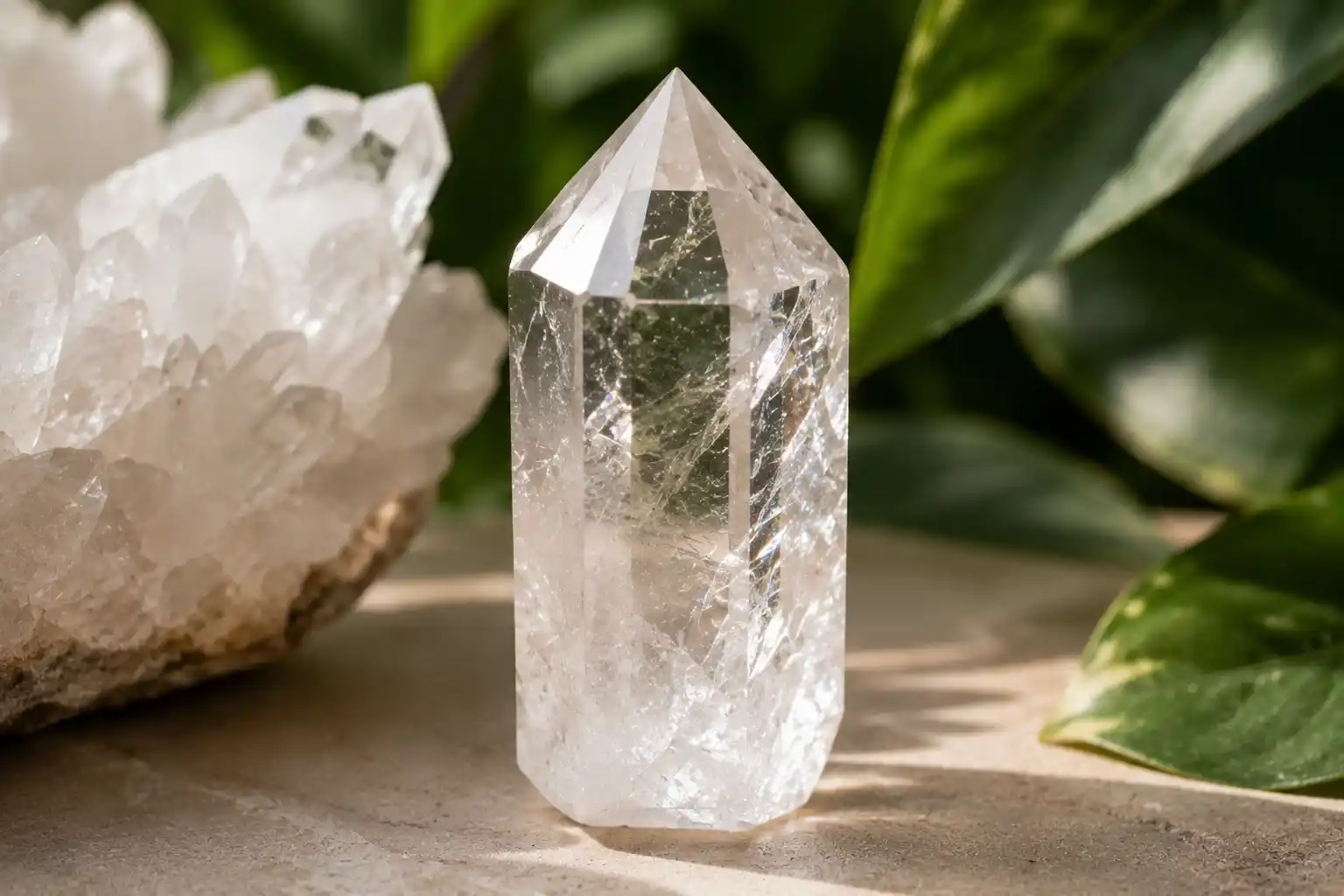
Clear Quartz Meaning: Identity, History & Symbolism
Clear quartz meaning is easiest to understand when clear quartz is treated first as a natural mineral material rather than as a container for every symbolic claim attached to transparent crystals. Clear quartz is the colorless to nearly colorless transparent variety of crystalline quartz, composed predominantly of silicon dioxide, SiO₂, and characterized by quartz’s trigonal crystal structure, Mohs hardness of about 7, vitreous luster, lack of true cleavage, and frequent occurrence as six-sided prisms terminated by rhombohedral faces. Its clarity can range from nearly flawless to densely included, and natural crystals may contain fluid inclusions, healed fractures, mineral needles, growth zoning, phantoms, or cloudy areas without ceasing to be genuine quartz. Within Gems Lore’s Healing Crystal coverage, those measurable characteristics are kept distinct from modern ideas about clarity, amplification, cleansing, intention, spiritual awareness, or energetic balance.
That separation is particularly important for clear quartz because few minerals have accumulated a broader range of modern metaphysical claims. Transparent quartz is sometimes described as a universal healer, energy amplifier, manifestation tool, memory holder, chakra cleanser, or substance capable of programming intentions. These descriptions belong to contemporary spiritual traditions and personal symbolism rather than established mineral physics. Quartz does have genuine technologically important properties, including piezoelectric behavior under appropriate physical conditions, but those properties do not demonstrate that a hand-held crystal amplifies thoughts, transmits healing energy, stores intentions in the ordinary metaphysical sense, or produces medical effects.
Clear Quartz at a Glance
| Property | Practical reference |
|---|---|
| Material identity | Colorless to nearly colorless crystalline quartz |
| Chemical composition | Predominantly SiO₂ |
| Crystal system | Trigonal |
| Common crystal appearance | Six-sided prismatic crystals with rhombohedral terminations |
| Mohs hardness | About 7 |
| Specific gravity | About 2.65 |
| Luster | Vitreous |
| Transparency | Transparent to translucent |
| Cleavage | No true cleavage; commonly conchoidal to uneven fracture |
| Common inclusions | Fluid inclusions, healed fractures, mineral inclusions, veils, phantoms, growth features |
| Typical formation settings | Hydrothermal veins, cavities, pegmatites, metamorphic environments, and other silica-rich geological systems |
| Major identification limit | Transparency and crystal shape alone cannot establish treatment, provenance, or even quartz identity in every cut object |
| Symbolic status | Modern meanings are cultural or personal interpretations, not demonstrated mineral effects |
The important point in this overview is that “clear” does not mean chemically pure, flawless, untreated, or geologically simple. A crystal may appear transparent while containing trace elements, microscopic inclusions, lattice defects, internal fractures, or subtle growth structures that record how it formed. Likewise, a perfectly polished transparent object may be genuine quartz, synthetic quartz, glass, another colorless gemstone, or a composite unless its identity is supported by appropriate evidence.
What Clear Quartz Actually Is
Clear quartz is crystalline silicon dioxide and belongs to the same mineral species as amethyst, citrine, smoky quartz, rose-colored quartz varieties, and many other forms of crystalline quartz whose trade names emphasize color or internal features. The defining distinction of clear quartz is principally its lack of strong body color rather than a different fundamental chemistry. In natural crystals, the familiar elongated prismatic form develops because quartz grows according to its trigonal crystal structure, although crystal habit varies with temperature, fluid chemistry, available space, growth rate, and the geometry of the host cavity.
The term “rock crystal” has historically been used for particularly transparent colorless quartz and remains a legitimate descriptive name in mineralogical, gemological, and historical contexts. “Clear quartz,” however, is the more common modern commercial and metaphysical label. Neither phrase guarantees that a specimen is completely inclusion-free, naturally terminated, untreated, or from a particular locality. Those are separate claims that need their own evidence.
This distinction also helps when looking across clear gemstones, because colorless appearance alone is not an identification category. Diamond, colorless topaz, beryl, zircon, sapphire, calcite, glass, synthetic materials, and quartz can all appear transparent to the unaided eye while differing greatly in refractive index, density, hardness, cleavage, dispersion, and internal features.
How Clear Quartz Forms
Quartz forms in a wide range of geological environments because silica is abundant in Earth’s crust and can be transported, dissolved, crystallized, and recrystallized under many conditions. Well-formed clear quartz crystals commonly grow where silica-bearing fluids move through fractures or cavities and have enough open space for crystal faces to develop. Hydrothermal veins can produce transparent crystals alongside minerals such as calcite, fluorite, sulfides, feldspar, or chlorite, while pegmatitic and metamorphic environments can produce quartz through different combinations of temperature, pressure, fluid activity, and rock chemistry.
A crystal therefore carries geological information in more than its outer shape. Growth zoning, healed fractures, mineral inclusions, fluid inclusions, phantoms, contact faces, matrix remnants, and multiple generations of crystal growth can reveal that a specimen developed through a sequence of geological events rather than appearing all at once. The dedicated guide to clear quartz formation and deposit geology explores those environments more deeply, while the important meaning-page boundary is that geological formation should not be converted into spiritual biography without evidence.
Natural crystal shape can also be misleading when commercial alteration is involved. A genuine quartz crystal may be polished, recut, reheated, irradiated, coated, drilled, assembled, or artificially enhanced after mining while remaining quartz as a material. Mineral identity and post-mining treatment are therefore different questions.
Why Clear Quartz Is Colorless
Ideally structured quartz does not strongly absorb visible wavelengths, allowing much of visible light to pass through and giving sufficiently pure material a colorless appearance. Real crystals contain imperfections, trace elements, structural defects, microscopic inclusions, and internal strain, any of which can modify transparency or introduce color. Amethyst, smoky quartz, citrine, and other quartz varieties demonstrate how relatively small structural or chemical differences can create dramatically different appearances within the same mineral species.
Clear quartz may consequently range from water-clear to milky, hazy, veiled, or locally clouded. Dense microscopic fluid inclusions can produce milky areas, while fractures can scatter light and create bright reflective surfaces or rainbow-like interference effects. Those internal colors are optical consequences of fracture geometry and light interaction rather than evidence that the quartz contains a permanent rainbow pigment or emits colored energy.
Readers interested in how transparency, refraction, internal reflection, scattering, and apparent rainbows affect what a specimen looks like can use the more technical clear quartz optical properties and color behavior reference. For identification, the key lesson is that unusual brightness or internal color should first be explained optically before a supernatural mechanism is proposed.
Diagnostic Traits of Clear Quartz
A convincing natural clear quartz specimen usually presents several mutually consistent characteristics: quartz-like crystal habit when crystal faces are preserved, vitreous luster, hardness around 7, no true cleavage, conchoidal to uneven fracture where broken, specific gravity close to 2.65, and optical properties consistent with quartz. A single characteristic rarely proves identity by itself. Glass can be transparent and show conchoidal fracture, while other minerals can form clear crystals with vitreous luster, so the strongest identification comes from a combination of evidence.
In faceted stones and polished objects, crystal habit may disappear completely. Refractive index, specific gravity, optic character, microscopic examination, and spectroscopy can then become more useful than external shape. Quartz is doubly refractive and typically has a refractive-index range around the mid-1.54s, values that help distinguish it from many common colorless substitutes when testing is performed correctly.
Magnification can reveal features that support natural growth or expose manufacturing clues, but it should not be treated as infallible. Fluid inclusions, healed fractures, growth zoning, mineral crystals, negative crystals, and natural-looking veils may support natural quartz, whereas curved flow structures or abundant spherical gas bubbles may suggest glass in the right context. Synthetic quartz can also display legitimate crystalline quartz properties, so confirming quartz does not automatically prove natural geological origin. The clear quartz microscope and inclusion notebook focuses specifically on what microscopic observations can and cannot establish.
An Original Specimen and Photo Evaluation Framework
Begin with the object’s physical category. A natural crystal cluster, detached crystal point, tumbled stone, carved sphere, polished tower, faceted gem, and jewelry component preserve different amounts of diagnostic evidence. An intact crystal may show growth faces, contacts with matrix, termination geometry, inclusions, and natural fracture surfaces, whereas a polished tower can have all outer surfaces reshaped by machinery. A photograph of a polished object should therefore never be evaluated as though its point and faces automatically represent natural crystal growth.
Next, examine transparency and internal structure across the whole object instead of selecting the clearest area. Natural quartz can be exceptionally transparent, so clarity alone does not prove glass or synthetic origin. At the same time, perfectly uniform transparency should not be marketed as proof of exceptional geological rarity without considering the object’s size, cutting, source, and treatment history. Look for natural-looking veils, healed fractures, growth interruptions, mineral inclusions, internal zoning, or contact marks, while remembering that the absence of visible inclusions does not prove manufacture.
Then compare surface features. Natural crystal faces may show subtle growth lines, unevenness, contact areas, incomplete terminations, or differing development from face to face, whereas polished objects generally show consistent lapidary surfaces and tool-created geometry. This distinction is especially useful with “crystal towers,” where a real quartz body may have a fully manufactured point. Calling the whole object “natural quartz” can be accurate as material identification while calling its termination “natural” would be inaccurate.
Photography should be assessed independently from the specimen. Strong backlighting can make mediocre quartz appear exceptionally transparent, dark backgrounds can increase contrast, wetting can hide surface scratches, and edited highlights can exaggerate internal rainbows. Multiple angles under neutral illumination are more useful than one dramatic photograph, but photographs still cannot prove natural versus synthetic origin, coating status, precise locality, or an undocumented claim that a crystal is completely untreated.
Finally, separate material facts from story claims. A seller may accurately identify quartz while making unsupported statements about rarity, ancient ritual use, “memory storage,” Lemurian origin, healing frequency, or exclusive mine provenance. Each claim requires a different kind of evidence. Confirming that a specimen is quartz does not automatically validate the narrative attached to it.
Disputed Names and Unsupported Claims
Clear quartz carries several commercial names that need careful interpretation. “Rock crystal” is a legitimate historical and mineralogical term for transparent colorless quartz. “Lemurian quartz,” “master healer quartz,” “record keeper,” “manifestation quartz,” “generator quartz,” and similar expressions generally belong to modern metaphysical or trade naming systems rather than recognized mineral species. Some of these labels may describe visible shapes or surface patterns, but the name itself does not establish unusual chemistry, ancient origin, energetic function, or a lost civilization connection.
The phrase “crystal memory” also requires separation from real quartz technology. Quartz can exhibit piezoelectric behavior and is widely used in frequency-control and electronic applications because its physical response can be engineered predictably. Synthetic quartz is grown industrially for these purposes. That genuine technological importance does not demonstrate that an ordinary crystal stores personal memories, intentions, emotions, or spoken messages in a metaphysical sense.
Likewise, the description “energy amplifier” is symbolic rather than a mineralogical property. Quartz can participate in electrical and mechanical systems under defined physical conditions, but a crystal sitting on a table does not scientifically amplify another gemstone’s supposed healing power, a person’s intention, or an invisible life-force field. Using the word metaphorically is different from claiming a measured physical process.
Natural, Synthetic, Treated, and Altered Clear Quartz
Natural quartz and synthetic quartz can share the same fundamental chemical composition and crystal structure. Synthetic quartz is commonly grown hydrothermally under controlled industrial conditions and plays an important role in electronics and precision applications. Consequently, a test that establishes “this is quartz” does not necessarily establish “this formed naturally underground.”
Natural quartz can also be altered after mining. Polishing, recutting, drilling, fracture filling, coating, irradiation, heating, metal deposition, or the application of decorative films can change appearance without necessarily changing the underlying quartz identity. The specialist treated clear quartz guide addresses those distinctions more fully because treatment identification can become technical and should not be compressed into a meaning reference.
This is especially relevant to intensely iridescent material sold under names such as aura quartz. Such objects can begin as natural quartz but receive a deposited surface coating that creates metallic or rainbow effects. The underlying mineral may be real quartz while the appearance is human-produced. “Natural mineral” and “natural appearance” are separate claims.
Clear Quartz in Documented Human History
Transparent quartz has a substantial material history independent of modern crystal spirituality. Archaeological and historical objects show that quartz crystal was carved, polished, used ornamentally, and valued for its transparency in multiple societies. The ancient Greek term often connected with quartz reflected an idea that transparent crystal was permanently frozen ice, a historically important interpretation but not a modern mineralogical explanation. Later lapidary traditions used rock crystal for vessels, seals, carvings, lenses, decorative objects, beads, and jewelry.
Historical evidence needs careful boundaries because an old reference to “crystal” does not automatically establish every modern clear quartz belief. Before modern mineralogy, “crystal” could function as a broader material or descriptive term, and surviving texts do not always identify substances according to today’s species definitions. A historically documented rock-crystal object provides stronger evidence than an unsupported claim that a particular modern crystal-healing ritual has been practiced unchanged since antiquity.
Quartz’s later technological history is equally significant. Its piezoelectric and resonant properties made precisely engineered quartz important in oscillators, watches, communications, electronics, and measurement systems. These applications are among the clearest examples of quartz possessing remarkable real physical properties, which makes it unnecessary to stretch those properties into unsupported metaphysical mechanisms.
Clear Quartz Meaning in Modern Symbolism
Modern clear quartz meaning commonly centers on clarity, focus, amplification, cleansing, intention, spiritual awareness, and versatility. The transparent appearance makes many of these associations intuitive: visual clarity can become a metaphor for mental clarity, and a colorless material can symbolically represent openness or neutrality. Some practitioners use clear quartz during meditation, place it with other stones, carry it as an intention reminder, or incorporate it into altar and chakra practices.
These meanings are interpretive rather than experimentally demonstrated. Clear quartz does not scientifically remove toxins, cure infection, treat cancer, regulate hormones, erase anxiety, repair organs, strengthen the immune system, or substitute for medical care. Nor is there established evidence that placing it beside another mineral amplifies that mineral’s alleged therapeutic power.
A grounded symbolic practice can retain the metaphor while removing unsupported causation. Someone who associates clear quartz meaning with clarity might use a crystal beside a journal and ask which facts are known, which assumptions remain untested, and what decision would benefit from additional information. Someone who connects it with focus might place it near a work area as a visual prompt to finish a defined task. In each case, the useful mechanism is attention and intentional behavior rather than energy emitted by SiO₂.
The “Master Healer” Claim
Clear quartz is frequently called a “master healer,” but this phrase is a modern metaphysical designation rather than a medical or mineralogical classification. It does not mean that quartz has demonstrated universal therapeutic action, and it should never be interpreted as evidence that a crystal can diagnose, prevent, treat, or cure disease.
The phrase can be retained only as a description of how some crystal traditions symbolically position clear quartz—as a versatile stone used across many rituals or paired with many other minerals. Once the phrase is interpreted literally, it crosses from cultural description into unsupported health advice.
That distinction matters because seemingly harmless wording can affect real decisions. A person who enjoys quartz as a symbolic object can do so while continuing evidence-based medical care and seeking qualified professional support when needed. The mineral does not need therapeutic claims to remain geologically, historically, aesthetically, or personally interesting.
Does Quartz Really “Amplify Energy”?
The word energy has precise meanings in physics and much broader meanings in everyday spiritual language. Quartz has real physical responses involving mechanical stress, electric polarization, resonance, heat, light, and electromagnetic systems under defined conditions. Those phenomena are measurable and form the basis of important technologies.
Metaphysical statements about amplifying “crystal energy,” intentions, emotions, prosperity, or another person’s spiritual state use the word energy differently. No established scientific evidence shows that an ordinary clear quartz specimen magnifies these proposed effects simply because quartz exhibits piezoelectricity. The physical phenomenon requires specific conditions, measurement, and circuitry; it should not be used as scientific decoration for a separate spiritual claim.
A symbolic interpretation remains available without that confusion. A person may regard clear quartz as an amplification metaphor and use it to emphasize a goal, written intention, or reflective theme. The act can be personally meaningful while remaining clearly distinguished from measurable physical amplification.
Clear Quartz, Jewelry, and Wear
At Mohs hardness about 7 and without true cleavage, quartz is suitable for many jewelry forms. It can be faceted, carved, cabbed, drilled, and polished into a wide range of designs, although daily wear can still produce scratches, chipped edges, fractures, or abrasion over time. Transparent material also makes surface wear more visually obvious because facet-edge damage and scratches can interrupt otherwise clean reflections.
Cutting orientation, inclusions, fractures, and design all affect the finished object’s durability and appearance. Those technical issues are addressed more fully in clear quartz cutting, orientation, and polish, while mounting choices belong in the separate clear quartz setting and wear engineering reference. The meaning page only needs the practical boundary: quartz is reasonably durable, but symbolism does not make a vulnerable setting mechanically safer.
Large points and carved objects also require realistic expectations. Their size can create leverage during impact, pointed terminations can chip, and internal fractures may expand under hard knocks or thermal shock. A specimen that survives geological formation is not automatically resistant to every household accident.
Buying Clear Quartz Without Paying for a Story
Clear quartz is abundant enough that a high price should be explained by something more specific than transparency and spiritual vocabulary. Exceptional natural crystal form, large size, unusual inclusion scenes, fine locality documentation, historical collection provenance, strong aesthetics, rare associated minerals, precision lapidary work, or sophisticated jewelry construction can all create legitimate premiums. A claim that a crystal is “high vibration,” “programmed,” “Lemurian,” “ancient healer grade,” or capable of attracting wealth does not by itself establish transferable gemological or collector value.
The dedicated where to buy clear quartz guide addresses retailer and seller evaluation in more detail. For a meaning reference, the most useful buying principle is to ask what observable or documented feature supports the premium and whether that feature would matter to another informed collector.
Provenance deserves particular care. Quartz from a documented mine or historic collection can carry scientific and collector significance, but locality cannot usually be established from transparency or crystal shape alone. The clear quartz provenance disclosure checklist provides a structured way to separate seller statements, inherited labels, chain-of-custody evidence, and visually plausible but unverified origin claims.
Ethical Context Depends on the Material
“Ethically sourced crystal” is often used as though it were a single measurable grade, but sourcing questions can involve labor conditions, land rights, environmental disturbance, legal mining, community benefit, traceability, trader disclosure, and transport chains. Clear quartz is mined in many regions and can pass through multiple intermediaries, so a polished crystal’s geographic or social history may be difficult to reconstruct without meaningful documentation.
Material-specific ethics also matter. The questions surrounding mined quartz are not identical to those affecting biologically produced gem materials. The separate discussion of coral ethics illustrates how wildlife conservation, species protection, ecosystem damage, and legal trade can create an entirely different evidence framework. An ethical label is most useful when it identifies the actual issue being documented rather than functioning as a generic marketing adjective.
Safe Ownership of Clear Quartz
An intact clear quartz crystal, polished stone, or finished piece of jewelry can normally be handled as an ordinary silica mineral object. There is no need for alarmist precautions during routine ownership. The main safety distinction appears when quartz is cut, drilled, ground, crushed, or sanded because these activities can generate respirable crystalline silica dust, which is a serious occupational inhalation hazard.
Lapidary and workshop activities should therefore use appropriate wet-processing methods, local dust extraction, ventilation, respiratory protection where required, and established occupational controls. Dry grinding quartz casually in an enclosed home environment is fundamentally different from holding an intact crystal. The mineral’s ordinary safe handling should not be confused with the hazards of intentionally generating fine silica dust.
Direct-water crystal elixirs are unnecessary. Even when quartz itself is comparatively chemically resistant, a real specimen may contain associated minerals, surface contamination, coatings, adhesives, metal components, polishing compounds, or treatment residues that are not known from appearance. Symbolic use does not require ingesting water that has been in contact with a mineral specimen.
Conservation and Long-Term Storage
Clear quartz is durable, but museum-like indestructibility should not be assumed. Fine terminations can chip, thin crystal plates can fracture, internal cracks can expand after impact, and polished surfaces can accumulate scratches. Dust lodged in delicate clusters can also be difficult to remove without stressing fragile contacts or associated minerals.
The correct conservation method depends on the complete specimen rather than quartz alone. A loose, clean single crystal can tolerate care that would be inappropriate for a cluster containing fragile secondary minerals or unstable matrix. The clear quartz specimen conservation record provides a more detailed framework for documenting condition, previous repairs, coatings, fractures, cleaning history, and storage decisions over time.
Collectors should also preserve old labels and provenance records instead of discarding them when a specimen is transferred to a prettier box. A modest handwritten label can sometimes carry more long-term scientific and historical value than an unsupported modern marketing description.
Frequently Asked Questions About Clear Quartz Meaning
What is clear quartz?
Clear quartz is the colorless to nearly colorless transparent variety of crystalline quartz, composed predominantly of silicon dioxide. It belongs to the same mineral species as amethyst, citrine, and smoky quartz but lacks their stronger body colors.
What does clear quartz mean spiritually?
In modern crystal traditions, clear quartz is commonly associated with clarity, focus, amplification, cleansing, intention, and spiritual awareness. These are symbolic or metaphysical interpretations rather than scientifically demonstrated mineral effects.
Is clear quartz scientifically proven to heal?
No. Clear quartz has important measurable physical properties and technological uses, but there is no established scientific evidence that wearing or holding it diagnoses, prevents, treats, or cures medical conditions.
Why is clear quartz called a master healer?
“Master healer” is a modern metaphysical label used because clear quartz is treated as a versatile stone in many crystal practices. It is not a medical designation and should not be interpreted as evidence of universal therapeutic ability.
Can clear quartz amplify other crystals?
There is no established scientific evidence that clear quartz amplifies the supposed metaphysical effects of another crystal. People may use it symbolically as an “amplifier,” but that meaning should not be confused with quartz’s real piezoelectric properties.
Is rock crystal the same as clear quartz?
Rock crystal is a long-established term for transparent colorless quartz and substantially overlaps with what is commonly sold today as clear quartz. The term does not automatically establish locality, natural termination, lack of treatment, or exceptional quality.
How can I tell whether clear quartz is real?
Look for a coherent set of quartz properties rather than a single visual clue. Crystal habit, hardness, refractive index, specific gravity, optic behavior, fracture, and microscopic features can all contribute to identification. Photographs alone may not reliably separate natural quartz, synthetic quartz, glass, and other transparent materials.
Are bubbles proof that clear quartz is fake?
Not automatically. Certain rounded gas bubbles can support a glass interpretation in the right context, but fluid inclusions and cavities also occur naturally in quartz. Inclusion shape, context, optical behavior, and supporting tests matter more than the simple presence of something that looks bubble-like.
Is synthetic clear quartz fake?
Synthetic quartz is genuine quartz in the mineralogical sense because it has essentially the same composition and crystal structure, but it did not form through natural geological processes. It should therefore be disclosed as synthetic rather than sold as naturally formed quartz.
Is clear quartz safe to handle?
An intact quartz specimen is generally safe for ordinary handling. Greater concern arises when quartz is cut, drilled, crushed, ground, or sanded because these processes can create hazardous respirable crystalline silica dust.
What Clear Quartz Meaning Can Responsibly Include
Clear quartz meaning becomes more useful when mineral fact, documented history, modern symbolism, and metaphysical practice remain visibly separate. Mineralogically, clear quartz is colorless crystalline SiO₂ with the measurable structural, optical, and physical properties of quartz. Historically, transparent rock crystal has been carved, collected, ornamented, studied, and eventually incorporated into important technological applications. In modern symbolic practice, transparency has encouraged associations with clarity, intention, focus, cleansing, and amplification. None of those symbolic themes requires the claim that quartz scientifically heals disease or emits an invisible force that controls external outcomes.
The strongest way to appreciate clear quartz is therefore not to choose between science and symbolism but to identify which type of statement is being made. A crystal’s hardness, refractive index, formation environment, inclusions, or piezoelectric behavior can be investigated experimentally. Its historical use can be evaluated from material and documentary evidence. Its personal symbolism can be meaningful to an individual without being presented as universal scientific fact.
Clear quartz remains a remarkable mineral even after unsupported claims are removed. Its crystal growth, transparency, inclusions, fracture patterns, industrial importance, lapidary versatility, and long human history provide substantial reasons to study or collect it. A person who also uses it as a reminder of clarity or deliberate intention can do so without asking the mineral to perform medical treatment, guarantee manifestation, or prove a metaphysical mechanism.
Gems Lore explains its broader authorship and site context on the About page, while the Disclaimer clarifies the limits of general mineral, symbolic, and safety information. Questions, corrections, or documentation relevant to a factual claim can be submitted through Contact, particularly when a specimen’s exact identity, treatment, or provenance cannot be resolved from photographs alone.