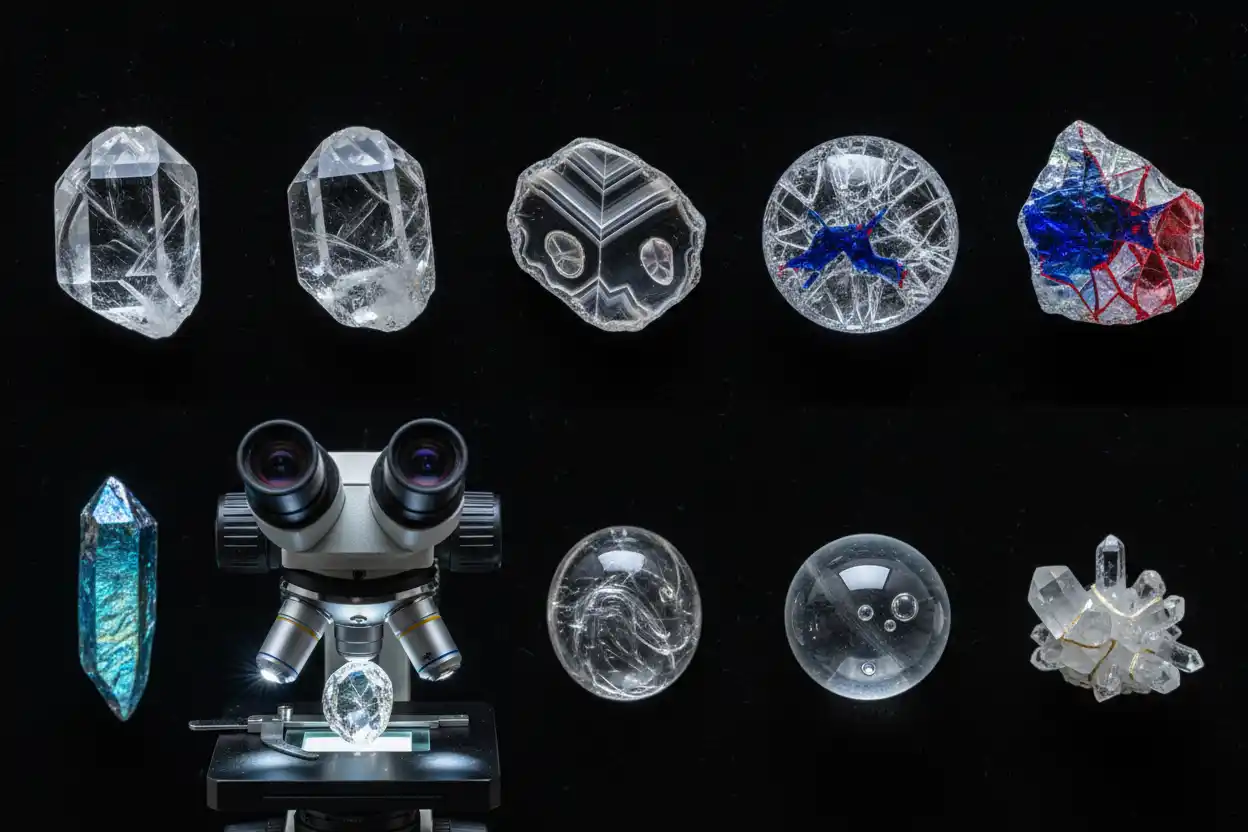
How to Spot Treated or Synthetic Clear Quartz
Clear Quartz, also called rock crystal, is transparent or nearly colorless crystalline quartz. Its simple appearance can conceal a surprisingly complex treatment and manufacturing market.
Natural rock crystal may be irradiated and heated to create Smoky Quartz, Amethyst-like, yellow, green, or other colored quartz. Clear material can also be quench crackled, dyed, coated with metals, filled with polymer, glued, backed, reconstructed from fragments, or carved and polished to resemble a natural crystal.
Hydrothermal synthetic rock crystal is produced on a large scale for electronics, optics, laboratory equipment, and gemstones. Because it has quartz’s composition and crystal structure, ordinary hardness, density, refractive-index, and thermal-feel tests cannot establish natural origin.
The correct examination therefore separates natural versus laboratory-grown quartz from post-growth treatment and from complete imitation.
Clear Quartz treatment categories at a glance
| Product category | What it is | Common evidence | Correct description |
|---|---|---|---|
| Natural rock crystal | Naturally formed colorless quartz | Natural growth, inclusions, twinning, quartz properties | Natural Clear Quartz |
| Irradiated quartz | Clear quartz exposed to radiation to create color centers | Smoky, purple, yellow, or green color after treatment | Irradiated quartz |
| Heat-treated quartz | Quartz heated to remove or change color centers | Color loss, altered inclusions, new commercial variety | Heated quartz |
| Quench-crackled quartz | Quartz heated and rapidly cooled to create fractures | Dense internal crack network | Crackled treated quartz |
| Dyed crackle quartz | Fractured quartz colored through introduced dye | Color concentrated in cracks | Dyed treated quartz |
| Coated quartz | Quartz with a metallic or colored surface film | Iridescence, peeling, edge wear, surface chemistry | Coated quartz |
| Fracture-filled quartz | Cracks filled with polymer, oil, wax, or glass | Flash effects, bubbles, filler spectrum | Filled Clear Quartz |
| Reconstructed quartz | Fragments or powder bonded with resin or glass | Binder between grains, molded construction | Composite quartz |
| Hydrothermal synthetic quartz | Laboratory-grown rock crystal | Seed plate, synthetic growth, FTIR evidence | Synthetic Clear Quartz |
| Assembled quartz | Quartz joined to backing, cap, or other component | Join plane, adhesive, different layers | Composite gemstone |
| Glass imitation | Manufactured amorphous material | Bubbles, flow lines, mold seams | Clear Quartz simulant |
What natural Clear Quartz is
Clear Quartz is colorless to nearly colorless crystalline silicon dioxide, SiO₂.
The species-level context appears in Quartz: Types, Properties & Meaning, while the transparent variety’s geology and common forms belong to Clear Quartz: Meaning, Healing Properties & Uses.
Natural rock crystal can form in hydrothermal veins, pegmatites, alpine clefts, geodes, sedimentary cavities, and metamorphic environments.
It may occur as six-sided prisms with rhombohedral terminations, massive transparent material, clusters, drusy coatings, sceptres, twins, and included crystals.
The tracker’s Types of Clear Quartz page owns the variety-level distinctions among ordinary rock crystal, included quartz, optical material, clusters, points, and special growth forms.
Clear does not mean flawless
Natural Clear Quartz can contain fluid inclusions, gas bubbles within liquid-filled cavities, mineral crystals, needles, veils, fingerprints, healed fractures, growth zoning, phantoms, and internal stress.
Large eye-clean crystals can also be natural because quartz is abundant and can grow to substantial dimensions.
A flawless-looking sphere or polished point is therefore not automatically synthetic. Conversely, an included object is not automatically natural because laboratory growth and manufactured composites can contain bubbles, particles, or deliberately inserted features.
The completed Real vs Fake Clear Quartz page owns the broad distinction among quartz, glass, plastic, and other lookalikes. This page remains focused on treatment and growth origin.
Irradiation changes colorless quartz
Colorless natural or synthetic quartz can be irradiated to create new color centers.
Suitable material may turn smoky gray, brown, black, violet, yellow, green, or multicolored depending on its trace impurities and subsequent heating.
When clear quartz becomes smoky through treatment, the finished material should be described as irradiated Smoky Quartz rather than untreated Clear Quartz.
The resulting smoky appearance is discussed in Smoky Quartz: Meaning, Healing Properties & Uses.
Radiation does not necessarily make the gemstone permanently radioactive. Commercially treated material must meet applicable safety requirements before release, but the color origin remains a disclosure issue.
Irradiation followed by heat
Heating irradiated quartz can partially destroy, shift, or transform its color centers.
This combination can produce Amethyst-like purple, Citrine-like yellow, green-gold, prasiolite-like green, or bicolored quartz.
The treatment route depends on trace iron, aluminum, lithium, hydrogen, the type and dose of radiation, and the annealing temperature.
These processes explain why clear synthetic quartz can become a starting material for numerous colored products.
The related treatment boundaries appear in How to Spot Treated or Synthetic Amethyst and How to Spot Treated or Synthetic Citrine.
Green-gold treated material is covered in Ouro Verde Quartz: Meaning, Properties & Symbolism, while yellow-green trade material appears in Lemon Quartz: Meaning, Properties & Symbolism.
Heat can remove color
Heat can bleach Smoky Quartz or Amethyst toward pale, yellowish, greenish, or colorless material.
A stone sold as Clear Quartz may therefore have begun as colored quartz whose color centers were destroyed deliberately.
Standard quartz testing cannot reconstruct that history because the finished crystal still has quartz’s ordinary physical properties.
Inclusions may show stress cracks, decrepitation, or mineral alteration after strong heat, but clean material can preserve little visual evidence.
An untreated claim should be approached cautiously when the price depends on an unusual transformation history.
Quench crackling
Clear Quartz has been intentionally crackled for centuries.
The stone is heated and then cooled rapidly, creating a dense network of surface-reaching fractures through thermal shock.
The host remains natural or synthetic quartz, but its internal structure has been deliberately damaged.
Crackle quartz may be sold transparently as fire-and-ice quartz, cracked quartz, ice quartz, or crackled rock crystal. Problems arise when the fracture network is described as a rare natural formation.
The fractures reduce toughness even though quartz hardness remains 7. A crackled bead can break more easily than sound Clear Quartz.
Dyed crackle quartz
The open fractures created through quench crackling readily absorb dye.
Blue, green, pink, purple, red, yellow, and rainbow products can be made by introducing color into the crack network.
The strongest clue is color confined to sharp fractures while the intact quartz between them remains colorless or pale.
Natural mineral staining can also follow fractures, but introduced dye often creates an unusually saturated, liquid-like network.
The broad non-destructive process appears in How to Spot Dyed Crystals.
Do not use solvent or prolonged soaking to test dye. These methods can damage the object without determining whether the quartz itself is natural or synthetic.
Metallic and aura coatings
Clear Quartz is frequently coated with thin metallic or oxide films to create intense iridescence.
Products may be sold as Aqua Aura, Angel Aura, Titanium Aura, Rainbow Aura, Flame Aura, or similar trade names.
The coating may contain gold, titanium, bismuth, chromium, lead, or other elements depending on the process.
The effect comes from thin-film interference at the surface rather than color inside the quartz lattice.
Possible clues include vivid metallic reflections, color strongest at the outer surface, coating wear at facet junctions, uneven film in recessed areas, peeling, or a colorless chip.
A coated natural-quartz core remains quartz, but the rainbow appearance is treatment-created. Repolishing or abrasion can remove it.
Natural iridescence versus coating
Natural fractures in quartz can create rainbow interference colors without a metallic coating.
The color normally appears only at certain internal angles and follows a fracture plane beneath the surface. It can disappear when the viewing angle changes.
A coating covers the exterior and may produce more widespread, metallic, or oil-film-like color.
Natural iridescence is also seen in certain finely structured materials. It should not be confused with the deliberate surface films applied to aura quartz.
Microscopy and surface analysis can determine whether the optical effect lies within an internal fracture or on the exterior.
Fracture filling
Surface-reaching cracks can be filled with resin, glass, oil, wax, or another transparent material.
Filling reduces the optical contrast of a fracture, making the quartz appear cleaner and sometimes improving mechanical stability.
Possible clues include blue, orange, purple, or yellow flash effects, bubbles, incomplete filling, flow structures, or a difference in luster where the filler reaches the surface.
FTIR can identify polymer, oil, and wax. Raman spectroscopy can help distinguish glass-like filler from quartz.
Filled Clear Quartz requires gentler care because solvents, heat, and ultrasonic vibration can damage the foreign substance.
Resin impregnation and stabilization
Highly fractured or porous quartz aggregates can be impregnated with resin before cutting.
The treatment may improve polish, hold fragments together, deepen color, or strengthen a weak carving.
Resin can enter fine cracks too small to identify easily with a loupe. Ultraviolet fluorescence may reveal the polymer, but some resins are inert.
FTIR provides more dependable evidence through organic absorption features.
A heavily impregnated object remains partly quartz but should not be described as one untreated solid crystal.
Reconstructed quartz
Quartz chips, powder, glass, dye, and resin can be molded into spheres, towers, skulls, cabochons, and decorative blocks.
A reconstructed object may contain genuine Clear Quartz fragments. Its overall shape and continuous body were nevertheless manufactured.
Under magnification, angular grains may sit inside transparent binder. Round resin bubbles, repeated grain sizes, molded seams, or a surface skin can also appear.
The correct terminology is reconstructed, bonded, composite, or reconstituted quartz.
The broader distinctions among treatment, synthesis, and composite construction appear in Gemstone Treatments Explained.
Glued and repaired crystal clusters
Natural quartz clusters may be repaired after crystals break during mining or transport.
A broken point can be glued back onto its base, or several crystals can be assembled into one decorative cluster.
Adhesive may appear as a shiny line, bubble-filled boundary, yellowed seam, or ultraviolet-fluorescent area.
Repair does not make every crystal artificial, but it affects collector value and should be disclosed.
Some decorative clusters are entirely manufactured by attaching loose quartz points to a resin, cement, or artificial matrix. Side and base inspection are essential.
Artificial phantoms and inserted inclusions
Natural phantom quartz forms when an earlier crystal surface becomes marked by mineral deposition and later overgrown by additional quartz.
Its complete profile appears in Phantom Quartz: Meaning, Properties & Symbolism.
Manufactured objects may imitate phantoms through internal films, glue, coatings, or joined quartz components.
Similarly, dried plants, metal flakes, pigments, and decorative particles may be embedded in resin and sold as included quartz.
A natural inclusion should exist within the continuous crystal and show a credible relationship with growth zoning. A decorative object suspended inside polymer belongs to a composite rather than natural included quartz.
Hydrothermal synthetic rock crystal
Synthetic Clear Quartz is grown hydrothermally in high-pressure vessels using a quartz seed.
It has the same SiO₂ composition, trigonal crystal structure, hardness 7, refractive index around 1.544–1.553, and specific gravity near 2.65 as natural rock crystal.
Synthetic quartz is produced extensively for electronic oscillators, watches, filters, optics, laboratory equipment, and gemstones.
The availability of large flawless synthetic crystals means clarity and size cannot establish natural origin.
The wider distinction appears in Lab-Grown vs Natural Gemstones.
Seed plates and growth structures
Hydrothermal synthetic quartz grows outward from a prepared seed plate.
Rough material may preserve a visible seed boundary. After cutting, the seed can be removed or hidden near an edge.
Growth may create structures parallel to the seed, breadcrumb-like particles, nail-head spicules, unusual fluid inclusions, or controlled zoning.
Some synthetic rock crystal is nearly flawless. The absence of visible bubbles or seeds does not prove natural origin.
Polarized-light examination, twinning analysis, inclusions, and FTIR are more dependable when used together.
Twinning
Natural quartz commonly shows Brazil-law or Dauphiné twinning.
Special polarized-light techniques or immersion can reveal repeated twinning patterns that support geological growth.
Older synthetic quartz often lacked complex natural twinning because manufacturers used carefully oriented untwinned seed plates.
The distinction is no longer absolute. Natural quartz may show weak twinning, while synthetic-growth practices can produce more complicated structures.
Twinning is useful evidence, not a universal pass-or-fail test.
FTIR and natural-versus-synthetic separation
High-resolution FTIR examines hydrogen-related defects and water species within quartz.
Natural and hydrothermal synthetic quartz can show different absorption patterns because their growth environments, temperatures, pressures, nutrient solutions, and seed conditions differ.
The analytical interpretation varies with orientation and the exact synthetic process. Laboratories therefore combine FTIR with microscopy, twinning, and growth structure.
A consumer handheld tester cannot reproduce this natural-versus-synthetic analysis.
Clear Quartz versus glass
Optical glass can imitate flawless rock crystal convincingly.
Possible glass clues include smooth round bubbles, curved flow lines, mold seams, conchoidal chips, and isotropic optical behavior.
Bubble-free optical glass exists, while quartz may contain bubble-like fluid inclusions. The complete structural distinction appears in Glass vs. Crystal.
The focused mineral comparison in Clear Quartz vs Selenite also helps prevent soft transparent Gypsum from being mistaken for rock crystal.
Why home tests are inadequate
Natural and synthetic quartz share hardness, density, thermal feel, and refractive properties.
A scratch test can confirm approximate quartz hardness but damages the surface and cannot establish origin.
Cold-touch, fog, water, sound, phone-light, and text-distortion tests are influenced by size, polish, cut, temperature, and handling.
The complete progressive workflow appears in How to Identify Crystals. General seller and imitation warning signs appear in How to Spot Fake Crystals.
Reports and buying evidence
A report is rarely necessary for an inexpensive ordinary point. It becomes useful for high-value natural-crystal claims, exceptional optical material, prestigious locality specimens, synthetic-origin disputes, unusual inclusions, or reconstructed objects.
The completed Gemstone Certification Labs Compared explains testing options. Use How to Read a Gem Lab Report to understand whether the laboratory confirmed natural origin, treatment, filler, coating, or merely quartz identity.
Seller and marketplace selection belongs to Where to Buy Real Clear Quartz.
Care for treated Clear Quartz
Sound untreated natural or synthetic Clear Quartz can normally be cleaned with warm water, mild soap, and a soft brush.
Crackle quartz should be protected from impact because its fracture network reduces toughness.
Dyed, coated, filled, repaired, or reconstructed quartz should not receive steam, prolonged ultrasonic cleaning, abrasive polishing, high heat, or household solvents.
Aura coatings can wear from friction. Resin filler can soften or discolor during repair, while glue can weaken during soaking.
When the treatment is unknown, gentle hand cleaning is the safest approach.
Frequently Asked Questions
1. Is synthetic Clear Quartz common?
Yes. Hydrothermal synthetic rock crystal is produced extensively for industrial, optical, and gemstone uses.
2. Is synthetic Clear Quartz real quartz?
It is laboratory-grown crystalline SiO₂ but is not naturally mined.
3. Can hardness separate natural and synthetic quartz?
No. Both have Mohs hardness 7.
4. Can Clear Quartz be irradiated?
Yes. Radiation can create smoky, purple, yellow, green, or other color centers in suitable quartz.
5. Is irradiated quartz still natural?
The starting crystal may be natural, but its finished color was treatment produced and should be described accordingly.
6. What is crackle quartz?
It is quartz deliberately fractured through heating and rapid cooling.
7. Is fire-and-ice quartz always natural?
The quartz host may be natural, but the dense internal crack network is often created through treatment.
8. Can crackle quartz be dyed?
Yes. Introduced color can penetrate its surface-reaching fractures.
9. What is aura quartz?
It is quartz coated with a thin metallic or oxide film that creates iridescent surface color.
10. Can fractures in Clear Quartz be filled?
Yes. Polymer, oil, wax, glass, or other substances can reduce their visibility.
11. How can a laboratory identify synthetic rock crystal?
Microscopy, seed and growth structures, twinning, and high-resolution FTIR provide important evidence.
12. When should Clear Quartz receive laboratory testing?
Testing is worthwhile for valuable locality specimens, exceptional natural-origin claims, synthetic disputes, repaired clusters, unusual inclusions, and reconstructed products.
Conclusion
Clear Quartz can receive more modification than its colorless appearance suggests. Irradiation and heat can transform it into several colored quartz varieties, while crackling, dye, coatings, filling, repair, and reconstruction alter its structure or surface.
Hydrothermal synthetic rock crystal presents the most important origin challenge because it shares natural quartz’s composition and standard physical properties.
A dependable examination confirms quartz first, then investigates growth origin, color history, fracture treatment, coating, and construction. Microscopy, twinning analysis, FTIR, Raman spectroscopy, and accurate seller disclosure provide answers that home hardness and temperature tests cannot.