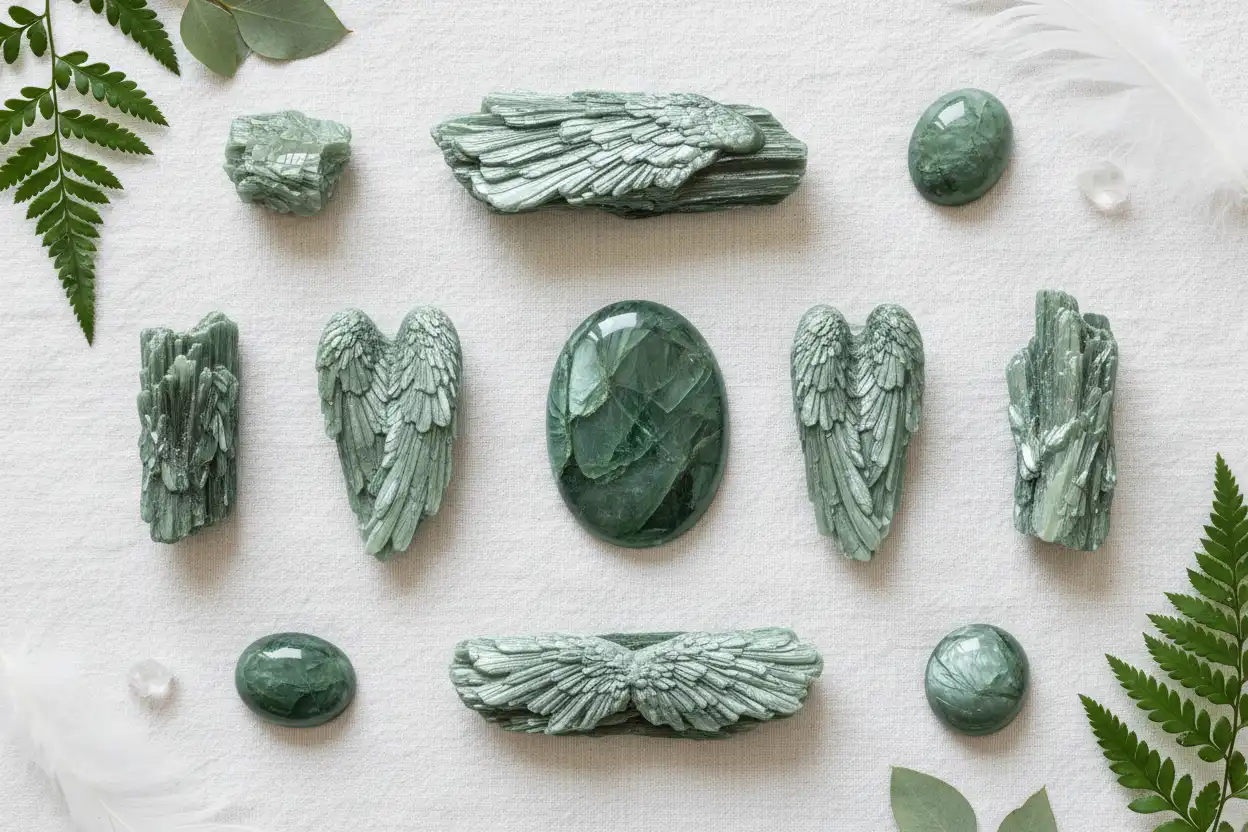
Clinochlore Meaning: Mineral Facts, History & Symbolism
Clinochlore meaning begins with a mineral identity that is often obscured by attractive trade names and broad crystal-shop language. Clinochlore is a magnesium- and aluminum-rich member of the chlorite mineral group, commonly green, soft, platy, and associated with metamorphic or hydrothermally altered rocks. It is not a variety of emerald, jade, serpentine, or mica, even though particular specimens can overlap with those materials in color, texture, or visual impression. Understanding that distinction makes the mineral more interesting rather than less, because clinochlore records real geological processes involving alteration, metamorphism, fluid movement, and changing mineral stability. Within Gems Lore’s Gemstone Guides references, measurable mineral properties are therefore separated from later symbolic ideas about growth, balance, emotional renewal, or spiritual grounding.
The name clinochlore belongs to a specific mineral species within the chlorite group, although natural specimens can contain chemical substitutions and intergrowths that make simplistic descriptions incomplete. Its idealized chemistry is commonly expressed as Mg₅Al(AlSi₃O₁₀)(OH)₈, but iron, chromium, and other substitutions may occur, and real specimens can form part of compositional series rather than behaving like perfectly pure textbook material. This chemical flexibility influences color, optical appearance, density, and associations, while its sheet-silicate structure explains the platy habit, low hardness, and pronounced cleavage that make clinochlore physically very different from harder green gemstones.
Clinochlore at a Glance
| Property | Practical reference |
|---|---|
| Material identity | Chlorite-group mineral, commonly magnesium- and aluminum-rich |
| Idealized formula | Mg₅Al(AlSi₃O₁₀)(OH)₈ |
| Mineral class | Phyllosilicate, or sheet silicate |
| Crystal system | Monoclinic |
| Typical color | Green, olive green, dark green, gray-green, occasionally chromium-rich brighter green |
| Typical habit | Platy, foliated, tabular, pseudohexagonal, scaly, massive, or micaceous aggregates |
| Mohs hardness | Commonly about 2–2.5 |
| Cleavage | Perfect basal cleavage |
| Luster | Pearly, vitreous, greasy, or dull depending on surface and aggregate |
| Transparency | Transparent in very thin plates to translucent or opaque in thicker material |
| Formation context | Metamorphic and hydrothermal alteration environments, commonly with other magnesium-rich minerals |
| Main identification limit | Green color and platy texture alone cannot prove clinochlore |
| Symbolic status | Modern meanings are personal or cultural interpretations rather than established mineral effects |
These properties immediately explain why clinochlore should not be evaluated like a conventional faceted gemstone. A material with low hardness and excellent cleavage can produce beautiful crystal specimens and occasional lapidary material, yet it does not have the mechanical profile of quartz, corundum, chrysoberyl, or other harder gems. Its value and interest often lie in crystal form, chemistry, locality, associations, color, and specimen aesthetics rather than in everyday jewelry durability.
What Clinochlore Actually Is
Clinochlore belongs to the chlorite group, a family of layered silicate minerals whose structures consist of repeating sheets rich in silicon, aluminum, magnesium, iron, hydroxyl, and related components. The sheet-like architecture produces a micaceous or foliated character in many specimens and explains why thin flakes may bend or separate along cleavage surfaces. Although clinochlore can resemble mica visually, chlorites represent a different structural and chemical mineral group.
The idealized clinochlore formula is useful for orientation but should not be treated as a perfect analysis of every natural crystal. Iron can substitute for magnesium, chromium can contribute strong green coloration in some material, and chemical variation may bridge toward related chlorite-group compositions. This means a specimen described as clinochlore from appearance alone may require analytical confirmation when precise species assignment matters scientifically.
Clinochlore can occur as individual tabular or pseudohexagonal crystals, foliated masses, rosettes, coatings, scaly aggregates, and compact material. Fine crystals may be attractive enough for dedicated mineral collections, particularly when the color, crystal habit, matrix, and locality form a visually coherent specimen.
How Clinochlore Forms
Clinochlore commonly develops when magnesium-rich rocks and minerals are altered by heat, pressure, and chemically active fluids. It is particularly characteristic of low- to moderate-grade metamorphic environments and hydrothermal alteration, where earlier minerals can become unstable and reorganize into chlorite-group phases. Ultramafic rocks, mafic rocks, serpentinites, metamorphosed carbonate rocks, and hydrothermal veins can all provide suitable chemical environments depending on local geology.
The mineral may occur with serpentine minerals, talc, magnetite, calcite, quartz, garnet, amphiboles, epidote-group minerals, or other metamorphic and alteration products. Those associations can reveal something about the rock’s history, but no single associated mineral proves clinochlore or a particular deposit. The specialist guide to clinochlore formation and deposit geology examines those environments more deeply, while the important point here is that clinochlore is best understood as part of a changing geological assemblage rather than as an isolated green crystal.
Crystal habit can also reflect growth environment. Open cavities may permit well-developed plates or rosettes, whereas tightly packed metamorphic rock may produce foliated masses whose individual crystals are difficult to distinguish. A collector should therefore avoid assuming that massive material is inferior or that every attractive crystal cluster formed under identical conditions.
Why Clinochlore Is Green
Clinochlore’s green color is connected with its chemistry, especially substitutions involving iron and, in some specimens, chromium. The exact hue can vary from pale gray-green through olive and rich forest green to unusually vivid chromium-associated greens. Color also depends on crystal thickness, inclusions, surface alteration, matrix contrast, and lighting, so two specimens with related compositions may appear markedly different.
Chromium-bearing clinochlore has attracted special attention because strong green material can look unusually gem-like. One trade-associated variety name sometimes encountered is “kammererite,” historically used for chromium-bearing clinochlore showing pink, purple, reddish, or violet colors rather than the more usual greens. However, trade and historical variety names should never be treated as separate mineral species unless the underlying mineralogy supports that distinction.
Optical appearance can also shift as thin plates transmit light. A dark green crystal in reflected light may become significantly brighter around thin edges, while foliated aggregates can show pearly flashes from cleavage surfaces. These effects are explored more fully in clinochlore optical properties and color behavior, where color is treated as an optical and chemical phenomenon rather than as proof of metaphysical function.
Diagnostic Traits
A useful clinochlore identification begins with several traits agreeing at once. The mineral is usually soft, has excellent basal cleavage, commonly develops platy or foliated habits, and often shows pearly to vitreous reflections on cleavage surfaces. Green coloration is frequent but not exclusive, and thin flakes or plates can appear translucent. These characteristics place clinochlore within a recognizable physical profile, but they are not individually diagnostic because other phyllosilicates can show similar habits.
Hardness is particularly informative when assessed responsibly. Clinochlore is much softer than quartz and many familiar jewelry stones, which explains why crystal surfaces can scratch or abrade relatively easily. However, deliberately damaging a good specimen to prove softness is unnecessary. Existing broken edges, matrix contacts, known mineral associations, optical observations, and professional analysis can provide better evidence.
Cleavage is equally characteristic. Clinochlore’s layered structure permits separation parallel to the basal plane, producing flat reflective surfaces and thin plates. This can make specimens appear micaceous, although a mica-like appearance should be treated as a descriptive observation rather than a mineral identification.
What Microscopy Can Show
Magnification can reveal stacked plates, cleavage traces, growth layers, intergrown minerals, surface alteration, fractures, and fine inclusions that are difficult to appreciate with the unaided eye. In transparent or translucent crystals, microscopy may also expose zoning or small mineral inclusions that help establish geological context. The dedicated clinochlore microscope and inclusion notebook explores these observations in greater detail.
Microscopy still has limits. A platy green crystal under magnification does not automatically become clinochlore, because chlorite-group members and unrelated sheet silicates can overlap visually. Precise species assignment may require chemical analysis, diffraction, spectroscopy, or other laboratory methods when the question matters scientifically.
This is especially relevant when a seller uses a locality-associated or chromium-related name as though it were self-proving. Microscopy can show consistency with the claim, but it may not establish exact composition or locality without additional evidence.
An Original Specimen and Photo Evaluation Framework
Begin by identifying the form of the object. A matrix specimen with visible plates preserves more geological information than a polished cabochon, carving, or loose fragment. In a natural specimen, look at how the green material sits within the host rock, whether the crystals form plates, rosettes, foliated masses, coatings, or isolated tabs, and whether associated minerals create a plausible metamorphic or hydrothermal assemblage. Record those observations without naming every phase from color alone.
Next, examine surface geometry. Clinochlore commonly produces broad flat faces and cleavage surfaces that can reflect light strongly, while stacked thin plates may create a flaky or micaceous texture. Look for whether these surfaces repeat naturally through the specimen or appear to have been produced by polishing. A manufactured flat face can hide the original habit and should not be treated as crystallographic evidence.
Then compare the apparent hardness and condition without performing unnecessary scratch tests. Rounded or abraded edges, bruised cleavage surfaces, and fine scratches may be consistent with a soft material, particularly on handled specimens. However, damage history matters: a specimen stored poorly can look far more worn than one protected since collection, so condition alone cannot identify the species.
Lighting should be controlled before judging color. Photograph the specimen under neutral diffuse light and compare the same area from several angles. Cleavage reflections can create bright flashes that appear almost metallic in one photograph and dull in another. Saturation editing can turn ordinary olive-green material into vivid emerald-like green, so color should be assessed from multiple images whenever possible.
Finally, separate what the photograph supports from what it cannot establish. Images can show habit, color, matrix, cleavage-like surfaces, apparent condition, and visible associations. They cannot conclusively establish magnesium-to-iron ratios, chromium content, exact chlorite species, treatment status, or locality. When those claims affect scientific significance or price, analytical evidence and documentation become more important than visual confidence.
Disputed Names and Unsupported Claims
Clinochlore appears under several names that can create confusion. “Chlorite” can refer broadly to the entire chlorite mineral group rather than specifically to clinochlore, so a green specimen labeled simply chlorite may require more precise identification. Conversely, not every attractive chlorite-group crystal should automatically be upgraded to clinochlore simply because that species name sounds more specific.
“Kammererite” is commonly used as a variety name for chromium-bearing clinochlore, especially material showing pink, purple, or reddish-violet coloration. The name can be useful descriptively, but it does not represent a separate mineral species. A commercial label should therefore preserve the relationship to clinochlore rather than implying a completely independent mineral identity.
Another source of confusion is visual similarity with serpentine-group minerals, mica, chloritoid, or other green phyllosilicates. Similar habit and color do not establish species. The correct approach is to identify the broad material family first and then determine whether evidence supports a more precise clinochlore assignment.
Unsupported metaphysical labels can create a different type of confusion. Descriptions such as “high-vibration chlorite,” “detox crystal,” “cellular healer,” or “auric cleanser” do not establish mineral identity or biological effects. Those phrases belong to modern spiritual marketing and should never substitute for chemical, structural, or medical evidence.
Clinochlore Compared With Other Mineral Materials
Green clinochlore can overlap visually with minerals whose chemistry and physical behavior are very different. Cobaltocalcite usually occupies a pink-to-magenta color range and is a cobalt-bearing calcite material, but both minerals illustrate how trace-element substitutions can strongly alter a mineral’s appearance without changing the fundamental need for species-level identification.
Cinnabar provides an even stronger contrast because it is dense mercury sulfide rather than a layered silicate. Its red color and mercury-related safety considerations have almost nothing in common with clinochlore’s usual physical profile, demonstrating why broad “crystal properties” lists can become misleading when mineral species are treated as interchangeable objects.
Copper is a native element rather than a silicate mineral, while chrysoberyl is a substantially harder beryllium aluminum oxide gemstone. These neighboring materials reinforce a basic identification principle: mineral names represent distinct structures and compositions, not merely different colors within one generalized crystal category.
Clinochlore in Documented History
Clinochlore’s historical story is primarily a mineralogical one rather than a well-documented ancient gemstone tradition. The species was identified and named through the development of modern mineralogy, when chemical analysis, crystallography, and systematic classification made it possible to distinguish minerals that earlier observers may have grouped together by color or texture. The name derives from Greek roots referring broadly to an inclined or oblique form and green coloration, reflecting early mineralogical description rather than a spiritual doctrine.
Older references to “green stone,” “chlorite,” or similar broad terms cannot automatically be interpreted as clinochlore. Before modern analytical methods, many visually related sheet silicates and green minerals were difficult to distinguish, and historical terminology did not always map neatly onto present mineral species. A claim that clinochlore was used in a specific ancient ritual therefore requires direct material or documentary evidence rather than a modern name attached retrospectively to an unidentified green mineral.
This limitation is important because absence of a dramatic ancient legend does not diminish the mineral’s genuine human significance. Clinochlore has value in petrology, mineral collecting, geological interpretation, and scientific classification, where its composition and associations can help explain metamorphic and hydrothermal processes.
Clinochlore Meaning in Modern Symbolism
Modern clinochlore meaning is often associated with emotional balance, personal growth, grounding, renewal, connection with nature, and reflective change. Green coloration naturally encourages metaphors involving vegetation, restoration, patience, and development, while the mineral’s layered habit may inspire symbolic ideas about gradual change or peeling back accumulated assumptions. Some practitioners also connect chlorite-group minerals with cleansing or meditation traditions.
These are symbolic interpretations rather than experimentally established properties. Clinochlore does not scientifically detoxify the body, remove infections, repair cells, cure anxiety, balance hormones, clean the bloodstream, eliminate heavy metals, or produce any other medical outcome. Its magnesium, iron, chromium, silicon, aluminum, or other chemical constituents do not become nutritional supplements merely because someone holds the mineral.
A grounded symbolic practice can instead use clinochlore as a prompt. Someone might connect its layered structure with examining a complicated problem one layer at a time, or use its green color as a reminder to spend time outdoors, review priorities, or approach change gradually. The psychological usefulness would come from the person’s chosen ritual and behavior, not from a medically active force generated by the mineral.
Chemistry Is Not Therapy
Clinochlore’s chemical composition includes elements that also appear in biology, but the presence of an element in a mineral does not imply that the body can absorb or benefit from it through normal handling. Biological effects depend on chemical form, concentration, solubility, dose, exposure route, and metabolism. Magnesium locked within a silicate structure, for example, should not be treated as though it were a dietary magnesium supplement.
The same principle applies to chromium-bearing material. Chromium can occur in different oxidation states and chemical environments with very different biological implications. A vivid chromium-associated color therefore tells the reader something about mineral chemistry; it does not establish a therapeutic benefit.
This distinction prevents a common category error in crystal-healing language, where the periodic-table contents of a stone are converted directly into wellness claims without considering actual chemistry or exposure.
Safe Ownership
An intact clinochlore specimen can generally be handled as an ordinary mineral specimen with sensible hygiene. The greater physical concern is fragility rather than unusual toxicity during routine ownership. Low hardness and perfect cleavage mean crystals can scratch, split, flake, or abrade if rubbed against harder objects or handled carelessly.
The risk profile changes during cutting, sanding, drilling, grinding, or crushing because those activities generate fine mineral dust and can expose associated phases that may not have been identified visually. Workshop processing should therefore use appropriate wet methods, ventilation, local extraction, eye protection, and respiratory controls suited to mineral dust rather than relying on the assumption that a decorative stone is harmless in powdered form.
Direct-water elixirs are unnecessary. A specimen may include matrix minerals, surface contamination, coatings, polishing compounds, adhesives, or associated phases whose composition is not apparent. Symbolic practice does not require soaking or ingesting mineral-contact water.
Cutting and Jewelry Context
Clinochlore’s softness and cleavage make lapidary work more demanding than its attractive green colors might suggest. Material can undercut, split along cleavage, lose sharp edges, or fail to maintain a durable high polish when composition and texture are unfavorable. Some specimens are better preserved as mineral specimens than converted into cabochons or carvings.
The technical choices involved in working the material are covered more fully in clinochlore cutting, orientation, and polish, while jewelry-specific protection belongs in clinochlore setting and wear engineering. The meaning reference only needs the central ownership boundary: a beautiful green surface does not make clinochlore mechanically equivalent to emerald, jade, chrysoberyl, or quartz.
Jewelry made with clinochlore therefore benefits from low-impact placements and designs that protect vulnerable edges. A pendant or collector piece may be more practical than an exposed everyday ring, particularly when the crystal shows obvious cleavage or foliated structure.
Conservation and Storage
Clinochlore specimens should be stored so that harder minerals cannot rub against their crystal faces. Individual boxes, padded supports, stable positioning, and minimal unnecessary handling can preserve thin plates and cleavage surfaces far better than an open tray where specimens strike each other whenever the collection is moved.
Cleaning should likewise be conservative. Aggressive brushing, scrubbing, ultrasonic cleaning, strong chemicals, and repeated wetting are poor default choices for a soft platy specimen, particularly when matrix minerals or repairs are present. Dust is better prevented through enclosed storage than repeatedly removed through mechanical cleaning.
Collectors documenting important specimens can use a clinochlore specimen conservation record to track fractures, detached plates, previous repairs, coatings, cleaning history, and changes in condition. Preserving this information can be as important as preserving the physical object, especially when future owners need to distinguish natural features from later damage.
Provenance and Locality Claims
Clinochlore occurs in multiple geological settings and regions, so green color or crystal shape alone cannot reliably establish geographic origin. Famous localities may develop reputations for particular crystal habits, associated minerals, or chromium-rich varieties, but visual resemblance should not be converted into mine identification without documentation.
Old collection labels, dealer records, field notes, acquisition history, and credible chain-of-custody information can strengthen a provenance claim. The clinochlore provenance disclosure checklist provides a more appropriate method for evaluating locality than attempting to identify a mine from a photograph.
This distinction can influence collector value substantially. A modest crystal with strong historic provenance may have more scientific significance than a larger unprovenanced specimen, while an unsupported famous-locality label should not command the same confidence as documented origin.
Frequently Asked Questions About Clinochlore Meaning
What is clinochlore?
Clinochlore is a chlorite-group sheet silicate mineral rich in magnesium and aluminum. It commonly occurs as green platy, foliated, tabular, or scaly crystals and aggregates in metamorphic and hydrothermally altered rocks.
What does clinochlore mean spiritually?
Modern crystal traditions commonly associate clinochlore with growth, grounding, emotional balance, renewal, and connection with nature. These are symbolic interpretations rather than scientifically demonstrated properties of the mineral.
Is clinochlore the same as chlorite?
Clinochlore is a member of the chlorite mineral group, but “chlorite” is a broader group name rather than a precise synonym for every clinochlore specimen. Accurate species identification may require chemical or structural evidence.
Is kammererite the same as clinochlore?
Kammererite is a traditional variety name commonly used for chromium-bearing clinochlore, particularly material with pink, purple, violet, or reddish coloration. It is not generally treated as a separate mineral species.
How hard is clinochlore?
Clinochlore is soft, commonly around Mohs 2 to 2.5. Its low hardness and perfect basal cleavage make crystal surfaces vulnerable to scratches, abrasion, and splitting.
Can clinochlore be used in jewelry?
It can be used selectively, but its softness and cleavage make it unsuitable for many exposed everyday jewelry applications. Protected pendants, collector pieces, or carefully designed low-impact settings are generally more realistic than heavily worn rings.
Is clinochlore scientifically proven to heal?
No. There is no established scientific evidence that clinochlore prevents, diagnoses, treats, or cures medical conditions. Statements about healing or energy belong to metaphysical belief systems rather than mineral science.
Does chromium in clinochlore provide health benefits?
No such conclusion follows from mineral chemistry. Chromium’s biological effects depend on chemical form, dose, concentration, solubility, exposure route, and metabolism. Chromium contributing to mineral color does not make clinochlore a nutritional or therapeutic source.
How can I identify clinochlore?
Look for a consistent combination of platy or foliated habit, soft hardness, excellent basal cleavage, green coloration, pearly-to-vitreous surfaces, and an appropriate geological assemblage. Precise species identification may require laboratory analysis because several sheet silicates can overlap visually.
Is clinochlore safe to handle?
An intact specimen can generally be handled normally with sensible mineral-collection hygiene. Greater caution is appropriate when cutting, drilling, sanding, grinding, or crushing because these activities generate fine dust and may expose associated minerals.
Is green clinochlore rare?
Clinochlore itself is not among the rarest minerals, but exceptional specimens can be scarce because collector value depends on crystal quality, color, size, condition, associations, locality, and provenance. Bright chromium-rich or unusually well-crystallized material can attract stronger collector interest.
What Clinochlore Meaning Can Responsibly Mean
Clinochlore meaning becomes more useful when measurable mineral facts, documented history, modern symbolism, and personal metaphysical practice remain separate. Mineralogically, clinochlore is a soft layered chlorite-group silicate whose chemistry, cleavage, crystal habit, color, and geological associations can be investigated directly. Historically, its identity belongs largely to the development of scientific mineral classification rather than to a securely documented universal ancient crystal tradition. Symbolically, modern users may associate its green color and layered form with growth, renewal, grounding, or gradual change, provided those ideas remain clearly identified as interpretation.
That framework allows clinochlore to remain interesting without unsupported medical or supernatural claims. Its role in metamorphic and hydrothermal geology, variable chemistry, chromium-bearing varieties, delicate crystal habits, collector provenance, and distinctive cleavage provide substantial reasons to study and preserve it. A person who also chooses to use the mineral as a reflective symbol can do so without claiming that it detoxifies the body, transmits nutrients, guarantees emotional healing, or produces measurable spiritual energy.
Gems Lore explains its broader site and authorship context on the About page, while the Disclaimer clarifies the limits of mineral, symbolic, safety, and identification information. Questions, corrections, or supporting documentation relevant to a clinochlore claim can be submitted through Contact, particularly when exact species, treatment, or provenance cannot be established from photographs alone.