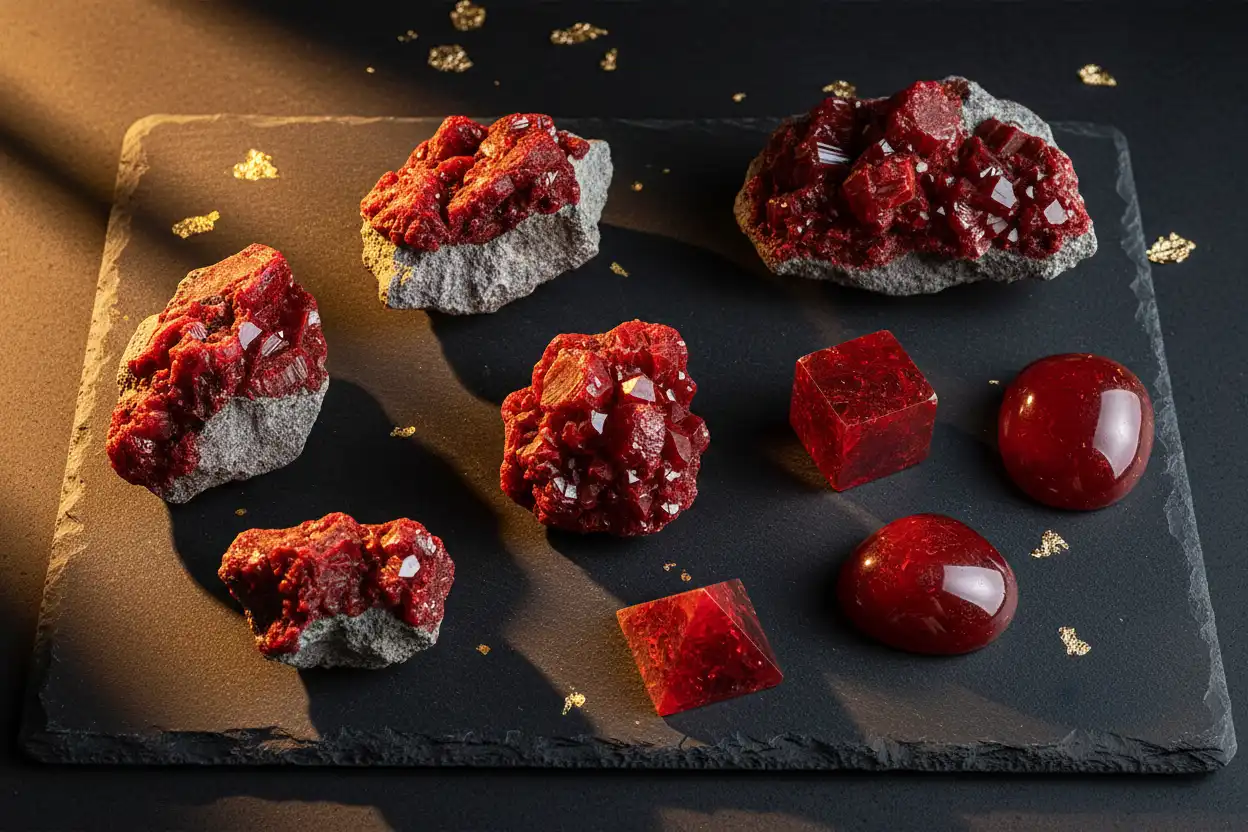
Cinnabar Meaning: Identity, History, Symbolism & Safety
Cinnabar meaning has an unusually important material foundation because cinnabar is not simply a decorative red stone: it is mercury sulfide, HgS, the principal natural ore mineral historically associated with mercury production. Its intense scarlet to brownish-red color, exceptional density, low hardness, red streak, and long history as a source of vermilion pigment make it distinctive, yet its mercury content also means that interpretation should never be separated from responsible ownership. Symbolic associations with vitality, transformation, wealth, protection, or spiritual power belong to cultural history and modern personal practice; they are not physical effects demonstrated by the mineral. Within Gems Lore’s Gemstone Guides, cinnabar is therefore best understood first as a mineral species with measurable properties and genuine conservation concerns, and only then as an object that has accumulated cultural and symbolic meanings.
Mineralogically, cinnabar is the red trigonal form of mercury sulfide and is characteristically soft, unusually heavy for its size, and capable of forming well-defined crystals as well as granular, massive, crust-like, and vein-filling material. Reference mineral data place its Mohs hardness around 2 to 2.5 and its specific gravity a little above 8, which means a comparatively small specimen can feel surprisingly heavy. Its typical red to brownish-red color and scarlet streak are useful clues, although color alone is never sufficient for a secure identification.
Cinnabar at a Glance
| Property | Practical reference |
|---|---|
| Material identity | Natural mercury sulfide mineral |
| Chemical formula | HgS |
| Crystal system | Trigonal |
| Typical color | Scarlet, cochineal red, brownish red, dark red, sometimes grayish on altered surfaces |
| Streak | Scarlet to red-brown |
| Mohs hardness | About 2–2.5 |
| Specific gravity | About 8.1–8.2, making it exceptionally dense |
| Common habit | Crystalline, granular, massive, crust-like, or vein-filling |
| Formation setting | Commonly low-temperature hydrothermal mineralization associated with mercury-bearing deposits |
| Historic material role | Major natural source of mercury and an important source of red cinnabar pigment |
| Main ownership concern | Mercury-containing mineral; avoid ingestion, dust generation, grinding, heating, or other destructive handling |
| Symbolic status | Historical and modern associations are cultural interpretations rather than scientifically established mineral effects |
The combination of softness and high density is particularly useful for understanding cinnabar because those properties are less visually obvious than its color. A glossy red specimen may look superficially similar to several other red minerals, pigments, resins, or manufactured objects, but genuine cinnabar behaves very differently from harder decorative stones. At the same time, no home test should involve scratching, breaking, heating, or grinding a specimen merely to prove its identity, especially when safer observational and professional analytical methods are available.
What Cinnabar Actually Is
Cinnabar is a recognized mineral species composed ideally of mercury and sulfur in a one-to-one atomic relationship expressed as HgS. It represents the red trigonal form of mercury sulfide and differs structurally from other mercury-sulfide polymorphs even though the broad chemical composition can be the same. Well-formed crystals may show rhombohedral, tabular, or prismatic habits, while much commercial and museum material occurs as massive or granular red mineralization embedded in matrix. Its luster can range from adamantine on good crystal faces toward metallic or duller appearances in dark, fine-grained, or altered material, and thin portions can display optical behavior that is far more complex than the appearance of an opaque red mass suggests.
This distinction between mineral identity and appearance becomes important in the marketplace because “cinnabar” is also used in contexts that do not describe a natural mineral specimen. Red carved objects, beads, lacquerware, resin jewelry, pigments, and imitation products may carry the word cinnabar because of color, historical style, or manufacturing tradition. A carved red bracelet sold as “cinnabar,” for example, should not automatically be assumed to consist of solid natural HgS. The name on a product listing identifies what the seller calls the item; it does not establish mineral composition.
How Cinnabar Forms
Cinnabar commonly forms from low-temperature hydrothermal fluids moving through fractures, veins, porous host rocks, and mineralized zones where mercury and sulfur can combine under suitable chemical conditions. Deposits may be associated with volcanic or geothermal environments, hot-spring systems, sedimentary settings, and structurally controlled veins, while common mineral associates can include quartz, chalcedony, calcite, pyrite, stibnite, realgar, barite, and native mercury. The exact assemblage depends on the deposit rather than on a universal formula for how every cinnabar specimen must look. Mineral reference data describe cinnabar as forming from low-temperature hydrothermal solutions across several host-rock environments, which helps explain its occurrence in dramatically different matrices.
A rough specimen should therefore be interpreted as part of a geological assemblage rather than as an isolated patch of red. Pale carbonate matrix, silica-rich veins, dark sulfides, fractures, weathered zones, and associated metallic minerals can all supply context, although none of those visual features proves a mine or country of origin. The specialist discussion of cinnabar formation and deposit geology examines these environments in greater detail without turning a meaning reference into a deposit catalogue.
Why Cinnabar Is So Intensely Red
Cinnabar’s red appearance arises from the electronic and structural properties of crystalline mercury sulfide rather than from an organic dye or a trace coloring element added to a colorless host mineral. Depending on grain size, crystal quality, lighting, surface condition, impurities, and alteration, specimens can range from vivid scarlet through cochineal and brownish red to dark red or grayish surfaces. Fine crystalline or powdered material historically produced the brilliant red pigment associated with natural vermilion, while good crystal faces can show a strong luster that makes the color appear unusually saturated.
Color can also change at the surface. Research into heritage materials has shown that cinnabar-containing pigments may darken under particular combinations of light, moisture, and halogen chemistry, with metallic mercury nanoparticles implicated in at least some blackening mechanisms. This is important because darkened areas should not automatically be identified as another mercury sulfide polymorph solely from appearance. The more detailed discussion of cinnabar optical properties and color behavior separates inherent optical properties from surface alteration and photographic effects.
Diagnostic Traits and Identification Limits
The strongest non-destructive visual case for cinnabar comes from several traits agreeing with one another rather than from redness alone. A convincing specimen may combine a scarlet or deep red color, unusually high apparent heft, soft-looking surfaces, a characteristic mineral habit, red streak visible only where it already occurs naturally, and an appropriate geological matrix. Well-developed crystals can add useful morphology, but many genuine specimens are massive and reveal little crystal form. Because the mineral is soft, destructive hardness testing should not be treated as a casual authentication method.
Magnification can reveal crystal boundaries, alteration films, fractures, included matrix, secondary coatings, polish marks, pigment-filled cavities, or evidence that a red object is actually manufactured rather than mineral. Even so, microscopy has limits. It cannot necessarily distinguish every mercury sulfide polymorph, establish a geographic source, or prove the absence of surface treatments without supporting analytical evidence. The cinnabar microscope and inclusion notebook focuses on observations that can genuinely be made under magnification while preserving this distinction between visual consistency and definitive identification.
A Specimen and Photo Evaluation Framework
Begin with context rather than color. For rough specimens, examine how the red material occurs within the host rock: whether it forms crystal clusters, vein fillings, granular masses, coatings, or irregular mineralized zones. Record surrounding minerals and matrix colors without assigning names to every visible phase unless the evidence supports them. A natural-looking matrix can strengthen geological plausibility, but an attractive association is not proof of locality because similar mineral assemblages can occur in more than one deposit.
Then consider scale, surface condition, and apparent density. Cinnabar’s high specific gravity is striking in hand, yet photographs cannot communicate weight reliably, so a seller’s image cannot confirm this diagnostic feature. Crystal faces should be evaluated for realistic geometry rather than exaggerated perfection, while very uniform carved red material deserves a different line of questioning because massive natural cinnabar is soft and is not interchangeable with the carved lacquer and resin objects commonly marketed using the same word.
Lighting deserves particular attention. Strong saturation, warm white balance, wet surfaces, or digital contrast can shift brownish-red material toward a dramatic scarlet that looks more valuable or visually pure than the object appears under neutral light. Multiple images under ordinary lighting are therefore more informative than one highly processed photograph. Even a complete photo set, however, cannot establish mercury content, synthetic versus natural pigment, treatment history, or mine provenance on its own.
Finally, separate mineral identity from commercial description. “Cinnabar,” “vermilion,” “cinnabar lacquer,” “Chinese cinnabar,” and “cinnabar-style” can refer to related but materially different things depending on context. Natural cinnabar is the mineral HgS; vermilion is traditionally the red pigment made from natural or synthetic mercury sulfide; cinnabar lacquer describes an artistic material and tradition rather than automatically identifying a solid mineral carving. A trustworthy description should say which meaning is intended rather than allowing historical terminology to substitute for composition.
Cinnabar and Vermilion Are Related but Not Identical Labels
Cinnabar has an exceptionally well-documented history as a red material because finely processed mercury sulfide became one of humanity’s important red pigments. Museum research distinguishes cinnabar as the mineral from vermilion as the pigment, although historical texts and modern discussions sometimes use the terms interchangeably because both can be chemically HgS. Natural cinnabar was processed into pigment, while synthetic vermilion could also be manufactured from mercury and sulfur, meaning that chemical identification of HgS in an artwork does not by itself prove that the pigment came directly from mined crystals.
That distinction is valuable far beyond art history. A collector looking at a red mineral specimen, a conservator examining a painted object, and a buyer considering a carved red bead may all encounter the word cinnabar, yet they are not necessarily evaluating the same material form. Responsible cinnabar meaning begins by establishing which object is actually being discussed before historical or symbolic associations are attached to it.
Documented Historical Importance
Cinnabar has been used across numerous cultures as a pigment, prestige material, and ritual color, with archaeological and museum analysis identifying mercury sulfide in painted objects, burial contexts, architectural decoration, lacquer traditions, and other material culture. Its brilliant red color naturally invited associations with blood, vitality, status, sacredness, victory, mortality, and transformation in different settings, but those meanings were not universal and should not be merged into one invented global belief system. Museum research demonstrates both the extensive historical use of cinnabar and the importance of scientific pigment analysis when identifying it in surviving objects.
Historical evidence also warns against projecting modern crystal-healing terminology backward. An archaeological culture may have valued red pigment ceremonially without believing that a handheld cinnabar crystal balanced energy centers or attracted money. Those latter claims belong to much later interpretive systems. Documented use, documented symbolism, modern metaphysical belief, and present-day mineral science should remain separate even when they all concern the same red material.
Cinnabar Meaning in Modern Symbolism
Modern interpretations often associate cinnabar meaning with transformation, personal power, confidence, abundance, manifestation, passion, and the ability to turn intention into action. The stone’s extraordinary density and vivid red color make those metaphors easy to understand: red can suggest vitality and urgency, while cinnabar’s historical connection with mercury and transformative metallurgical processes has encouraged later symbolic links with change and material ambition. Some crystal traditions additionally connect cinnabar with root- or sacral-centered symbolism.
These meanings are cultural and personal interpretations, not demonstrated mineral effects. Cinnabar does not scientifically attract wealth, make a business successful, increase fertility, improve circulation, raise energy levels, cure disease, protect a person from harm, or cause a desired relationship outcome. A collector can still use the mineral as a reminder of persistence, disciplined action, financial boundaries, or creative commitment, but the practical decision-making remains with the person.
The distinction is especially important because a substance containing mercury should never be ingested, powdered for ritual use, added to drinking water, placed in the mouth, or heated in an attempt to intensify its symbolic properties. Metaphysical practice does not alter toxicology.
Symbolic Use Without Unnecessary Exposure
A person who values cinnabar meaning can engage with the symbolism without carrying the specimen against bare skin for long periods or manipulating it repeatedly. Displaying an intact specimen in a closed case, viewing it during reflection, keeping a photograph in a journal, or using its red color as a visual prompt can preserve the symbolic role while reducing unnecessary contact. The point of a reflective practice is the meaning assigned to the object, not the amount of physical exposure to the mineral.
A useful personal interpretation might connect cinnabar with questions about ambition and consequences: what goal is genuinely worth pursuing, what risks accompany it, which boundaries should not be crossed, and what actions are supported by evidence rather than wishful thinking. That approach is especially appropriate for a mineral whose historical value and chemical hazards both illustrate how something visually compelling can demand informed handling.
Cinnabar Safety: Mercury Chemistry Matters
Cinnabar contains mercury in the form of mercury sulfide. That chemical form is far less water-soluble and generally less readily absorbed than several other mercury compounds, so an intact specimen is not equivalent to a pool of elemental mercury or a soluble mercury salt. Nevertheless, low solubility does not make cinnabar appropriate for ingestion or destructive handling. Government toxicology references classify mercuric sulfide as an inorganic mercury compound, and historical mercury production depended on heating cinnabar ore to release mercury vapor.
The practical distinction is between ordinary intact storage and activities that substantially change exposure. Cutting, drilling, sanding, dry grinding, crushing, or polishing can generate contaminated dust, while heating cinnabar can release hazardous mercury vapor. Mercury vapor is readily absorbed through the lungs and presents a materially different hazard from brief contact with an intact mineral specimen. For this reason, cinnabar should not be heated, burned, used in incense arrangements, placed near open flames, processed in an ordinary hobby workspace, or ground into powder.
Good ownership practice also means keeping specimens away from young children and pets, avoiding food-preparation surfaces, washing hands after direct handling, and using a closed display or storage box when practical. A damaged, friable, dusty, or powdery specimen deserves more caution than a stable enclosed piece because loose material increases the potential for contamination. These precautions are proportionate to the material and do not require treating an intact specimen as though it were continuously releasing dangerous quantities of mercury vapor under ordinary room conditions.
Conservation and Long-Term Display
Cinnabar deserves thoughtful conservation for both safety and appearance. Its low hardness makes crystal faces and massive surfaces vulnerable to scratches, while strong or prolonged environmental exposure can alter color in some specimens and cinnabar-containing heritage materials. Rather than repeatedly cleaning the mineral, a collector should minimize dust accumulation through enclosed storage, avoid abrasive wiping, protect fragile crystal faces from contact, and keep documentation with the specimen so that future owners understand its identity.
The cinnabar specimen conservation record addresses condition monitoring, storage observations, surface change, previous repairs, and other conservation details that belong outside a general meaning reference. For valuable or historically important material, a conservator or mineral collection specialist is preferable to experimental household cleaning.
Cinnabar in Cutting and Jewelry
Cinnabar is not an ordinary jewelry stone. Its softness, cleavage, high density, mercury content, and sensitivity to abrasive processing make lapidary work substantially different from cutting quartz, corundum, or other mainstream gems. Some objects sold as cinnabar jewelry are not carved from natural crystalline cinnabar at all; they may be lacquer, resin, composite material, pigment-bearing products, or imitations whose composition should be established before care advice is applied.
The technical issues involved in shaping or finishing the natural mineral belong in the separate cinnabar cutting, orientation, and polish reference, while the cinnabar setting and wear engineering page addresses how fragility, abrasion, exposure, and mounting design affect objects intended to be worn. The important boundary here is that a meaning reference should not encourage unnecessary cutting of mercury-bearing material merely to create a symbolic accessory.
Provenance and Seller Claims
Locality can matter greatly to mineral collectors because some deposits are known for exceptional crystals, historic mining significance, or distinctive associations, but provenance cannot reliably be determined from red color alone. A crystal from a documented historic mercury district may have greater scientific or collector interest than visually similar unprovenanced material, yet that value depends on records such as old labels, collection history, dealer documentation, or reliable mine information.
The cinnabar provenance disclosure checklist provides a more appropriate framework for those claims than visual guesswork. A seller who states that an item is natural cinnabar should also be clear about whether the object is a mineral specimen, pigment-bearing material, lacquer, resin, composite, or another product category, especially when the name is being used commercially rather than mineralogically.
Similar-Looking Materials Are Not Interchangeable
Cinnabar’s saturated red encourages comparisons with unrelated minerals, but appearance should never replace identity. Cobaltocalcite can show intense pink to reddish tones while remaining a cobalt-bearing calcite material with entirely different chemistry, hardness, density, and geological behavior. Chrysoberyl is far harder and belongs to a different mineral system despite occasional warm color varieties, while clinochlore is generally associated with green chlorite-group material rather than mercury sulfide.
Even patterned decorative materials can create naming confusion. Chrysanthemum Stone is a rock or ornamental aggregate defined by its flower-like mineral patterns, not by a single red pigment mineral, illustrating why trade appearance and mineral species need to remain distinct. These comparisons are not meant to turn every neighboring stone into a cinnabar substitute; they demonstrate why proper identification begins with mineral properties rather than color vocabulary.
Unsupported Claims to Treat With Caution
Claims that a cinnabar specimen proves ancient ritual lineage, guarantees prosperity, activates a particular biological process, safely releases beneficial mercury, or can be powdered for medicinal or spiritual use should be treated very differently from documented mineralogical or historical statements. The first group requires evidence that is usually absent or contradicts basic safety principles, while the second can be evaluated through mineral data, archaeological analysis, conservation science, and documented object history.
Likewise, an online photograph cannot establish that a carved red object is natural cinnabar simply because it is labeled “Chinese cinnabar.” The item may belong to a lacquer tradition, may contain pigment rather than massive mineral, or may be a modern imitation. Accurate naming requires enough information to distinguish mineral species, pigment, manufactured object, treatment, and provenance instead of compressing all five into one commercial word.
What Cinnabar Meaning Can Responsibly Include
Cinnabar meaning becomes more informative when physical evidence, documented history, symbolism, and safety are allowed to remain separate. Mineralogically, cinnabar is trigonal HgS: a soft, remarkably dense red mercury mineral with an important role in mercury deposits. Historically, it supplied a brilliant pigment and appears in diverse cultural contexts whose meanings must be understood individually rather than merged into one universal ancient tradition. Symbolically, modern practitioners may interpret its color and history through themes of transformation, ambition, vitality, or disciplined action, but those interpretations do not establish a scientific mechanism.
Safe ownership provides the final boundary. Cinnabar is not a wellness supplement, crystal elixir ingredient, powder for ritual use, or material that should be heated to explore its properties. Its beauty can be appreciated through careful collecting, enclosed display, documentation, photography, and non-contact symbolic use without turning mercury exposure into part of the experience. That distinction respects both the mineral and the reader.
Gems Lore explains its broader editorial and authorship context on the About page, while the Disclaimer clarifies the limits of mineral, symbolic, and safety information. Questions, corrections, or documentation relevant to a factual claim can be submitted through Contact, particularly when a specimen or historical object requires evidence that cannot be established from photographs alone.