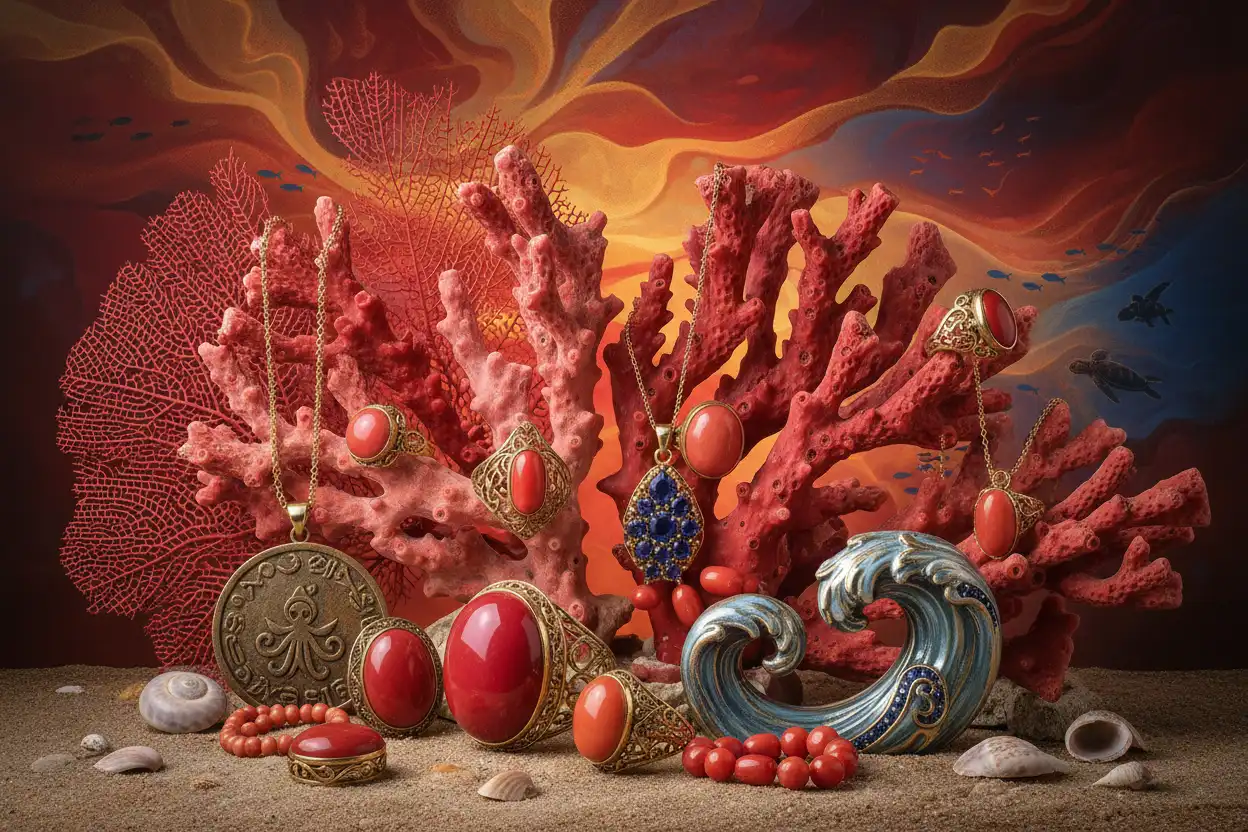
Coral Meaning: Material Identity, History & Symbolism
Coral meaning begins with a distinction that separates it from nearly every conventional gemstone: coral is not a mineral crystal formed through inorganic geological crystallization, but a biologically produced skeletal material created by marine organisms belonging to several coral groups. Gem-quality red, pink, orange, white, and related precious corals have historically been fashioned into beads, cabochons, carvings, amulets, and ornamental objects because their compact skeletal material can accept a smooth polish and occur in attractive natural colors. Composition depends on the biological group being discussed, so the word coral should not be reduced to one universal chemical formula or physical structure. Precious red and pink corals used traditionally in jewelry are calcium-carbonate skeletal materials, while other commercially called corals can differ significantly in composition and structure. Within Gems Lore’s Gemstone Guides, these measurable biological and material facts are kept distinct from cultural symbolism involving protection, vitality, fertility, status, good fortune, the sea, or emotional balance.
That distinction is particularly important because the commercial word coral can describe very different objects. A natural precious-coral branch, a polished bead cut from skeletal material, a dyed pale coral, reconstructed material made from fragments, imitation resin, glass, shell, and an object merely colored “coral red” do not have the same identity. Even genuine natural coral requires more precise description because different biological groups create different skeletal materials, growth structures, colors, and conservation concerns. A responsible coral meaning reference therefore begins by asking what the material actually is before attaching history, symbolism, price, or care advice to it.
Coral at a Glance
| Property | Practical reference |
|---|---|
| Material identity | Biogenic skeletal gem material rather than a conventional mineral crystal |
| Biological origin | Produced by marine coral organisms |
| Common precious-coral composition | Predominantly calcium carbonate in compact skeletal material, with composition varying among coral groups |
| Typical gem colors | Red, salmon, pink, orange, pale pink, white and related shades depending on species and material |
| Common forms | Natural branches, beads, cabochons, carvings, inlay and polished ornamental pieces |
| Hardness | Generally low compared with common crystalline gemstones; exact behavior depends on coral type |
| Surface character | Fine-grained to compact, capable of a smooth polish but vulnerable to abrasion |
| Common internal clues | Growth structures, pores, channels, banding or skeletal features depending on material |
| Important market issues | Dyeing, impregnation, reconstruction, imitation and incorrect species or origin claims |
| Key identification limit | Color and a single photograph cannot establish coral type, natural color, treatment or biological origin |
| Conservation concern | Heat, acids, harsh chemicals, abrasion and prolonged unsuitable storage can damage coral |
| Symbolic status | Historical and modern meanings are cultural interpretations rather than scientifically demonstrated effects |
This overview shows why coral should not be handled as though it were simply a red stone with a hardness number. Its biological origin influences internal structure, surface response, color, durability and even the questions that matter when provenance is evaluated. A polished piece may preserve only a small part of the evidence visible in an unworked branch, while dye, fillers or reconstruction can further obscure natural characteristics.
What Coral Actually Is
Coral is created by colonies or individual marine cnidarians that build skeletal structures as they grow. In gemology, the most historically significant red and pink precious corals come from particular groups whose dense branches can be cut and polished, rather than from the massive reef-building corals that people often picture when they hear the word coral. The biological distinction matters because “coral” is an umbrella term covering organisms and skeletal materials with different structures, colors and compositions.
Precious red coral associated with genera such as Corallium and Pleurocorallium is valued for compact branches that can produce attractive red, pink, salmon and related polished material. Its skeleton is predominantly calcium carbonate with an organic component and natural pigments contributing to appearance. Other organisms sold or historically used under the coral name can produce materially different skeletons; black coral, for example, should not be described as though it were simply black calcium-carbonate red coral. A scientifically useful description therefore identifies the coral category before discussing properties.
This biological origin also explains why describing coral as a “crystal” is technically misleading when crystal is being used in the mineralogical sense. The material can contain crystalline calcium-carbonate components at the microscopic level, but the gem object as a whole is a biologically constructed skeleton with organized growth architecture. That structure is part of its identity.
How Gem Coral Forms
Coral formation is fundamentally biological. Coral polyps produce skeletal material incrementally as the organism grows, generating branches, axial structures, channels, growth bands and other features according to the group involved. Environmental conditions such as water chemistry, depth, temperature, food availability, currents, biological stress and growth rate can influence the resulting skeleton, but the process should not be described as equivalent to a quartz crystal precipitating from hydrothermal fluid.
After the organism dies or skeletal material becomes separated from living tissue, the coral structure may persist and eventually enter biological, archaeological or commercial contexts. Material intended for ornament can then be selected, cut, shaped and polished, which may remove much of the outer growth surface while preserving internal skeletal features. The more specialized coral formation and deposit geology reference examines how biological growth and the surrounding marine environment intersect with the geological record without turning this page into a complete marine-science treatment.
The difference between coral and mineral formation matters because statements such as “coral grows as a crystal beneath the sea” collapse two very different processes. The organism controls skeletal construction biologically even though inorganic chemical processes participate in calcium-carbonate formation.
What Causes Coral Color?
Natural coral color can arise from organic pigments, skeletal composition, microscopic structure and biological differences among coral groups. Precious coral ranges from pale pink and salmon through richer red and orange-red, while white or lightly colored material also occurs. The appearance can be relatively even or show natural variation across a branch, and polished pieces may reveal lighter or darker zones that were less obvious before cutting.
Color is commercially important but diagnostically limited. Dye can intensify pale material or give another substance a coral-like appearance, while coatings and impregnation can modify surface color and luster. Photography further complicates interpretation because a warm light source, increased saturation, deep shadows or a dark background can turn an ordinary salmon-red object into a dramatically intense scarlet.
The dedicated discussion of coral optical properties and color behavior examines these effects more fully. For the meaning page, the useful boundary is that an attractive red color supports a visual description but cannot establish species, natural color, treatment, geographic origin or legal trade status by itself.
Diagnostic Traits and Identification Limits
Genuine gem coral is usually identified through a combination of structure, physical properties, microscopic growth features and, when necessary, instrumental analysis. Polished coral may show characteristic longitudinal structure, fine growth lines, pores, channels or internal organization associated with skeletal growth, although the appearance varies according to coral type and cutting direction. Surface and internal features therefore need to be interpreted as a pattern rather than reduced to one supposedly universal hallmark.
Low hardness is another practical characteristic. Precious coral can scratch and abrade more readily than quartz, sapphire or many common faceted gems, which is one reason antique coral beads sometimes show softened surfaces around drill holes and exposed edges. Yet deliberately scratching a collectible or finished piece is not a sensible authentication method. Existing wear, magnification, density, optical behavior and professional examination provide less destructive evidence.
The coral microscope and inclusion notebook focuses on the internal and surface structures that can support identification. Magnification can be especially useful when comparing natural skeletal material with glass, resin or reconstructed products, but microscopy does not automatically establish coral species, exact geographic origin or the absence of every treatment.
An Original Coral Specimen and Photo Evaluation Framework
Begin by identifying the object’s form before judging its authenticity. A natural branch preserves external growth architecture that a bead, cabochon or carving may no longer show, while a strand of highly polished spheres removes much of the context that could have helped identify how the material grew. Record whether the object is rough skeletal material, a cut fragment, carved ornament, loose bead, finished jewel or composite decorative item because the available evidence changes with each format.
Next, examine structure rather than relying on red color. On a branch or cut surface, look for coherent biological growth features, fine linear structures, pores, channels, changes in branch direction and internal organization rather than a homogeneous glass-like body. In polished pieces, inspect drill holes and less-finished edges because these areas may reveal structure that is hidden beneath a glossy surface. Irregularity alone is not proof of natural coral, however, because resin and reconstructed materials can be manufactured to look imperfect.
Then evaluate color distribution under neutral light. Natural coral can be evenly attractive, so uniform color does not prove dye, but strong color concentration in cracks, pores or drill holes may warrant closer investigation in the proper context. Compare several pieces in a necklace or matched pair because identical saturated color across numerous objects can have several explanations, including careful sorting, treatment or manufactured imitation. The observation should trigger a question rather than an automatic verdict.
Surface response provides another layer of information. Genuine coral can take a smooth polish, but it generally does not display the same optical appearance as transparent glass or crystalline quartz. Examine worn areas, edges and drill openings for differences between a surface coating and the underlying body. Abrupt color changes beneath damaged polish may indicate treatment, while consistent color through a cut edge can strengthen—but not conclusively prove—a natural-color interpretation.
Finally, separate what a photograph can support from what requires physical examination. Images can document approximate color, visible growth texture, drill holes, craftsmanship, surface wear, pattern consistency and object form. They cannot conclusively establish species, natural versus dyed color, reconstructed construction, geographic provenance, age or whether the object entered trade through a lawful and responsibly documented supply chain.
Natural Coral, Dyed Coral, Reconstructed Material and Imitation
A useful coral description should distinguish material identity from treatment. Natural coral may be polished without changing its fundamental identity, while dye can modify color, impregnation can alter porosity or stability, and reconstruction can combine crushed or fragmented biological material with binders into a new manufactured product. Each description communicates something different to a buyer or collector.
Imitations add another category. Resin, plastic, glass, shell, bone or other materials can be colored and shaped to resemble coral. Some reproductions are easy to recognize when bubbles, mold marks, artificial seams or obviously homogeneous interiors are visible, while more sophisticated products may require closer examination.
The objective is not to assume that every vivid red bead is treated or fake. Fine natural coral can be strongly colored. The responsible approach is to match the strength of the claim with the strength of the evidence and to preserve distinctions among natural material, treatment, composite construction and imitation rather than reducing everything to “real versus fake.”
Coral Is Not a Conventional Gemstone Mineral
Coral’s biological origin places it alongside other organic or biogenic gem materials rather than conventional mineral crystals. Its identity is therefore closer in conceptual terms to materials whose formation involves living organisms than to quartz or corundum, even when coral is sold in the same jewelry setting as crystalline gems.
This difference affects technical language. A coral cabochon does not have a crystal system in the sense used to classify a sapphire crystal, and a coral branch is not a crystal habit. The skeleton itself contains mineral phases, but describing the complete biological material requires more than a mineral formula.
That distinction also affects value, conservation and provenance. The source organism, skeletal quality, color, treatment, workmanship, documentation and legal or ethical context can all matter in ways that do not map cleanly onto the usual “clarity, cut and carat” model used for transparent faceted stones.
Coral in Documented Human History
Coral has an extensive documented history as an ornamental and symbolic material in Mediterranean, European, North African, Middle Eastern, South Asian and other cultural contexts. Red coral in particular was shaped into beads, branches, pendants, carved figures and protective ornaments, while its color and marine origin encouraged associations with blood, life, fertility, protection, status and the boundary between land and sea. These historical meanings varied across cultures and periods rather than forming one universal coral doctrine.
The strongest historical claims come from surviving objects, archaeological context, written records, artistic representation and documented trade rather than from modern lists that assign identical meanings to every ancient society. An old red bead should not automatically be identified as precious coral without material evidence, and a historical reference to a “red stone” or marine ornament cannot be converted into precise coral identification simply because the symbolism sounds plausible.
Coral’s long use in jewelry also reflects practical material qualities. Dense branches could be carved and polished, the red-to-pink color remained visually distinctive, and maritime trade connected sources with distant markets. These documented material and economic factors are sufficient to explain much of coral’s historical prominence without inventing continuous metaphysical traditions.
Coral Meaning in Modern Symbolism
Modern coral meaning commonly draws on the material’s red or pink color, marine origin, branching growth and historical use. Symbolic associations can include vitality, protection, emotional warmth, family continuity, fertility, courage, creativity and connection with the sea. Pink coral may be interpreted through softer themes involving affection or compassion, while red coral is frequently linked symbolically with energy, determination or protection.
These meanings are cultural and personal interpretations rather than biological effects of coral skeleton. Wearing coral does not scientifically increase fertility, improve blood circulation, protect a pregnancy, cure anemia, prevent accidents, enhance courage through a biochemical mechanism or create a measurable protective field. Its calcium-carbonate content also does not make it a calcium supplement when worn or held.
A grounded personal practice can retain symbolism without making unsupported claims. Someone who associates coral with continuity might use an inherited coral object as a prompt to document family history. A person who connects branching coral with community could use that image as a metaphor for relationships and mutual responsibility. The meaning resides in culture, memory and intentional reflection rather than in a demonstrated therapeutic emission from the material.
Coral, Fertility and Protective Traditions
Historical and modern coral traditions sometimes connect red coral with fertility, childbirth, infants or protection from misfortune. These associations deserve careful cultural description because they appear in real material traditions, but they should not be converted into medical advice. A coral amulet cannot scientifically improve conception, prevent pregnancy complications, protect an infant from disease or substitute for appropriate medical care.
The distinction between historical evidence and biological mechanism is essential. An object can have genuinely documented protective symbolism without physically delivering the protection its users hoped for. Recognizing that difference preserves the cultural history while avoiding false health claims.
Modern owners can therefore appreciate inherited or culturally meaningful coral pieces without treating them as medical devices. Symbolic value and clinical efficacy are different categories of evidence.
Why Calcium Carbonate Does Not Make Coral a Supplement
Many coral skeletons contain calcium carbonate, and calcium is a biologically important element. That chemical fact does not mean that wearing, holding or soaking coral provides a useful nutritional calcium dose. Biological effects depend on chemical form, purity, concentration, solubility, dose, exposure route and metabolism.
Attempting to consume powdered coral, coral fragments or water that has been soaked with an unidentified specimen introduces unnecessary uncertainties involving contamination, treatments, associated materials and dosage. A jewelry or collection object was not produced or tested as a nutritional product.
This is a recurring chemistry boundary across gem materials: an element appearing in a specimen’s composition explains something about the material, not automatically something therapeutic about human contact with it.
Jewelry Context Without Turning Coral Meaning Into a Jewelry Guide
Coral’s long ornamental history makes jewelry part of its identity, but detailed construction decisions belong on dedicated pages. Because coral is relatively soft and can be vulnerable to abrasion, matching and setting quality matter greatly. A pair of coral earrings requires attention to matching, weight, backs and mounting security, while a coral necklace introduces drill-hole wear, strand construction, clasps, stringing material and pendant balance.
The important meaning-page point is that physical wear does not change according to symbolic significance. An heirloom believed to represent protection still needs mechanically appropriate handling, and an expensive red strand remains vulnerable to abrasion, cosmetics and inappropriate cleaning.
More specialized construction considerations are addressed in coral setting and wear engineering, which is the more appropriate place for detailed design and durability decisions.
Buying and Value Need Separate Evidence
Color, natural origin, size, surface condition, matching, craftsmanship, treatment disclosure, provenance and coral type can all influence market value. Fine natural material with desirable color and strong documentation may command significant prices, while treated, reconstructed or imitation material belongs in a different commercial category.
The dedicated buy coral guide covers seller evaluation, while coral price focuses on valuation methodology and comparison. The meaning page should not replace either by presenting a generic price table or seller checklist.
A high asking price does not prove that coral is natural, untreated, old or responsibly sourced. Conversely, low price alone does not prove imitation. Commercial value becomes interpretable only when the material category and evidence are understood first.
Care and Conservation Boundaries
Coral is more chemically and mechanically sensitive than many common crystalline gemstones. Acids can attack calcium-carbonate skeletal material, while abrasion can dull polished surfaces and damage fine details. Heat, harsh chemicals, cosmetics, perfumes, aggressive cleaners and unsuitable ultrasonic or steam methods may create problems depending on the object, treatments and construction.
Routine jewelry-specific care belongs in how to clean coral jewelry, while historically or scientifically significant specimens may require a more conservative conservation approach. The coral specimen conservation record provides a structured way to document cracks, abrasion, discoloration, repairs, previous cleaning, labels and changes over time.
For valuable pieces, preservation should be based on the complete object rather than the generic word coral. Thread, adhesives, metal fittings, dyes, fillers, coatings and associated materials may be less stable than the skeletal material itself.
Cutting and Polishing Coral
Coral can be shaped into beads, cabochons, carvings and other ornaments because compact material accepts a smooth polish, but biological growth structure influences how pieces behave during cutting. Pores, channels, fractures, differences in density and branch geometry can affect orientation and yield, while excessive material removal can erase natural features that might have helped document identity.
Those lapidary questions belong more fully in coral cutting, orientation, and polish. For a natural branch specimen with scientific or historical value, cutting can reduce rather than increase significance because the original morphology and surface may contain evidence that no polished piece can preserve.
A polished object should consequently be judged both as craftsmanship and as transformed biological material. Fine finishing can add aesthetic value, but it also changes which diagnostic features remain available.
Provenance Matters More Than Color Alone
Coral origin claims can involve geographic source, biological type, collection history and the circumstances through which material entered the market. None of these can be proved reliably by red color alone. Similar-looking material can come from different regions and biological sources, while old trade routes often separate a finished object’s place of manufacture from the location where the coral originally grew.
The coral provenance disclosure checklist provides a more useful framework for evaluating labels, invoices, seller statements, inherited records and other origin evidence. Strong provenance can add scientific, historical or collector significance, while undocumented famous-locality language should be treated cautiously.
Photographs can support consistency with a material description, but they cannot establish a complete chain of custody or responsible sourcing history. Provenance is documentary evidence, not a shade of red.
Ethical and Ecological Context
Because coral begins as biological material produced in marine ecosystems, ownership carries questions that differ from those surrounding ordinary mined quartz or feldspar. Species protection, habitat damage, harvesting methods, trade regulation, age of material, antique status and documentation can all become relevant depending on the object and jurisdiction.
A responsible buyer should therefore avoid assuming that “natural” automatically means environmentally preferable. A material can be genuinely natural yet poorly documented or sourced through practices that create ecological concerns. Likewise, an antique or inherited object presents a different decision from purchasing newly harvested material.
These issues are complex enough that they should be evaluated through documented species, source and trade information rather than simplified claims such as “all coral jewelry is unethical” or “all old coral is automatically unrestricted.”
Frequently Asked Questions About Coral Meaning
What is coral?
Coral is biologically produced skeletal material created by marine coral organisms. Gem coral is therefore an organic or biogenic gem material rather than a conventional mineral crystal, although calcium-carbonate mineral phases form much of the skeleton in important precious-coral groups.
What does coral mean spiritually?
Modern and historical traditions have associated coral with protection, vitality, fertility, courage, family continuity, affection and connection with the sea. These are cultural and symbolic interpretations rather than scientifically established effects.
Is coral a crystal?
Not in the ordinary mineralogical sense used for quartz, sapphire or calcite crystals. Coral is a biologically constructed skeletal material, although crystalline mineral components occur within its structure.
Is red coral naturally red?
Natural precious coral can genuinely occur in red, salmon, pink and related colors. However, dyeing and other treatments also occur, so vivid color by itself does not prove that a polished object has natural color.
How can you tell real coral from imitation coral?
Identification relies on several observations, including skeletal growth structure, surface and internal features, physical properties and, where necessary, analytical testing. Resin, glass and reconstructed materials can imitate color, so one visual clue should not be treated as conclusive.
Is coral the same as calcite?
No. Many gem corals contain calcium-carbonate skeletal material, including calcitic material in important precious-coral groups, but coral as an object is a biologically organized skeleton rather than an ordinary geological calcite crystal.
Does coral have healing properties?
There is no established scientific evidence that wearing or holding coral prevents, diagnoses, treats or cures medical conditions. Healing claims belong to traditional or modern belief systems rather than demonstrated clinical effects.
Does red coral improve fertility or circulation?
There is no established evidence that coral jewelry improves fertility, circulation or other bodily functions. Historical fertility or vitality symbolism should not be converted into medical claims.
Can coral be worn every day?
Coral can be worn as jewelry, but its relatively soft surface and sensitivity to acids, cosmetics, abrasion and unsuitable cleaning mean frequent wear requires more care than harder gemstones. The construction of the specific piece also matters.
Can coral go in water?
Brief contact with clean water is different from prolonged soaking, but soaking is not a useful default care or ritual method. Treatments, thread, adhesives, metal components and the coral surface itself may impose additional limitations.
Is all coral jewelry ethically problematic?
The answer depends on biological type, source, age, documentation, harvesting context, trade rules and whether the object is newly acquired, inherited or antique. A blanket conclusion based only on the word coral ignores these distinctions.
Can a photograph prove coral provenance?
No. Photographs can document visible material characteristics, but geographic origin, biological source, collection history and chain of custody require stronger documentation.
What Coral Meaning Can Responsibly Mean
Coral meaning becomes richer when biological fact, documented human history, symbolism and personal practice remain separate. Materially, coral is skeletal matter produced by marine organisms, with composition and structure varying among coral groups. Its growth architecture, color, surface texture and physical behavior can be examined, while treatment and imitation require their own evidence. Historically, coral has genuine documented importance in jewelry, trade, ornament and protective symbolism across multiple cultures, but those traditions should be described individually rather than compressed into one universal ancient belief.
Modern symbolism adds another layer. A red coral object may represent vitality or courage, pink coral may evoke affection or gentleness, and branching growth may serve as a metaphor for family or community. These interpretations can carry genuine personal and cultural value without claiming that coral alters fertility, heals disease, transfers calcium, guarantees protection or emits a medically active energy.
Coral is distinctive enough without those overstatements. Its biological origin, marine history, growth structure, long ornamental tradition, treatment challenges, conservation needs and ethical context make it unlike conventional mineral gemstones. Understanding those differences allows a natural branch, polished bead or inherited jewel to be appreciated both as material evidence and as a human cultural object while keeping symbolism clearly separated from scientific fact.
Gems Lore explains its broader authorship and site context on the About page, while the Disclaimer clarifies the limits of general material, symbolic, health, safety and identification information.