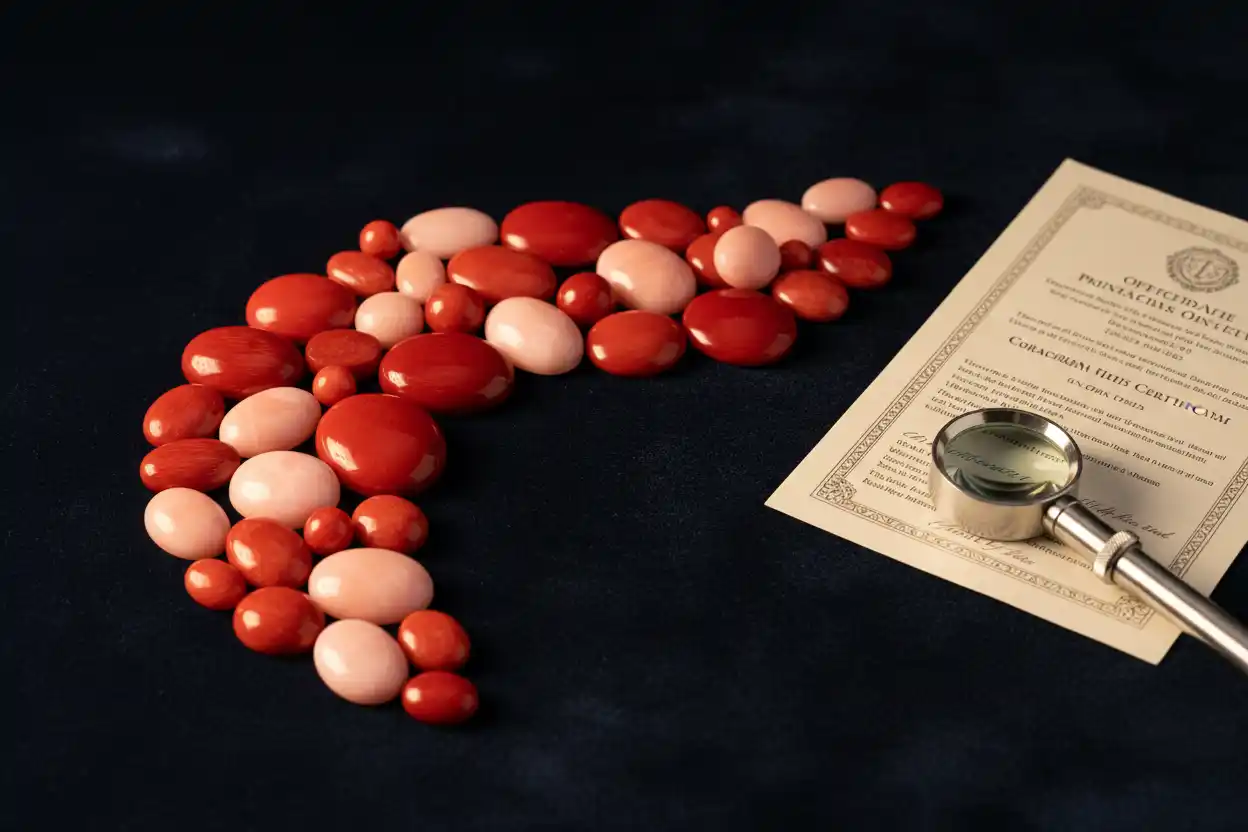
Coral Price: Value Factors, Quality, Size & Origin
Coral price varies enormously because “coral” can describe materially different products ranging from fine natural-color precious coral to dyed common coral, reconstructed products, composite pieces, and outright imitations. Before any price comparison is meaningful, the buyer must establish the material category and treatment status. CIBJO defines jewellery-grade precious coral narrowly within the Corallidae family and distinguishes it from common coral, reef coral, and artificial or composite products. GIA likewise documents extensive treatment and imitation in the coral market, including dyeing, bleaching, wax, polymer stabilization, reconstruction, glass, plastic, limestone, ceramics, bone, and marble.
Once identity is established, precious coral value depends on a group of interacting characteristics rather than one universal price per carat or per gram. CIBJO’s current Precious Coral Guide identifies color, color distribution, luster, surface quality, size, and symmetry as primary value criteria and explicitly states that precious coral does not have an internationally accepted overall grading system. Anyone moving from research to an actual purchase should first read the Gems Lore guide on how to buy coral, because material identity, treatment disclosure, provenance, condition, and trade documentation must be resolved before a quoted coral price can be evaluated fairly.
Coral Price At a Glance
| Value Factor | Stronger Value Signals | Factors That Can Lower Value |
|---|---|---|
| Material Category | Properly identified precious coral | Common coral, composite, reconstruction, or imitation represented ambiguously |
| Color | Desirable species-appropriate hue and saturation | Weak, undesirable, artificial-looking, or poorly matched color |
| Color Distribution | Even color appropriate to the coral variety | Distracting spots, zoning, veins, or inconsistent matching |
| Luster | Fine porcelain-like polished appearance | Dull, chalky, porous, or poorly finished surface |
| Surface Quality | Minimal unwanted pits, fractures, cavities, or blemishes | Heavy surface defects, damage, repairs, excessive porosity |
| Size | Larger fine beads, cabochons, branches, or carvings | Extra size combined with low quality or treatment |
| Symmetry | Well-shaped beads and cabochons | Misshapen or poorly executed workmanship |
| Matching | Consistent color, size, luster, and shape across a suite | Noticeably mismatched beads or replacements |
| Treatment | Untreated natural color where verified and commercially desired | Dye, coating, reconstruction, impregnation, or undisclosed enhancement |
| Condition | Strong polish, intact drill holes, no major chips | Scratching, fractures, dulling, worn holes, broken elements |
| Provenance | Credible species, locality, vintage, or collection documentation | Unsupported prestigious origin claims |
| Jewelry Context | Important maker, design, precious metal, historical significance | Generic setting or damaged mounting |
| Transaction Type | Properly comparable retail or auction evidence | Mixing appraisal, asking price, and resale offer as though identical |
Precious Coral Has Recognized Value Factors but No Universal Grade
CIBJO’s Precious Coral Guide provides unusually direct guidance on valuation. It lists color, color distribution, luster, surface quality, size, and symmetry as the principal factors used to understand precious-coral value and warns that no internationally accepted grading system exists for those factors individually or as a complete quality classification. That makes coral different from markets where standardized grades provide a more consistent shorthand.
The absence of a universal grade does not mean coral value is arbitrary. Experienced specialists can compare material systematically, but they must describe the actual characteristics rather than hiding them behind a generic AAA or AAAA label. A strong appraisal or sales description should identify the material, dimensions, color, treatment, surface quality, workmanship, condition, matching, and supporting provenance rather than merely assigning an unexplained commercial grade.
Material Identity Can Change Coral Price More Than Any Other Factor
A bright red bead could be precious coral, dyed bamboo coral, coated soft coral, reconstructed coral, glass, dyed bone, or another imitation. GIA has documented all of these kinds of marketplace substitutions and treatments. Because they occupy fundamentally different value categories, the first step in any coral valuation is determining what material is actually present.
This is why online “red coral price per carat” figures are often unreliable. Two listings can use the phrase red coral while referring to products with little commercial equivalence. A low price may indicate common treated material rather than a bargain on fine precious coral, while a high asking price may merely reflect aggressive marketing unless the seller supports identity and quality with credible evidence.
The same principle applies across Gems Lore’s broader buying and value coverage. The black opal price guide separates solid opal from doublets and triplets before discussing per-carat value, while ammolite price distinguishes treatment and construction before market comparison. Coral requires the same category-first discipline.
Color Is One of the Strongest Coral Price Drivers
Color preferences depend on the precious-coral species and variety. CIBJO notes that red is generally more valued than orange in Mediterranean Corallium rubrum, darker saturated red is strongly appreciated in oxblood Corallium japonicum, and a light flesh-pink hue is particularly desirable in angel’s-skin material associated with Pleurocorallium elatius. These examples show why one universal “best coral color” cannot be applied across every category.
The important comparison is within the relevant coral type. A high-quality angel’s-skin bead should not be judged as inferior because it is pale rather than deep red; its appeal comes from a different established color preference. Likewise, Mediterranean red coral should be evaluated within the normal range and commercial expectations for that material.
Color should be inspected under neutral light because photographs, warm illumination, and image editing can materially alter red, orange, and pink tones. When a large price premium depends on exact hue, buyers should request realistic imagery and, where possible, inspect the piece in person.
Color Distribution Can Affect Value Separately From Hue
CIBJO states that greater color uniformity generally supports higher value, while also recognizing that natural structural features differ among varieties. Mediterranean coral is commonly relatively uniform, whereas some other precious corals may show cores, veins, spots, or uneven pink distribution that can influence commercial desirability.
Matching becomes particularly important in necklaces and suites. One attractive bead does not establish the quality of an entire strand. A fine necklace may require considerable sorting to assemble beads with compatible hue, saturation, diameter, luster, and surface appearance, which can create value beyond the sum of random individual beads.
At the same time, collectors may value unusual natural structures or antique pieces even when color is not perfectly uniform. The appropriate price reflects the target market and the specific object rather than an inflexible rule that all variation is undesirable.
Natural Color Can Command a Different Market From Dyed Material
GIA research documents extensive dyeing of pale and white coral into commercially desirable pink-to-red colors and explains that bleaching may precede dyeing to create a more receptive, uniform base. GIA also identifies wax, plastic stabilization, reconstruction, and other enhancements in coral jewellery.
A natural-color premium can therefore be rational when natural color is rare and credibly established, but no universal multiplier should be applied. The effect depends on species, hue, size, surface quality, fashion, provenance, and the reliability of treatment determination. A beautifully dyed piece may still have decorative value, but its market category is different from verified fine natural-color precious coral.
The most serious pricing problem occurs when treated material is sold without disclosure at a price based on presumed untreated status. Written treatment information and appropriate laboratory examination become increasingly valuable as the asking price rises.
Luster Gives Fine Coral Much of Its Visual Richness
CIBJO includes luster as a value factor and describes precious coral as showing a porcelain-like polished appearance with varying degrees of glassiness. Strong luster can make an evenly colored coral bead look exceptionally refined, while a chalky or dull surface can reduce the visual impact of otherwise desirable color.
Surface finish should be distinguished from treatment. Wax, resin, or polymer may improve apparent smoothness or sheen, so high gloss alone does not prove superior untreated material. GIA explicitly identifies wax and plastic stabilization as coral enhancements that should be disclosed. A fair valuation therefore considers both the quality of the polish and the means by which the final appearance was achieved.
Surface Quality Can Create Major Price Differences
Natural coral skeleton can contain growth structures, pits, cavities, and internal variations. CIBJO nevertheless identifies surface quality as a major value criterion. Large, clean beads with attractive polish and few disruptive blemishes require suitable source material and more successful cutting, so they can command significant premiums over heavily pitted or fractured pieces of similar color.
Surface quality becomes particularly important in large cabochons, carvings, and spherical beads because their polished areas make imperfections easy to see. Small defects near a drill hole may have limited visual impact, while a deep cavity or fracture across the main face can materially reduce desirability.
Collectors of antique coral may accept more wear or natural irregularity because age, provenance, and workmanship create separate value. Condition should still be documented rather than concealed.
Size Can Increase Value Sharply When Quality Remains Strong
CIBJO includes size among the recognized precious-coral value factors. Larger high-quality beads and carvings require sufficiently substantial coral branches or sections, so the combination of size, strong natural color, high luster, good surface, and symmetry can become increasingly scarce.
This does not justify one universal price-per-millimeter curve. Large treated or heavily blemished coral may be less desirable than smaller untreated fine material, and a large carving’s value can depend heavily on workmanship and artistic importance. Bead diameter, cabochon dimensions, carving measurements, and total piece weight should therefore be recorded together rather than reduced to carat weight alone.
For matched strands, increasing bead diameter can create an additional scarcity challenge because the seller needs multiple pieces of comparable material rather than one isolated large bead.
Symmetry and Shape Add Value Through Workmanship and Yield
A well-formed sphere wastes more rough than an irregular bead, while a symmetrical cabochon or finely carved object may require extensive cutting and finishing. CIBJO includes symmetry among its coral value criteria for precisely this reason.
Perfect roundness is not always necessary for artistic or antique jewellery, but execution should look intentional. Poorly centered drill holes, visibly flattened spheres, asymmetrical paired earrings, rough polishing, or awkward cabochon outlines can reduce market appeal.
Carvings introduce another dimension because craftsmanship can contribute substantial independent value. A masterfully carved coral object can command far more than comparable raw coral weight, particularly when the maker, period, or provenance is significant.
Matching Can Make a Coral Strand More Valuable Than Random Individual Beads
Although matching is not separately listed in CIBJO’s short value-factor summary, it logically combines color distribution, size, symmetry, surface quality, and luster across multiple components. Producing a fine strand requires sorting enough coral to create visual continuity from bead to bead, which can consume substantial inventory.
A matched necklace should therefore be evaluated as a suite rather than merely by total grams. Check whether color shifts abruptly, whether bead diameters follow the stated graduation, whether some beads are duller or more porous, and whether replacements interrupt an otherwise consistent strand.
Antique necklaces may have been restrung or repaired over decades, so small differences do not automatically indicate fraud. They should simply be recognized when they affect market value.
Species and Trade Variety Can Influence Coral Price
Precious-coral species differ in normal color, growth form, typical branch size, geographic distribution, and commercial history. CIBJO’s standardized nomenclature identifies multiple species and accepted commercial names, including Mediterranean, aka or oxblood, angel’s skin, momo, pure white, Midway, and several others.
Because the preferred color and available sizes differ by type, the market cannot apply one price structure to every precious coral. Fine oxblood material is judged according to expectations for Corallium japonicum, while Mediterranean red coral and angel’s-skin material occupy their own established categories.
Species claims should remain evidence-based, particularly when a rare or prestigious designation drives the price. CIBJO notes that conclusive species identification can be complex and may require advanced scientific methods.
Origin Can Add Value, but Seller Origin Claims Are Not Scientific Proof
Geographic provenance can matter because particular coral species and traditional industries are associated with the Mediterranean, Japan, Taiwan, Pacific regions, and other marine areas. A well-documented antique Italian carving or Japanese precious-coral jewel can therefore carry cultural and collector value beyond the raw material.
Origin should still be separated from material quality. A famous source does not transform dyed, cracked, poorly polished, or mismatched coral into fine material. Nor does a seller’s statement automatically establish where a coral colony grew. When locality materially affects the price, documentation should support the claim.
The distinction mirrors other gemstone markets covered by Gems Lore, including benitoite price, where documented California provenance can matter but does not replace color, cut, condition, and identity.
Treatment Can Move a Piece Into a Different Price Category
Coral treatments include dyeing, bleaching, wax, polymer impregnation, coating, reconstruction, and other appearance modifications documented by GIA and CIBJO. Each can have a different commercial effect, so “treated coral” should not be treated as one uniform category.
A discreet stabilizing treatment disclosed on inexpensive jewellery may have limited practical significance to some buyers, while heavy dyeing and reconstruction can place a product in a substantially different market from untreated natural-color precious coral. Treatment can also change care requirements and long-term appearance.
Value should therefore be compared on equivalent treatment terms. A natural-color premium is meaningful only when natural color has been established with evidence strong enough to support the premium.
Condition Can Matter Almost as Much as Original Quality
Coral is relatively soft, around 3 to 4 on the Mohs scale, and can scratch, dull, chip, or fracture through wear. Bead strands can develop worn drill holes where string repeatedly rubs the material, while rings and bracelets may acquire more surface abrasion than protected necklaces or brooches.
A heavily worn antique object can remain valuable because of its maker or history, but condition still changes what buyers are willing to pay. Re-polishing may improve appearance while also removing material or altering original workmanship, so restoration should be disclosed when relevant.
For modern commercial jewellery, a clean high polish and intact surfaces normally support a stronger price than comparable scratched or damaged pieces.
Legal Documentation Can Affect Marketability and Resale
Different coral taxa fall under different international and domestic trade rules, and CITES maintains species-specific listings rather than treating every coral identically. GIA has demonstrated the practical importance of correct species identification in differentiating protected Stylaster corals from other pink-to-red jewellery coral.
An item that cannot be moved legally across a border without required permits may have a narrower resale market than a comparable properly documented piece. Buyers of high-value coral should therefore consider species information, provenance, export/import documentation, and local law as commercial factors as well as compliance questions.
Because rules can change, historical statements about CITES status should not be substituted for checking the current listing and destination-country requirements at the time of the transaction.
Retail Asking Price, Appraisal, Auction Result and Resale Offer Are Different
A retailer’s coral price includes sourcing, sorting, cutting, matching, jewellery manufacture, inventory costs, documentation, overhead, return privileges, and profit margin. An insurance appraisal may estimate replacement cost, while a dealer purchasing from a consumer needs room for authentication, repair, inventory risk, marketing, and resale margin.
Auction results represent what bidders paid for particular objects under specific sale conditions and may include additional value from maker, age, provenance, and artistic importance. A famous antique coral necklace cannot be used as a simple per-gram benchmark for newly produced loose beads.
The type of value must therefore be identified before figures are compared. Asking price is not the same as realized sale price, replacement value is not the same as dealer cash value, and none of them guarantees future appreciation.
Coral Does Not Have a Universal AAA or AAAA Price Tier
CIBJO explicitly states that precious coral lacks an internationally accepted grading system covering its value factors or an overall holistic quality grade. This makes generic internet categories such as A, AA, AAA, AAAA, premium, museum grade, and investment grade impossible to compare reliably between sellers unless each merchant publishes detailed criteria.
One seller’s AAA may represent natural-color material with excellent surface quality, while another may use the same label for treated beads selected mainly for color. Buyers should therefore ignore the letter at first and examine material identity, treatment, color, luster, surface, size, symmetry, matching, and condition directly.
A seller-defined grading system can still be useful within one inventory if it is transparent and applied consistently. It simply should not be mistaken for an independent laboratory standard.
Laboratory Identification Can Support Value Without Setting It
Advanced gemological testing can identify coral material, distinguish some coral groups, and determine whether color is natural or treated in situations where visual inspection is insufficient. GIA’s published coral research demonstrates the use of microscopy, spectroscopy, Raman analysis, and other techniques for these purposes.
A laboratory conclusion does not itself assign a market price. Two equally authentic natural-color corals can differ significantly in hue, size, luster, surface quality, symmetry, matching, condition, provenance, and workmanship.
The report is therefore evidence supporting the valuation rather than the valuation itself.
What Usually Raises Coral Price?
Coral tends to occupy a stronger market position when the material is properly identified precious coral, the color is desirable for its species, distribution is attractive and relatively uniform, luster is strong, the surface is clean, size is substantial, workmanship is symmetrical, treatment is absent or appropriately disclosed, and condition is excellent. CIBJO’s own value framework supports these factors directly.
Additional premiums can come from exceptional matching, documented provenance, important antique manufacture, a signed jewellery house, historically significant ownership, rare carving quality, or legally documented old material. Those premiums should be understood as separate value layers rather than attributed entirely to coral weight.
What Usually Lowers Coral Price?
Dyed or heavily treated material, reconstruction, composite construction, common coral represented ambiguously, obvious imitation, weak color, poor luster, surface porosity, fractures, scratching, mismatching, small dimensions, poor symmetry, questionable provenance, or missing documentation can all reduce value.
A lower price does not mean the item is undesirable. Dyed coral, reconstructed products, and imitations can offer attractive jewellery at accessible prices when represented honestly. The critical issue is whether the price matches the product category and whether the buyer knows exactly what is being purchased.
How to Compare Coral Prices Fairly
Before comparing two coral items, align the following characteristics:
Material category and species or trade description.
Natural versus treated color.
Exact treatment or reconstruction disclosure.
Hue, saturation, and color uniformity.
Luster and surface quality.
Bead diameter, cabochon dimensions, or carving size.
Symmetry and craftsmanship.
Matching across strands or suites.
Condition and restoration.
Provenance and age.
Legal trade documentation where relevant.
Precious-metal, designer, antique, or maker value in finished jewellery.
Transaction type: retail, auction, appraisal, or dealer resale.
Only after these variables are reasonably similar does a numerical coral price comparison become meaningful.
Conclusion
Coral price is determined by a combination of material identity, color, color distribution, luster, surface quality, size, symmetry, treatment, condition, provenance, workmanship, and market context. CIBJO formally recognizes the core physical value factors and, equally importantly, states that precious coral has no internationally accepted holistic grading system. That makes descriptive evidence more useful than generic AAA labels or universal per-carat tables.
The safest valuation begins by establishing whether the item is actually precious coral, common coral, treated material, reconstructed coral, composite material, or an imitation. From there, compare pieces within the same category and keep laboratory identification, appraisal value, retail price, and resale value separate. Buyers who follow that sequence can understand coral price far more accurately than those who begin with color or weight alone.
Frequently Asked Questions
How much is coral worth per carat?
There is no universal coral price per carat because different materials sold as coral can belong to entirely different commercial categories. Even within precious coral, CIBJO identifies color, color distribution, luster, surface quality, size, and symmetry as important value factors and states that no international overall grading system exists.
What color coral is most valuable?
The answer depends on the species and commercial variety. CIBJO notes strong demand for red in Mediterranean coral, darker saturated red in oxblood coral, and light flesh-pink in angel’s-skin material. One universal color ranking would therefore be misleading.
Is red coral always expensive?
No. Red material may be dyed common coral, reconstructed coral, imitation material, or fine natural-color precious coral. GIA documents extensive dyeing and imitation in the market. Identity and treatment must be determined before color can be translated into value.
Does natural-color coral cost more than dyed coral?
Verified natural color can command a premium when the species, color, size, and quality justify it, but there is no universal multiplier. Fine dyed jewellery can still have decorative value, while poor-quality natural-color coral may remain less desirable than a beautifully made treated piece.
Does larger coral always have a higher price?
Larger fine material can be more valuable because size is one of CIBJO’s recognized value factors, but size interacts with color, luster, surface quality, treatment, and symmetry. A large damaged or heavily treated bead is not automatically worth more than a smaller exceptional one.
What does AAA coral mean?
AAA is usually a seller-defined commercial grade. CIBJO states that precious coral has no internationally accepted grading system covering its value factors or overall quality. Buyers should ask what the seller’s grade specifically means.
Does origin affect coral price?
Documented origin or provenance can influence collector demand, particularly for historically important species, local industries, or antique jewellery. Origin should still be separated from quality and from an unsupported seller claim. Fine color, treatment status, condition, luster, and workmanship remain essential.
Does a coral laboratory report state its value?
A gemological report may help identify the material or treatment, but it is not automatically a monetary appraisal. Advanced testing can support a value conclusion by reducing uncertainty, while the actual price still depends on quality, size, condition, provenance, workmanship, and market demand.
Is vintage coral more valuable than new coral?
Sometimes, but not automatically. Antique coral can carry premiums for age, provenance, important maker, workmanship, design period, or scarcity, while wear, replacement components, damage, or weak documentation can reduce value. Age and material quality should be evaluated separately.
Is coral a guaranteed investment?
No. Fine precious coral can be rare and collectible, but future appreciation depends on demand, legal marketability, condition, provenance, fashion, transaction costs, and buyer liquidity. No retailer grade or rarity claim can guarantee a future return.