Crazy Lace Agate Benefits: 10 Popular Uses, Deep Symbolism, Evidence, Safe Use & Clear Limits
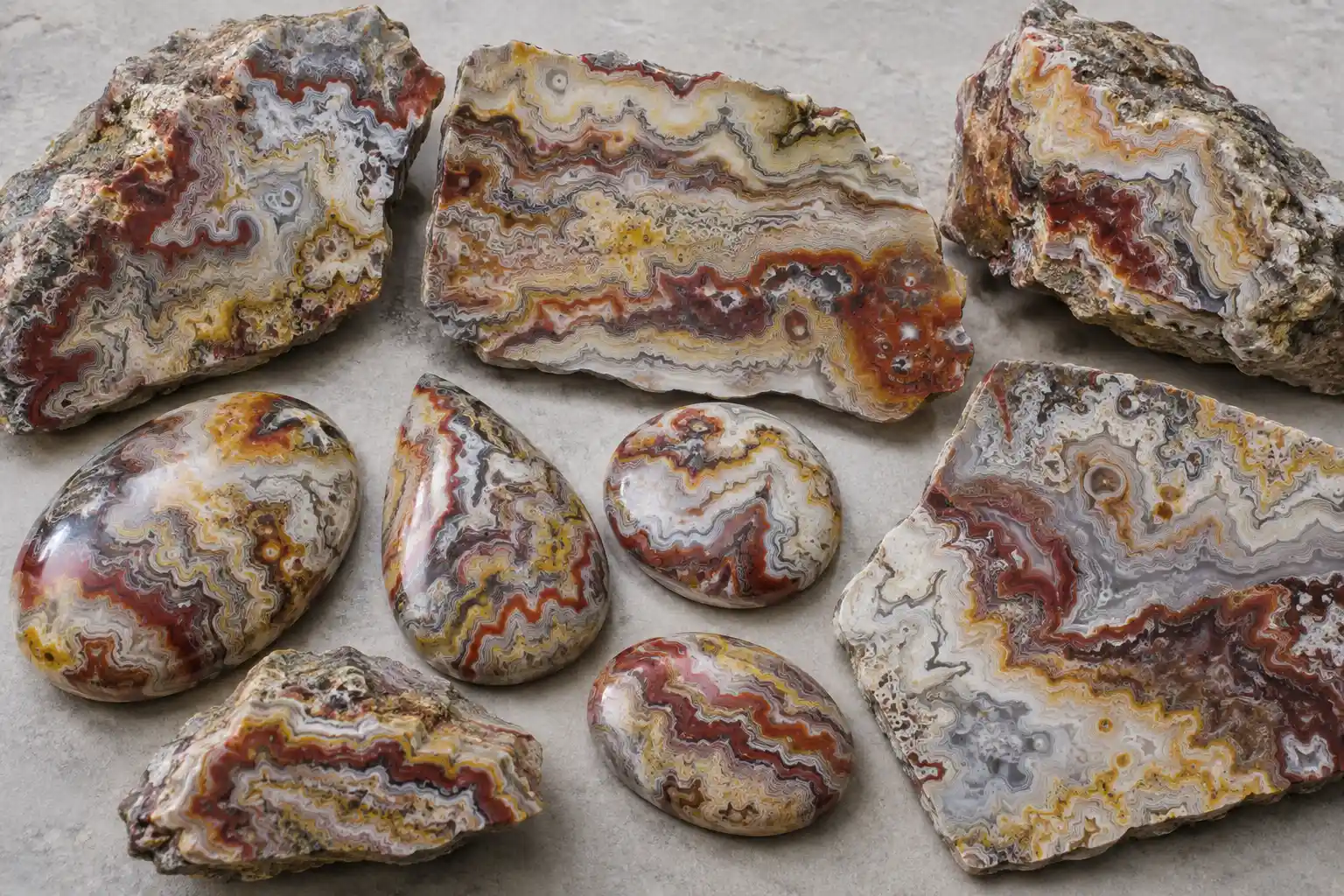
Crazy Lace Agate benefits begin with qualities that can be seen and measured: intricate natural banding, quartz-family durability, excellent polish, highly individual patterns, strong lapidary potential, and geological interest. Crazy Lace Agate is a patterned variety of agate, a form of chalcedony composed predominantly of microcrystalline silica. It is especially associated with Mexico and is widely recognized for complicated swirls, loops, angular bands, eyes, curves, and interlocking areas of cream, gray, red, brown, yellow, and occasionally other subdued tones.
Unlike a transparent gemstone whose appeal depends mainly on clarity and faceting, Crazy Lace Agate benefits from complexity. A polished slab can contain dozens of intersecting bands and color transitions within a relatively small area. Those patterns formed through repeated stages of silica deposition and changing mineral impurities rather than being printed or painted onto the surface. Iron-bearing compounds contribute many of the warmer red, brown, and yellow tones commonly seen in the stone.
Modern crystal traditions often add Crazy Lace Agate benefits involving optimism, emotional balance, laughter, confidence, grounding, or social connection. Such themes may serve as personal symbolism, but they are not established medical effects. Crazy Lace Agate does not treat depression, anxiety disorders, circulation problems, neurological conditions, pain, or other illnesses through ordinary wearing or handling.
10 Crazy Lace Agate Benefits at a Glance
- Intricate natural banding gives every polished piece a distinctive visual pattern.
- Quartz-family hardness makes Crazy Lace Agate practical for many jewelry and decorative uses.
- Good toughness supports cabochons, beads, carvings, slabs, and frequently handled objects.
- Fine chalcedony texture allows the stone to take a smooth, attractive polish.
- Layered patterns provide an accessible way to study repeated silica deposition and agate formation.
- Collectors can compare banding, color, inclusions, locality, rough surfaces, and polished cross-sections.
- Lapidaries can orient rough creatively because different cuts reveal dramatically different patterns.
- Identification practice helps buyers distinguish natural agate from dyed, composite, glass, and misleadingly labeled products.
- Jewelry designers gain a neutral-to-warm patterned stone that works with many metals and styles.
- Modern symbolism can represent adaptability, optimism, or perspective when clearly separated from health claims.
Natural Lace-Like Banding Is the Most Distinctive Crazy Lace Agate Benefit
Pattern is the feature that defines most Crazy Lace Agate benefits. While many agates show relatively parallel or concentric bands, Crazy Lace Agate can contain far more complicated arrangements in which lines curve, fold, branch, circle, and intersect across the polished surface. Some pieces show tight lace-like networks, while others include broader bands, eye-shaped structures, fortification-like geometry, or isolated areas of contrasting color.
These patterns develop through repeated silica deposition in openings within rock. Conditions change over time, and later silica-rich fluids may differ from earlier ones in trace components, suspended particles, oxidation conditions, or other factors. The result is a record of multiple growth stages rather than a single uniform mass.
For a collector or jewelry owner, the practical consequence is individuality. Two cabochons cut from the same rough may display completely different compositions because one slice passes through tightly curved bands while another crosses broader layers. This natural variability means symmetrical perfection is not required for beauty. In many cases, asymmetry is precisely what makes the stone visually engaging.
The general agate benefits associated with toughness, polish, geological patterning, and jewelry use are especially evident in Crazy Lace Agate, but this variety places unusual emphasis on visual complexity.
Quartz-Family Hardness Makes Crazy Lace Agate Practical for Jewelry
Durability is one of the strongest Crazy Lace Agate benefits. As chalcedony, the stone generally falls around 6.5 to 7 on the Mohs hardness scale and has good toughness because of its extremely fine intergrown silica structure. It does not have the prominent cleavage planes that make minerals such as calcite or fluorite especially vulnerable to splitting along predictable directions.
This combination allows Crazy Lace Agate to perform well in pendants, earrings, beads, brooches, bracelets, cabochons, and many ring designs when ordinary gemstone care is used. Rings experience the greatest mechanical stress, so protective bezels or lower-profile settings can help preserve exposed edges, while pendants and earrings usually face fewer hard impacts.
The stone’s intricate pattern can also disguise minor visual wear better than a perfectly transparent gem, although that does not make scratches irrelevant. Diamond, sapphire, topaz, and other harder gemstones can still scratch agate during storage, and a severe impact can chip a thin edge or break a fractured stone.
These physical Crazy Lace Agate benefits explain why the variety is suited to objects meant to be worn and handled rather than confined exclusively to display cabinets.
Fine Chalcedony Texture Produces an Excellent Polished Surface
A smooth polish is another important source of Crazy Lace Agate benefits. The microcrystalline silica structure is sufficiently fine that properly cut pieces can develop a glossy surface without visible mineral grains interrupting the pattern. Polishing also deepens visual contrast, making cream, gray, red, yellow, and brown areas appear more distinct than they may look on weathered rough.
This transformation can be dramatic. An uncut nodule or rough fragment may appear dull, fractured, or coated with an unremarkable exterior, while a freshly cut face exposes tightly packed bands underneath. Progressive grinding and polishing then reveal the final depth and color relationships.
Cabochons work especially well because broad curved surfaces preserve large sections of the pattern. Slabs provide an even wider geological cross-section, while beads transform the banding into rotating miniature compositions. Freeforms can preserve interesting pattern areas that would be lost if the cutter forced every piece into a standard oval.
These Crazy Lace Agate benefits make the variety particularly rewarding for lapidaries because craftsmanship does not create the pattern but determines how successfully the hidden pattern becomes visible.
Crazy Lace Agate Provides an Accessible Lesson in Agate Formation
Geological education is one of the less obvious Crazy Lace Agate benefits. Agates generally form when silica-rich fluids deposit chalcedony and related silica phases within cavities, fractures, or other available spaces. Repeated deposition can produce bands whose composition, translucency, inclusions, and color change from one growth stage to another.
Crazy Lace Agate makes those stages unusually visible. A single polished surface may reveal sharp boundaries between several bands, curved structures that follow earlier growth surfaces, and color variations related to iron-bearing compounds or other inclusions. The stone therefore provides a tangible example of how a gemstone can preserve changing conditions rather than forming as one perfectly uniform event.
The patterns should not be interpreted too literally. A particular curve does not automatically reveal one specific chemical event, and visual inspection alone cannot reconstruct the entire geological history of a specimen. Even so, the visible layering provides an excellent introduction to mineral precipitation, cavity filling, microcrystalline quartz, color-producing inclusions, and repeated growth.
For students and collectors, these Crazy Lace Agate benefits add scientific depth to an ornamental stone that might otherwise be appreciated only for appearance.
Lapidary Orientation Can Produce Completely Different Finished Designs
The way rough is sliced has an enormous influence on the appearance of Crazy Lace Agate. A cut made in one direction may reveal loops and eye-like structures, while a perpendicular cut can expose stripes, irregular waves, or broad blocks of color. This makes orientation one of the most creative aspects of working with the stone.
A skilled cutter studies natural fractures, color concentrations, band direction, thickness, and potential focal areas before deciding where to saw. Maximizing weight is not always the best objective. Removing additional rough may expose a stronger central pattern or create better balance within the finished cabochon.
These lapidary-focused Crazy Lace Agate benefits also make freeform cutting particularly appropriate. A rigid calibrated outline can sometimes remove the most interesting part of the pattern, whereas an irregular shape may follow the visual movement naturally. Larger slabs and display pieces can preserve even more geological information because multiple pattern systems remain visible together.
The process illustrates a recurring principle in ornamental gemstone cutting: geology provides the visual possibilities, but orientation determines which possibilities survive into the finished object.
Collecting Rewards Pattern Diversity Rather Than One Ideal Appearance
Crazy Lace Agate benefits collectors because there is no single pattern that every desirable specimen must reproduce. Some pieces contain tight, complex lace structures, while others emphasize fortification bands, eyes, broad swirls, yellow-brown areas, red accents, pale gray layers, or contrasting white zones. Rough pieces, polished slabs, cabochons, spheres, and carvings can each reveal different aspects of the same variety.
Collectors may also care about locality. Crazy Lace Agate is strongly associated with Mexico, particularly deposits in the north of the country, and reliable provenance adds geological context beyond the commercial name. A specimen with trustworthy locality information can therefore be more informative than an attractive but anonymous polished stone.
Natural surface condition is another useful consideration. Rough specimens may preserve host-rock relationships, weathering, fracture surfaces, or cavity forms that disappear during cutting. A collection combining rough and polished examples can show how much lapidary work changes the appearance without changing the underlying gemstone.
These Crazy Lace Agate benefits encourage appreciation of variation rather than imposing a narrow standard in which only one color combination or pattern qualifies as worthwhile.
Identification Skills Protect Buyers from Misleading Patterned Stones
Colorful banding can be imitated, enhanced, or mislabeled, so identification is another practical source of Crazy Lace Agate benefits. Natural agate may be confused with dyed chalcedony, glass, resin composites, reconstructed products, or other patterned jasper and agate varieties, particularly in heavily edited online photographs.
Natural structure provides useful clues, but no single feature proves authenticity in every case. Dye may concentrate along cracks or porous zones, while glass can contain bubbles or flow structures. Chalcedony has hardness, luster, microscopic texture, and optical properties distinct from glass and plastic, although professional testing may be needed when the purchase value justifies certainty.
Trade naming adds another complication because patterned chalcedony is sold under many descriptive names. Buyers should focus on actual mineral identity, treatment disclosure, pattern, workmanship, dimensions, and provenance rather than assuming a colorful marketing term represents a separate mineral species.
A person deciding where to buy Crazy Lace Agate benefits from realistic photographs showing the actual stone under normal lighting. Highly saturated images can make natural reds and yellows look more intense than they appear in hand.
Jewelry Designers Gain a Patterned Stone with Warm, Versatile Colors
Crazy Lace Agate benefits jewelry designers because its natural palette works with many metals and styles. Red, brown, cream, gray, yellow, and white can appear together within one cabochon, creating enough visual complexity that an elaborate setting is not always necessary.
Yellow gold or brass can reinforce warm yellow and brown tones, while silver-colored metals provide stronger contrast against red and cream bands. Copper can create an earthy appearance, particularly when the stone contains strong rust-red coloration. Blackened silver may emphasize lighter lace structures by providing a dark frame.
Large cabochons work particularly well because intricate bands need enough surface area to remain readable. Smaller stones can still be effective when the cutter isolates one strong eye, swirl, or contrasting segment. Earrings rarely match perfectly, but complementary patterns can look more natural than forcing two pieces to appear identical.
These Crazy Lace Agate benefits support one-of-a-kind jewelry because natural pattern variation becomes an intentional design feature rather than a defect.
Modern Symbolism Can Represent Adaptability and Perspective
Contemporary crystal traditions commonly describe Crazy Lace Agate benefits in terms of optimism, joy, emotional balance, confidence, grounding, laughter, and social connection. Some sellers call it a happiness or laughter stone, but these modern labels should not be mistaken for scientifically demonstrated emotional effects or universal ancient traditions.
A more grounded interpretation uses the complex pattern as symbolism. The stone’s bands change direction repeatedly while remaining part of one continuous piece, which can represent adapting to changing circumstances without losing one’s overall direction. Multiple colors and structures may also symbolize perspective, especially when a situation contains several competing considerations rather than one simple answer.
Someone may keep a polished Crazy Lace Agate near a workspace because its lively pattern reminds them not to treat every setback as permanent. Another person may associate it with humor or social connection because they received it during a memorable trip or from a friend.
Beliefs surrounding Crazy Lace Agate healing properties may go further into anxiety, digestion, circulation, pain, energy, or emotional healing. Those interpretations belong to spiritual practice rather than established medicine.
Safe Care Helps Preserve Polish, Pattern, and Long-Term Wearability
Stable Crazy Lace Agate is relatively easy to maintain. Lukewarm water, mild soap, and a soft cloth or brush are suitable for many untreated pieces, while separate storage protects polished surfaces from harder gemstones. Extreme heat, severe thermal shock, strong chemicals, and unnecessary aggressive cleaning should be avoided, particularly when treatment history is uncertain.
The greatest workshop safety issue arises during cutting and grinding. Crazy Lace Agate is silica-rich, so dry sawing, drilling, or polishing can generate respirable crystalline silica dust. Lapidaries should use wet methods, effective dust control, ventilation, eye protection, and appropriate respiratory precautions rather than relying on the stone’s ordinary jewelry safety as evidence that airborne dust is harmless.
Finished jewelry and intact polished stones do not present the same inhalation exposure as dry machining. The important distinction is between ordinary ownership and generating fine mineral dust.
These responsible-use practices preserve the genuine Crazy Lace Agate benefits of durability, pattern, jewelry versatility, collecting value, and long-term enjoyment.
Conclusion
Crazy Lace Agate benefits include intricate natural patterning, quartz-family durability, smooth polish, geological education, lapidary versatility, collecting diversity, identification practice, jewelry usefulness, and meaningful modern symbolism. Its complicated bands turn geological variation into the central attraction, allowing one agate variety to produce an extraordinary range of finished designs.
The strongest Crazy Lace Agate benefits remain tied to what the stone demonstrably offers: patterned chalcedony structure, toughness, craftsmanship, visual individuality, and geological information. Modern themes involving optimism, adaptability, laughter, or perspective can add personal meaning when they remain symbolic rather than being presented as medical effects.
FAQs
What are the main Crazy Lace Agate benefits?
The most verifiable Crazy Lace Agate benefits include jewelry durability, distinctive natural banding, lapidary use, collecting, geological education, gemstone identification, decorative carving, and personal symbolism. Its quartz-family structure also gives it useful resistance to everyday scratching.
What is Crazy Lace Agate made of?
Crazy Lace Agate is a patterned form of agate composed primarily of microcrystalline silica within the chalcedony family. Its contrasting colors can reflect iron-bearing compounds and other natural inclusions.
How hard is Crazy Lace Agate?
Like many agates, Crazy Lace Agate generally falls around 6.5 to 7 on the Mohs hardness scale and has good toughness, making it suitable for many jewelry and decorative uses.
Where does Crazy Lace Agate come from?
The variety is strongly associated with Mexico, particularly northern Mexican deposits. Precise locality claims are most useful when supported by reliable provenance rather than appearance alone.
Why does Crazy Lace Agate have complicated patterns?
Repeated stages of silica deposition and changing growth conditions can produce curved, angular, eye-like, and lace-like bands. Cutting direction then determines which parts of those internal patterns become visible.
Is Crazy Lace Agate good for everyday jewelry?
Many well-set pieces are suitable for regular wear. Rings still benefit from protection against severe impacts, while pendants and earrings generally experience less mechanical stress.
Can Crazy Lace Agate be dyed?
Agate can be dyed commercially, so treatment disclosure matters when natural color is important. Natural Crazy Lace Agate also displays strong red, brown, cream, gray, and yellow patterns without artificial coloration.
What does Crazy Lace Agate symbolize?
Modern symbolism commonly connects it with optimism, adaptability, humor, perspective, steadiness, and social connection. These are personal or spiritual interpretations rather than proven physiological effects.
Does Crazy Lace Agate help with anxiety or mood?
There is no established clinical evidence that Crazy Lace Agate treats anxiety disorders, depression, neurological conditions, or other mental-health concerns.
Is Crazy Lace Agate safe to cut?
Lapidary work requires proper silica-dust precautions. Wet cutting, effective ventilation, dust control, eye protection, and appropriate respiratory protection are important because dry grinding can release respirable crystalline silica.
Crazy Lace Agate benefits described as healing, emotional, mood-related, chakra, grounding, or energetic effects remain spiritual and personal beliefs and should not replace qualified medical or mental-health care.