Where to Buy Real Crazy Lace Agate and Avoid Dyed Fakes
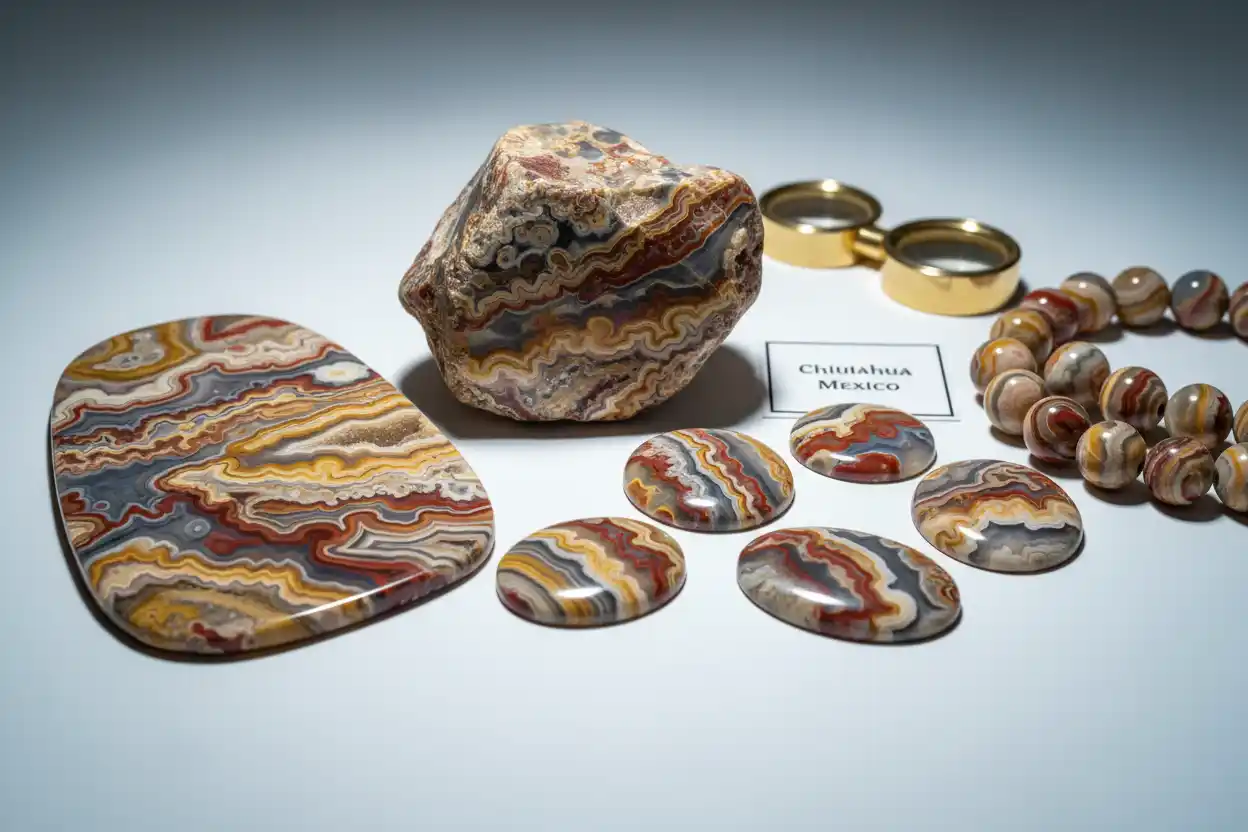
Real Crazy Lace Agate is known for densely interwoven bands, eyes, loops, scallops, zigzags and swirling patterns. Traditional material combines white, cream, gray, yellow, orange, red and brown in arrangements that can look almost drawn across the stone.
The strongest commercial association is with northern Mexico, especially Chihuahua. However, the name is sometimes applied more loosely to any highly patterned agate, including dyed material from unrelated sources.
Most deceptive products are not sophisticated synthetic agate. Buyers are more likely to encounter artificially dyed chalcedony, printed resin, colored glass, assembled slabs, ordinary agate sold with an unsupported Mexican locality or weak material photographed while wet to exaggerate its pattern.
The Crazy Lace Agate meaning and properties guide covers its identity and traditional symbolism. This guide remains focused on seller selection, pattern quality, color treatment, locality evidence, lapidary construction and realistic value.
Understand What Crazy Lace Agate Is
Crazy Lace Agate belongs to the broad agate family, which consists mainly of banded or structurally patterned chalcedony. Its fine-grained silica body is closely related to the wider material described in the chalcedony guide.
Unlike agates defined by simple parallel or fortification bands, Crazy Lace Agate commonly displays several patterns in one piece. Curving bands may surround eyes, branch into bouquets or cross one another in irregular loops.
Classic material is commonly associated with Sierra Santa Lucia and nearby mining areas in Chihuahua. Rather than forming as ordinary volcanic nodules like many famous Mexican agates, documented Crazy Lace material occurs within highly silicified limestone.
Gray and white dominate much of the rough. Iron- and manganese-related staining can produce natural yellow, orange, red and brown areas. Consequently, natural staining within the deposit should not be confused automatically with artificial dye added after mining.
The types of agate guide explains how lace, fortification, moss, plume and other patterns differ.
Decide Which Product Form You Need
Different forms require different buying checks.
| Product form | Best source | Main buying concern |
|---|---|---|
| Natural rough | Mexican mineral dealer or lapidary supplier | Source claim, dry appearance, fractures and usable pattern |
| Slab | Lapidary supplier | Band continuity, dye, resin and cutting yield |
| Cabochon | Gem dealer or independent cutter | Pattern placement, polish, backing and filling |
| Tumbled stone | Reputable crystal retailer | Generic agate or dyed material substitution |
| Bead strand | Established bead supplier | Artificial color, mixed varieties and drill-hole damage |
| Sphere | Experienced lapidary retailer | Plain reverse areas, filler and weak pattern coverage |
| Tower or carving | Skilled stone seller | Repaired tips, resin, coating and pattern orientation |
| Jewelry | Jeweler with treatment disclosure | Backing, glue and whether the exact pictured stone will ship |
| Collector specimen | Mineral dealer with locality records | Unsupported Chihuahua or old-stock provenance |
The completed general agate buying guide provides family-wide seller checks. This page owns the narrower issues of Mexican provenance, complex lace pattern and color enhancement.
Where to Buy Genuine Crazy Lace Agate
Specialist lapidary suppliers
Lapidary suppliers are usually the strongest source for rough and slabs. An experienced seller should show a natural exterior, at least one sawn face, both slab surfaces and exposed edges.
Request dry photographs. Water and oil increase contrast, deepen warm colors and conceal fine scratches. A wet image can preview the final polish, but it should appear beside a matching dry view.
Ask whether cabochons have been cut from the same parcel. Their finished patterns reveal more about the rough than one polished window in a large block.
Mineral dealers familiar with Mexican material
A mineral dealer is useful when provenance carries value. Request the country, state, municipality or mining area and the basis for that information.
An original label, importer invoice or direct supplier relationship is stronger than a visual guess. Crazy Lace patterns can be distinctive, but appearance alone cannot establish a precise concession or mine.
Be cautious with “old-stock” claims. Older material may be desirable, yet the seller should provide dates, collection labels or purchase history rather than relying on scarcity language.
Gem and mineral shows
Shows allow direct comparison with Botswana Agate, Blue Lace Agate, dyed agate and other Mexican varieties.
Rotate the piece beneath neutral light and inspect it over white paper. Natural bands should continue beneath the surface and across exposed edges.
A loupe can reveal color concentrated in fractures, resin-filled cavities, surface coatings and drilling damage. Do not use solvents or scratch tests on merchandise.
Established online sellers
The online gemstone buying guide explains protected payment methods, seller identity and return rights.
For Crazy Lace Agate, exact-item photographs are essential for cabochons, spheres and carvings. One exceptional stock image cannot represent the pattern of every item in a batch.
Request a complete rotation under ordinary room light. Digital saturation can transform muted rust, cream and gray into intense red, gold and purple.
Independent jewelry makers
A maker who cut the stone may know whether the material was dyed, stabilized or backed. Ask to see the loose cabochon before it enters a closed setting.
For matched earrings, expect related color and band density rather than identical patterns. Natural lace designs rarely mirror one another perfectly.
What Genuine Crazy Lace Agate Looks Like
Traditional material usually combines a pale base with intricate warm-colored bands. Common colors include white, gray, cream, yellow, ochre, orange, rust red and brown.
Patterns may include loops, eyes, zigzags, arcs, scallops, fan-like forms and irregular folded-looking bands. Several structures often appear within one small cabochon.
Natural bands normally vary in thickness and direction. Some terminate against other bands, while others curve around an eye or cavity.
The pattern should continue into the stone. A printed or painted design may stop at the edge, bridge over scratches or repeat across several objects.
Small pits and crystalline cavities can occur. Their presence does not prove authenticity, but they should be described because they affect polish and durability.
Some natural pieces contain muted lavender, greenish, black or pinkish areas. Nevertheless, electric blue, neon purple and vivid green require strong treatment evidence.
Natural Geological Staining Versus Artificial Dye
Crazy Lace Agate’s natural colors can be influenced by mineral staining within the deposit. Iron oxides and related compounds may create yellow, orange, red and brown zones along bands and fractures.
Artificial dye is introduced after mining. It may penetrate porous layers, open cracks, pits and drill holes.
The distinction matters because both processes can produce color concentrated along structural features. Therefore, one dark fracture does not prove treatment.
Artificial color becomes more likely when the saturation is extremely uniform, appears strongest around every drill hole or introduces hues uncommon for the classic material.
The treated-agate guide owns the complete discussion of dyeing, heating, bleaching and enhancement. The real-versus-fake agate guide addresses agate identity and manufactured substitutes.
Crazy Lace Agate Versus Blue Lace Agate
Blue Lace Agate typically shows pale blue and white bands with a softer, calmer pattern. It is strongly associated with southern Namibia rather than Chihuahua.
Crazy Lace Agate usually has warmer cream, gray, yellow, orange, red and brown tones and more energetic interlocking bands.
The completed guide to buying genuine Blue Lace Agate covers blue dye, Ysterputs provenance and lace-band quality.
A seller should not call a blue-dyed Crazy Lace slab Blue Lace Agate merely because the treatment changed its color.
Crazy Lace Agate Versus Botswana Agate
Botswana Agate commonly displays fine, relatively orderly gray, white, brown, pink and peach bands.
Crazy Lace Agate tends to show more chaotic loops, eyes, scallops and intersecting structures. However, individual pieces can overlap visually.
The completed guide to buying Botswana Agate addresses geographic provenance and muted natural color in that separate market.
Crazy Lace Agate Versus Fire Agate
Fire Agate is prized for iridescent internal layers that produce flashes of green, orange, red, gold or blue under reflected light.
Crazy Lace Agate relies primarily on visible banded pattern rather than iridescence. A polished lace agate can be glossy and colorful without displaying true fire.
A seller should not use “fire” merely to describe bright red or orange Crazy Lace bands.
Crazy Lace Agate Versus Moss Agate
Moss Agate contains branching, filamentous or moss-like inclusions in chalcedony. It generally lacks the dense rhythmic banding associated with Crazy Lace material.
Some Crazy Lace pieces include dendritic or moss-like sections, but the dominant identity should follow the stone’s overall structure.
Dyed Agate
Dyed agate is the most common treatment concern. Chalcedony can accept color along porous bands and fractures, producing dramatic blue, purple, green, pink or red designs.
Inspect the back, edges and drill holes. Artificial color may appear much darker in those locations than across compact bands.
Strong color can still be natural, especially in red, yellow, orange and brown material. Therefore, combine color distribution with seller disclosure and provenance rather than relying on saturation alone.
The gemstone treatments guide explains why a stone may be natural agate yet still have treated color.
Glass, Resin and Composite Imitations
Colored glass can imitate translucent banded agate. Round bubbles, flow lines, mold seams and an overly uniform glassy body support manufacture.
Resin can be swirled into convincing lace patterns. Bubbles, soft scratches, repeated designs and casting seams may reveal it.
Some products use printed patterns beneath a clear resin dome. Inspect the side to see whether the bands continue through the object.
Reconstituted products can combine crushed agate with polymer. They contain natural silica but are not one solid natural stone.
The fake-crystal buyer’s guide provides broader checks for glass, resin, coating and assembly.
Resin Filling and Stabilization
Open cavities and fractures can be filled with transparent or color-matched resin. Filling may make a cabochon wearable or allow a sphere to maintain its shape.
Treatment becomes deceptive when the seller describes a heavily filled piece as completely solid and untreated.
Tilt the stone under strong light. Resin may show a different surface reflection, trapped bubbles or a glossy pool within a cavity.
Large carvings and spheres require more scrutiny than small cabochons because producing one intact object may involve extensive weak material.
How to Evaluate Rough
A strong rough purchase should show enough interior to estimate pattern depth. A natural rind can conceal the best bands, but one small polished window can also exaggerate the quality of the entire block.
Ask for the weight and dimensions. A broad thin slab may provide less usable material than its face area suggests.
Look for open fractures that divide the most attractive pattern. Also inspect for chalky limestone remnants and pits that could reduce polishing yield.
If the price depends on Mexican origin, ask for supply-chain documentation rather than relying solely on the band style.
How to Evaluate Slabs
Compare both faces and every exposed edge. Bands should continue through the material in a plausible three-dimensional arrangement.
A quality slab contains enough coherent pattern for several intentional cuts. One intricate corner in a mostly plain slab offers limited yield.
Backlighting can reveal translucent bands and fractures, although reflected light is better for assessing natural color.
Ask whether the slab has been resin-stabilized or photographed with oil.
How to Judge Cabochons
A skilled cutter uses the band flow deliberately. Eyes may be centered, loops can follow an oval outline, and zigzags may cross a freeform shape dynamically.
The dome should have a smooth reflection without flat areas or deep scratches. A clean girdle reduces setting problems.
Inspect the back for dye, backing, resin and open fractures. Natural pattern should generally continue through the stone rather than ending at the face.
Buying Beads
A natural strand should show related colors without repeating identical patterns. Each bead comes from a different section of rough.
Inspect drill holes for concentrated dye and radial cracks. Rough edges can cut cord or elastic.
Ask whether the strand consists entirely of Crazy Lace Agate or includes other agates selected for color. Mixed strands should be labeled accurately.
Buying Spheres, Towers and Carvings
Request a full rotation. A dramatic lace pattern may cover only the display face, while the reverse remains gray or plain.
A tower should have a stable base and a point free from major fractures. Remember that the point is carved, not naturally grown.
Carvings should use the bands intentionally. Deep recesses can conceal filler, pigment or polishing residue.
Buying Crazy Lace Agate Jewelry
Chalcedony provides useful scratch resistance and generally good toughness. The gemstone hardness chart places agate near Mohs 6.5 to 7.
Even so, the gemstone toughness-versus-hardness guide explains why open fractures, cavities and thin girdles can still fail.
A bezel protects cabochon edges better than tall prongs. For closed settings, ask whether the stone is backed or glued.
Locality and Provenance
Northern Chihuahua is the classic source region, with Sierra Santa Lucia strongly associated with commercial Crazy Lace Agate.
A precise concession or mine claim needs supplier records, labels or direct purchasing history. Similar patterns can appear in agate from elsewhere.
Land access also matters. Many Mexican agate occurrences are on private concessions or ranch property, so current collecting requires permission.
The ethical gemstone sourcing guide offers practical questions about legal extraction, cutting labor and traceability.
Price and Value
Crazy Lace Agate is generally affordable, but exceptional pattern, strong natural color, large usable size and skilled cutting can increase value.
Important factors include band complexity, contrast, pattern placement, structural condition, polish, treatment and credible origin.
A smaller cabochon with a complete eye-and-lace composition may be more desirable than a large stone whose best bands disappear around the edge.
Dyed material should not receive an untreated Mexican premium. Likewise, an unsupported “rare old-stock” label adds little without documentation.
The gemstone pricing guide explains how cutting yield, workmanship, documentation and retail overhead influence price.
Questions to Ask the Seller
Ask whether the material is natural Crazy Lace Agate from Mexico or simply a visually similar patterned agate.
Request the country and more precise locality when available. Then ask whether the stone has been dyed, heated, bleached, filled, coated, waxed, oiled or backed.
For rough and slabs, request dry photographs of both faces and the edges. For cabochons, ask for front, back and girdle views.
For spheres and carvings, obtain a complete rotation video. Finally, confirm that the return period allows ordinary visual and magnified inspection.
Professional Identification
A gemologist can confirm chalcedony through refractive properties, specific gravity, microscopy and Raman spectroscopy.
Microscopy may reveal dye concentration, resin, glass bubbles and composite boundaries. Spectroscopy can support treatment investigation, although some color-origin questions remain difficult.
Laboratory confirmation of agate does not automatically prove Chihuahua origin. Provenance records remain essential when location affects price.
Cleaning and Storage
Sound untreated Crazy Lace Agate can generally be cleaned with lukewarm water, mild soap and a soft cloth.
Avoid prolonged soaking when the stone is dyed, filled, backed or glued. Harsh chemicals can affect treatments and metal settings.
Ultrasonic cleaning is inappropriate for heavily fractured or filled pieces. Store polished stones separately from diamonds, sapphires and other harder gems.
Frequently Asked Questions
1. Is Crazy Lace Agate a natural stone?
Yes. It is naturally patterned banded chalcedony, although dyed and manufactured imitations also exist.
2. Where does genuine Crazy Lace Agate come from?
The classic commercial material is associated with Chihuahua, Mexico, particularly the Sierra Santa Lucia area.
3. Is every patterned Mexican agate Crazy Lace Agate?
No. Mexico produces several distinct agate varieties. Crazy Lace is identified by its complex looping, scalloped, eye-like and zigzag banding.
4. What colors are natural?
White, cream, gray, yellow, orange, red and brown are common. Other shades can occur, but neon blue, green or purple deserves treatment questions.
5. Is natural staining the same as dye?
No. Natural staining forms through geological processes within the deposit. Dye is added after mining.
6. How can I recognize dyed material?
Look for color concentrated in fractures, porous bands, pits and drill holes. Advanced dye may still require professional examination.
7. Is Crazy Lace Agate the same as Blue Lace Agate?
No. Blue Lace Agate has a pale blue-and-white lace pattern and a different source association.
8. Is it the same as Botswana Agate?
No. Botswana Agate usually has finer, more orderly muted bands rather than Crazy Lace’s intricate looping structures.
9. Can Crazy Lace Agate contain resin?
Yes. Fractures and cavities may be filled, especially in large spheres and carvings. Treatment should be disclosed.
10. Is it suitable for everyday rings?
Sound cabochons are generally wearable, particularly in a protective bezel. Open fractures and thin edges require caution.
11. Do ordinary pieces need laboratory certificates?
Usually not. Exact photographs, treatment disclosure and return rights are more practical for common material.
12. What is the biggest warning sign in a listing?
Be cautious when a neon-colored “rare Mexican Crazy Lace” stone has no dry photographs, edge views, treatment statement or locality documentation.
Buy the Pattern That Continues Beyond the Display Face
Crazy Lace Agate should remain interesting when turned over. Its loops, eyes and bands should belong to the stone rather than to editing, surface color or a printed layer.
The C crystal directory, C gemstone directory and visual gemstone guide provide wider comparisons. Choose the piece whose pattern, color and Mexican provenance remain coherent from every side.
Safety note: Crazy Lace Agate contains crystalline silica. Intact polished pieces are suitable for normal handling, but cutting, drilling, sanding or grinding can create hazardous respirable silica dust. Never dry-work agate; use professional wet lapidary methods, effective extraction and appropriate eye and respiratory protection.