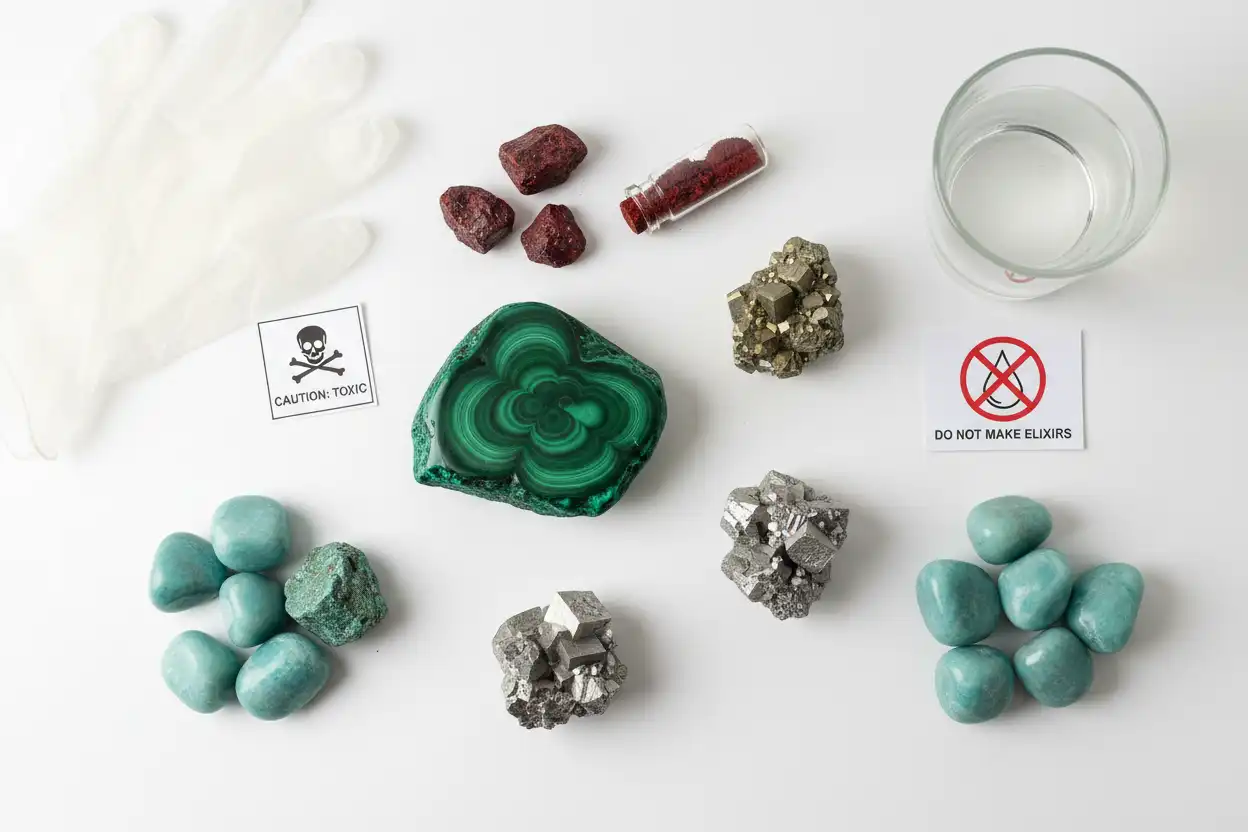
Toxic Crystals: A Safety List for Handling
Some crystals and mineral specimens contain elements or structures that require special handling.
Potential hazards may involve:
- Lead.
- Arsenic.
- Mercury.
- Copper compounds.
- Nickel or cobalt.
- Soluble metal salts.
- Radioactive elements.
- Asbestos-form fibers.
- Fine mineral dust.
- Sharp or unstable surfaces.
This does not mean every specimen is immediately dangerous to touch.
Risk depends on:
- Mineral composition.
- Crystal habit.
- Whether the piece is intact or powdering.
- Duration and frequency of contact.
- Whether dust is inhaled.
- Whether material is swallowed.
- Whether it is heated, cut or placed in acids.
- Whether children or pets can access it.
An intact labeled specimen in a closed display case presents a different situation from grinding the same mineral without dust controls.
Basic Safety Rules
Use these rules for unfamiliar minerals:
- Identify the material before handling it regularly.
- Do not lick crystals.
- Do not place loose stones directly in drinking water.
- Do not cut, sand or drill unknown minerals.
- Avoid creating dust.
- Wash your hands after handling raw metal-bearing specimens.
- Keep hazardous pieces away from children and pets.
- Store specimens with labels.
- Do not heat unknown minerals.
- Seek professional guidance for radioactive or asbestos-form material.
Use How to Identify Crystals before relying on a color-based guess.
Understanding Exposure Routes
A mineral’s name alone does not define the full risk.
Inhalation
Cutting, drilling, crushing, brushing or handling a powdering specimen can release fine particles.
Inhalation is a major concern for:
- Asbestos-form fibers.
- Lead-bearing dust.
- Arsenic-bearing dust.
- Silica dust.
- Radioactive particles.
- Fine metal compounds.
Ingestion
Exposure may occur when mineral residue transfers from hands to:
- Food.
- Drinks.
- The mouth.
- Cigarettes or vaping devices.
- Cosmetics.
- Children’s toys.
Wash hands after handling hazardous specimens.
Skin Contact
Many intact minerals can be handled briefly without significant skin absorption, but some materials may:
- Irritate skin.
- Leave residue.
- Trigger metal sensitivity.
- Enter cuts.
- Contaminate hands.
Gloves may be appropriate for dusty, unstable or unidentified specimens.
Heating
Heating a mineral can:
- Release vapor.
- Produce toxic fumes.
- Change chemical compounds.
- Damage treatments.
- Create fractures.
- Increase oxidation.
Do not use flame tests at home.
Acids and Water
Acids can dissolve minerals and mobilize elements that remain less available in an intact crystal.
Direct crystal elixirs are therefore inappropriate for unidentified or metal-bearing specimens.
Lead-Bearing Crystals
Lead-bearing minerals should not be ground, licked, soaked for drinking water or handled by children.
Galena
Galena is lead sulfide.
It commonly appears metallic silver-gray and may form cubes or cleavage fragments.
Risks increase when galena:
- Leaves dark residue.
- Is crushed.
- Is cut.
- Is drilled.
- Produces dust.
- Is handled before eating.
Keep it in a labeled specimen box and wash your hands afterward.
Cerussite
Cerussite is lead carbonate.
It may be colorless, white, gray, yellowish or brown and can form highly attractive crystals.
Its softness and lead content make it unsuitable for casual jewelry or frequent handling.
Anglesite
Anglesite is lead sulfate.
It may occur as colorless, white, gray, yellow or blue crystals.
Transparent material can look gem-like, but it should remain in a controlled collection.
Vanadinite
Vanadinite is lead chlorovanadate.
Its red, orange and brown hexagonal crystals can break from matrix and produce small fragments.
Do not brush or clean fragile clusters aggressively.
Wulfenite
Wulfenite is lead molybdate.
Its orange, red or yellow tabular crystals are soft and brittle.
Avoid handling thin plates directly.
Crocoite
Crocoite is lead chromate.
Its vivid orange-red crystals are highly fragile and contain both lead and hexavalent chromium compounds.
Keep specimens sealed, stable and clearly labeled.
Mimetite and Pyromorphite
Mimetite is a lead arsenate mineral, while pyromorphite is lead chlorophosphate.
Both may form attractive green, yellow, orange or brown crystals.
Mimetite combines lead and arsenic concerns and deserves especially cautious handling.
Arsenic-Bearing Crystals
Arsenic minerals should remain intact, labeled and protected from heat, acids and abrasion.
Realgar
Realgar is an arsenic sulfide mineral known for orange-red crystals.
It is:
- Toxic.
- Soft.
- Light-sensitive.
- Vulnerable to alteration.
- Unsuitable for jewelry.
Store it away from light and prevent dust.
Orpiment
Orpiment is a yellow to orange arsenic sulfide.
It may form flaky, layered or powdery material.
Do not rub, grind or allow it to contaminate work surfaces.
Arsenopyrite
Arsenopyrite is an iron arsenic sulfide mineral with a metallic silver-white appearance.
Do not use heat or acid tests. Certain reactions can produce highly toxic arsenic-containing compounds.
Adamite
Adamite is a zinc arsenate hydroxide mineral.
It may occur in yellow, green, purple, pink or colorless crystals.
Despite its attractive appearance, it should not be worn as ordinary jewelry or placed in water.
Scorodite
Scorodite is a hydrated iron arsenate mineral.
It may appear green, blue-green, gray, brown or purple.
Keep earthy or powdering specimens contained.
Erythrite and Annabergite
Erythrite is a cobalt arsenate, while annabergite is a nickel arsenate.
Both can produce brightly colored coatings or crystals.
They combine arsenic concerns with cobalt or nickel exposure and should remain in protected collections.
Mercury-Bearing Crystals
Mercury minerals should never be heated.
Cinnabar
Cinnabar is mercury sulfide and typically appears bright red to dark red.
Avoid:
- Grinding.
- Cutting.
- Heating.
- Acid contact.
- Prolonged handling.
- Wearing raw material against skin.
- Using it in water preparations.
Natural cinnabar should not be confused with red resin or lacquer products sold under decorative trade names.
Metacinnabar
Metacinnabar has the same basic composition as cinnabar but a different crystal structure.
It commonly appears black or dark gray.
Treat it with the same precautions as other mercury-bearing material.
Native Mercury
Mineral specimens containing visible liquid mercury require specialist containment.
Do not attempt to open, clean or repair containers holding mercury.
Copper-Bearing Crystals
Copper minerals are not all equally hazardous, and intact polished pieces are commonly used in jewelry.
The greatest avoidable risks involve:
- Dust.
- Ingestion.
- Acid dissolution.
- Direct water infusions.
- Powdering raw specimens.
Examples include:
- Malachite.
- Azurite.
- Chrysocolla.
- Dioptase.
- Shattuckite.
- Turquoise.
- Cuprite.
- Brochantite.
- Chalcanthite.
Malachite and Azurite
Polished malachite and azurite jewelry can generally be worn with ordinary care.
Do not:
- Grind them without proper controls.
- Place them in drinking water.
- Clean them with acids.
- Allow children to chew beads.
- Use raw dust in cosmetics or crafts.
Chalcanthite
Chalcanthite is hydrated copper sulfate.
It is water-soluble and should not be soaked or used in jewelry exposed to moisture.
Bright blue artificial crystals may be grown from copper sulfate and require the same caution.
Nickel- and Cobalt-Bearing Minerals
Nickel and cobalt can cause skin sensitivity in some people, particularly with repeated contact.
Examples include:
- Gaspeite.
- Millerite.
- Pentlandite.
- Annabergite.
- Erythrite.
- Skutterudite.
- Cobalt-rich ores.
Avoid wearing rough or unstable specimens against the skin.
Metal allergies should be assessed based on both the stone and its jewelry setting.
Antimony-Bearing Crystals
Stibnite
Stibnite is antimony sulfide.
It forms metallic gray bladed crystals that can be fragile and sharp.
Avoid:
- Handling broken blades.
- Creating dust.
- Grinding.
- Heating.
- Using it in water.
- Allowing children to handle it.
Stibnite is primarily a display specimen.
Fibrous and Asbestos-Form Minerals
Not every specimen of a mineral capable of fibrous growth is asbestos.
Crystal habit matters.
Potential asbestos-form minerals include:
- Chrysotile.
- Crocidolite.
- Amosite.
- Fibrous tremolite.
- Fibrous actinolite.
- Fibrous anthophyllite.
Serpentine Is Not Automatically Asbestos
Serpentine is a mineral group. Some serpentine material contains chrysotile fibers, while other serpentine is compact and non-fibrous.
Do not cut or sand unidentified serpentine rough.
Tremolite and Actinolite
Tremolite and actinolite may occur in:
- Bladed crystals.
- Massive material.
- Non-asbestiform habits.
- Asbestos-form fibers.
The name alone does not prove that a specimen is asbestos, but fibrous material should be treated cautiously.
Tiger’s Eye and Fibrous Origins
Tiger’s eye is commonly used as a polished jewelry material and is not equivalent to loose asbestos fibers during ordinary wear.
However, cutting or grinding any silica-rich lapidary material creates dust. Unknown rough should be worked only with proper wet methods, ventilation and respiratory controls.
Radioactive Crystals and Minerals
Some minerals contain uranium, thorium or their decay products.
Examples include:
- Uraninite.
- Pitchblende.
- Autunite.
- Torbernite.
- Carnotite.
- Uranophane.
- Thorianite.
- Some monazite.
- Some euxenite.
- Some zircon.
- Some xenotime.
Not every zircon or xenotime specimen presents the same level of radioactivity.
Risk depends on:
- Composition.
- Specimen size.
- Radiation level.
- Distance.
- Time near the specimen.
- Containment.
- Dust.
- Radon or decay products.
Safe Practices for Radioactive Specimens
Do not:
- Wear them.
- Carry them in pockets.
- Keep them beside a bed or desk.
- Store them with food.
- Grind or cut them.
- Allow children to handle them.
Use:
- Proper labeling.
- Stable containment.
- Distance from occupied spaces.
- Radiation measurement.
- Professional advice.
- Local regulatory guidance.
Silica Dust
Quartz, agate, jasper, chalcedony and many rocks are safe to wear in finished form.
Cutting, grinding or dry sanding them can create respirable crystalline silica dust.
Lapidary work requires appropriate controls such as:
- Wet cutting.
- Local exhaust ventilation.
- Suitable respiratory protection.
- Separate work areas.
- Careful cleanup.
A polished quartz bracelet and airborne quartz dust do not present the same exposure.
Pyrite and Unstable Sulfides
Pyrite is iron sulfide.
Most stable polished pieces can be handled normally, but some specimens oxidize in humid conditions and produce:
- Powder.
- Staining.
- Acidic residues.
- Sulfur-like odor.
- Structural breakdown.
Store unstable sulfides in dry conditions and isolate affected specimens from the rest of a collection.
Fluorite and Fluorine Confusion
Fluorite contains fluorine in its crystal structure, but an intact fluorite specimen is not equivalent to exposure to fluorine gas or hydrofluoric acid.
The practical concerns are:
- Softness.
- Cleavage.
- Dust from cutting.
- Acid reactions.
- Possible impurities.
Do not use fluorite in direct drinking-water preparations.
Crystals That Are Dangerous in Water
A mineral can be unsuitable for water because it is:
- Toxic.
- Soluble.
- Porous.
- Reactive.
- Dyed.
- Coated.
- Metal-bearing.
- Glued.
- Misidentified.
Review Which Crystals Can and Cannot Go in Water before soaking any stone.
For anything intended to be consumed, the safest rule is not to place the crystal directly in the liquid.
Treated and Manufactured Materials
Treatments can introduce:
- Dye.
- Resin.
- Metal coatings.
- Adhesive.
- Polymer filling.
- Unknown surface chemicals.
A natural mineral may therefore require different care after treatment.
Use Gemstone Treatments Explained to recognize common enhancement categories.
Safe Storage
Store hazardous minerals:
- In closed containers.
- With clear labels.
- Away from living areas where practical.
- Away from children and pets.
- Away from food and drink.
- Separate from wearable stones.
- Where they cannot fall or release dust.
Preserve the specimen’s name and locality.
Do not rely on memory alone.
Safe Cleaning
For hazardous or unstable minerals, cleaning may be more dangerous than leaving a little dust or matrix.
Avoid:
- Ultrasonic cleaners.
- Steam.
- Acids.
- Bleach.
- Dry brushing.
- Compressed air.
- Household vacuums.
- Abrasive polishing.
Use the general principles in How to Cleanse Crystals Safely while recognizing that some specimens should not be physically cleaned at home.
Children and Pets
Do not allow children or pets to handle:
- Small crystals.
- Toxic minerals.
- Flaky specimens.
- Sharp points.
- Radioactive material.
- Fibrous minerals.
- Water-soluble salts.
- Beads that can be swallowed.
A display case should be stable and inaccessible.
Crystals in Pockets and Jewelry
Do not carry toxic, radioactive, powdering or fibrous minerals against the body.
Choose stable polished materials for everyday use.
The practical limits and compatibility rules appear in How Many Crystals Can You Carry?.
What to Do After Possible Exposure
If a hazardous mineral breaks or releases dust:
- Stop handling it.
- Keep people and pets away.
- Avoid sweeping or using compressed air.
- Do not eat or drink in the area.
- Contain the specimen if it can be done without spreading dust.
- Wash exposed skin.
- Contact an appropriate poison, medical, radiation-safety or environmental authority when exposure may be significant.
- Follow professional cleanup instructions.
Do not attempt to neutralize unknown mineral dust with household chemicals.
How to Dispose of Toxic Crystals
Do not casually place toxic, radioactive or asbestos-form specimens in household waste.
Keep the material sealed and labeled, then consult the guidance in How to Dispose of Crystals Respectfully.
Local requirements differ, so the appropriate destination may be:
- A hazardous-waste facility.
- A radiation-safety service.
- A qualified mineral institution.
- A specialist collector.
- Another authority approved to receive the material.
Frequently Asked Questions
Are all crystals toxic?
No. Many common polished gemstones can be handled and worn safely. Risk depends on composition, form and exposure.
Is touching malachite dangerous?
Brief handling of a stable polished piece is different from inhaling malachite dust or ingesting dissolved copper compounds. Wash hands after rough material and avoid direct crystal water.
Is pyrite toxic?
Stable pyrite is not usually a major handling concern, but dust and oxidation products should be avoided. Unstable specimens may deteriorate in humidity.
Is fluorite poisonous?
An intact fluorite specimen is not the same as fluorine gas or hydrofluoric acid. Avoid dust, acids and direct drinking-water use.
Can I wear cinnabar?
Cinnabar contains mercury. Raw or uncertain cinnabar should not be worn against the skin or handled frequently.
Are radioactive minerals safe in a display case?
They require assessment based on specimen activity, size, containment, distance and local guidance. Do not assume every display case is sufficient.
Is all tremolite asbestos?
No. Tremolite can occur in asbestos-form and non-asbestiform habits. Fibrous material requires special caution.
Can I make crystal-infused water?
Direct infusion is not recommended because identity, treatments, contamination and chemical stability may be uncertain.
Are polished gemstones safer than raw crystals?
Often, because polished surfaces release less dust. A polished stone may still be treated, porous, radioactive or chemically sensitive.
What is the safest rule for unknown minerals?
Do not lick, soak, heat, grind, cut or carry them until they are accurately identified.
Continue Exploring
Browse more mineral safety, care and beginner guidance in the Crystals 101 collection.