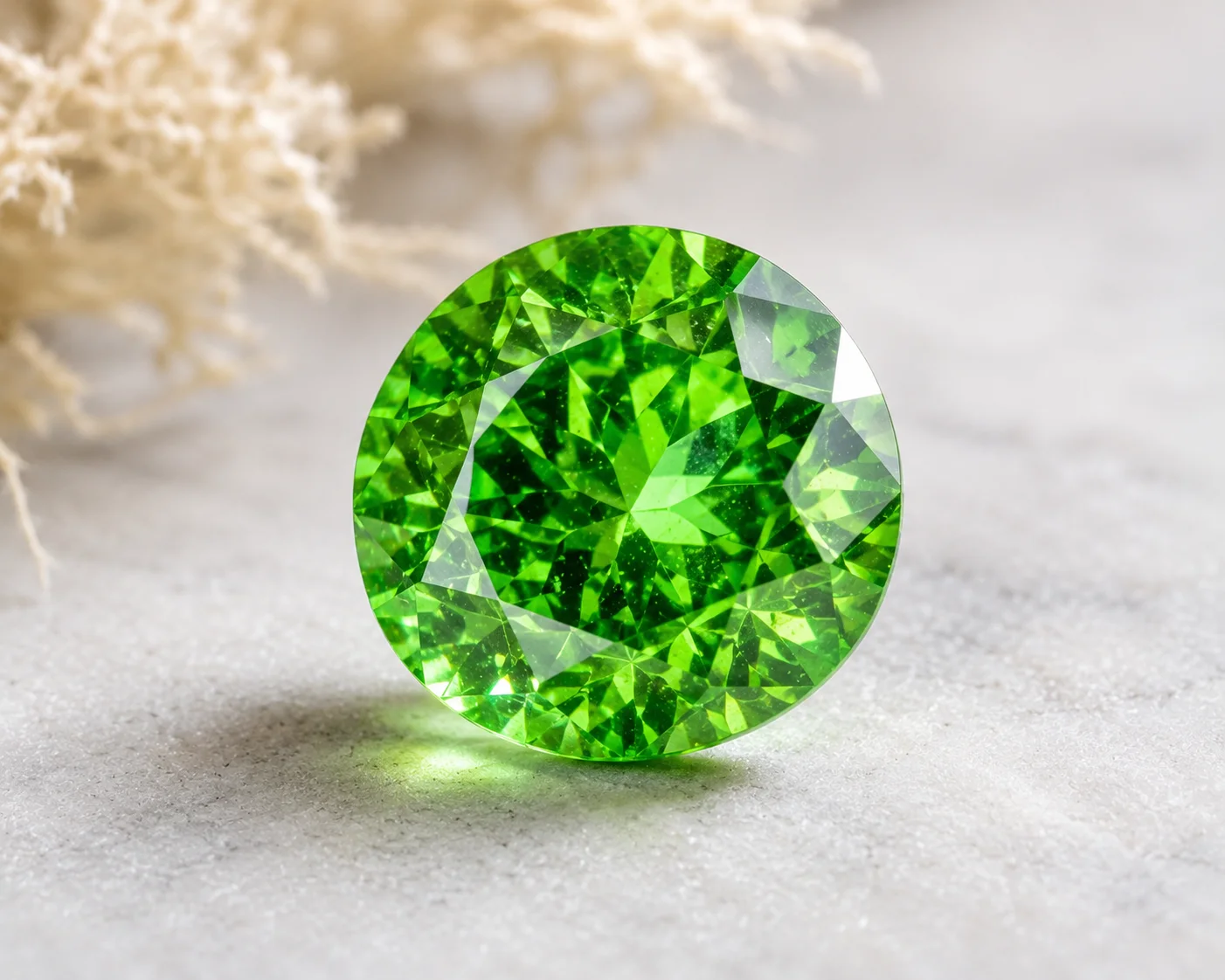
Demantoid Garnet Meaning: Facts, History & Symbolism
Demantoid garnet meaning begins with a specific variety of andradite garnet rather than with the broad idea of a green crystal. Demantoid belongs to the garnet group and is the green gem variety of andradite, a calcium-iron silicate commonly represented by the formula Ca₃Fe₂(SiO₄)₃. Its combination of vivid green color, high refractive index, strong dispersion, adamantine-to-vitreous luster, and comparatively uncommon gem-quality transparency gives fine demantoid a visual character that can be striking even before any symbolic interpretation is considered. Colors range from yellowish green through bright grass green to deeper green, with chromium playing an important role in desirable coloration while iron remains fundamental to the andradite structure.
That mineral identity sets the boundary for demantoid garnet meaning. Modern crystal traditions sometimes associate the gemstone with growth, confidence, prosperity, emotional renewal, creativity, or heart-centered symbolism because of its green color and brilliance. Those meanings can function as personal or cultural interpretations, but they are not experimentally demonstrated effects of calcium, iron, chromium, silicate structure, or light dispersion. Demantoid does not medically affect the heart because it is green, and chromium within a garnet crystal does not act as a nutritional or therapeutic chromium source through ordinary wear.
Within Gems Lore’s Healing Crystal coverage, demantoid garnet meaning is therefore approached material first: what the stone is, how it forms, why it is green, which traits support identification, what its recorded history actually establishes, and where symbolism begins. Buying, jewelry construction, pricing, cleaning, advanced optical work, and provenance remain separate subjects so this page can answer the central meaning question without duplicating the rest of the cluster.
Demantoid Garnet at a Glance
| Property | Practical reference |
|---|---|
| Material identity | Green gem variety of andradite garnet |
| Garnet group | Andradite |
| Idealized formula | Ca₃Fe₂(SiO₄)₃ |
| Crystal system | Isometric/cubic |
| Typical color | Yellow-green, grass green, vivid green, occasionally deeper green |
| Important color contributor | Chromium is associated with desirable green coloration; iron is intrinsic to andradite chemistry |
| Transparency | Transparent to translucent |
| Luster | Vitreous to adamantine |
| Mohs hardness | Roughly 6.5–7 |
| Specific gravity | Commonly around the upper 3s |
| Optical character | Singly refractive under standard conditions because of cubic symmetry, although anomalous effects can occur |
| Dispersion | High for a colored gemstone, contributing noticeable spectral fire |
| Classic inclusion feature | Fibrous “horsetail” inclusions in some specimens |
| Main identification caution | Green color or horsetail-like inclusions alone do not prove species or locality |
| Symbolic associations | Growth, confidence, renewal, abundance, creativity, heart-related themes |
| Evidence boundary | Symbolic interpretations are not scientifically demonstrated healing effects |
Demantoid garnet meaning becomes especially distinctive because its physical properties already explain much of what makes the gem feel unusual. A green stone that combines high brilliance with strong dispersion can show flashes of spectral color that are less obvious in many other green gems, creating a lively appearance that does not require an energetic or mystical explanation.
What Demantoid Garnet Actually Is
Demantoid is not an independent mineral species separate from garnet. It is a gem variety of andradite, one of the major species within the garnet group. The underlying andradite structure contains calcium and iron, while minor compositional substitutions can influence color and other characteristics.
This matters because the word garnet often makes readers think only of dark red stones. Garnet is actually a mineral group capable of producing a wide range of colors depending on composition. Demantoid occupies the green end of that broader family and is mineralogically different from green grossular varieties such as tsavorite even though both are garnets.
Demantoid garnet meaning should therefore never be reduced to “green garnet” as though all green garnets are chemically identical. The correct question is which garnet species is present. Demantoid is andradite; tsavorite belongs primarily to grossular. Their compositions, inclusions, optical behavior, densities, colors, and deposit environments differ.
Why Demantoid Is Green
The green color central to demantoid garnet meaning is associated particularly with chromium in gem-quality material, while iron remains an essential part of andradite chemistry and also affects the stone’s overall optical absorption. The exact color perceived by the eye depends on composition, concentration of coloring components, crystal thickness, cut, lighting, and internal features.
Demantoid can therefore range from yellow-green to intense green rather than appearing in one fixed shade. Material with stronger yellow influence may be less commercially prized than vivid balanced green, but market preference should not be confused with species identity. A yellowish-green demantoid can still be genuine demantoid.
Darkness also matters. A stone with abundant green saturation but excessive tone may return less light to the viewer, while a lighter stone with good cut can appear lively and brilliant. This relationship between body color, brightness, and spectral fire is one reason demantoid evaluation cannot rely on color swatches alone.
The specialist demantoid garnet optical properties and color behavior page owns the detailed optical discussion. For demantoid garnet meaning, the essential distinction is that green color has a mineralogical cause, while symbolic associations with growth or the heart are human interpretations layered onto that color.
How Demantoid Garnet Forms
Demantoid forms in geological environments capable of producing andradite while also supplying the trace chemistry associated with green coloration. Classic occurrences are strongly connected with ultramafic and serpentinized rocks, where interaction between fluids and chromium-bearing host materials can create conditions favorable for green andradite formation.
Other demantoid deposits occur in somewhat different geological settings, which is important because no single matrix appearance or inclusion suite should be projected onto every specimen worldwide. Formation conditions influence crystal size, transparency, color, associated minerals, internal inclusions, and the likelihood of finding facetable material.
The deeper geological sequence belongs in demantoid garnet formation and deposit geology. On this page, the important point is that demantoid garnet meaning should not turn geological transformation into proof of metaphysical transformation. The first is a physical process involving minerals, fluids, temperature, pressure, and rock chemistry; the second is symbolic language.
Why Demantoid Can Show So Much Fire
One of demantoid’s most celebrated physical properties is dispersion: the separation of white light into spectral colors as it passes through and reflects within the faceted gem. Because demantoid has relatively strong dispersion, a well-cut stone can produce visible flashes of red, orange, yellow, blue, and other spectral colors even though the body color is green.
This visual fire helped inspire the demantoid name, which refers to its diamond-like appearance or brilliance. The comparison concerns optical impression rather than chemical relationship. Demantoid remains garnet, not diamond.
Strong body color can partially mask dispersion, which means the most saturated green stone is not automatically the one that displays the most obvious rainbow fire. Cut quality and lighting also matter. A poorly proportioned stone may fail to return light effectively regardless of its inherent optical potential.
Demantoid garnet meaning sometimes interprets that brilliance as “inner light” or spiritual activation. As metaphor, that can be understandable. Physically, the effect comes from refractive and dispersive behavior.
The Famous Horsetail Inclusion
Perhaps no feature is more closely associated with demantoid than the horsetail inclusion. In suitable specimens, fine fibers radiate or curve through the gemstone in a pattern resembling a horse’s tail, sometimes originating around a small central crystal or mineral grain.
These inclusions can be beautiful and historically important to gem identification, but several cautions are necessary. Not every demantoid contains horsetails. A clean stone is not automatically fake because no horsetail is visible. Conversely, a fibrous inclusion that resembles a horsetail should not independently prove that an unknown green stone is demantoid.
The specialist demantoid garnet microscope and inclusion notebook handles inclusion morphology in detail. For demantoid garnet meaning, the important lesson is that an inclusion is evidence within a larger identification process rather than a one-feature authentication shortcut.
Horsetails Do Not Automatically Prove Russian Origin
Classic Ural demantoid is famous for horsetail inclusions, which has led to a persistent shortcut: horsetail equals Russian. That conclusion is too strong.
Inclusion character can contribute to a locality opinion when evaluated together with chemistry, geological context, growth features, spectroscopy, trace-element data, and documented provenance. One fibrous pattern viewed through a loupe is not a geographic certificate.
This is especially important in the market because Russian-origin demantoid can attract strong collector and commercial interest. A seller who upgrades origin based only on an inclusion pattern is turning a useful clue into a much stronger claim than the evidence supports.
The demantoid garnet provenance disclosure checklist provides the proper framework for separating documented source information from appearance-based assumptions.
Diagnostic Traits of Demantoid Garnet
A convincing demantoid identification combines several independent characteristics. Green color consistent with andradite, high luster, strong refractive behavior, pronounced dispersion, garnet-group physical properties, appropriate density, isometric structure, and characteristic inclusions can collectively support the identification.
One particularly useful consequence of cubic symmetry is that ordinary garnet is singly refractive. However, natural garnets can show anomalous optical effects caused by strain or structural complexities, so an unexpected reaction should not be interpreted through a simplistic yes-or-no rule without context.
Hardness around 6.5–7 gives demantoid meaningful resistance to scratching but does not make it as hard as sapphire or diamond. Surface abrasion can develop during long-term wear, particularly in rings.
Density is also useful, although mounted stones cannot be weighed independently without removing them from jewelry. For valuable gems, professional testing is more appropriate than destructive or improvised home experiments.
An Original Demantoid Specimen and Photo Checklist
Begin with the entire object and record whether it is a natural crystal, rough fragment, cut gemstone, matrix specimen, or mounted jewel. Demantoid garnet meaning is interpreted differently in each case because natural crystal morphology can support mineral identification, while a faceted stone has lost most exterior growth evidence.
Next, document color under neutral illumination. Photograph the material under diffuse daylight-balanced light and again under a controlled point source. The first image is useful for body color and transparency; the second can reveal dispersion and brilliance. Do not increase saturation until yellow-green material becomes emerald green.
Then inspect apparent fire. Record whether spectral flashes emerge from specific facets when the stone moves rather than appearing as a permanent digital rainbow added by image processing. Dispersion should vary with angle and lighting.
Use magnification to examine inclusions. If fibrous features occur, record their direction, curvature, density, relationship to any central grain, and whether they are distributed through the stone or localized. Describe them first; identify them second. “Radiating fibrous inclusion” is stronger observational language than immediately declaring “Russian horsetail.”
Inspect facet junctions and surface condition in cut material. Abraded edges, scratches, chips, polish lines, and residue can affect brilliance and apparent quality. A dull demantoid may simply be dirty or worn rather than intrinsically low quality.
For a natural crystal, preserve matrix relationships. Associated minerals and host rock can provide valuable geological context, particularly when provenance is being evaluated. Do not remove matrix merely to make the crystal look more gem-like.
Finally, assign confidence separately to species, treatment, and locality. A stone can be confidently identified as demantoid while its country of origin remains uncertain. Those are different conclusions and should not be bundled together.
A Source-Comparison Table for Common Demantoid Claims
| Common claim | What can reasonably be retained | What needs correction or stronger evidence |
|---|---|---|
| “Demantoid is green garnet.” | Demantoid is a green garnet variety | Not every green garnet is demantoid |
| “Demantoid is andradite.” | Correct mineralogical relationship | Individual stones still require identification |
| “Chromium contributes to its green color.” | Chromium is important in desirable green demantoid | Color depends on the complete composition and optical context |
| “Every demantoid has horsetail inclusions.” | Horsetails are famous in some material | Many genuine stones do not show them |
| “Horsetail means Russian demantoid.” | Horsetails are strongly associated with classic Ural material | One inclusion feature cannot prove origin |
| “Demantoid is a type of diamond.” | Its brilliance inspired a diamond-related name | It is garnet, not crystalline carbon |
| “Darker green is always more valuable.” | Strong green can be desirable | Excessively dark tone can reduce brightness and visible dispersion |
| “Demantoid has healing chromium.” | Chromium can participate in color | A garnet is not a therapeutic chromium supplement |
| “Demantoid heals the heart.” | Green gems are often given heart symbolism | No established medical mechanism supports cardiac treatment |
| “Demantoid attracts wealth.” | Prosperity is a modern symbolic theme | No scientific evidence shows it changes financial outcomes |
This comparison captures the central challenge of demantoid garnet meaning: many inaccurate claims begin with a true fact and then extend beyond what that fact supports. Chromium contributes to color, but that does not make the gem medicine. Horsetails can support identification, but that does not turn them into automatic origin certificates.
Demantoid Versus Tsavorite
Demantoid and tsavorite are both green garnets, but they belong to different garnet compositions. Demantoid is andradite, while tsavorite is a green grossular garnet colored principally by trace elements such as vanadium and chromium.
Their optical personalities also differ. Demantoid is especially famous for high dispersion, while tsavorite is often appreciated for rich saturated green color and good transparency. Individual stones vary, so appearance alone should not be used as a species test.
This distinction is valuable because commercial descriptions sometimes use “green garnet” as though it identifies one material. It does not. A proper evaluation asks which garnet species and variety are actually present.
Demantoid Versus Emerald
Emerald is green beryl, chemically unrelated to garnet. It commonly obtains color from chromium, vanadium, or both, which creates superficial similarity because chromium also plays a role in demantoid coloration.
The minerals differ sharply in crystal system, refractive behavior, density, inclusions, hardness, cleavage tendencies, geological occurrence, and optical character. Demantoid’s stronger dispersion can create rainbow fire that is less central to emerald’s classic visual identity.
A vivid green stone should therefore never be described as “emerald-like” in a way that obscures its actual identity. Similarity of color is not equivalence of material.
Demantoid Versus Diopside
Diopside can also occur in vivid green varieties and may enter similar jewelry markets, yet it is a pyroxene mineral with different chemistry, crystal structure, cleavage, and optical properties.
Chrome diopside can produce intense green coloration and may be confused visually with demantoid or other green gemstones when viewed without testing. The comparison becomes particularly difficult in small mounted stones where crystal habit and density measurements are unavailable.
This is another reason demantoid garnet meaning should emphasize converging evidence rather than a “green equals demantoid” shortcut.
Demantoid Versus Dioptase
Dioptase can display extraordinarily saturated green to blue-green color, sometimes even more visually intense than demantoid. It is a copper cyclosilicate, however, with much lower practical durability and a completely different geological context.
Fine dioptase crystals are usually valued as mineral specimens rather than conventional everyday gemstones, while demantoid has a stronger established faceted-gem market.
These neighboring green minerals demonstrate how misleading color-based identification can be. Similar visual impact can arise from entirely different crystal chemistries.
Recorded History of Demantoid
Demantoid became famous through gem discoveries in the Ural region of Russia, where exceptionally bright green andradite entered jewelry and mineral collections. Its diamond-like brilliance inspired the name demantoid, and fine Russian material became particularly associated with vivid color, strong fire, and characteristic inclusion scenes.
The stone subsequently became closely linked with high-end jewelry, especially designs that benefited from small intensely brilliant green gems. Later discoveries from other regions broadened the market and demonstrated that demantoid is not restricted to one country, even though classic Russian provenance retains exceptional historical importance.
This documented gemological history is stronger than claims that demantoid was universally used as an ancient heart-healing stone. Garnets have deep historical importance, but evidence for garnet in general should not automatically be transferred to the specific demantoid variety without identification.
Demantoid garnet meaning can therefore include both layers honestly: a documented mineral and jewelry history, followed by modern symbolic interpretation.
Why “Ancient Demantoid Lore” Needs Caution
The broad garnet family appears in old jewelry, trade, literature, and symbolism, but historically identifying a specific green garnet as demantoid requires more than the generic word garnet. Older descriptions may not contain the chemistry, spectroscopy, locality, or gemological measurements needed to distinguish andradite from other green stones retrospectively.
It is therefore more accurate to describe many metaphysical associations as modern demantoid garnet meaning rather than ancient demantoid doctrine.
This does not erase the symbolism. It simply avoids turning the documented history of garnet as a broad category into unsupported evidence for one later-defined gem variety.
Demantoid Garnet Meaning in Modern Symbolism
Modern demantoid garnet meaning commonly includes renewal, confidence, personal growth, creativity, abundance, emotional openness, and movement toward practical goals. Green encourages associations with vegetation, growth, spring, prosperity, and the heart in contemporary color symbolism.
The stone’s brilliance adds another metaphorical layer. Because demantoid can combine rich green with flashes of rainbow fire, some practitioners use it as a symbol of recognizing possibilities inside circumstances that initially appear fixed or one-dimensional.
Those interpretations can serve personal reflection without being presented as mineral powers. Demantoid does not scientifically increase confidence, attract money, repair relationships, open the heart chakra, treat cardiovascular disease, or change external events.
A grounded use of demantoid garnet meaning might involve choosing the stone as a reminder to define growth concretely. Instead of asking whether the gem is “bringing abundance,” a person might ask which measurable action would improve financial stability, career development, creative output, or relationship quality.
Heart-Chakra Symbolism
Green gemstones are frequently associated with the heart chakra in contemporary seven-chakra systems, and demantoid is sometimes included because of its color. Within that framework, demantoid garnet meaning may emphasize emotional openness, compassion, forgiveness, connection, or balance.
These are spiritual interpretations rather than anatomical facts. No medical imaging method identifies a heart chakra inside the chest, and no validated gemological test demonstrates that demantoid activates one.
The color connection can still work symbolically. Green is culturally associated with life, growth, and renewal in many settings, so using a green gemstone during reflection on those themes can be personally coherent.
The important boundary is that symbolic heart language should not become cardiovascular advice.
Prosperity and Abundance Claims
Demantoid’s rarity, bright green color, and historical association with luxury jewelry make prosperity symbolism easy to understand. Green is also culturally connected with money in some societies, strengthening the association.
However, demantoid does not create financial returns simply by being owned or worn. No credible evidence demonstrates that the stone changes probability, increases income, attracts customers, or protects investments through an emitted field.
A more useful interpretation of demantoid garnet meaning is behavioral. A person using the gem as an abundance symbol can define abundance in measurable terms: saving consistently, reducing unnecessary debt, building a business skill, completing a project, or maintaining valuable relationships.
That turns symbolism into an intentional reminder instead of a promise.
Chromium Is Not Medicine
Chromium contributes to the chemistry behind desirable green demantoid coloration, but the presence of chromium in a gemstone does not make the gem a nutritional or medical chromium source.
Biological effects depend on oxidation state, chemical form, concentration, dose, solubility, route of exposure, and metabolism. Trace elements locked inside a durable silicate lattice should not be treated as supplements delivered through skin contact.
The same principle applies to calcium and iron in andradite. Their names are familiar from nutrition, but demantoid is a mineral crystal, not a mineral tablet.
This distinction matters because chemistry can make unsupported healing language sound scientific when the underlying inference is invalid.
Safe Ownership
Ordinary handling and wearing of intact demantoid garnet are different from industrial or lapidary processing. A finished gemstone does not need unusual alarmist treatment simply because it contains iron, chromium, calcium, and silica within its crystal structure.
The primary routine concerns are physical preservation. Demantoid is hard enough for jewelry, but not as scratch-resistant as sapphire or diamond. Chips, abrasions, existing fractures, and setting damage can therefore affect long-term condition.
Cutting, grinding, drilling, or repolishing creates fine mineral dust and should use appropriate lapidary controls rather than casual dry processing. The specialized demantoid garnet cutting, orientation, and polish guide addresses those workshop questions more directly.
Direct-contact crystal elixirs are unnecessary. Symbolic use does not require putting a gemstone or rough specimen into drinking water.
Demantoid in Jewelry
Demantoid’s brilliance makes it particularly attractive in jewelry, but wearability should be judged from actual material properties. Rings receive more abrasion than pendants or earrings, and stones with significant surface-reaching inclusions may require greater protection.
Setting design influences risk. A high exposed setting can make a gemstone more vulnerable to impact, while inappropriate prong pressure can create problems around existing fractures. The demantoid garnet setting and wear engineering guide owns those construction details.
Readers considering specific jewelry formats can also evaluate demantoid garnet rings, demantoid garnet necklaces, demantoid garnet earrings, and demantoid garnet bracelets according to the different abrasion, impact, matching, and security demands each design creates.
The symbolic idea of protection does not change these mechanical realities.
Cleaning and Maintaining Demantoid Jewelry
A demantoid’s apparent brilliance can decrease when oils, cosmetics, soap residue, skin products, or dirt coat its surfaces. Cleaning can therefore make a significant visual difference, particularly on faceted stones whose performance depends on clean pavilion surfaces.
However, not every cleaning method should be applied automatically. Internal inclusions, fractures, filled areas, antique settings, neighboring gemstones, and delicate metals can alter what is appropriate for a specific piece.
The dedicated guide on how to clean demantoid garnet jewelry addresses those practical limits. Within demantoid garnet meaning, a stone appearing dull after wear should not be interpreted as spiritually depleted when ordinary surface contamination provides a simpler explanation.
Price Is a Different Question From Meaning
Fine demantoid can command substantial prices because attractive color, transparency, size, cut, provenance, and rarity interact within a specialized gem market. Classic origin claims and distinctive inclusions can add interest when properly supported.
Those market dynamics belong in the separate demantoid garnet price guide. A meaning page should not imply that expensive stones possess stronger symbolic energy or that a rare locality makes the crystal spiritually more effective.
Financial value and personal meaning can overlap, but neither proves the other.
Someone purchasing primarily for gem quality can use buy demantoid garnet to evaluate disclosure, identification, treatment, documentation, and seller claims without turning this article into a shopping guide.
Preserving Natural Demantoid Specimens
Natural demantoid crystals can preserve geological evidence that faceting removes permanently. Crystal faces, matrix, associated minerals, contact zones, surface alteration, inclusions, and old labels can all contribute to scientific or collector significance.
Aggressive cleaning, polishing, acid treatment, or removal from matrix may make a specimen temporarily more attractive while destroying evidence that cannot be reconstructed afterward.
The demantoid garnet specimen conservation record provides a place to document chips, repairs, detached crystals, labels, cleaning history, storage changes, and condition when a specimen is important enough to preserve systematically.
Conservation is particularly relevant for documented historic material because provenance and physical condition can become intertwined.
What Demantoid Garnet Meaning Should Not Absorb
Demantoid garnet meaning owns the foundational story: andradite identity, green coloration, formation overview, recognizable traits, recorded history, symbolism boundaries, and safe ownership. It should not duplicate full price modeling, buying instructions, jewelry construction, detailed cleaning procedures, microscopy protocols, optical tables, deposit geology, or provenance analysis.
That boundary gives each neighboring article a clear purpose and prevents readers from encountering the same generic explanations under several URLs.
It also makes the symbolism more credible. When metaphysical interpretation occupies its own clearly identified section rather than being mixed into gem identification, readers can distinguish what is measurable from what is personally meaningful.
Frequently Asked Questions About Demantoid Garnet Meaning
What is demantoid garnet?
Demantoid is the green gem variety of andradite garnet. It is a calcium-iron silicate mineral belonging to the garnet group and is known for vivid green color, high luster, and strong dispersion.
What does demantoid garnet meaning symbolize?
Modern demantoid garnet meaning commonly includes growth, renewal, confidence, creativity, prosperity, emotional openness, and heart-related symbolism. These are cultural or personal interpretations rather than scientifically demonstrated effects.
Why is demantoid green?
Chromium is an important contributor to desirable green coloration in demantoid, while iron is fundamental to andradite chemistry. Exact appearance depends on the complete composition, stone thickness, cut, and lighting.
Is demantoid a type of emerald?
No. Emerald is green beryl, while demantoid is green andradite garnet. Their chemistry, crystal systems, optical behavior, inclusions, and geological formation differ.
Is demantoid the same as tsavorite?
No. Both are green garnets, but demantoid is andradite while tsavorite is grossular. Their composition and optical characteristics are different.
Why is demantoid called diamond-like?
Its name refers to exceptional brilliance and dispersion that can create a diamond-like visual liveliness. Demantoid is not chemically or structurally related to diamond.
What is a horsetail inclusion?
A horsetail is a distinctive radiating or curved fibrous inclusion pattern found in some demantoid garnets. It can be an important gemological clue, but not every genuine demantoid has one.
Does a horsetail prove Russian origin?
No. A horsetail can support an origin assessment when combined with other evidence, but it does not by itself prove that a stone came from Russia.
Is demantoid rare?
Fine transparent demantoid with attractive green color, good size, desirable cut, and strong provenance can be comparatively scarce. Availability varies significantly with quality and origin.
Does darker green demantoid mean better quality?
Not automatically. Strong green saturation can be desirable, but excessive darkness can reduce brightness and visible dispersion. Color, tone, cut, transparency, and fire should be considered together.
Is demantoid durable enough for jewelry?
Its hardness around 6.5–7 makes jewelry use possible, but it is less resistant to abrasion than sapphire or diamond. Setting style, inclusions, fractures, and wear conditions still matter.
Does demantoid have healing properties?
There is no established scientific evidence that demantoid treats medical or psychological conditions, changes heart function, improves circulation, or produces therapeutic effects through normal handling.
Does demantoid open the heart chakra?
Heart-chakra association belongs to modern spiritual symbolism. No established scientific test demonstrates physical chakra activation by demantoid.
Does demantoid attract money?
There is no evidence that owning or wearing demantoid changes financial outcomes through a mineral-generated force. Prosperity is a symbolic association rather than a guaranteed effect.
How can demantoid be identified?
Identification can combine color, refractive behavior, dispersion, density, garnet-group properties, magnification, inclusions, spectroscopy, and other gemological tests. Valuable stones should not be authenticated from color or one horsetail-like inclusion alone.
Demantoid Garnet Meaning Without the Myths
Demantoid garnet meaning becomes richer when the gem does not have to compete with exaggerated claims. Mineralogically, it is already exceptional: a green andradite garnet capable of combining strong color with high luster and unusually vivid dispersion. Its classic fibrous inclusions provide another distinctive feature, while the geological conditions that create chromium-bearing green andradite connect the gemstone to specific rock and fluid environments.
Its recorded history adds another layer. Demantoid became internationally recognized through classic Ural material and earned a reputation in fine jewelry because its optical liveliness could rival expectations normally associated with colorless brilliant gems. Later sources expanded the geographic picture without erasing the significance of documented classic provenance.
Modern symbolism can then be understood on its own terms. Green can represent growth, renewal, prosperity, or emotional openness, while spectral fire can become a metaphor for finding complexity within a seemingly simple situation. A person may choose those meanings deliberately without claiming that andradite alters physiology or controls external events.
That layered approach is the most responsible interpretation of demantoid garnet meaning: establish the gem first, verify origin and inclusions according to evidence, preserve documented history, and allow symbolism to remain symbolism. The result is more specific to demantoid than a generic list of crystal benefits could ever be.