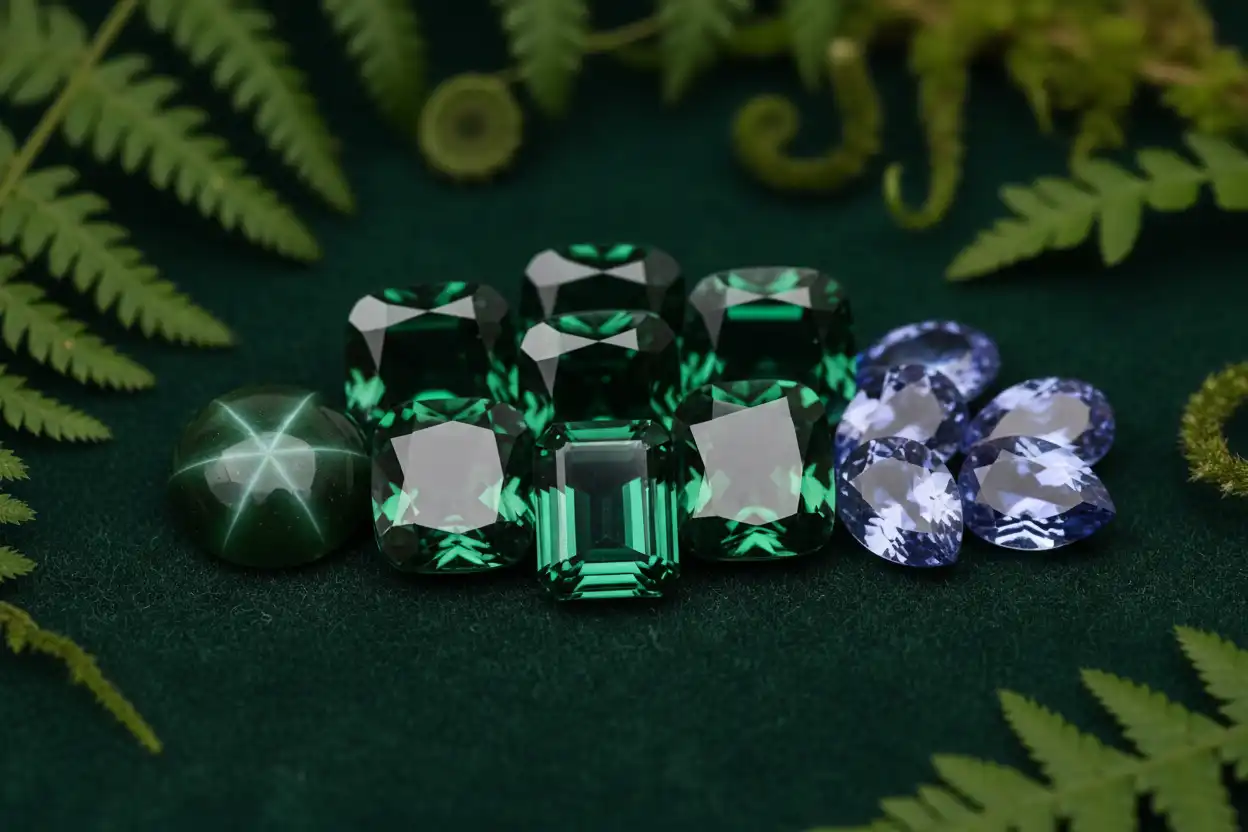
Diopside Meaning: Mineral Facts, History & Symbolism
Diopside meaning is easiest to understand once the broad commercial phrase “green crystal” is replaced with a precise mineral identity. Diopside is a calcium-magnesium silicate with the idealized formula CaMgSi₂O₆ and belongs to the pyroxene mineral group. It crystallizes in the monoclinic system and occurs in several geological environments, producing material that may be colorless, white, pale green, yellow-green, vivid emerald-like green, brown, gray, violet-blue, or nearly black. Transparent green material can be faceted, darker material may be cut as cabochons, and well-formed natural crystals are collected as mineral specimens.
The green varieties are especially responsible for modern diopside meaning, but green does not arise from one universal cause. Chromium can produce the intense coloration associated with chrome diopside, while iron and other substitutions influence many ordinary green, yellow-green, and brown diopsides. Some unusual colors and optical effects depend on additional trace chemistry, inclusions, or structural characteristics. This matters because sellers sometimes turn a color name directly into a mineral identity, treating every vivid green pyroxene as chrome diopside or every dark cabochon with a light effect as a special species.
Modern symbolism adds another layer. Diopside is commonly associated with growth, emotional openness, renewal, compassion, connection with nature, resilience, and perspective. Those themes can function as personal or cultural interpretations, particularly because green has widespread associations with vegetation and renewal, but they are not demonstrated physiological effects of calcium, magnesium, chromium, silicate structure, or crystal color. Within Gems Lore’s Gemstone Guides collection, diopside meaning therefore starts with the mineral and only then considers the stories people attach to it.
Diopside at a Glance
| Property | Practical reference |
|---|---|
| Material identity | Calcium-magnesium silicate mineral |
| Idealized formula | CaMgSi₂O₆ |
| Mineral group | Pyroxene |
| Crystal system | Monoclinic |
| Common colors | Colorless, white, pale green, yellow-green, rich green, brown, gray, violet-blue, nearly black |
| Transparency | Transparent to translucent; some material is opaque |
| Luster | Vitreous |
| Mohs hardness | Approximately 5.5–6.5 |
| Specific gravity | Commonly around 3.2–3.4 |
| Cleavage | Two important directions typical of pyroxenes, intersecting close to right angles |
| Common gem variety | Chrome diopside |
| Other commercial descriptions | Star diopside, black diopside, violane, trade-named pale green material |
| Main color caution | Green color alone does not prove chromium-rich chrome diopside |
| Main durability caution | Moderate hardness plus cleavage require realistic jewelry expectations |
| Symbolic associations | Growth, compassion, renewal, perspective, grounding, nature |
| Evidence boundary | Symbolism is interpretive rather than a scientifically demonstrated healing mechanism |
The table shows why diopside should not be described as though one vivid green faceted stone represents the whole species. Much of the mineral occurs as pale, dark, opaque, included, massive, or specimen-quality material rather than as the intensely saturated transparent gems emphasized in jewelry photography.
What Diopside Actually Is
Diopside is one member of the large pyroxene family, a group of silicate minerals characterized by chain-like silicate structures and important roles in igneous and metamorphic rocks. Its ideal calcium-magnesium composition places it within a broader compositional system in which substitutions can modify color and other properties.
The formula CaMgSi₂O₆ describes the idealized end-member composition rather than every atom in every natural specimen. Iron, chromium, manganese, and other elements may substitute into the structure in varying amounts, while inclusions and associated mineral matter add further complexity.
That variation is responsible for part of diopside’s diversity. A colorless crystal, a pale green faceted gem, a vivid chrome-rich stone, and an opaque black star cabochon can all belong within the diopside family while looking dramatically different.
Diopside meaning should therefore begin with structural identity rather than market color.
Diopside Is a Pyroxene, Not a Quartz Variety
Diopside is sometimes loosely grouped with unrelated green “crystals” in commercial settings, which can obscure the fact that it belongs to a well-defined mineral group.
Quartz is SiO₂ and has a completely different crystal structure. Beryl, garnet, tourmaline, olivine, and feldspar likewise belong to other mineral families despite producing green varieties that can overlap visually with diopside.
Pyroxenes have characteristic cleavage relationships and chain-silicate structures that help distinguish them from those materials.
The distinction matters particularly after faceting removes natural crystal habit. A green oval gemstone could potentially belong to several species, so color should narrow the possibilities rather than decide them.
How Diopside Forms
Diopside forms in several geological settings where calcium, magnesium, silica, temperature, pressure, and fluid chemistry create favorable conditions. It is particularly familiar from metamorphosed carbonate rocks, skarns, ultramafic rocks, mantle-derived material, and some igneous environments.
In carbonate-rich metamorphic settings, limestone or dolostone can react with silica-bearing fluids or adjacent rocks as temperature rises. New calc-silicate minerals develop, and diopside may crystallize as part of these metamorphic assemblages.
Diopside can also occur in magnesium-rich igneous and mantle rocks, sometimes alongside olivine, other pyroxenes, spinel-group minerals, garnet, or related phases. The precise associations depend on local chemistry.
The dedicated diopside formation and deposit geology guide examines those environments in detail. For diopside meaning, the essential point is that the species is not tied to one mine, one country, one rock type, or one shade of green.
Why Chrome Diopside Is So Green
Chrome diopside owes its striking green appearance principally to chromium substituting within the mineral structure. Appropriate concentrations create strong absorption of parts of visible light, allowing a saturated green appearance to dominate.
The resulting hue can range from bright yellowish green to rich forest or emerald-like green. The comparison with emerald is visual only. Emerald is chromium- and/or vanadium-bearing beryl, while chrome diopside remains a pyroxene with very different chemistry, hardness, cleavage, density, optical properties, and geological occurrence.
Color depth also depends on stone thickness.
A small chrome diopside may appear vivid and bright, while a substantially larger stone with similar chemistry can become too dark because light travels through a longer optical path. This is one reason large size does not automatically improve appearance.
Not Every Green Diopside Is Chrome Diopside
The phrase chrome diopside should be used when chromium is materially responsible for the characteristic green variety, not simply as a more attractive name for any green diopside.
Ordinary diopside can display greenish coloration through other compositional influences, including iron-related absorption. Some material lies between simple commercial categories because natural chemistry varies continuously rather than according to retail labels.
A photograph cannot quantify chromium content reliably.
When the distinction matters scientifically or financially, spectroscopy or chemical analysis provides stronger evidence than visual saturation alone.
The neighboring diopside optical properties and color behavior reference handles those absorption and directional-color questions more deeply.
Why Some Diopside Is Brown or Yellow-Green
Iron can contribute significantly to yellow, green, and brown appearances in diopside. Its oxidation state, concentration, interaction with other elements, and structural position influence which wavelengths are absorbed and therefore what color reaches the observer.
This means color exists on a continuum rather than as a set of perfectly separated variety boxes.
A yellow-green stone may contain enough green to be commercially appealing without belonging to the vivid chrome-rich end of the range. Brownish material may still be transparent and attractive in a mineral specimen even if it has limited mainstream gem demand.
Lighting can alter the perception further. Warm illumination emphasizes yellow or brown components, while cooler backgrounds and image processing can make a moderately green stone look significantly greener.
Neutral photography is therefore essential when color carries commercial importance.
Violet-Blue Diopside and the Violane Name
Violane is a traditional variety name applied to violet, violet-blue, or bluish diopside material, often occurring in metamorphic environments and commonly more translucent or ornamental than the transparent chrome diopside familiar from jewelry.
The color has been associated with manganese-related chemistry in suitable material, although exact coloration in a specimen should not be reduced to one element without analytical evidence.
Violane is not a separate mineral species.
It remains diopside, with the variety term describing an unusual color expression.
This is an important naming principle throughout diopside meaning: a descriptive variety name can be useful without implying a fundamentally new mineral.
What Is Star Diopside?
Some dark diopside displays asterism—a star-like optical effect visible when a suitably oriented cabochon is illuminated by a small, concentrated light source.
The phenomenon arises from light reflecting from oriented internal inclusions arranged according to the crystal’s structure. When the stone is cut with the correct orientation and curved surface, reflected bands intersect to produce a star.
The star is optical, not painted onto the surface.
However, not every black diopside displays a strong star, and a bright reflection on a polished cabochon should not automatically be called asterism.
A genuine star should move in a coherent way as the light or stone moves.
The detailed inclusion architecture belongs with the diopside microscope and inclusion notebook rather than being reduced to one visual shortcut here.
Black Diopside Is Not a Separate Mineral Species
“Black diopside” is a descriptive commercial term for very dark diopside material, often made opaque or nearly opaque by composition, inclusions, or both.
Some black material is valued specifically because it can display a star when cabochon-cut.
The black color does not create a new species.
Nor does black appearance automatically establish the exact identity of every included mineral responsible for opacity. Fine-scale inclusions can require microscopy, spectroscopy, chemical analysis, or other specialist methods when their mineral species matters.
A seller who turns one black spot or needle into a definitive mineral name without evidence is making a stronger claim than appearance supports.
Tashmarine and Other Trade Names
Pale yellow-green to green diopside has appeared in the gem market under specialized trade names, including Tashmarine for selected material.
Trade names can be commercially useful because they help distinguish an appearance or source within a broader mineral species, but they do not change the underlying mineral identity.
A trade name should not automatically imply treatment status, exceptional rarity, geographic origin, or superior quality unless those claims are defined and supported separately.
This distinction is particularly useful when comparing diopside with other gemstones that have accumulated strong brand identities. Mineral names describe materials; commercial names describe market positioning.
Diagnostic Traits That Matter
Diopside identification works best through converging evidence. Mineral chemistry, monoclinic structure, hardness around the mid-5 to mid-6 range, specific gravity in the low-to-mid 3s, two pyroxene cleavage directions, optical behavior, pleochroism where present, refractive measurements, inclusions, and geological associations can all contribute.
Cleavage is particularly informative in rough material. Pyroxenes typically show two cleavage directions intersecting at angles close to 90 degrees, unlike amphiboles whose corresponding cleavage relationship is noticeably different.
Hardness can help but should not be tested destructively on attractive crystals or polished gems.
Transparent faceted material may require routine gemological testing because natural crystal faces have already been removed. A green stone’s brilliance, darkness, or saturation cannot identify it reliably by themselves.
Species identification should come before variety claims.
An Original Diopside Specimen and Photo Checklist
Begin by recording the material’s form. Is the object a natural crystal, matrix specimen, transparent rough fragment, faceted gemstone, opaque cabochon, bead, carving, or massive rock-forming material? Each preserves different evidence.
For a natural crystal, photograph at least three orientations and record crystal faces, broken areas, cleavage surfaces, matrix contacts, associated minerals, and color distribution. Do not remove matrix merely to make the crystal look more gem-like.
For transparent green material, photograph under neutral diffuse lighting first. Record whether the hue is yellow-green, medium green, blue-green, dark green, or brownish green rather than jumping immediately to “chrome diopside.”
Add a white and medium-gray background. Highly saturated green gemstones can look markedly different depending on background contrast and camera exposure.
For dark cabochons, test any claimed star with a small point light. Move the light gradually and observe whether the star travels coherently across the dome. A diffuse broad reflection under a large lamp is not sufficient evidence of asterism.
Under magnification, record fractures, crystals, needles, clouds, cleavage-related features, polishing lines, cavities, and surface wear. Describe the inclusions before assigning species names.
Then separate the conclusions:
Species: Is the material diopside?
Variety: Is chromium-rich green material adequately supported as chrome diopside?
Phenomenon: Does a dark cabochon genuinely show asterism?
Origin: Is geographic provenance documented?
Treatment: Is modification known, absent, or uncertain?
This layered checklist prevents one impressive feature from being used to prove everything else about the specimen.
A Claim-Reconciliation Table
| Common claim | What can reasonably be retained | What requires correction or stronger evidence |
|---|---|---|
| “Diopside is CaMgSi₂O₆.” | This is the accepted idealized formula | Natural specimens can contain substantial elemental substitutions |
| “Every green diopside is chrome diopside.” | Chromium creates important vivid green material | Green alone does not prove chromium-rich variety status |
| “Chrome diopside is emerald.” | Fine stones can resemble emerald visually | Emerald is beryl; diopside is pyroxene |
| “Black diopside is a separate mineral.” | Black diopside is a useful descriptive term | It remains diopside |
| “Every black diopside shows a star.” | Some dark material is asteriated | Asterism requires suitable oriented inclusions and cutting |
| “The star proves spiritual energy.” | The moving star is a genuine optical effect | It results from reflection from oriented inclusions |
| “Violane is another mineral.” | Violane describes violet-to-blue diopside material | It is a variety name rather than a separate species |
| “A trade name proves origin.” | Commercial names may be associated with selected material | Provenance requires documentation |
| “Green diopside heals the heart.” | Green supports modern heart-related symbolism | No established medical effect follows from color |
| “Magnesium in diopside relaxes muscles.” | Magnesium is part of ideal diopside chemistry | Wearing the mineral does not provide a therapeutic magnesium dose |
| “Calcium in diopside strengthens bones.” | Calcium is structurally present | The stone is not a calcium supplement |
| “Dark color means stronger protection.” | Dark stones often receive protective symbolism | Color does not demonstrate a protective physical field |
This table captures a recurring problem in diopside meaning: a correct mineral fact is often used as the first step toward a claim that the fact cannot support. Chromium can produce green, but green does not heal the heart. Magnesium occurs in the structure, but the gemstone does not function as a magnesium treatment.
Diopside Versus Dioptase
Dioptase is one of the most visually dramatic comparisons because fine crystals can show an intense green to blue-green color that competes with the visual impact of chrome diopside.
The minerals are unrelated.
Dioptase is a hydrated copper cyclosilicate, whereas diopside is a calcium-magnesium pyroxene. Dioptase is also significantly less durable for jewelry and is generally valued primarily as a mineral specimen.
Chrome diopside can therefore resemble dioptase in color while offering a very different combination of hardness, cleavage, density, crystal habit, and gem use.
The comparison demonstrates why saturation is not identification.
Diopside Versus Diaspore
Diaspore can also appear greenish when faceted, but its most famous gem-quality material shows strong pleochroism and lighting-dependent color change.
Diaspore is AlO(OH), an aluminum oxide hydroxide, while diopside is CaMgSi₂O₆.
The two differ in crystal structure, cleavage, optical behavior, composition, formation, and typical color effects.
A green gemstone that changes toward pinkish or champagne tones under warm illumination may suggest diaspore, while chrome diopside generally retains its green identity across ordinary illumination even though shade and saturation can change.
Actual testing remains more reliable than a visual rule.
Diopside Versus Dolomite
Dolomite provides an important geological comparison because carbonate rocks rich in dolomite can participate in metamorphic reactions that produce calc-silicate minerals such as diopside when suitable silica and temperature conditions are present.
The materials themselves are very different.
Dolomite is a calcium-magnesium carbonate mineral, whereas diopside is a calcium-magnesium silicate pyroxene.
Shared calcium and magnesium do not make them varieties of one another.
This comparison is useful because mineral chemistry is not simply an ingredient list. The structural arrangement and chemical groups present determine the mineral species.
Diopside Versus Diamond
Diamond illustrates how strongly jewelry appearance can obscure physical differences.
Both may be transparent and faceted, yet diamond is crystalline carbon with Mohs hardness 10, while diopside is a silicate mineral with much lower hardness and significant cleavage.
Diamond usually tolerates routine abrasion far better. Diopside requires more care, particularly in exposed jewelry.
A visually bright faceted stone should therefore never be assumed to possess diamond-like durability.
Hardness and brilliance describe different properties.
What Diopside Color Can—and Cannot—Tell You
Color is one of the most informative first observations and one of the least reliable final conclusions.
Strong green can suggest chromium-rich chemistry.
Dark color can suggest abundant absorption or inclusions.
Violet-blue coloration can suggest an unusual compositional variety.
A black cabochon may be suitable for examining asterism.
But none of those observations alone proves species, treatment, locality, or value.
The most responsible diopside meaning treats color as evidence to investigate rather than a name generator.
Documented History of Diopside
The name diopside comes from Greek roots referring broadly to two appearances or views, reflecting early observations connected with the mineral’s crystal form or optical behavior.
Its scientific history developed within mineralogy and the classification of pyroxenes rather than through modern crystal-healing practice.
Diopside became important as both a rock-forming mineral and a collector species, while transparent colored varieties later expanded its role into gemology. Chrome-rich green material became particularly important commercially because it offered saturated green color at sizes and prices different from emerald, tourmaline, garnet, and other better-known green gems.
Dark star material, violet varieties, and attractive natural crystals broadened the mineral’s collector identity further.
This documented development is more defensible than assigning every modern diopside belief to ancient cultures without specific evidence.
Older Green-Stone Lore Is Not Automatically Diopside Lore
Human societies have used green stones for ornament, status, ritual, trade, and symbolism for a very long time.
However, a historical text that mentions a green stone cannot automatically be assigned to diopside.
Emerald, jade, serpentine, green glass, garnet, malachite, peridot, diopside, and many other materials can overlap in broad historical descriptions when modern chemical and optical testing was unavailable.
The correct historical approach is to distinguish broad green-stone symbolism from documented identification of diopside itself.
Modern diopside meaning does not become weaker when its newer symbolic traditions are described accurately as modern. It becomes more credible.
Diopside Meaning in Modern Symbolism
Modern diopside meaning commonly emphasizes growth, renewal, compassion, emotional openness, forgiveness, connection with nature, grounding, and perspective.
Green chrome diopside naturally encourages many of these associations. Vegetation is green, spring growth is green, and numerous contemporary spiritual systems connect green gemstones with emotional or heart-centered themes.
Dark and star-bearing diopside can attract different symbolism, including protection, grounding, introspection, and finding direction within uncertainty.
The symbolism therefore changes partly with appearance.
That alone shows why it should not be mistaken for an intrinsic mineral property. A vivid green faceted diopside and a black star cabochon share the same broad mineral species while receiving different spiritual interpretations because humans respond differently to their visual features.
Growth Is a Color Metaphor, Not a Biological Effect
Growth is one of the most intuitive parts of diopside meaning because green is associated so strongly with living vegetation.
A person can use a green diopside as a reminder to develop a skill, maintain a habit, cultivate a relationship, or make gradual progress on a difficult project.
That is symbolism translated into behavior.
The gemstone has not been shown to accelerate tissue growth, plant growth, fertility, hair growth, muscle recovery, or wound healing.
The connection originates in visual and cultural association, not physiology.
Heart Symbolism Without Heart Medicine
Chrome diopside is frequently associated with the heart in modern crystal practice because of its saturated green color.
That may include themes of compassion, emotional openness, forgiveness, grief processing, trust, or relational growth.
Those themes belong to symbolic practice.
There is no established evidence that wearing diopside improves circulation, changes blood pressure, repairs cardiac tissue, treats heart disease, or alters the autonomic nervous system through a gemstone-generated field.
The difference between heart symbolism and cardiology should remain explicit.
A stone can represent care without becoming treatment.
Nature Connection Without Invented Mineral Biology
Diopside occurs naturally in rocks that participate in large geological systems, and its green gem varieties visually resemble colors associated with forests and plant life. Those facts make nature symbolism understandable.
A collector may use diopside as a reminder to spend more time outdoors, study geology, reduce screen time, walk regularly, or pay closer attention to landscapes.
The effect comes from intentional association and behavior.
The stone does not biologically connect a person to trees, transmit ecological information, or create a measurable “Earth frequency.”
Diopside meaning remains useful without those claims.
Black and Star Diopside Symbolism
Dark diopside receives a somewhat different symbolic vocabulary from transparent chrome diopside.
Black stones are often associated with grounding, protection, boundaries, seriousness, or introspection in contemporary crystal systems. A moving star adds themes such as direction, focus, navigation, insight, or finding a path.
These interpretations follow appearance.
The star itself is an optical phenomenon produced by oriented inclusions and correct cutting. It does not demonstrate a beam of protective energy leaving the stone.
A person may still choose the star as a visual reminder to maintain direction during uncertainty.
That use respects both optics and symbolism.
Calcium and Magnesium Are Not Therapeutic Through Touch
The idealized formula of diopside contains calcium and magnesium, two elements familiar from nutrition and physiology.
Their names should not be used to make medical claims about the gemstone.
Calcium and magnesium locked into a silicate crystal lattice are not equivalent to dietary compounds, medicines, or controlled supplements. Biological effects depend on chemical form, solubility, dose, exposure route, and metabolism.
Wearing diopside does not deliver a known nutritional dose through the skin.
The same principle applies to chromium in chrome diopside. Chromium-related color does not make a gemstone a therapeutic chromium source.
Chemistry explains the mineral; it does not create a prescription.
Safe Ownership
An intact diopside specimen or finished gemstone can generally be handled normally with ordinary mineral-collection hygiene.
The primary everyday issue is durability rather than chemical alarm.
Hardness around 5.5–6.5 means diopside can scratch more readily than quartz, sapphire, or diamond. Cleavage also makes sharp impact potentially damaging, particularly in stones with existing internal fractures.
Cutting, grinding, drilling, or sanding creates a different exposure environment because fine mineral dust can be generated. Wet processing, appropriate extraction, ventilation, eye protection, and respiratory controls are more appropriate than uncontrolled dry grinding.
Direct-contact crystal elixirs are unnecessary, especially when natural material may contain inclusions, matrix, polishing residues, coatings, or unknown associated minerals.
The broader distinction between educational mineral information and individualized health or workplace-safety advice is described in the site’s Disclaimer.
Cutting Diopside Requires More Than Preserving Green
Transparent green rough can tempt cutters to preserve every possible carat, but orientation, cleavage, color depth, inclusions, and optical performance all affect the finished gem.
A thicker stone may retain more weight yet become too dark.
A shallower design may brighten the gem but create windowing.
An inclusion may require repositioning.
Cleavage can restrict safe orientation.
Star diopside creates an entirely different problem because the cabochon must be aligned so the oriented inclusions produce the optical star properly.
Those technical choices belong in diopside cutting, orientation, and polish. For diopside meaning, the essential insight is that a finished gemstone is a collaboration between natural crystal properties and cutting decisions.
Jewelry Suitability Depends on Exposure
Diopside can be used in rings, earrings, pendants, bracelets, and other jewelry, but it should not be treated as an unusually hard everyday gem.
Pendants and earrings generally receive less abrasion and direct impact than rings. Rings place the stone near hard surfaces and routine contact, increasing the importance of setting protection.
A secure bezel or protective design may reduce certain risks, while excessive pressure during setting can create its own problems around cleavage or fractures.
The engineering tradeoffs belong in diopside setting and wear engineering.
Symbolic protection does not make a chrome diopside physically harder.
Provenance Should Be Stronger Than a Color Guess
Chrome diopside is strongly associated commercially with particular mining regions, and certain colors or inclusion scenes can become familiar enough that sellers begin inferring origin visually.
That is not the same as documented provenance.
Once rough has been faceted, host rock, matrix, associated minerals, crystal surfaces, and much geological context disappear. Color can support a plausibility judgment but rarely acts as a unique geographic fingerprint.
The diopside provenance disclosure checklist provides the more defensible approach: original labels, mine information, supplier documentation, old collection records, and coherent chain of custody should support origin claims when locality adds commercial or collector value.
Green tells you what the gem looks like. It does not tell you where it was mined.
Preserving Natural Diopside Specimens
A transparent natural crystal can have scientific or collector significance that faceting would permanently erase.
Crystal faces record growth.
Matrix records geological association.
Surface alteration can record post-growth history.
Inclusions may preserve information about formation.
Old labels can preserve provenance that cannot be recovered from the crystal itself.
Before cutting a fine natural specimen, it is therefore worth asking whether polished-gem value genuinely exceeds specimen value.
The diopside specimen conservation record provides a structure for documenting chips, repairs, detached crystals, cleaning history, labels, matrix changes, and other condition information when preservation matters.
A specimen does not need to shine like jewelry to be valuable evidence.
What Diopside Meaning Should Not Become
A meaning reference should answer what diopside is, how it forms, why its colors differ, which traits matter for identification, what its documented history supports, how modern symbolism developed, and what ordinary ownership requires.
It should not become a disguised price guide, shopping page, treatment catalog, jewelry catalogue, advanced microscopy manual, or locality database.
That separation is central to the evidence approach described on Gems Lore’s About page. The same mineral can support many different questions, but answering all of them under one URL produces repetition and makes it harder to distinguish identification from interpretation.
Diopside meaning is strongest when the species remains the organizing subject.
Frequently Asked Questions About Diopside Meaning
What is diopside?
Diopside is a calcium-magnesium silicate mineral with the idealized formula CaMgSi₂O₆. It belongs to the pyroxene group and crystallizes in the monoclinic system.
What does diopside meaning symbolize?
Modern diopside meaning commonly includes growth, renewal, compassion, emotional openness, nature, grounding, resilience, and perspective. These are symbolic interpretations rather than scientifically demonstrated effects.
What is chrome diopside?
Chrome diopside is vivid green diopside whose desirable color is associated significantly with chromium in the crystal structure.
Is every green diopside chrome diopside?
No. Diopside can be green for compositional reasons that do not justify calling every green specimen chromium-rich chrome diopside.
Is chrome diopside an emerald?
No. Emerald is green beryl, while chrome diopside is a pyroxene. They differ in chemistry, crystal structure, hardness, cleavage, optical behavior, and formation.
What is black diopside?
Black diopside is dark to opaque diopside material. The term describes appearance rather than a separate mineral species.
What is star diopside?
Star diopside is diopside containing oriented inclusions that can create asterism when the stone is cut as a correctly oriented cabochon and viewed under a suitable point light.
Does every black diopside show a star?
No. Suitable inclusions, orientation, and cutting are required for a strong star effect.
What is violane?
Violane is a traditional variety name applied to violet, violet-blue, or bluish diopside material. It is not a separate mineral species.
How hard is diopside?
Diopside is generally around 5.5–6.5 on the Mohs scale. It has useful hardness for some jewelry but is less scratch-resistant than quartz, sapphire, or diamond.
Does diopside have cleavage?
Yes. Diopside has important pyroxene cleavage directions, which make impact resistance and cutting orientation more significant than hardness alone suggests.
Does diopside have healing properties?
There is no established scientific evidence that diopside treats disease, repairs emotional disorders, changes circulation, improves fertility, or produces medical effects through ordinary handling.
Does chrome diopside heal the heart?
Heart-related meanings belong to modern green-stone symbolism. There is no established evidence that chrome diopside treats cardiac or circulatory conditions.
Can diopside be worn every day?
It can be worn in jewelry, but exposed daily pieces require realistic care because of moderate hardness and cleavage. Lower-impact settings generally reduce risk.
How can I tell whether green diopside is genuine?
Identification can use refractive properties, density, optical behavior, inclusions, cleavage, spectroscopy, chemistry, and other gemological tests. Color alone is insufficient for a high-value conclusion.
The Strongest Diopside Meaning Starts With the Green
The most useful diopside meaning does not need to ignore why people are attracted to the stone. Vivid chrome diopside really can show an extraordinary green, star diopside genuinely can produce a moving optical star, and violet material demonstrates that the species is far more diverse than the familiar jewelry image suggests.
The important question is what those observations actually establish.
Green can tell us something about light absorption and potentially about chromium or iron. A star tells us that oriented inclusions are interacting with light. Cleavage tells us something about crystal structure. Matrix tells us something about geological context. None of those observations, by itself, demonstrates heart healing, protection, emotional transformation, or geographic origin.
Symbolism becomes more credible when it begins after those distinctions are made. Green can represent growth because people associate it with vegetation. A star can represent direction because humans have long used stars as symbols of guidance. A mineral formed through changing geological conditions can become a metaphor for resilience or adaptation.
Those meanings remain human.
For a specimen that does not fit the expected categories—a supposedly chrome-rich stone with weak green color, a claimed star that behaves like ordinary surface reflection, an unusual violet specimen, or a locality claim unsupported by the surviving label—the useful next step is evidence rather than a stronger trade name. Photographs, measurements, reports, and provenance records can be submitted through Contact so the specific material question can be examined on its own terms.