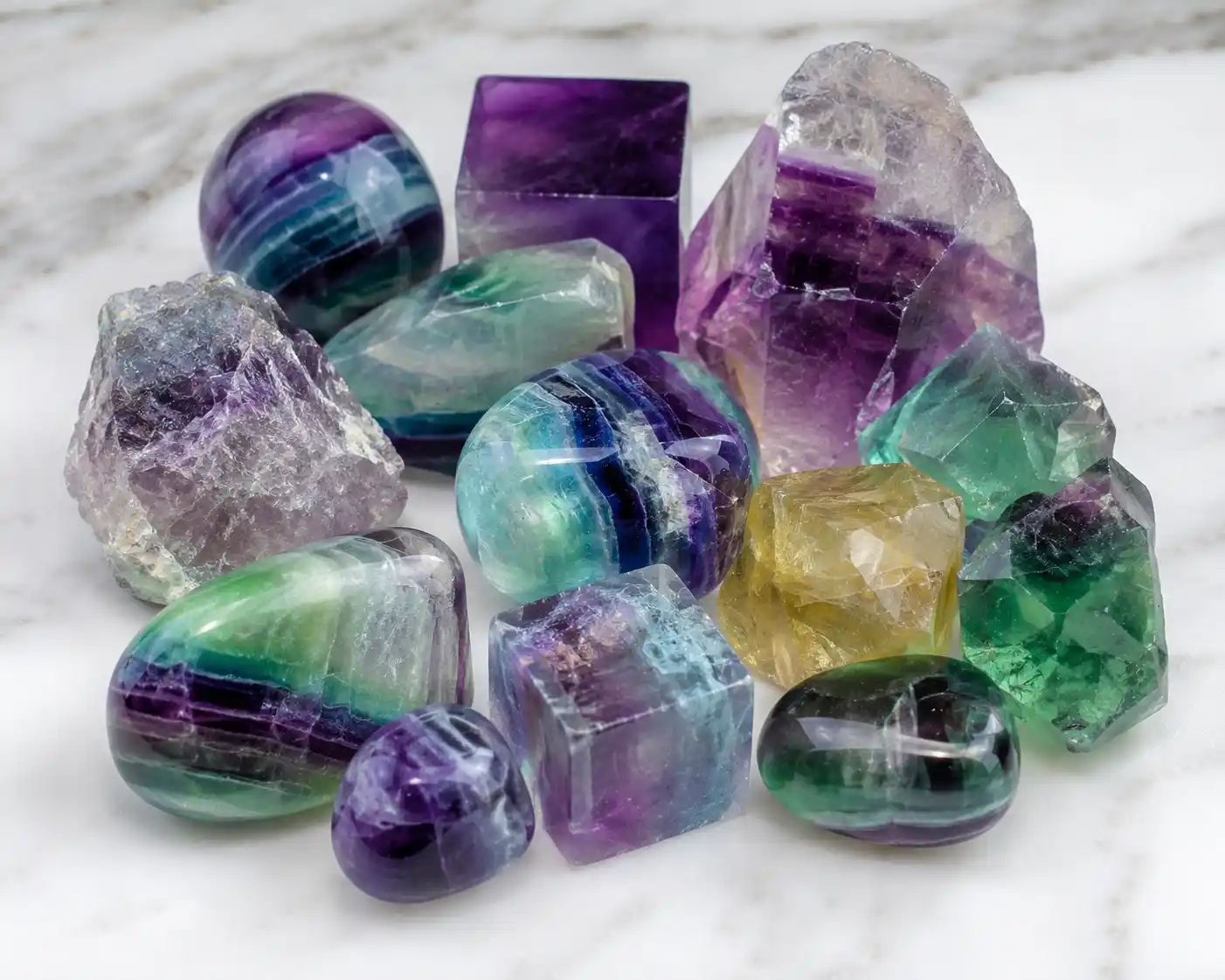
Fluorite Meaning: Healing Properties, Benefits & Uses
Fluorite meaning begins with calcium fluoride, CaF₂, not with the broad healing claims often attached to purple, green, blue, or multicolored crystals. Fluorite is a distinct mineral species that crystallizes in the cubic system and commonly forms cubes, octahedra, interpenetrating forms, massive material, crusts, and cleavable fragments. It is famous for an unusually wide range of natural colors, excellent octahedral cleavage, relatively low Mohs hardness of about 4, and the fluorescence displayed by some specimens under ultraviolet radiation. These physical properties can be examined and tested; symbolic descriptions such as clarity, focus, protection, emotional balance, or energetic cleansing belong to modern cultural and personal interpretation.
That distinction is especially important because fluorite meaning content often treats different evidence levels as though they were interchangeable. A crystal’s purple color is a measurable optical characteristic. The trace chemistry, radiation damage, structural defects, or color centers contributing to that appearance are mineralogical questions. A historical claim about fluorite being used as a flux can be checked against the documented development of the mineral’s name. A statement that purple fluorite “clears mental fog,” however, is symbolic unless a scientifically established physiological mechanism and evidence are supplied. Readers who enjoy crystal symbolism can still use fluorite reflectively, but the mineral does not need medical or supernatural claims to be interesting.
Within Gems Lore, other belief-centered stone references are grouped in the Healing Crystal section. On this page, fluorite meaning is approached material-first so that mineral identity, documented history, modern symbolism, and safety remain clearly separated.
Fluorite Meaning at a Glance
| Feature | Grounded reference |
|---|---|
| Mineral identity | Calcium fluoride |
| Formula | CaF₂ |
| Crystal system | Cubic/isometric |
| Common crystal forms | Cubes, octahedra, modified cubes and massive aggregates |
| Typical colors | Colorless, purple, green, blue, yellow, pink, brown, violet, multicolored and strongly zoned |
| Mohs hardness | About 4 |
| Cleavage | Perfect octahedral cleavage in four directions |
| Luster | Vitreous |
| Transparency | Transparent to translucent, sometimes opaque in massive material |
| Typical specific gravity | Around 3.1–3.2 in ordinary material |
| Refractive character | Singly refractive under ideal cubic behavior |
| Notable phenomenon | Some specimens fluoresce under ultraviolet radiation; not all fluorite does |
| Major geological environments | Hydrothermal veins, carbonate replacement systems, cavities, pegmatitic settings and related mineral deposits |
| Major practical use | Industrial fluorine source and historically important flux mineral; collector and ornamental material |
| Symbolic associations | Modern themes such as clarity, organization, focus or protection; not measured mineral effects |
| Main ownership limitation | Low hardness and perfect cleavage make fluorite easier to scratch, chip and split than many jewelry gems |
This framework gives fluorite meaning a useful starting point because color alone can be misleading. A bright green cube, deep purple cleaved fragment, banded polished slab, and pale blue octahedron may all be fluorite, yet their color mechanisms, provenance, inclusions, treatment history, and collector significance can differ substantially.
What Fluorite Actually Is
Fluorite is a halide mineral composed primarily of calcium and fluorine. Its cubic crystal structure is highly symmetrical, and well-developed specimens can form sharp cubes with smooth or stepped faces. Because the mineral cleaves perfectly along octahedral planes, a broken cube can yield triangular and octahedral fragments that look almost deliberately shaped. This cleavage is so characteristic that it is useful diagnostically, but intentionally breaking a good specimen merely to demonstrate it destroys the very object being examined.
The mineral’s hardness is also significant. Fluorite defines hardness 4 on the Mohs scale, meaning it is considerably softer than quartz and many common jewelry stones. That softness can be hidden by a highly polished surface: a flawless fluorite cabochon may look durable in a photograph while remaining vulnerable to scratches from harder household dust, accidental impacts, and contact with other gems.
Fluorite meaning should therefore start with an important ownership lesson: beauty does not imply toughness. A transparent faceted fluorite can show impressive brilliance and color, yet it remains a comparatively delicate collector gem. A natural crystal can preserve sharp edges and attractive surfaces, but those features may chip if the specimen is handled casually.
How Fluorite Forms
Fluorite forms in several geological settings, but hydrothermal activity is especially important. Hot mineral-bearing fluids can move through fractures, faults, cavities, and permeable rock, depositing fluorite as temperature, pressure, fluid chemistry, and interaction with host rocks change. Calcium must be available, fluorine must be present in the fluid system, and conditions must favor precipitation of CaF₂ rather than keeping those components dissolved.
This process commonly places fluorite beside minerals such as quartz, calcite, barite, sulfides, and other hydrothermal species. In carbonate rocks, mineralizing fluids can fill veins or replace portions of the original rock. In some igneous and pegmatitic settings, fluorine-rich late-stage fluids can also contribute to fluorite development. The exact assemblage, crystal habit, color, inclusions, and zoning depend on local chemistry and the sequence of mineralization.
Because similar geological processes occur in many regions, appearance rarely authenticates a specific locality. Purple cubes, green octahedra, and zoned crystals are produced in more than one deposit. A dramatic color combination can be characteristic of a famous locality without being exclusive to it.
Readers interested in fluid chemistry, host rocks, mineral associations, zoning sequences, and deposit styles can continue to fluorite formation and deposit geology rather than expecting this foundational fluorite meaning page to duplicate a dedicated geological analysis.
Why Fluorite Comes in So Many Colors
Pure fluorite can be colorless, but natural crystals occur in almost every major hue. Purple, violet, green, blue, yellow, pink, brown, and multicolored fluorite all appear in collections, sometimes within a single crystal. That diversity reflects a combination of structural defects, color centers, trace-element substitutions, natural irradiation, oxidation states, and other lattice-scale processes.
One of the most important cautions in fluorite meaning is that simple color formulas are often too confident. Statements such as “purple always comes from one element” or “green fluorite is always colored by another specific element” flatten a complex mineralogical problem. Similar visible colors can arise through different combinations of defects and impurities, and stones from different geological environments need not share identical color mechanisms.
Natural radiation can create or modify defect centers within the crystal lattice. Trace rare-earth elements can also influence optical absorption or luminescence in some specimens. Heating, irradiation, and other external processes can alter certain colors, which is one reason treatment history matters when commercial value depends on a particular appearance.
Color zoning provides additional geological evidence. A cube may have a colorless core surrounded by purple zones, alternating green and violet bands, or thin edge layers of stronger color. These patterns can reflect changes in fluid chemistry, defect formation, growth interruption, or later modification during crystal development.
The deeper relationship between color centers, zoning, fluorescence, optical response, and enhancement belongs in fluorite optical properties and color behavior. The dedicated fluorite color meaning page addresses color-by-color interpretation separately so this fluorite meaning reference does not become a repetitive catalog of purple, green, blue, and rainbow symbolism.
Fluorescence and Fluorite Are Historically Connected
Fluorite is closely associated with the scientific vocabulary of fluorescence because certain fluorite specimens emit visible light when exposed to ultraviolet radiation. The effect varies widely: some material fluoresces strongly, some weakly, some in different colors depending on wavelength, and some shows little or no obvious response.
Fluorescence is not evidence of metaphysical energy. Ultraviolet photons interact with defects or activator elements in the material, and the crystal can emit part of that absorbed energy at longer visible wavelengths. The phenomenon is physical and measurable.
This distinction matters because photographs showing fluorite glowing under ultraviolet light can easily be repurposed as proof that the stone “radiates energy” in ordinary conditions. The experiment demonstrates luminescence under specific excitation, not a supernatural field.
A specimen that does not fluoresce is not fake fluorite. Fluorescence is a variable property, not an identity requirement.
Diagnostic Traits That Help Identify Fluorite
Several characteristics combine to make fluorite relatively recognizable when good material is available. Cubic or octahedral crystal forms, perfect octahedral cleavage, hardness around 4, vitreous luster, specific gravity around the low 3s, and singly refractive cubic optical behavior are all useful. Color contributes supporting context but should never dominate identification.
Cleavage deserves special attention. Fluorite can separate along four equivalent octahedral directions, producing smooth triangular surfaces and octahedral fragments. Some commercially sold fluorite octahedra are natural cleavage pieces created from larger crystals rather than naturally grown octahedral crystals. That does not make them synthetic or fake; it means their shape was produced by cleavage rather than crystal growth.
Crystal faces and cleavage surfaces can sometimes be distinguished through surface texture. A growth face may show zoning, etching, stepped development, or natural surface features, while freshly cleaved surfaces can appear flatter and smoother. Magnification can help document these distinctions along with internal fractures, zoning, inclusions, healed cracks, and possible repairs.
The fluorite microscope inclusion notebook provides a dedicated framework for recording those features without claiming that one inclusion pattern proves locality or treatment status.
When the material is polished, mounted, unusually colored, or commercially important, additional testing may be needed. Refractive observations, spectroscopy, fluorescence behavior, density, microscopy, or other laboratory methods can strengthen an identification. No photograph can independently establish every technical claim.
An Original Fluorite Name, Specimen, and Photo Audit
Fluorite meaning becomes more reliable when familiar names are separated into mineralogical terms, trade descriptions, locality claims, and symbolic marketing. The table below identifies what common labels can reasonably communicate and what they cannot prove.
| Name or claim | What it can reasonably describe | What should not be assumed |
|---|---|---|
| Fluorite | CaF₂ mineral with fluorite structure | Specific locality or color origin |
| Purple fluorite | Fluorite with purple or violet body color | One universal coloring mechanism |
| Green fluorite | Green-colored fluorite | One specific trace element in every stone |
| Blue fluorite | Blue or blue-green fluorite | Geographic origin |
| Rainbow fluorite | Commercial term for multicolored or strongly zoned fluorite | Separate mineral species |
| Banded fluorite | Visibly layered or color-zoned material | One standardized variety |
| Blue John | Traditional name associated with distinctive banded fluorite from a specific English mining district | Any blue-purple-yellow banded fluorite from elsewhere |
| Fluorite octahedron | Octahedral-shaped fluorite | That the shape necessarily grew naturally rather than being cleaved |
| Yttrium fluorite / yttrian fluorite | Historical or compositional terminology for fluorite enriched in yttrium | A simple appearance-based identification |
| Rare-earth fluorite | Fluorite containing or claimed to contain rare-earth elements | Quantitative composition from fluorescence or color |
| Natural untreated | Seller or laboratory treatment statement | Proof merely because no treatment is visible |
| UV-reactive fluorite | Specimen that fluoresces under stated ultraviolet conditions | Metaphysical energy emission |
| AAA fluorite | Seller-specific commercial grade | Universal gemological quality standard |
| Healing fluorite | Metaphysical or commercial wording | Medical efficacy |
| Protection fluorite | Modern symbolic interpretation | Scientifically measurable protection |
This audit is particularly useful for “rainbow fluorite.” The name generally describes multicolored zoning rather than a separate mineral variety. Purple and green bands can make the material highly recognizable commercially, but the optical pattern remains fluorite color zoning.
“Blue John” requires even tighter boundaries. It is not a generic synonym for every blue, purple, or yellow banded fluorite. The traditional term carries geographic and historical associations, so using it for material without supporting provenance can erase the very distinction that gives the name meaning.
Natural Octahedron or Cleavage Octahedron?
Fluorite’s perfect cleavage creates one of the most interesting label problems in the mineral market. Octahedra occur as natural crystal forms, but highly regular octahedral pieces can also be produced by carefully cleaving larger fluorite crystals.
The resulting object is still natural fluorite. The question is how the shape originated.
A naturally grown octahedron may preserve growth textures, modifications, attached matrix, or other evidence of crystal development. A cleavage octahedron often has smooth triangular faces created when the larger specimen separated along cleavage planes.
Sellers should ideally distinguish “natural crystal form” from “cleaved fluorite octahedron” when the distinction matters to collectors. Calling both “natural fluorite” can be chemically accurate while still leaving an important specimen-history question unanswered.
Blue John and Locality-Based Names
Blue John is one of the better-known historic fluorite names and is associated with banded fluorite from the Derbyshire region of England. Its purple, blue, yellow, white, or mixed bands made it suitable for ornamental objects as well as mineral collecting.
The important point for fluorite meaning is that Blue John is not simply a color category. Its significance includes geographic and cultural provenance. A similarly banded fluorite from another country may look comparable while lacking the historical connection that makes the traditional name specific.
This principle applies to other locality-linked labels too. A seller may correctly recognize visual similarity to material from a famous district, but “looks like” does not equal documented origin.
Where geographic attribution matters, retain old labels, collection numbers, invoices, mine records, and any supporting chain-of-custody information. The fluorite provenance disclosure checklist provides a dedicated structure for distinguishing recorded provenance from visual inference.
The Documented History Behind the Name Fluorite
The name fluorite is connected with the Latin root meaning “to flow.” The mineral was historically valued as a flux because adding suitable fluorine-bearing material to metallurgical processes could help lower melting behavior and improve the flow of slags and related materials.
That etymology is mineralogical and technological, not spiritual. Modern crystal descriptions sometimes transform “flow” into claims that fluorite makes thoughts, energy, money, relationships, or emotions “flow.” That can function as a metaphor, but it is not what the historical name demonstrates.
Fluorite also has a long ornamental history because colored and banded material can be carved, polished, or fashioned into decorative objects. Its softness makes carving feasible compared with harder gems, although that same softness increases susceptibility to wear.
The scientific history surrounding fluorescence adds another important layer. Some fluorite specimens display strong luminescence under ultraviolet radiation, contributing to the terminology now used for fluorescence across many materials. Again, that documented optical history should not be rewritten as evidence for metaphysical radiation.
Fluorite Meaning in Modern Symbolism
Modern fluorite meaning commonly centers on clarity, organization, concentration, pattern recognition, emotional boundaries, and the idea of separating useful information from noise. Multicolored fluorite is sometimes framed around balance or integration, while purple, green, and blue stones receive additional color-specific symbolic interpretations.
These themes can be used constructively as personal prompts. A fluorite cube on a desk might become a reminder to define one problem clearly before attempting to solve it. A zoned crystal could serve as a cue to divide a complicated decision into separate layers: facts, assumptions, preferences, risks, and actions. A collector might use fluorite’s perfect cleavage as a metaphor for recognizing that apparent solidity can conceal directional weaknesses.
Those reflective uses are real in the sense that a person deliberately chooses the object as a reminder. The causal mechanism is attention, habit, association, or journaling—not a proven force transmitted from CaF₂ into the nervous system.
Fluorite meaning should therefore not be presented as evidence that the mineral automatically improves memory, raises intelligence, treats attention disorders, cures anxiety, eliminates depression, regulates emotions, or changes neurological function.
What About Fluorite “Healing Properties”?
The phrase “fluorite healing properties” is widely used in modern crystal culture, but the evidence boundary needs to be explicit. Mineralogical properties include hardness, cleavage, composition, optical behavior, crystal structure, and fluorescence. “Improves concentration,” “detoxifies the body,” “strengthens bones,” or “heals the nervous system” are medical or physiological claims and require medical-quality evidence rather than crystal tradition.
There is no established scientific basis for treating fluorite as a therapy for disease or mental-health conditions. Someone may find a fluorite object calming because they like its colors, because handling a familiar object is part of a reflective routine, or because it reminds them to slow down and organize a task. Those experiences should not be misrepresented as proof that fluoride ions or crystal energy are creating a clinical effect.
Readers should also avoid substituting crystal practices for appropriate professional care. The broader evidence and health boundary is explained in the site’s Disclaimer.
Fluorine in Fluorite Is Not Dental Fluoride Treatment
Fluorite contains fluorine as part of the calcium fluoride crystal structure. That chemistry should not be confused with the fluoride compounds and controlled concentrations used in dental or public-health contexts.
Touching fluorite does not deliver a measured dental dose. Wearing fluorite does not strengthen teeth or bones. Placing a specimen against the body does not make its fluorine content nutritionally or medically available in a controlled way.
This distinction illustrates a broader rule: an element’s presence in a mineral formula does not imply that the mineral provides the biological role associated with some other chemical form of that element.
Fluorite should not be licked, ingested, powdered for consumption, or intentionally placed in drinking water as a crystal elixir. Symbolic fluorite meaning does not require chemical exposure.
“Cleansing” Fluorite: Symbolic Practice Versus Material Care
Modern crystal practice often uses “cleansing” to mean a ritual reset, while gem and mineral care uses cleaning to mean physically removing dirt or residue. These are different activities.
Someone may choose a non-destructive symbolic ritual because it has personal meaning, but the ritual does not remove measurable metaphysical contamination because no such contamination has been established scientifically. More importantly, a symbolic routine should not damage the actual mineral.
Fluorite is soft and cleavable, so aggressive washing, repeated soaking, salt contact, thermal cycling, impacts, or abrasive methods can create physical risks depending on the specimen and associated matrix. The dedicated guide to how to cleanse fluorite keeps those symbolic practices and material limits separate instead of overloading this foundational fluorite meaning page.
Safe Ownership of Fluorite
Normal handling of an intact fluorite crystal or polished stone is fundamentally different from cutting, grinding, drilling, sanding, crushing, or heating mineral material. A stable display specimen can generally be examined with ordinary mineral-collection precautions, while processing creates dust, sharp cleavage fragments, and additional exposure routes.
Fluorite’s perfect cleavage makes broken edges and fragments an immediate mechanical concern. A dropped specimen can split unexpectedly along structurally favorable planes. Owners should handle fine crystals over a padded surface and avoid unnecessary pressure on corners or protruding crystals.
Lapidary processing should use appropriate wet methods, local dust control, eye protection, respiratory protection, and professional work practices rather than dry uncontrolled grinding. Material should never be deliberately inhaled or ingested.
The specialized challenges of orienting cleavage, controlling fracture, retaining color zoning, and achieving a polish are covered in fluorite cutting, orientation and polish.
Fluorite in Jewelry Requires Realistic Expectations
Fluorite can be faceted, carved, polished, and mounted, but hardness around 4 and perfect cleavage make it poorly suited to many high-impact jewelry situations. A ring worn during routine manual activity faces far greater risk than a protected pendant used occasionally.
Scratching is only part of the problem. Even if a surface remains polished, a sharp impact can exploit cleavage and split the stone. Thin faceted corners, exposed girdles, drilled areas, and existing internal fractures create additional vulnerabilities.
Jewelry engineering therefore needs to account for stone orientation, bezel or prong protection, wear frequency, and the possibility that replacement may be difficult for unusual collector material. Those design questions are treated in fluorite setting and wear engineering.
Buying Fluorite Without Buying the Story First
Fluorite is sold in a wide range of markets, from inexpensive cleaved octahedra to important locality specimens, transparent faceted stones, polished rainbow material, carvings, slabs, and highly aesthetic crystal clusters. Price differences can reflect size, color, transparency, crystal form, damage, provenance, rarity within a specific locality, preparation quality, and collector demand.
Symbolic language should not substitute for those material variables. A specimen described as “high-vibration,” “master healer,” or “rare chakra fluorite” does not acquire gemological rarity simply through wording.
Likewise, a famous locality name needs documentation when it materially increases price. Buyers comparing specimens should preserve seller descriptions but separate those descriptions from independent evidence.
Transaction-focused questions, including seller documentation and purchase comparison, belong on where to buy fluorite rather than being repeated here.
Preserving Fluorite Specimens
A natural fluorite specimen can preserve crystal faces, etching, zoning, inclusions, matrix relationships, associated minerals, old repairs, collection numbers, and historical labels. These features may matter more to a mineral collector than a polished surface.
Because fluorite is soft and cleavable, careless cleaning can scratch faces or dislodge crystals. Repeated handling can abrade edges. Poorly fitted boxes can allow specimens to knock against harder minerals, while aggressive removal of matrix may destroy geological context.
Color preservation can also matter for certain specimens because some color centers may change with prolonged exposure to intense light or heat. The degree of sensitivity varies, so blanket statements that every fluorite crystal will fade identically are inappropriate.
Long-term storage, condition photography, label preservation, cleaning decisions, and conservation records belong in fluorite specimen conservation and record keeping.
What Fluorite Meaning Can Reliably Tell You
A grounded fluorite meaning reference can explain that fluorite is calcium fluoride, describe its cubic crystal system and perfect octahedral cleavage, outline how hydrothermal and related geological systems form it, explain why color can arise through complex combinations of defects and trace components, and distinguish fluorescence from mystical energy.
It can also identify limits. Purple does not establish one universal coloring mechanism. Rainbow fluorite is not a separate mineral species. An octahedron may be natural-growth or cleavage-produced. Blue John is a locality-linked historical material rather than a generic label for all banded fluorite. Fluorescence does not prove a specimen is fluorite, and absence of fluorescence does not disprove fluorite.
A photograph can document habit, color zoning, transparency, cleavage, matrix, visible inclusions, condition, and apparent repairs. Exact color-center chemistry, trace-element composition, treatment status, and consequential locality claims may require specialist mineralogical or gemological examination.
Gems Lore’s approach to keeping measurable mineral facts separate from cultural interpretation is described on About Gems Lore. Readers with analytical data, provenance records, disputed terminology, or documented corrections can provide that evidence through Contact Gems Lore, with submitted information handled according to the Privacy Policy.
FAQ
What is the simplest fluorite meaning?
The simplest fluorite meaning is mineralogical: fluorite is calcium fluoride, CaF₂, a cubic mineral known for exceptional color variety, perfect octahedral cleavage, relatively low hardness, and fluorescence in some specimens. Modern symbolic associations with clarity, focus, or protection are interpretations rather than measurable mineral properties.
What are fluorite’s healing properties?
No scientifically established medical healing properties are demonstrated simply by wearing or holding fluorite. Crystal traditions may associate fluorite meaning with concentration, emotional balance, or mental organization, but these should be treated as symbolic practices rather than treatments for physical or mental-health conditions.
Why is fluorite purple or green?
Fluorite color can arise through structural defects, color centers, natural irradiation, trace elements, rare-earth components, and combinations of these mechanisms. The precise cause can vary among specimens, so one visible color should not automatically be assigned one universal element.
Is rainbow fluorite a separate mineral?
No. Rainbow fluorite is a commercial description for fluorite showing multiple colors or strong color zoning. The underlying mineral remains fluorite.
Is every fluorite octahedron naturally crystallized in that shape?
No. Fluorite can grow naturally in octahedral forms, but its perfect cleavage also allows larger crystals to be split into regular octahedra. A cleaved octahedron is still natural fluorite, but its shape did not necessarily form as a free-growing crystal.
Does all fluorite glow under ultraviolet light?
No. Fluorescence varies among specimens. Some fluorite fluoresces strongly, some weakly, and some may show little visible response under a particular ultraviolet wavelength. Fluorescence is useful supporting information but not a universal identity requirement.
Is Blue John the same as ordinary fluorite?
Blue John is fluorite, but the traditional name refers to distinctive banded material associated with a specific English locality and historical ornamental tradition. It should not be used generically for every purple, blue, or yellow banded fluorite.
Is fluorite safe to wear?
Fluorite can be worn in protected jewelry, but its hardness of about 4 and perfect cleavage make it relatively vulnerable to scratching and impact. Rings and exposed settings require more caution than occasional pendants or protected pieces.
Does fluorite provide beneficial fluoride to teeth or bones?
No. Fluorine bound within calcium fluoride crystal chemistry is not a controlled dental treatment or nutritional supplement. Wearing or touching fluorite does not provide a medically useful dose of fluoride.
Can I put fluorite in drinking water?
Direct crystal elixirs are unnecessary and are not recommended. The mineral may contain inclusions, surface residues, treatments, matrix materials, or other components that are not appropriate for ingestion, and fluorite meaning does not require consuming anything from the stone.
Can fluorite improve focus or memory?
There is no established evidence that fluorite chemically or energetically improves cognition. A person can use a fluorite specimen as a visual cue for organizing work, reducing distractions, or following a study routine, but the practical mechanism is the chosen behavior rather than a proven neurological effect of the crystal.
Fluorite Meaning Is Stronger When Color, History, and Symbolism Stay Separate
Fluorite meaning does not need to begin with promises of healing. The mineral already combines unusually rich color, elegant cubic symmetry, perfect octahedral cleavage, complex defect chemistry, variable fluorescence, hydrothermal geological history, industrial significance, and a long ornamental tradition. Each feature can be observed, studied, or documented without stretching the evidence.
The symbolic layer can then be added with clearer boundaries. A cubic fluorite crystal can become a personal reminder to impose structure on a complicated problem. Color zoning can inspire reflection on different layers of a decision. Cleavage can serve as a metaphor for hidden vulnerabilities, while fluorescence can remind a collector that some properties appear only under particular conditions. Those interpretations can be meaningful precisely because they are presented as interpretations.
Keeping those layers distinct protects the reader from unsupported medical claims while preserving what attracts many people to the stone in the first place. Fluorite meaning becomes more useful when the mineral’s real chemistry and history remain the foundation, and modern symbolism is allowed to remain human rather than being disguised as science.