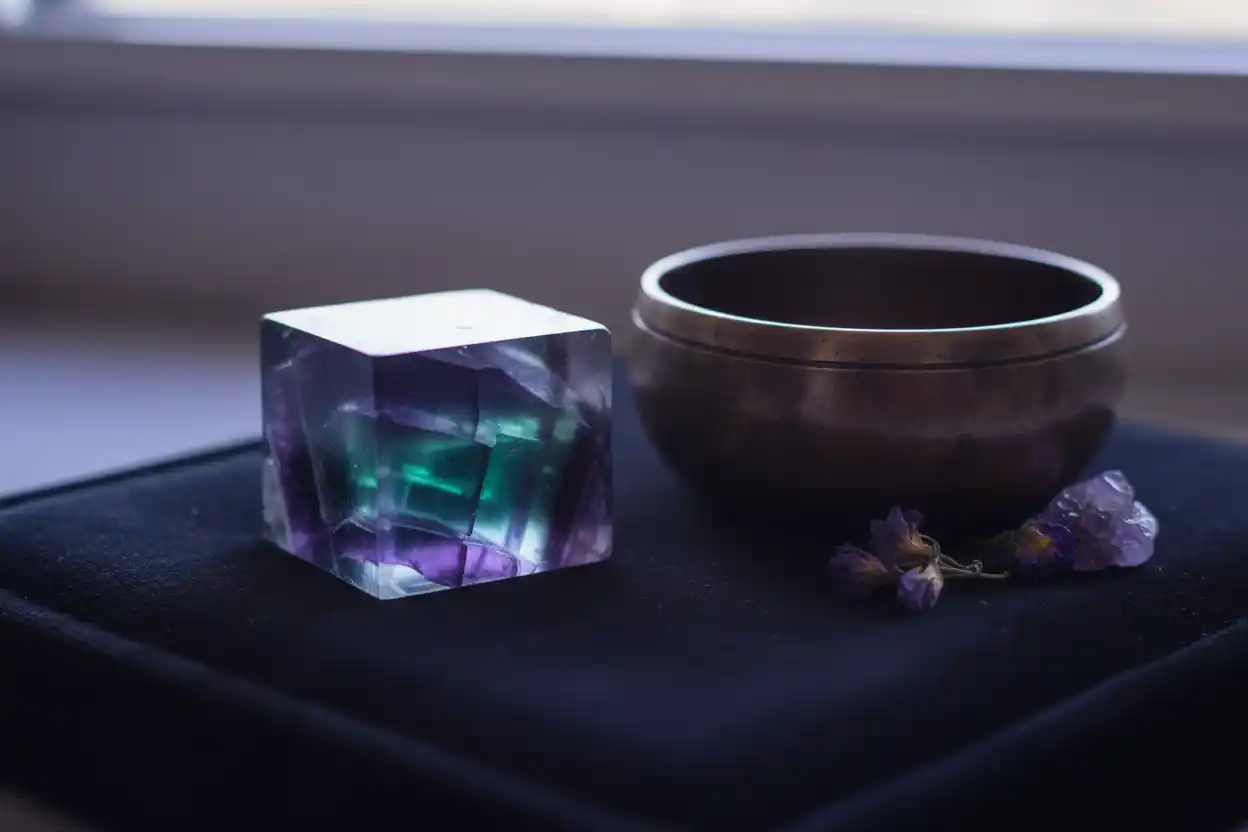
How to Cleanse and Charge Fluorite
The safest ways to cleanse and charge Fluorite are sound, intention, visualization, gentle breath, indirect indoor moonlight, a written dedication, and other dry, low-contact rituals.
Fluorite should not be soaked, exposed to salt, left in direct sunlight, placed in an ultrasonic or steam cleaner, or rubbed against harder crystals. It defines Mohs hardness 4, is brittle, and has four perfect cleavage directions that allow cubes to split into octahedral fragments.
What Cleansing and Charging Mean
Cleansing is a personal or spiritual ritual used to mark a fresh start, release previous associations, or prepare an object for meditation.
Charging generally means dedicating the stone to a purpose, routine, value, or symbolic role.
Neither process is required to preserve Fluorite as a mineral. No established scientific evidence shows that ritual cleansing changes its chemistry, health effects, crystal structure, fluorescence, or measurable physical energy.
The mineral’s geology, colors, deposits, and symbolic associations belong to the broader Fluorite guide.
Color-specific symbolism belongs separately to Fluorite Color Meaning.
Why Fluorite Needs Dry, Low-Contact Care
Fluorite is calcium fluoride and defines hardness 4 on the Mohs scale.
It commonly forms cubes and octahedra but may also occur as combinations, stepped crystals, rounded forms, botryoidal masses, fibers, grains, and massive material.
| Property | Ritual implication |
|---|---|
| Composition | Calcium fluoride |
| Crystal system | Cubic |
| Typical colors | Purple, green, blue, yellow, colorless, pink, red, brown, or multicolored |
| Mohs hardness | 4 |
| Tenacity | Brittle |
| Cleavage | Perfect in four octahedral directions |
| Common forms | Cubes, octahedra, combinations, masses, and zoned crystals |
| Safest ritual methods | Sound, intention, visualization, breath, and protected moonlight |
| Water exposure | Avoid soaking |
| Sunlight exposure | Avoid prolonged direct exposure |
| Main risks | Cleavage, broken corners, scratches, color fading, matrix damage, glue, and hard contact |
The gemstone hardness chart explains why glass, steel, Quartz, ceramic, and many common gemstones can scratch Fluorite.
Its perfect cleavage creates an even greater practical concern. A cube may break into octahedral fragments after a sharp blow or pressure in an unfavorable direction.
The difference between scratches and structural breakage appears in Gemstone Toughness vs Hardness and Gemstone Cleavage Explained.
Inspect the Fluorite Before Beginning
Examine the specimen under soft, indirect light.
Look for chipped cube corners, fresh cleavage surfaces, open fractures, loose crystals, crumbling matrix, cloudy glue, repaired sections, scratches, and color transfer.
Natural internal color zoning, phantom cubes, inclusions, and cleavage-related reflections are not dirt.
Do not press on a cleavage line or twist a crystal attached to matrix.
A loose faceted stone or polished palm stone may tolerate careful handling, while a cluster on Calcite, Barite, Quartz, Galena, or another matrix should remain on its stable base.
When the stone is damaged or treatment is uncertain, choose a non-contact method.
Physically Clean Dust Separately
Symbolic cleansing does not remove actual dust, fingerprints, or residue.
A stable polished Fluorite can be wiped lightly with a clean dry microfiber cloth.
A crystal cluster may be dusted with a very soft makeup brush or fine artist’s brush. Support it from beneath and brush away from exposed corners.
Do not use a stiff toothbrush, compressed-air can, vacuum nozzle, running tap, steam, or ultrasonic machine.
The complete equipment restrictions appear in Which Gemstones Can Go in an Ultrasonic Cleaner?.
When dirt is cemented to matrix or trapped between fragile crystals, professional mineral conservation is safer than household washing.
Method 1: Cleanse Fluorite with Sound
Place the Fluorite on a thick folded cloth or leave it securely in its display box.
Ring a bell, chime, tuning fork, or singing bowl nearby.
You may also hum, chant, clap gently, or play calm music at a comfortable volume.
Do not place Fluorite inside a metal singing bowl or directly against a vibrating surface. Its corners and cleavage planes can chip.
Several gentle tones are sufficient. Strong physical vibration offers no additional symbolic benefit.
Method 2: Use Intention
Leave the stone on its padded support.
Choose one concise purpose. Fluorite might serve as a reminder to organize information, protect uninterrupted study time, review a decision carefully, or complete one step before beginning another.
State the intention silently or aloud.
This method works for cubes, octahedra, clusters, carvings, polished objects, faceted stones, and mixed-mineral specimens.
The stone does not need to be held for the ritual to feel deliberate.
Method 3: Use Visualization
Place the Fluorite where it cannot roll, tip, or fall.
Imagine previous associations fading while its color zoning becomes linked with the chosen purpose.
Some practitioners visualize purple, green, blue, yellow, rainbow, white, or neutral light depending on the specimen.
The visualization is symbolic and does not alter the actual color centers inside the crystal.
Continue for several slow breaths or a few minutes.
Method 4: Use Breath at a Distance
Keep the specimen supported on a soft surface.
Take several slow breaths and exhale gently toward the space above it once or twice.
Do not blow strongly into a cluster or across loose matrix. Airflow can dislodge small fragments.
Avoid creating condensation on cool crystal faces.
State the intention after the brief breath ritual.
Method 5: Use Indirect Moonlight Indoors
Place Fluorite indoors near a window on a padded tray or inside a lined display case.
An hour, an evening, or overnight indoor placement may be used.
Do not place it outdoors. Dew, rain, grit, animals, falling debris, theft, and temperature changes create unnecessary risks.
Indirect moonlight avoids the strong ultraviolet exposure associated with direct sun.
The wider light-sensitivity framework belongs to Which Crystals Can and Can’t Go in the Sun.
Method 6: Use a Written Intention
Write one concise statement and place it beside the Fluorite.
A practical statement might involve completing a study session, reviewing evidence before deciding, or organizing a complicated project.
Do not move a fragile cluster solely to place paper beneath it.
Keep pens, clips, staples, and metal objects away from the crystal edges.
A written ritual allows the specimen to remain stable on its established support.
Method 7: Create a Dry Color-Based Arrangement
Place Fluorite near a journal, photograph, textile, or another object that reflects its color or intended purpose.
Use separate padded supports.
Do not stack Clear Quartz, Amethyst, Citrine, or other harder crystals on top of Fluorite. They can scratch it.
The wider color and variety framework appears in Types of Fluorite.
Direct contact is unnecessary for the arrangement to carry symbolic meaning.
Method 8: Use a Mindful Dry-Cloth Ritual
This method is appropriate for a stable polished Fluorite object without open fractures.
Place it on a padded surface and wipe once or twice with a very soft microfiber cloth.
Use minimal pressure and stop if the cloth catches against a chip, cleavage edge, or rough area.
Do not buff repeatedly. Friction and trapped grit can dull the polish.
As you wipe, focus on the intention associated with the object.
Clusters and matrix specimens should receive sound or visualization instead.
Purple Fluorite
Purple Fluorite can range from pale lilac to deep violet and may show zoning, phantoms, or alternating bands.
Its material-specific meaning and appearance belong to the Purple Fluorite guide.
Some purple coloration is associated with irradiation-related color centers and other structural effects. Prolonged strong light can change or weaken color in susceptible specimens.
Use sound, intention, visualization, and indirect moonlight rather than direct sun.
The identification distinction from purple quartz belongs to Fluorite vs Amethyst.
Green Fluorite
Green Fluorite may appear mint, apple green, blue green, yellow green, emerald-like, or deeply saturated.
Its material profile belongs to the Green Fluorite guide.
Some locality-specific green Fluorite is notably light sensitive, so display location matters.
Keep valuable green specimens away from direct windows, strong ultraviolet lamps, and continuously illuminated cabinets.
A dry indoor ritual is preferable to outdoor moonlight exposure that may continue into morning sunlight.
Rainbow Fluorite
Rainbow Fluorite contains multiple color bands or zones within one specimen.
Its material profile belongs to the Rainbow Fluorite guide.
The boundaries reflect changes during crystal growth rather than layers that need separate cleansing.
Do not scrub a color transition or try to intensify a weak band through sunlight.
The entire specimen can be included in one sound, intention, or visualization ritual.
Yellow and Yttrian Fluorite
Yellow Fluorite ranges from pale straw to golden or brownish yellow. Its individual profile appears in the Yellow Fluorite guide.
Yttrian Fluorite contains significant yttrium substituting within the structure and may display distinctive color or optical characteristics. Its material profile belongs to the Yttrian Fluorite guide.
Neither variety becomes more durable because of its color or trace-element composition.
Both retain Fluorite’s Mohs hardness 4 and perfect octahedral cleavage, so dry rituals remain appropriate.
Avoid Prolonged Direct Sunlight
Fluorite color can come from several causes, including trace elements, defects, irradiation-related centers, and microscopic structures.
Some specimens are much more light stable than others.
Because the owner rarely knows the exact color mechanism, prolonged direct sunlight is an unnecessary risk.
Brief ordinary room viewing differs from leaving a specimen in a sunny window for days or months.
Keep valuable or locality-sensitive Fluorite in indirect light and use moonlight indoors only when morning sun cannot reach it.
Do Not Soak Fluorite
Water is not required for symbolic cleansing.
Soaking can enter cleavage openings, loosen matrix, affect glue, mobilize dirt, leave deposits, and increase the chance of dropping a wet, slippery crystal.
A polished sound piece may tolerate a quick damp wipe when physical cleaning is necessary, but repeated immersion offers no ritual advantage.
The wider water-selection framework appears in Which Crystals Can and Can’t Go in Water.
When the specimen contains Calcite, Barite, Galena, Pyrite, clay, repairs, or unknown matrix, use dry methods only.
Avoid Salt and Saltwater
Salt can scratch Fluorite and lodge inside cleavage openings, crystal clusters, and matrix cavities.
Saltwater adds moisture and may leave residue after evaporation.
Do not bury Fluorite cubes or octahedra in coarse salt.
When salt has symbolic importance, keep it in a separate lined bowl while the Fluorite remains several centimeters away.
Avoid Soil Burial
Soil contains Quartz grains that can scratch Fluorite easily.
It also introduces moisture, organic acids, fertilizers, microorganisms, staining material, pressure, and the risk of losing the specimen.
A nature-based alternative places the stone near a plant while keeping it dry on a separate padded dish.
Do not place a Fluorite cluster directly against ceramic pots or stone trays.
Avoid Smoke Residue and Heat
A brief cool-smoke ritual may be used cautiously in traditions that include it.
Keep Fluorite away from candles, hot ash, incense coals, heated bowls, fireplaces, and radiators.
Smoke can leave soot or oils on pale and transparent crystal faces. Removing that residue may require more handling than the ritual justifies.
Sound and visualization are cleaner alternatives.
Avoid Crystal Water and Destructive Testing
Do not place Fluorite directly in drinking water or prepare elixirs by soaking it.
Commercial specimens may contain associated minerals, surface treatments, repairs, polishing compounds, or contaminants that have not been evaluated for ingestion.
Do not lick, grind, burn, heat, or intentionally create dust from Fluorite.
Ordinary intact display differs from ingesting minerals or exposing the body to dust. The broader handling framework belongs to the Toxic Crystals safety list.
Treatments, Coatings, and Imitations
Fluorite may be irradiated, coated, filled, dyed, stabilized, glued, repaired, or imitated with glass and other materials.
Treatment can alter light stability, solvent resistance, and surface durability.
The broad enhancement framework belongs to Gemstone Treatments Explained.
Do not use sunlight, heat, chemicals, scratching, or ultraviolet exposure as a home authenticity test.
The purchase and condition workflow belongs to Where to Buy Real Fluorite.
General Cleansing Context
The tracker’s broader How to Cleanse Crystals guide compares sound, moonlight, water, smoke, indirect salt, earth-adjacent methods, intention, and companion objects.
This page retains ownership of Fluorite’s perfect cleavage, Mohs hardness 4, color zoning, sunlight sensitivity, matrix risks, and handling boundaries.
When a general ritual conflicts with those properties, the Fluorite-specific limit should take priority.
Frequently Asked Questions
1. What is the safest way to cleanse Fluorite?
Use sound, intention, visualization, gentle breath at a distance, a written dedication, or indirect indoor moonlight.
2. Can Fluorite be cleansed in water?
Soaking is not recommended. A stable polished piece may receive a quick damp wipe when physical cleaning is necessary.
3. Can Fluorite be left in moonlight overnight?
Yes, when kept indoors on a padded support and removed before direct morning sunlight reaches it.
4. Can Fluorite be charged in sunlight?
Prolonged direct sunlight is not recommended because some Fluorite colors can fade.
5. Can Fluorite be cleansed with salt?
No. Salt can scratch the mineral and lodge inside cleavage openings or clusters.
6. Can Fluorite be cleansed with smoke?
A brief cool-smoke ritual is possible, but sound or visualization avoids soot and residue.
7. Can Fluorite touch Clear Quartz?
Use a soft barrier. Quartz is substantially harder and can scratch Fluorite.
8. Why does Fluorite break into octahedral shapes?
Its four perfect cleavage directions allow cubes and other forms to split along octahedral planes.
9. Can Fluorite be placed in drinking water?
No. Direct-soak crystal water is not recommended because identity, treatments, associated minerals, and contamination may be uncertain.
10. Are all Fluorite colors cleansed the same way?
Yes. Color causes vary, but every variety retains the same basic softness, brittleness, and cleavage.
11. How long should Fluorite be charged?
A few minutes or an evening is sufficient. There is no scientifically required duration.
12. Does cleansing change Fluorite scientifically?
No established evidence shows that cleansing changes its chemistry, health effects, fluorescence, or measurable physical energy.
Conclusion
Fluorite’s vivid colors and geometric crystals conceal a fragile structure defined by softness, brittleness, and four perfect cleavage directions. Sound, intention, visualization, and protected moonlight provide meaningful rituals without introducing salt, water, hard contact, or direct sunlight. The safest method preserves every corner, color zone, and matrix attachment exactly as it was.
Crystal cleansing and charging are spiritual or personal practices, not scientifically established methods for changing health, energy, or the physical properties of Fluorite.