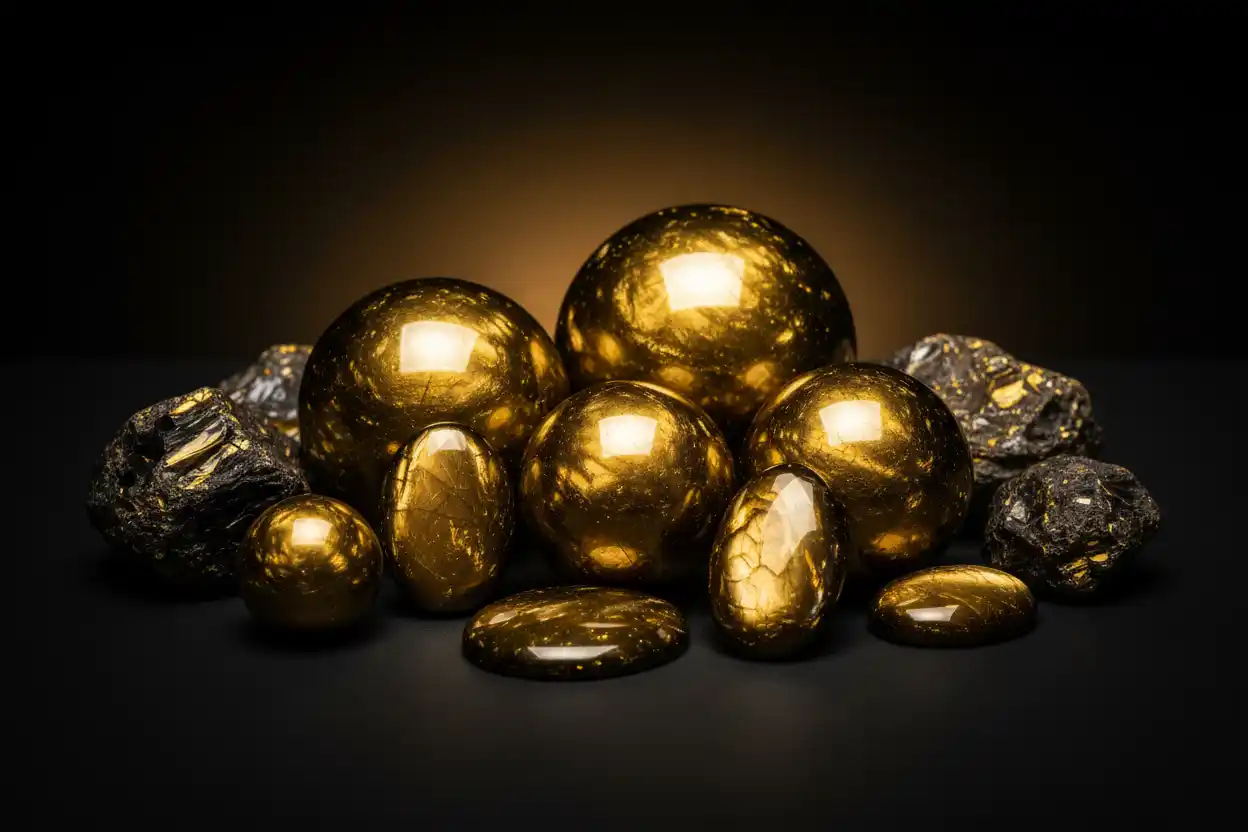
Golden Obsidian Meaning: Properties, Uses & Symbolism
Golden obsidian meaning begins with natural volcanic glass rather than a crystalline gemstone. The material usually sold as golden obsidian, gold-sheen obsidian, or golden-sheen obsidian is a variety of obsidian that displays a directional golden reflection against a dark glassy body. Obsidian itself forms when silica-rich volcanic melt cools quickly enough that extensive crystal growth is inhibited. USGS describes obsidian as dense volcanic glass, usually rhyolitic in composition, characterized by its glassy structure and conchoidal fracture rather than the ordered atomic lattice of a mineral crystal.
The golden effect does not require metallic gold. Gemological references describe sheen obsidian as black to brown volcanic glass whose golden sheen is produced by microscopic gas bubbles arranged along flow layers created while the molten material was moving before solidification. Mindat documents the same basic mechanism in a gold-sheen obsidian specimen, describing the sheen as resulting from a pattern of microscopic gas bubbles.
That physical explanation provides the correct foundation for golden obsidian meaning. Volcanic-glass formation, gas bubbles, flow texture, hardness, density, fracture, and optical behavior are material facts. Archaeological use of obsidian can be documented historically. Associations with grounding, reflection, protection, confidence, or personal insight belong to modern symbolic interpretation unless a specific historical source demonstrates otherwise. Related material-first references appear throughout the Gemstone Guides, but this page remains focused on golden obsidian itself.
Golden Obsidian Meaning at a Glance
| Question | Evidence-aware answer |
|---|---|
| What is golden obsidian? | Natural sheen-bearing obsidian, a volcanic glass |
| Is it a mineral crystal? | No. Obsidian is amorphous volcanic glass rather than a crystalline mineral species |
| Typical body color | Black, dark brown, or brown-black |
| Golden visual effect | Directional reflection or sheen |
| Main reported cause of sheen | Microscopic gas bubbles aligned with volcanic flow structure |
| Does it contain metallic gold? | The golden sheen does not require gold metal |
| Mohs hardness | Commonly about 5–5.5 for sheen obsidian |
| Specific gravity | Approximately 2.33–2.50 in gemological references |
| Refractive index | Approximately 1.45–1.55, depending on glass composition |
| Fracture | Conchoidal, capable of forming extremely sharp edges |
| Crystal system | None; amorphous |
| Common uses | Cabochons, carvings, beads, spheres, ornaments, specimens |
| Historical significance | Obsidian has extensive archaeological use as cutting tools and traded material |
| Modern symbolism | Often associated with reflection, grounding, self-examination, boundaries, or confidence |
| Scientific status of symbolism | These themes are interpretive, not demonstrated medical or physiological effects |
| Main safety distinction | Intact polished material differs from broken edges and dust-generating lapidary work |
Gemdat reports sheen obsidian at approximately Mohs 5–5.5, specific gravity around 2.33–2.50, an isotropic optical character, amorphous structure, and conchoidal fracture. These values provide useful reference points, although natural volcanic glass varies in composition and can contain bubbles, crystals, flow structures, and other heterogeneities.
What Is Golden Obsidian?
Golden obsidian is an appearance-based variety of obsidian. Its foundation is volcanic glass created when viscous, generally silica-rich magma cools without developing the abundant crystals found in most igneous rocks. USGS notes that rhyolitic obsidian commonly forms from high-silica magma whose viscosity and rapid cooling inhibit crystal growth, leaving a dense glass.
Because glass lacks long-range crystalline order, calling golden obsidian a “crystal” is technically imprecise in mineralogical discussion even though crystal shops often use the word broadly. It is better described as a natural volcanic glass or mineraloid. It can nevertheless be a genuine geological material, just as a natural material does not have to be crystalline to be scientifically interesting or collectible.
The golden sheen is an additional optical characteristic within that glass. It can appear strongly from one viewing angle and almost disappear from another, which makes orientation important both for identifying the phenomenon and for cutting attractive polished pieces.
Golden Obsidian Identity Table
| Characteristic | Golden obsidian |
|---|---|
| Material class | Natural volcanic glass |
| Typical composition | Usually silica-rich/rhyolitic volcanic glass |
| Structure | Amorphous |
| Typical color | Black to dark brown |
| Characteristic feature | Gold-colored directional sheen |
| Reported sheen mechanism | Microscopic gas bubbles aligned within flow layers |
| Transparency | Commonly opaque to translucent in thinner areas |
| Luster | Vitreous |
| Hardness | About 5–5.5 |
| Specific gravity | Roughly 2.33–2.50 |
| Fracture | Conchoidal |
| Cleavage | No mineral cleavage in the crystalline sense |
| Common internal features | Gas bubbles, flow structures, occasional mineral inclusions and devitrification features |
| Main identification caution | Black glass with gold-looking reflections is not automatically natural gold-sheen obsidian |
| Main trade-name caution | “Golden” describes appearance; it does not establish metallic gold content |
The identity table is a screening framework rather than authentication. Manufactured glass can be dark and reflective, and other natural obsidians can show silver, rainbow, mahogany, snowflake-like, or flow-banded appearances. Where a high-value specimen, unusual locality, or authenticity claim matters, multiple gemological observations should agree before certainty is increased.
How Golden Obsidian Forms
Obsidian forms during volcanic activity when viscous magma cools rapidly enough to preserve a glassy structure. Rhyolitic magma is particularly suited to this because its high silica content produces strong viscosity, slowing atomic movement and making crystal growth difficult during cooling. USGS describes obsidian flows as glass-rich products of rapidly cooled rhyolitic lava and notes that volcanic glass can retain evidence of flow, fracturing, degassing, and later alteration.
Golden obsidian adds another structural requirement: the glass must preserve microscopic features capable of producing the sheen. Gemological references attribute the gold-sheen effect to gas bubbles arranged in layers generated by movement of the molten lava before solidification. The bubbles therefore record aspects of volcanic flow and degassing rather than the presence of an added golden pigment.
The detailed eruption sequence, cooling behavior, geological setting, and deposit interpretation belong in the Golden Obsidian Formation and Deposit Geology guide. On this meaning page, the key point is that volcanic transformation can inspire symbolic comparisons without proving that the material causes personal transformation.
What Causes the Golden Sheen?
The golden appearance is an optical effect created when light interacts with microscopic internal structures. In gold-sheen obsidian, aligned gas bubbles are the commonly cited cause. Their orientation follows flow structures created while the volcanic melt was still moving. When light strikes those layers at a favorable angle, the reflected and scattered light can create a broad gold or bronze-looking flash across the dark surface.
This explains an important observation: golden obsidian does not look equally golden from every direction. A cabochon may display a dramatic sheen face-up but become nearly black after a small rotation. A rough specimen can contain several flow orientations, causing the effect to appear irregularly across different surfaces. The cutter must therefore understand the direction of the internal structure if the finished piece is intended to display strong sheen.
The deeper relationship between lighting, orientation, transparency, flow banding, refractive behavior, and sheen belongs in the Golden Obsidian Optical Properties and Color Behavior guide.
Does Golden Obsidian Contain Gold?
A gold-colored sheen is not evidence of metallic gold. The established optical explanation relies on microscopic bubbles and flow structure rather than visible gold particles. A seller should therefore not imply that ordinary gold-sheen obsidian contains precious-metal gold simply because the reflected light looks golden.
This distinction is commercially important because phrases such as “gold-infused,” “natural gold inside,” or “contains real gold energy” can transform an optical description into an unsupported compositional claim. If metallic gold is specifically alleged, that is a chemical or mineralogical question requiring evidence independent of the trade name.
Color is an observation. Composition requires identification.
Diagnostic Traits of Golden Obsidian
An initial examination should establish whether the object behaves like natural volcanic glass. Look for a vitreous surface, conchoidal fractures on rough or chipped areas, flow structures, variable translucency at thin edges, small bubbles, and a directional sheen that changes as the specimen rotates under a fixed light source. USGS emphasizes conchoidal fracture as a characteristic of obsidian, while gemological references report gas bubbles and undulating flow structures among common internal features.
Microscopy becomes particularly useful because it can reveal whether the golden phenomenon corresponds to dense bubble layers or whether the object contains metallic glitter, manufactured swirls, mold-related features, or other structures inconsistent with natural sheen obsidian. The mapped Golden Obsidian Microscope Inclusion Notebook owns that detailed inclusion analysis.
No single photograph can prove all relevant properties. An important specimen may require refractive-index work, specific-gravity testing, microscopy, spectroscopy, or other appropriate gemological examination, particularly if natural origin or unusual provenance materially affects value.
Golden Obsidian Is Glass, but Glass Does Not Mean Fake
One of the most persistent misunderstandings around golden obsidian meaning comes from using “glass” as a synonym for imitation. Obsidian is genuinely natural glass. It forms geologically when volcanic melt cools into an amorphous solid instead of crystallizing extensively.
Manufactured glass is also glass, but its origin is different. Therefore, establishing that an object is glass does not by itself establish whether it is natural obsidian or an artificial imitation.
A useful identification sequence asks two separate questions: Is the material glass? If so, is the evidence consistent with natural volcanic obsidian or manufactured glass? Internal structures, chemistry, inclusions, surface features, and provenance can help answer the second question.
Original Information Gain: Golden Obsidian Specimen and Photo Checklist
The following checklist separates observations that can reasonably be made from photographs from claims that require stronger evidence.
| Claim or observation | Photograph may support | Photograph usually cannot prove | Better evidence when important |
|---|---|---|---|
| Dark black or brown body color | Yes | Exact glass chemistry | Direct examination or analytical testing |
| Gold-colored sheen | Yes | Physical cause of every reflective feature | Orientation study and microscopy |
| Directional sheen | Often | Exact bubble geometry | Microscopy |
| Conchoidal fracture | Often on rough material | Natural volcanic origin by itself | Combined physical and analytical evidence |
| Rounded bubbles | Sometimes | Whether all bubbles are natural volcanic features | Microscopy and broader inclusion context |
| Flow banding | Often | Exact volcanic locality | Provenance records |
| Natural obsidian | Appearance may be consistent | Natural versus manufactured glass conclusively | Gemological/laboratory examination |
| Metallic gold | Reflective color may be visible | Elemental gold content | Chemical/mineralogical analysis |
| Specific mine or region | Label can state the claim | Geographic origin | Traceable provenance |
| “Ancient sacred stone” | Listing can repeat the phrase | Historical truth | Archaeological or documentary evidence |
| “Protective energy” | Nothing measurable in a photo | A physical protective field | Remains spiritual interpretation |
| “Healing effect” | Nothing measurable in a photo | Medical efficacy | Appropriate medical evidence would be required |
| “Rare grade” | Attractive appearance can be documented | Standardized rarity or grade | Defined criteria and market/locality evidence |
| Untreated | Natural-looking surface may be visible | Complete treatment history | Disclosure and specialist examination |
This framework prevents visually compelling material from carrying claims its appearance cannot support. A strong golden flash can confirm that an attractive optical effect exists; it cannot prove metallic gold, a famous locality, medical action, or ancient spiritual continuity.
Original Source-Comparison Framework
Golden obsidian claims should also be matched to the type of source capable of answering them.
| Source type | Best used for | Main limitation |
|---|---|---|
| Geological survey | Volcanic-glass formation, rhyolitic magma, fracture, eruption processes | Usually does not address crystal-market symbolism |
| Gemological reference | Optical properties, hardness, inclusions, natural versus imitation questions | May not reconstruct full archaeological history |
| Mineral database | Naming, specimen localities, recorded varieties and observations | Individual records vary in evidentiary depth |
| Archaeological publication | Artifact use, sourcing, trade, manufacturing and historical context | Does not prove modern metaphysical meanings |
| Collection label | Specimen-specific provenance | Reliability depends on chain of custody |
| Retail listing | Current commercial terminology | Marketing statements require verification |
| Metaphysical source | Documents current symbolic beliefs | Does not establish physical or medical mechanisms |
| Personal testimony | Records individual experience | Cannot establish universal or reproducible effects |
The source should fit the claim. A geological survey can explain volcanic glass. A microscope can help evaluate bubbles. Archaeology can document ancient obsidian use. None of those automatically validates a statement that golden obsidian alters health, luck, or another person’s behavior.
Documented Human History of Obsidian
Obsidian has an exceptionally well-established archaeological history because its conchoidal fracture allows it to produce extremely sharp edges. USGS notes its long use for tools and weapons, while Smithsonian research documents obsidian artifacts in early human exchange networks, showing that valuable volcanic glass was transported considerable distances from geological sources.
This history concerns obsidian broadly. It does not prove that ancient toolmakers isolated the modern commercial category “golden obsidian” or attributed current crystal-healing meanings to gold-sheen material. Archaeological specimens may be sourced chemically to specific volcanic deposits and studied for technology and trade, but symbolism needs its own contextual evidence.
A statement such as “people have valued obsidian for an extremely long time” is well supported. A statement such as “ancient cultures universally used golden obsidian for manifestation” is not supported merely by the existence of ancient obsidian artifacts.
Golden Obsidian Meaning in Modern Symbolism
Modern golden obsidian meaning commonly centers on reflection, grounding, boundaries, confidence, self-examination, discernment, and recognition of personal patterns. Its appearance naturally supports this symbolism: a dark stone can seem almost featureless until light reaches the internal structure at the correct angle, when a broad golden sheen suddenly becomes visible.
That optical behavior lends itself to a useful metaphor. Information or motives that are not obvious from one perspective may become clearer when examined differently. A person might therefore use a polished stone while journaling about a decision, identifying assumptions, or reviewing whether personal boundaries are being respected.
The symbolic usefulness comes from intentional reflection. It does not require the glass to emit a medically active energy field.
Golden Obsidian and Self-Reflection
Self-reflection is one of the more defensible themes within golden obsidian meaning because it can be translated directly into behavior. A person can use the specimen as a cue to ask: What evidence do I have? What am I assuming? What am I avoiding? Which part of this situation is within my control?
The stone does not answer those questions. It acts only as a chosen reminder to ask them.
That distinction matters because claims that golden obsidian automatically reveals hidden truths, detects lies, or exposes another person’s intentions go beyond symbolism. A gemstone cannot reliably determine honesty, read thoughts, or substitute for evidence.
Golden Obsidian and Grounding
Modern crystal practitioners often associate golden obsidian meaning with grounding. In a practical context, grounding can mean redirecting attention toward immediate facts, physical surroundings, current responsibilities, or one manageable next action.
A polished piece may function as a tactile reminder during that process. Someone can hold it while slowing down, reviewing a written list, or returning attention to the present task.
No established scientific evidence shows that golden obsidian itself regulates the nervous system, alters brain activity, treats anxiety, or produces a specific physiological grounding response. The reflective practice and the material object should remain conceptually separate.
Golden Obsidian and Protection
Protection language is common around obsidian, but it needs careful definition. Symbolically, a person may use golden obsidian as a reminder of boundaries, risk awareness, or deliberate decision-making. That kind of protection refers to behavior.
The stone cannot guarantee protection from accidents, violence, illness, financial loss, supernatural harm, or manipulation. It cannot replace locks, protective equipment, medical care, legal safeguards, financial controls, or personal safety planning.
A symbolic object can represent a boundary. It does not physically enforce one.
Golden Obsidian and Confidence
The golden sheen can also inspire associations with confidence, visibility, achievement, or personal strength. A responsible use might connect the stone with a specific behavior: prepare thoroughly, speak clearly, review a decision, or complete a delayed task.
Golden obsidian does not guarantee career advancement, wealth, successful manifestation, romantic success, or another person’s approval. Those outcomes depend on circumstances and actions far beyond the mineral object.
This is particularly important when golden obsidian meaning is used in commercial claims promising guaranteed prosperity or influence.
Golden Obsidian Versus Goldstone
Golden obsidian and goldstone can both show warm reflective effects, but they are materially different. Goldstone Meaning concerns manufactured glass containing numerous reflective metallic crystals, whereas gold-sheen obsidian is natural volcanic glass whose sheen is associated with aligned microscopic bubbles.
The visual distinction can be striking. Goldstone typically displays abundant discrete sparkling points throughout the glass, while golden obsidian more often produces a broad directional sheen that changes with orientation.
Neither name should be used interchangeably simply because both materials can look golden.
Golden Obsidian Versus Golden Healer Quartz
Golden Healer Quartz Meaning concerns crystalline quartz with iron-related staining or mineralization. Golden obsidian is amorphous volcanic glass whose characteristic gold sheen is associated with internal bubble structure.
The two materials therefore differ in atomic structure, geological origin, hardness, fracture behavior, and mechanism of color or sheen. A warm golden appearance is not evidence that they belong to the same mineral family.
This comparison illustrates why commercial color names should never replace material identification.
Golden Obsidian Versus Goethite
Goethite Meaning covers FeO(OH), an iron oxyhydroxide mineral commonly appearing yellow-brown, brown, or black. Golden obsidian does not need goethite to produce its characteristic gold-sheen phenomenon; microscopic gas bubbles provide the established explanation for typical sheen obsidian.
If a specific obsidian specimen has a yellow-brown surface coating claimed to be goethite, that becomes a separate mineral-identification question. The golden sheen itself should not automatically be called an iron-mineral coating.
The appearance and the composition must be distinguished.
A Crystalline Contrast: Goshenite
For comparison with a transparent crystalline gem rather than volcanic glass, Goshenite Meaning covers colorless beryl. Goshenite possesses an ordered crystal structure, characteristic refractive properties, cleavage and fracture behavior, and mineral chemistry completely different from obsidian.
This contrast helps clarify why “crystal” should not be used as a technical synonym for every polished stone. Golden obsidian can be natural and gemologically interesting while remaining glass.
Cutting and Orientation
Gold-sheen obsidian presents an orientation challenge because the visual effect depends strongly on the relationship between internal bubble layers and the finished surface. Cutting without considering that direction can leave a cabochon that appears almost uniformly black despite attractive sheen being present in the rough.
At the same time, obsidian’s conchoidal fracture produces sharp edges. Sawing, grinding, shaping, and polishing should therefore be approached as lapidary work, not casual experimentation. The detailed workmanship decisions belong in the Golden Obsidian Cutting, Orientation and Polish guide.
The important meaning-page boundary is that attractive sheen does not make the material mechanically invulnerable.
Jewelry Wear and Durability
With hardness commonly around 5–5.5, golden obsidian is softer than quartz and many familiar faceted gemstones. Its polished surface can therefore accumulate scratches and abrasion during regular wear, while its brittle glass structure can chip when struck.
Jewelry format matters. A pendant or earring generally experiences fewer hard impacts than an exposed ring or bracelet. Rounded cabochons can also avoid the thin sharp corners present in some faceted designs.
The engineering side of mounting, edge protection, setting pressure, and appropriate wear belongs in the Golden Obsidian Setting and Wear Engineering guide.
Safe Ownership: Intact Stone Versus Broken Glass
Intact polished golden obsidian presents a very different physical situation from freshly fractured material. Obsidian breaks conchoidally and can form extraordinarily sharp edges; USGS specifically notes that obsidian fracture can produce edges sharper than very fine steel blades.
A broken specimen should therefore be handled cautiously rather than treated like an ordinary rounded stone. Deliberately striking obsidian to test authenticity is unnecessary and creates both specimen damage and laceration risk.
Lapidary cutting, drilling, sanding, crushing, and grinding introduce additional concerns from fine particulate matter and flying fragments. Wet methods, eye protection, appropriate respiratory controls, equipment guards, good housekeeping, and material-specific professional practices are preferable to dry uncontrolled processing.
Do Not Powder or Ingest Golden Obsidian
Golden obsidian should not be ground into powder, eaten, added to supplements, or used in drinking-water preparations for metaphysical purposes. A geological material is not transformed into medicine or nutrition because it contains silica or trace elements.
Natural obsidian can also contain tiny crystals, inclusions, alteration products, surface contamination, polishing residues, or other components not obvious from a trade name.
There is no reason to create an ingestion exposure in order to engage with golden obsidian meaning symbolically.
Specimen Conservation
Polished obsidian can scratch when stored against harder minerals, while unpolished specimens can contain delicate flow surfaces, weathered areas, sharp fracture edges, or attached matrix. Individual wrapping or separated compartments reduce unnecessary abrasion and collisions.
Documentation deserves similar care. Record dimensions, weight where useful, photographs under several lighting angles, locality claims, acquisition source, prior labels, and any known cutting or polishing history. Because sheen changes strongly with orientation, a useful collection record should include at least one image showing the maximum gold effect and another showing the dark body under neutral illumination.
The Golden Obsidian Specimen Conservation Record provides the mapped framework for preserving those observations without turning this article into a collection-management manual.
Provenance and Locality Claims
Obsidian occurs in volcanic regions around the world, and chemically distinct sources can sometimes be differentiated well enough for archaeological sourcing studies. That does not mean an owner can determine locality from sheen, color, or a photograph.
A claim such as “Mexican golden obsidian,” “California sheen obsidian,” or another named origin should therefore remain proportional to its documentation. Original labels, supplier records, field information, previous collection history, and analytical sourcing data can strengthen provenance.
The Golden Obsidian Provenance Disclosure Checklist is the appropriate place for distinguishing verified, documented, seller-reported, and unknown origins.
What Golden Obsidian Meaning Does Not Prove
Golden obsidian meaning does not establish that the material cures disease, treats anxiety or depression, regulates hormones, improves cardiovascular function, alters neurological activity, restores fertility, strengthens immunity, relieves pain, or removes toxins from the body.
It also does not demonstrate guaranteed protection, financial gain, manifestation, psychic ability, lie detection, telepathy, or control over another person’s thoughts or behavior. Such statements move beyond symbolism into biological, behavioral, or supernatural claims that require evidence unavailable from the material itself.
The site-wide boundary between gemstone information, traditional belief, and unsupported health claims is explained in the Gems Lore Disclaimer.
Evidence and Technical Limits
This article does not claim first-hand excavation, mine visits, laboratory characterization of a reader’s specimen, private purchases, unpublished measurements, or personal authentication. The broader material-first approach used by the site is described on About Gems Lore.
Some golden obsidian questions cannot be resolved confidently from photographs. Distinguishing natural volcanic glass from a convincing manufactured imitation, confirming unusual inclusions, proving locality, or characterizing an atypical sheen may require gemological, mineralogical, geological, archaeological, or laboratory examination.
Documented corrections, provenance information, or technically relevant evidence can be submitted through Contact Gems Lore for review.
Frequently Asked Questions About Golden Obsidian Meaning
What is golden obsidian meaning?
Golden obsidian meaning commonly refers to modern symbolic associations with reflection, grounding, boundaries, confidence, and self-examination. Materially, golden obsidian is natural sheen-bearing volcanic glass rather than a crystalline mineral.
Is golden obsidian a real crystal?
It is a real natural geological material, but technically it is volcanic glass rather than a crystal. Obsidian lacks the long-range crystalline structure found in minerals such as quartz or beryl.
Why does golden obsidian shine gold?
Gemological references attribute the sheen to microscopic gas bubbles aligned along flow layers produced while molten volcanic material was moving before it cooled. Light interacting with those layers produces the directional golden reflection.
Does golden obsidian contain real gold?
The characteristic gold sheen does not require metallic gold. A specific claim that a specimen contains elemental gold would need chemical or mineralogical evidence independent of its appearance.
Is golden obsidian the same as goldstone?
No. Golden obsidian is natural volcanic glass, while goldstone is manufactured glass containing reflective metallic crystals. Their golden effects arise through different structures.
Is golden obsidian naturally occurring?
Yes. Gold-sheen obsidian is a naturally occurring variety of volcanic glass when its sheen-bearing internal structure formed during volcanic cooling and flow.
How hard is golden obsidian?
Gemological references commonly place sheen obsidian around Mohs 5–5.5. That provides moderate scratch resistance but is substantially below quartz and many common faceted gemstones.
Can golden obsidian break easily?
Obsidian is brittle glass and breaks with conchoidal fracture. A sufficiently strong impact can chip or fracture it, sometimes creating very sharp edges.
Was golden obsidian used in ancient cultures?
Obsidian broadly has extensive archaeological use in tools, weapons, and exchange networks. That does not automatically prove that ancient communities recognized modern gold-sheen obsidian as a separate spiritual category or assigned it present-day metaphysical meanings.
Does golden obsidian have healing properties?
There is no established scientific evidence that golden obsidian treats disease or produces specific physiological healing effects. Healing descriptions belong to modern metaphysical interpretation rather than medical geology.
Can golden obsidian protect someone?
It can be used symbolically as a reminder of boundaries, caution, or self-awareness. It cannot guarantee physical, medical, financial, or supernatural protection.
Can golden obsidian help with confidence?
A person may use the stone as a personal reminder to prepare, speak clearly, or follow through on a goal. The object itself is not scientifically demonstrated to create confidence or guarantee success.
Can you identify golden obsidian from a photo?
A photograph can show a dark glassy body and directional golden sheen, but it usually cannot prove natural volcanic origin, exact locality, treatment status, or every internal feature. Important specimens may require direct gemological examination.
Is golden obsidian safe to handle?
A stable polished piece is different from freshly fractured obsidian. Broken obsidian can have extremely sharp edges, while cutting and grinding introduce additional fragment and dust hazards.
Can golden obsidian go in drinking water?
It should not be powdered, ingested, or deliberately used to prepare mineral drinking-water elixirs. Symbolic use does not require introducing geological materials or their surface residues into food or drink.
Final Perspective
Golden obsidian meaning becomes more accurate once the stone’s spectacular sheen is explained without turning it into a separate mineral or supernatural mechanism. Golden obsidian is natural volcanic glass, generally dark and silica-rich, whose characteristic golden reflection is associated with microscopic bubbles organized along flow structures within the glass. Its hardness, conchoidal fracture, amorphous structure, flow features, and geological formation are measurable properties.
Obsidian also has a genuine and remarkable human history. Archaeological evidence demonstrates its long use as a sharp tool material and its movement through early exchange networks. That history deserves to remain distinct from modern crystal symbolism rather than being used to imply that current beliefs about golden obsidian have existed unchanged since antiquity.
Modern themes of grounding, reflection, boundaries, confidence, and self-examination can still provide meaningful personal symbolism when they are clearly identified as interpretations. The strongest approach is material-first: recognize golden obsidian as volcanic glass, understand that its sheen is an optical consequence of internal flow-related structure, preserve provenance carefully, protect the material from impacts and abrasion, treat broken edges and lapidary processing appropriately, and allow golden obsidian meaning to remain symbolic rather than turning volcanic geology into medicine.