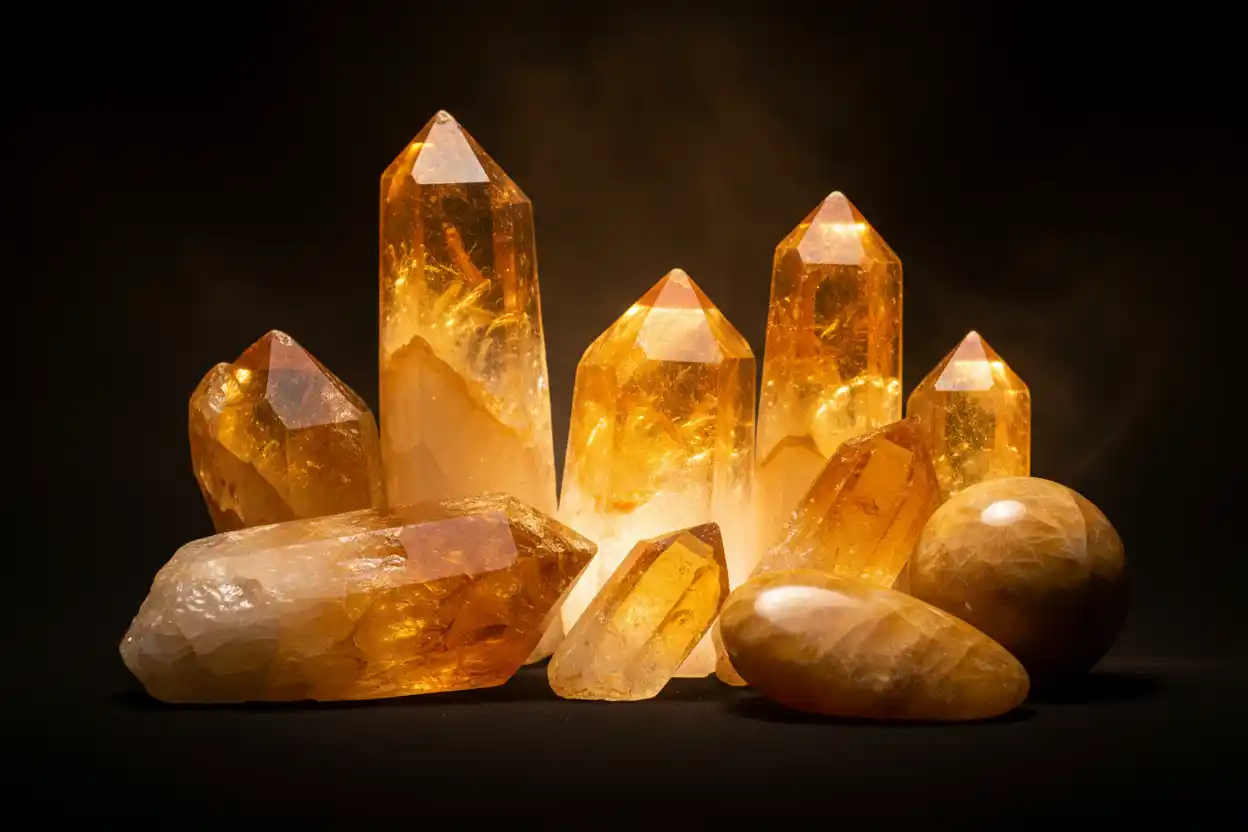
Golden Healer Quartz Meaning: Properties, Uses & Symbolism
Golden healer quartz meaning begins with ordinary quartz that has acquired a yellow, golden, ocher, or rusty appearance from iron-rich material rather than with a separate mineral species. Mindat lists Golden Healer Quartz as a trade name for iron-stained quartz from Arkansas and notes that much Arkansas quartz is naturally iron stained before cleaning. That definition immediately establishes an important boundary: “Golden Healer Quartz” is a commercial descriptive name applied to quartz, not a formally distinct quartz species with its own chemical formula or crystal structure.
The underlying quartz remains silicon dioxide, SiO₂. Standard gemological data for crystalline quartz places its Mohs hardness at about 7, refractive indices around 1.544–1.553, and specific gravity near 2.66. What distinguishes material sold under the golden-healer label is principally its visible iron-related staining, coatings, inclusions, or associated mineralization. The exact iron phase should not automatically be called hematite, goethite, “limonite,” or any other mineral from color alone because several iron-bearing phases can produce yellow, brown, orange, or red appearances in and on quartz.
This distinction matters because golden healer quartz meaning is frequently discussed as if three very different subjects were one: quartz mineralogy, iron-mineral coloration, and modern crystal symbolism. They should remain separate. Quartz chemistry and iron-mineral associations are measurable. The history of a trade name can be documented to the extent reliable records permit. Themes such as healing, confidence, grounding, warmth, or personal transformation belong to modern metaphysical interpretation unless stronger evidence establishes a particular historical tradition.
Readers exploring comparable material-first references can browse the Gemstone Guides collection, while this page stays focused on what Golden Healer Quartz is, what may cause its appearance, how it should be described, and what its symbolism can responsibly mean.
Golden Healer Quartz Meaning at a Glance
| Question | Evidence-aware answer |
|---|---|
| What is Golden Healer Quartz? | A trade name for iron-stained quartz rather than a separate mineral species |
| Base mineral | Quartz |
| Ideal quartz formula | SiO₂ |
| Crystal system | Trigonal for ordinary alpha quartz |
| Typical appearance | Transparent, translucent, or milky quartz with yellow, gold, ocher, orange-brown, or rusty iron-related coloration |
| Mohs hardness | About 7 for quartz |
| Refractive index | Approximately 1.544–1.553 for crystalline quartz |
| Specific gravity | About 2.66 for typical quartz |
| Source of golden appearance | Iron-rich stains, coatings, inclusions, or associated phases; exact mineral can vary |
| Is it always goethite? | No |
| Is it always hematite? | No |
| Is “limonite” a precise mineral identification? | Usually not; the term commonly refers to mixtures of hydrated iron oxides/oxyhydroxides |
| Formal mineral status | Trade name, not a separately approved mineral species |
| Modern symbolism | Common themes include warmth, reflection, perseverance, confidence, or deliberate change |
| Scientific status of symbolism | These meanings are interpretive and not demonstrated medical or physiological effects |
| Safe-use principle | Handling intact quartz differs from cutting, drilling, sanding, crushing, or otherwise generating quartz-bearing dust |
The practical advantage of this framework is that it does not require dismissing the name. A trade name can be useful when it consistently describes a recognizable commercial appearance. The problem arises only when the name is treated as proof of chemistry, locality, rarity, treatment status, or supernatural effect that the label itself cannot establish.
What Is Golden Healer Quartz?
Golden Healer Quartz is quartz whose surface or interior displays yellow-to-golden iron-related coloration. In the narrow mineral-reference definition, Mindat describes it as iron-stained quartz from Arkansas and frames the name as a way of marketing material whose natural staining might otherwise be removed during cleaning. The base material is therefore conventional quartz; “golden healer” describes the commercial presentation rather than a change in quartz’s fundamental mineral identity.
In the broader crystal retail market, however, the name may be applied more loosely to pale yellow, honey-colored, rusty, or iron-rich quartz from locations beyond Arkansas. That expanded commercial use creates uncertainty. A listing called Golden Healer Quartz does not by itself establish that the specimen came from Arkansas, that the golden material is one particular iron mineral, or that the coloration is entirely natural and untreated.
The strongest specimen description therefore separates what is observed from what is inferred. “Clear quartz with yellow-brown iron staining” is a physical description. “Golden Healer Quartz” is the trade designation. “Goethite coating from Arkansas” adds two stronger claims—mineral identity and provenance—that require their own evidence.
Golden Healer Quartz Identity Table
| Characteristic | Practical interpretation |
|---|---|
| Mineral species | Quartz |
| Trade designation | Golden Healer Quartz |
| Quartz chemistry | SiO₂ |
| Common form | Natural quartz crystals, clusters, points, polished pieces, cabochons, spheres or freeforms |
| Color description | Pale yellow, gold, ocher, honey, orange-brown, rusty yellow or mixed iron-stained tones |
| Color location | May occur on crystal faces, inside fractures, in cavities, between growth layers or as internal mineral inclusions |
| Quartz luster | Vitreous on fresh or polished quartz surfaces |
| Quartz hardness | About Mohs 7 |
| Quartz cleavage | No prominent cleavage; conchoidal fracture is typical |
| Iron-phase certainty | Cannot be established from the Golden Healer Quartz name alone |
| Provenance certainty | Cannot be established from appearance alone |
| Treatment certainty | The trade name itself does not prove untreated status |
| Identification level | Quartz may be straightforward to identify, but exact iron phase can require further testing |
The distinction between identifying quartz and identifying its coating is especially important. A refractive-index measurement, density observation, or quartz crystal habit may establish the underlying material with good confidence, while a microscopic yellow coating may still require Raman spectroscopy, X-ray diffraction, chemical analysis, or another suitable technique before it can be confidently called goethite or hematite.
The Golden Healer Quartz Microscope Inclusion Notebook owns the specimen-scale inclusion work rather than having individual iron features diagnosed from photographs on this page.
Why Does Golden Healer Quartz Look Golden?
Iron is the central explanation, but “iron” is not one single mineral. Iron can occur structurally, as discrete inclusions, as coatings deposited on quartz surfaces, as material introduced into cracks, or as secondary alteration products. Published GIA work on complex iron-bearing quartz documents iron occurring in several different mineralogical forms, including goethite needles and fine hematite, demonstrating why yellow, brown, and reddish quartz coloration cannot automatically be assigned to one phase.
Goethite, an iron oxyhydroxide with formula FeO(OH), is an important yellow-to-brown iron mineral. GIA has also documented yellow-brown limonitic residues in gems in which goethite is a major component and shown that heating can transform goethite to reddish hematite. This provides a useful mineralogical reason why visual color alone is not a safe identification method: related iron phases can exist in different oxidation, hydration, and textural states.
The safest wording for an untested specimen is therefore “iron stained,” “iron coated,” or “iron-rich coloration” unless the actual mineral has been established. The Golden Healer Quartz Optical Properties and Color Behavior guide holds the deeper discussion of color, light transmission, and optical observations.
Is Golden Healer Quartz the Same as Citrine?
No. Citrine is a yellow-to-orange color variety of quartz in which color is associated with iron-related processes within the quartz itself, whereas Golden Healer Quartz, as the trade name is ordinarily used, emphasizes external or included iron-rich staining and mineralization. A quartz crystal can therefore look golden without being correctly described as citrine.
The distinction can become difficult in photographs because transmitted light through a pale iron-stained crystal may make the entire specimen appear yellow. Surface staining, internal coatings along fractures, and true quartz body color need to be evaluated separately.
This is another reason not to identify quartz varieties purely from a retail photograph. A specimen can contain more than one color-producing mechanism, and laboratory characterization may be required when exact terminology materially affects value or scientific documentation.
Is Golden Healer Quartz Always Goethite Quartz?
No. Goethite is plausible in many yellow-brown iron-rich quartz specimens, and published gemological examples demonstrate goethite needles and limonitic material associated with quartz or other gems. But Golden Healer Quartz is not formally defined as “quartz containing goethite and nothing else.”
Hematite, other iron oxides and oxyhydroxides, mixed limonitic material, iron-rich clays, or combinations of phases can also occur with quartz. Fine-grained mixtures are particularly difficult to assign visually. The word “limonite” itself is commonly used for mixed hydrated iron-oxide and oxyhydroxide material rather than a single modern mineral species.
Readers who need the mineralogical background for one of the most important possible yellow-brown phases can use the separate Goethite Meaning reference. That page defines goethite as its own mineral rather than implying every golden quartz coating belongs to it.
How Golden Healer Quartz Forms
The quartz itself forms through ordinary quartz-producing geological processes. Silica-bearing fluids can precipitate quartz in veins, fractures, cavities, and open spaces, while quartz also occurs broadly in igneous and metamorphic environments. After or during quartz growth, iron-bearing fluids, weathering, oxidation, mineral alteration, or later fluid movement can introduce iron-rich material onto crystal faces or into accessible fractures and cavities.
The exact timing matters. Some iron minerals can become enclosed during continued quartz growth, creating true internal inclusions. Others may coat the outer crystal after quartz formation. Still others can enter surface-reaching fractures much later. Two specimens with similar golden appearances may therefore record substantially different geological histories.
A yellow stain is not enough to reconstruct that sequence. Establishing whether an iron phase formed contemporaneously with quartz, later in a fracture, or only as near-surface weathering requires textural and geological evidence.
The detailed paragenesis and deposit questions belong in the Golden Healer Quartz Formation and Deposit Geology guide.
Surface Stain, Fracture Coating, or Inclusion?
This distinction is one of the most useful practical ways to examine Golden Healer Quartz. A surface stain may follow crystal faces and can sometimes be concentrated in recesses. A fracture coating appears along a crack or healed internal plane and may penetrate beneath the visible exterior. An inclusion is enclosed within quartz and may have been trapped during crystal growth or later fracture healing.
These categories can overlap in one specimen. A fracture may reach the surface, allowing iron-rich material to enter it after the quartz has formed. Later quartz growth can potentially enclose earlier mineralization. Weathering can subsequently alter exposed iron minerals.
Microscopy can clarify some relationships, but a polished surface or photograph can conceal the three-dimensional structure. The appropriate description should remain proportional to the evidence.
Diagnostic Characteristics of the Quartz
Once the commercial name is stripped away, the base identification problem becomes conventional quartz identification. Crystalline quartz has a Mohs hardness around 7, specific gravity close to 2.66, and refractive indices approximately 1.544–1.553. It is typically uniaxial and lacks prominent cleavage.
Crystal morphology can also help when natural faces remain. Quartz commonly forms six-sided prismatic crystals terminated by rhombohedral faces, although growth interference, damage, coatings, polishing, and aggregate development can obscure textbook form.
Hardness should not be verified by deliberately scratching a finished or collectible specimen. A home scratch test can damage quartz or another object without settling the more difficult question—the identity of the iron material. Non-destructive gemological or mineralogical examination is preferable whenever the specimen has monetary, scientific, or historical significance.
Documented History of the Trade Name
The documented history of Golden Healer Quartz is much more modest than many metaphysical accounts suggest. Mindat treats Golden Healer Quartz as a trade name for naturally iron-stained Arkansas quartz rather than as a historic mineral variety. Its description implies a commercial reframing of quartz that might traditionally have had iron staining chemically removed for a clearer appearance.
That makes it inappropriate to claim that ancient Egyptians, Romans, Indigenous peoples, or another historical culture specifically used “Golden Healer Quartz” under the modern trade concept unless a reliable source documents the material and terminology. Quartz itself has a long human history, and iron-rich pigments and minerals have even older histories, but those histories cannot simply be combined into evidence for the current commercial name.
A modern trade name can still have cultural interest. Its emergence reflects changing collector preferences: a feature once viewed as staining to remove can become an aesthetic feature marketed and appreciated in its natural state.
Original Information Gain: Golden Healer Quartz Name and Claim Audit
The following framework separates material facts from commercial descriptions and metaphysical claims.
| Claim or label | What evidence supports | What should not automatically be assumed | Stronger evidence when important |
|---|---|---|---|
| Quartz | A defined SiO₂ mineral | Exact locality or coating identity | Standard gemological/mineralogical identification |
| Golden Healer Quartz | Trade name for iron-stained quartz | Separate mineral species | No species claim should be made from the trade name |
| Arkansas Golden Healer Quartz | Quartz reportedly from Arkansas | Appearance proves Arkansas provenance | Original locality records and chain of custody |
| Iron-stained quartz | Descriptive observation | Which iron mineral causes the stain | Raman, XRD, chemistry or other phase identification |
| Goethite in quartz | Specific mineral association | Every yellow-brown area is goethite | Mineralogical confirmation |
| Hematite in quartz | Specific iron-oxide association | Every orange-red zone is hematite | Mineralogical confirmation |
| Limonite coating | Broad field/trade description | One pure mineral species | Analytical identification of component phases |
| Natural golden color | Natural-origin/treatment claim | No cleaning, staining, coating or alteration has occurred | Provenance, disclosure and appropriate examination |
| “Uncleaned quartz” | Commercial condition claim | Completely untouched since mining | Mining/preparation records |
| “High vibration” | Metaphysical description | Measured physical energy with health effects | Reproducible physical evidence would be required |
| “Healing stone” | Modern symbolic or metaphysical language | Treatment of disease or injury | Appropriate clinical evidence would be required |
| “Ancient healing crystal” | Historical claim | Modern Golden Healer Quartz terminology existed historically | Primary historical or archaeological evidence |
| “Rare” | Possible statement about a particular specimen or quality | Quartz or iron staining is inherently rare | Specific supply, locality and quality evidence |
| “Untreated” | Treatment-status claim | Can be confirmed from photographs | Examination and documented preparation history |
| “Iron gives the body energy” | Biological claim | Skin contact supplies usable iron | Medical evidence; mineral composition alone is insufficient |
The decision rule is straightforward: every additional adjective increases the evidentiary burden. “Quartz with golden iron staining” may be visually defensible. “Untreated Arkansas quartz containing verified goethite from a historic mine” requires substantially more documentation.
Specimen and Photo Checklist
A useful Golden Healer Quartz photograph should reveal where the golden material occurs rather than simply exaggerating its color. Look at whether yellow material coats exposed crystal faces, lines internal cracks, forms discrete needles or particles, concentrates near matrix, or produces a relatively uniform body color. Photograph the specimen under neutral reflected light and then, where useful, transmitted or side lighting.
Color editing should be minimized because aggressive warmth and saturation can turn pale tan staining into vivid gold. Dark backgrounds can likewise make thin yellow coatings appear dramatically richer than they do under ordinary viewing conditions. Multiple angles help separate exterior staining from inclusions.
A photograph may document morphology and apparent color, but it cannot prove exact iron phase, mine origin, treatment history, or metaphysical effect.
Iron Staining Is Not Automatically a Defect
In conventional clear-quartz preparation, iron staining is sometimes removed to reveal a cleaner crystal surface. Golden Healer Quartz reverses that preference by treating the stain itself as part of the specimen’s visual identity. Mindat explicitly notes this commercial inversion in its description of the trade name.
Whether the staining improves or reduces desirability is therefore context-dependent. A collector seeking pristine colorless quartz may prefer a cleaned specimen, while another may value naturally patterned yellow coatings that preserve evidence of alteration. Aesthetic value is not the same as mineralogical purity.
Importantly, cleaning history can also matter scientifically. Aggressive chemical preparation may remove secondary minerals from crystal surfaces and fractures, erasing part of the specimen’s geological record.
Golden Healer Quartz Meaning in Modern Symbolism
Modern golden healer quartz meaning commonly centers on warmth, confidence, resilience, reflection, optimism, grounding, or personal transformation. The golden color makes these associations easy to understand within contemporary crystal culture: yellow and gold are often used symbolically for sunlight, vitality, hope, achievement, or clarity.
A person can responsibly use those themes as metaphors. A specimen might sit beside a journal as a reminder to identify one practical step toward a goal, or it might represent patience during a long project. Someone may simply value the contrast between transparent quartz and earthy iron staining as a visual metaphor for accepting complexity rather than demanding perfect clarity.
None of those uses requires the mineral to produce a measurable therapeutic field.
Golden Healer Quartz and “Healing”
The word “healer” in the trade name deserves particular caution because it can sound like a medical claim even when sellers intend metaphysical symbolism. The name does not establish that the quartz treats disease, repairs tissue, improves immunity, relieves pain, regulates hormones, treats depression or anxiety, alters cardiovascular function, restores fertility, or changes neurological activity.
Quartz and iron-bearing minerals have measurable physical properties, but those properties do not translate automatically into medical effects from wearing or holding a specimen.
The safest interpretation is linguistic: “healer” is part of a modern commercial and spiritual name. It is not a clinical designation.
Golden Healer Quartz and Iron
Another recurring claim suggests that because the specimen contains iron-rich material, the body can somehow absorb useful iron or receive iron-related vitality through skin contact. Mineral chemistry does not support that inference.
An element locked within a crystalline or mineral phase is not automatically bioavailable, nutritious, medicinal, or transdermally delivered. The presence of iron in a yellow coating therefore explains aspects of mineral coloration; it does not turn the quartz into an iron supplement.
Golden Healer Quartz should not be powdered, ingested, or used as a substitute for medical assessment of iron deficiency or any other condition.
Golden Healer Quartz and Confidence
Confidence is a common symbolic theme because golden colors are culturally associated with visibility, success, warmth, and brightness. A grounded use can connect the specimen to behaviors under the owner’s control: prepare carefully, rehearse a presentation, ask a clear question, finish one delayed task, or document a decision.
The stone can serve as a cue for those behaviors. It cannot guarantee professional success, eliminate social anxiety, make another person respond positively, or change external outcomes without the person’s actions.
That distinction keeps golden healer quartz meaning personally usable without overstating what a mineral can do.
Golden Healer Quartz and Transformation
Iron staining can visibly change the appearance of clear quartz, so transformation is another natural metaphor. Geological fluids, oxidation, secondary mineral growth, and weathering can produce a specimen very different from pristine rock crystal.
A metaphor inspired by geology should not be confused with a demonstrated psychological mechanism. The specimen does not automatically remove trauma, rewrite habits, change personality, or transform a relationship.
A more defensible use is to let the mineral represent gradual change: the geological object records interaction between materials and environments, while the owner decides what personal change, if any, to pursue.
Golden Healer Quartz Versus Golden Obsidian
The Golden Obsidian Meaning guide concerns natural volcanic glass, not crystalline quartz. A black-to-brown glassy stone with golden optical effects is therefore fundamentally different from transparent or milky quartz bearing yellow iron staining.
The comparison matters because color-based trade names can make unrelated materials sound connected. “Golden” is an appearance descriptor, not a mineral family.
Atomic structure, chemistry, fracture behavior, hardness, geological formation, and diagnostic testing distinguish the two materials much more reliably than their commercial names.
Golden Healer Quartz Versus Goldstone
The Goldstone Meaning reference addresses another material that illustrates why naming matters. Goldstone is manufactured glass containing reflective metallic crystals, whereas Golden Healer Quartz is based on natural quartz with iron-related coloration.
Both can show warm golden effects, but their material origins are entirely different. Goldstone’s sparkle is engineered into a glass body; Golden Healer Quartz’s appearance is associated with natural quartz and iron-rich mineralization or staining.
A photograph that simply looks “golden” cannot establish which material is present.
Golden Healer Quartz Versus Girasol Quartz
The Girasol Quartz Meaning guide covers quartz selected for a soft, opalescent-looking or internally luminous appearance rather than iron staining. Both are appearance-based commercial quartz names rather than independent mineral species, which makes the comparison instructive.
Girasol Quartz emphasizes translucent light scattering. Golden Healer Quartz emphasizes golden iron-related coloration. A pale cloudy quartz specimen with yellow staining could potentially attract both kinds of descriptive language in informal retail, reinforcing the need to describe visible features before assigning names.
Cutting and Polishing
Quartz’s Mohs hardness around 7 makes it a common lapidary material, but an iron-stained specimen may be valued precisely because of surface coatings, fracture mineralization, or internal patterns that cutting can remove or rearrange. A lapidary decision should therefore consider whether the objective is to preserve natural crystal surfaces or reveal an internal color pattern.
Sawing and polishing may expose new cross-sections through iron-rich fractures, while aggressive surface grinding can remove the golden coating entirely. Highly fractured quartz also requires careful orientation to reduce breakage during shaping.
The detailed lapidary scope belongs in the Golden Healer Quartz Cutting, Orientation and Polish guide.
Jewelry Wear
Quartz provides relatively good scratch resistance for many jewelry applications, but it remains brittle and can chip after impact. Iron-rich coatings can introduce an additional aesthetic concern because an attractive surface film may abrade differently from the underlying quartz.
A polished cabochon whose golden appearance comes from material enclosed beneath the surface may behave differently from a natural crystal whose visual appeal depends on a delicate exterior iron coating. Jewelry suitability must therefore be assessed from the actual specimen rather than from the trade name alone.
Setting design, exposed edges, existing fractures, stone thickness, and wear pattern are handled in the Golden Healer Quartz Setting and Wear Engineering guide.
Safe Ownership: Intact Quartz Versus Dust
Ordinary handling of an intact quartz crystal is not equivalent to cutting, grinding, drilling, sanding, or crushing quartz. Processing crystalline silica-bearing material can generate fine dust, making dust management a serious occupational consideration during lapidary work.
Iron coatings and matrix also complicate the composition of generated dust. A specimen may contain quartz plus goethite, hematite, clays, feldspar, sulfides, or other associated minerals that are not obvious from a polished face.
Golden Healer Quartz should not be dry-ground as part of a spiritual practice, intentionally crushed into powder, or processed without appropriate lapidary engineering controls.
Do Not Use Golden Healer Quartz as an Elixir Ingredient
Placing minerals in drinking water or grinding them into preparations is unnecessary and introduces uncertainty. A natural quartz specimen can carry iron minerals, matrix, polishing residues, cleaning chemicals, unidentified coatings, surface contamination, or treatments.
There is no nutritional requirement to obtain quartz or iron through mineral-soaked water, and a decorative crystal should not be converted into a medicine because its trade name contains the word “healer.”
The health and interpretation boundaries that apply across the site are stated in the Gems Lore Disclaimer.
Specimen Conservation
Golden Healer Quartz can preserve more geological information than its commercial name suggests. Exterior coatings can record later alteration, fracture fillings can indicate fluid movement after quartz growth, and associated matrix can retain evidence about the geological setting. Cleaning should therefore be approached carefully when preserving natural history matters.
Removing every iron stain may produce a visually clearer quartz crystal while destroying the feature that made the specimen scientifically or aesthetically distinctive. Conversely, loose earthy coatings may be fragile and require minimal handling.
Photographs, original labels, dimensions, acquisition records, locality claims, and notes about any cleaning should remain with the object. The Golden Healer Quartz Specimen Conservation Record provides the structured framework for maintaining those details.
Provenance and Arkansas Claims
Because the mineral-reference definition specifically associates Golden Healer Quartz with Arkansas iron-stained quartz, locality deserves careful handling. A quartz crystal does not become Arkansas material merely because it has honey-yellow staining. Similar iron-related mineralization can occur wherever suitable quartz and iron-bearing fluids or weathering conditions intersect.
A seller’s Arkansas attribution can be recorded honestly as reported provenance, but stronger confidence requires supporting documentation such as an original mine or dealer label, acquisition history, collection records, or traceable chain of custody.
The Golden Healer Quartz Provenance Disclosure Checklist is the appropriate place for evaluating how strongly a locality statement is documented.
Original Source-Comparison Framework
A claim about Golden Healer Quartz should be evaluated according to the type of source making it.
| Source type | Strongest useful contribution | Main limitation |
|---|---|---|
| Mineral database | Mineral status, accepted names, trade-name notes, locality records | May not document every retail usage or metaphysical interpretation |
| Gemological laboratory | Tested identity, optical properties, inclusions, treatments | Usually addresses submitted specimens rather than the whole commercial market |
| Geological paper | Formation, host rocks, mineral associations, paragenesis | May not use commercial crystal names |
| Mine or collection label | Specimen-specific provenance | Reliability depends on chain of custody |
| Retail listing | Current commercial terminology and seller disclosure | Marketing statements require independent verification |
| Crystal-healing book or website | Documents modern symbolic interpretations | Does not establish mineralogical or medical mechanisms |
| Social-media post | Can reveal contemporary naming trends | Weak source for technical identity and historical claims |
| Personal testimony | Describes one person’s experience or symbolism | Cannot establish reproducible medical or mineralogical facts |
Using the correct source for the correct question prevents a trade name from carrying more authority than it deserves. A mineral database is appropriate for deciding whether Golden Healer Quartz is a distinct species. A laboratory can determine what an unknown coating is. A retailer can document that a marketing phrase is being used, but not automatically prove the underlying mineralogy.
What Golden Healer Quartz Meaning Does Not Prove
Golden healer quartz meaning does not prove that a specimen heals organs, treats cancer, eliminates anxiety or depression, regulates blood pressure, corrects hormonal problems, restores fertility, increases immunity, controls pain, detoxifies the body, or changes neurological activity.
It also does not prove guaranteed financial success, protection from every hazard, manifestation of a desired outcome, or the ability to control another person’s emotions or behavior.
Likewise, the quartz’s natural iron content is not a basis for recommending ingestion, powders, supplements, mineral water, or transdermal iron use.
Symbolism becomes more credible when it remains clearly labeled as symbolism.
Frequently Asked Questions About Golden Healer Quartz Meaning
What is golden healer quartz meaning?
Golden healer quartz meaning commonly combines a trade name for iron-stained quartz with modern symbolic themes such as warmth, confidence, perseverance, reflection, and transformation. The symbolic themes are contemporary interpretations rather than scientifically measured properties of quartz.
Is Golden Healer Quartz a real mineral?
The underlying quartz is unquestionably a real mineral, but Golden Healer Quartz is not a separate formal mineral species. Mindat identifies it as a trade name for iron-stained quartz.
What is Golden Healer Quartz made of?
Its base material is quartz, SiO₂. The golden appearance is associated with iron-rich staining, coatings, inclusions, or related mineral phases. The exact iron mineral can vary and should not be assumed from color alone.
Is Golden Healer Quartz always from Arkansas?
The mineral-reference definition specifically associates the trade name with iron-stained Arkansas quartz, but commercial sellers may use the term more broadly. Appearance alone cannot prove Arkansas provenance.
Is Golden Healer Quartz the same as citrine?
No. Citrine is a yellow-to-orange quartz color variety, whereas Golden Healer Quartz typically refers to quartz whose golden appearance involves iron-rich staining or mineralization. A photograph can sometimes make the distinction difficult.
Is Golden Healer Quartz always colored by goethite?
No. Goethite may occur in iron-rich quartz, but hematite and other iron oxides, oxyhydroxides, or mixtures can also be present. Exact identification can require mineralogical testing.
What is limonite in Golden Healer Quartz?
Limonite is generally a broad term for mixtures of hydrated iron oxides and oxyhydroxides rather than one precisely defined modern mineral species. A yellow-brown coating described as limonite can contain substantial goethite, but analytical testing is needed for precise phase identification.
Why do some specimens look pale yellow while others are orange or rusty?
Iron mineralogy, particle size, coating thickness, oxidation state, hydration, distribution, associated phases, quartz transparency, and lighting can all affect the apparent color.
Can Golden Healer Quartz be identified from a photograph?
A photograph can support identification of quartz-like morphology and show where golden material occurs, but it cannot reliably determine the exact iron phase, treatment status, or geographic origin.
Does Golden Healer Quartz have healing powers?
There is no established scientific evidence that Golden Healer Quartz treats disease or produces specific physiological healing effects. “Healer” is part of its commercial and metaphysical naming rather than a medical classification.
Can Golden Healer Quartz increase iron in the body?
No evidence supports obtaining therapeutically useful iron by holding the specimen against the skin. Iron present in a mineral coating is not automatically a transdermal nutrient or supplement.
Is Golden Healer Quartz safe to handle?
Ordinary handling of an intact specimen is different from cutting, drilling, sanding, or crushing it. Dust-generating quartz processing requires appropriate lapidary and respiratory controls.
Should Golden Healer Quartz be cleaned to remove the iron?
That depends on the purpose of the specimen. If its iron staining is the feature being collected, aggressive cleaning can destroy part of its appearance and potentially remove useful geological information.
Is Golden Healer Quartz valuable?
Value depends on specimen aesthetics, crystal quality, size, condition, locality documentation, mineral associations, preparation, market demand, and whether the appearance is attractive to the buyer. The trade name alone does not guarantee high value.
Is Golden Healer Quartz ancient?
Quartz is geologically ancient and has a long history of human use, but the commercial designation Golden Healer Quartz should not automatically be projected backward into ancient cultures. Historical claims about the modern name require specific documentary evidence.
Evidence and Technical Limits
This article does not claim first-hand Arkansas mine visits, private specimen purchases, unpublished laboratory analyses, direct authentication of a reader’s quartz, or personal verification of individual retail listings. The broader scope of Gems Lore and its material-first approach are described on About Gems Lore.
Where an exact coating mineral, treatment, mine locality, unusual inclusion, or paragenetic relationship materially matters, appropriate mineralogical, geological, gemological, or laboratory confirmation may be needed. Published evidence clearly demonstrates that quartz can contain several iron-bearing phases, which makes overconfident color-only identification inappropriate.
Readers with a documented correction, analytical result, locality record, or historical source that materially changes a claim can submit it through Contact Gems Lore.
Final Perspective
Golden healer quartz meaning becomes clearer when the trade name is treated as a descriptive commercial layer placed over ordinary quartz mineralogy. The quartz itself is SiO₂, with the familiar hardness, density, refractive behavior, crystal structure, and fracture properties of crystalline quartz. What gives Golden Healer Quartz its distinctive appearance is iron-related staining or mineralization, but the precise iron phase cannot be reliably determined from the trade name or golden color alone. Mindat’s definition is especially useful because it explicitly identifies Golden Healer Quartz as a trade name for iron-stained quartz rather than a separate mineral species.
The iron-rich material can also preserve genuine geological information. Goethite, hematite, mixed limonitic products, and other iron phases can occur with quartz under different formation and alteration histories, and published gemological examples show how several iron minerals can coexist within a single quartz growth sequence.
Modern ideas of warmth, confidence, resilience, reflection, or transformation can remain part of golden healer quartz meaning when they are presented as symbolism rather than chemistry or medicine. The most evidence-aware approach is therefore straightforward: identify quartz first, describe the golden material conservatively, verify iron phases and provenance when the stakes justify testing, preserve natural coatings when they carry specimen value, distinguish intact handling from dust-generating processing, and never let the word “healer” turn a mineral trade name into an unsupported medical promise.