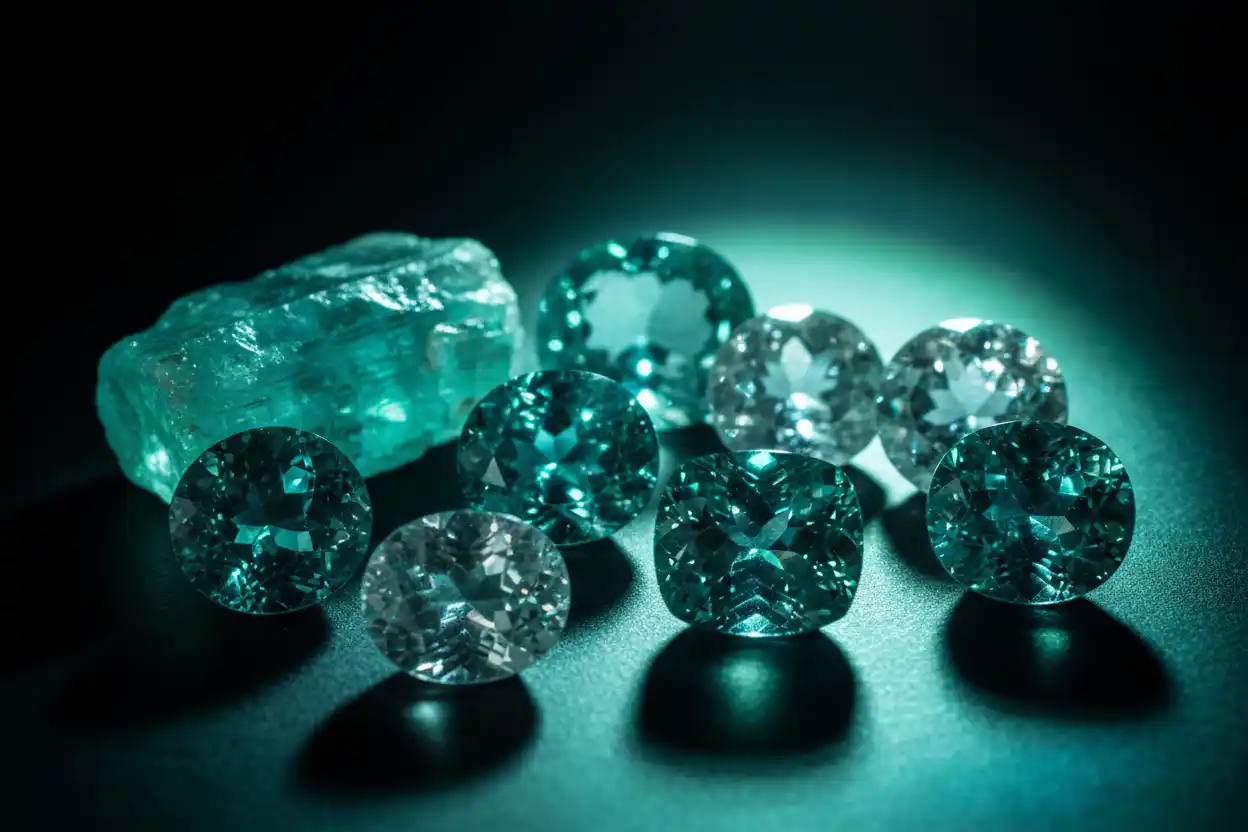
Grandidierite Meaning: Properties, Uses & Symbolism
Grandidierite meaning begins with an unusually scarce blue-green borosilicate mineral rather than with a metaphysical definition. Grandidierite is an orthorhombic mineral with a magnesium-aluminum borosilicate composition commonly represented as (Mg,Fe)Al₃(BO₃)(SiO₄)O₂, with iron substituting for magnesium to varying degrees. Mindat lists its typical color as bluish green to greenish blue, Mohs hardness around 7.5, specific gravity near 2.98–2.99, and an orthorhombic crystal structure. The species was formally described by Alfred Lacroix from southern Madagascar and named in honor of French explorer and naturalist Alfred Grandidier.
Gem-quality grandidierite adds another layer of rarity. GIA notes that the mineral was first described in southern Madagascar in 1902 and that transparent material suitable for faceting remained exceptionally scarce for many years. The first transparent faceted example described in Gems & Gemology was a tiny 0.29 ct stone reportedly from Sri Lanka, while later discoveries in Madagascar brought additional transparent blue-green material into the gem market.
Those facts provide the correct foundation for grandidierite meaning. Mineral identity, color, refractive behavior, pleochroism, hardness, geological setting, and inclusions belong to mineralogy and gemology. Its naming history can be documented. Modern ideas such as clarity, resilience, communication, intuition, or emotional balance belong to symbolic interpretation unless specific historical evidence establishes otherwise.
Readers exploring other mineral-first references can use the Gemstone Guides. This page remains focused on defining grandidierite, explaining its physical identity and documented history, and separating those facts from modern symbolism.
Grandidierite Meaning at a Glance
| Property or question | Evidence-aware summary |
|---|---|
| Mineral identity | Rare magnesium-aluminum borosilicate |
| Idealized formula | Commonly expressed as (Mg,Fe)Al₃(BO₃)(SiO₄)O₂ |
| Crystal system | Orthorhombic |
| Typical color | Bluish green to greenish blue |
| Major color relationship | Iron content contributes to stronger blue components |
| Transparency | Commonly translucent; fine gem material can be transparent |
| Mohs hardness | About 7.5 |
| Specific gravity | Approximately 2.98–2.99 in mineral references |
| Optical character | Biaxial |
| Pleochroism | Often pronounced, with different pale, green-blue, and blue directions depending on material |
| Luster | Vitreous to locally pearly |
| Historical name | Named for Alfred Grandidier |
| First formal description | Southern Madagascar |
| Main gem-market distinction | Transparent facetable material is much scarcer than ordinary translucent mineral material |
| Modern symbolism | Often associated with reflection, communication, resilience, perspective, or deliberate change |
| Scientific status of symbolism | These themes are interpretations, not demonstrated medical or physiological effects |
| Safe-use principle | Handling intact material differs from cutting, drilling, grinding, sanding, or generating mineral dust |
GIA reports refractive-index ranges roughly spanning the high 1.5s to low 1.6s for studied gem grandidierite, with substantial birefringence and strong pleochroism. These optical properties help distinguish it from other blue-green gems when combined with appropriate testing.
What Is Grandidierite?
Grandidierite is a distinct mineral species rather than a trade name for a better-known gem. It is a borosilicate containing magnesium and aluminum, with iron commonly substituting into its structure. That iron relationship is important because the relative magnesium-to-iron balance contributes to changes in color and optical behavior. Lower-iron material can appear greener or paler, while higher iron content generally strengthens blue coloration.
The mineral is structurally and chemically related to ominelite, an iron-dominant analogue. That relationship does not mean every blue-green borosilicate should be casually called either mineral. Exact classification can depend on chemical composition, and a transparent specimen’s appearance alone is not sufficient to establish where it falls compositionally.
Grandidierite can occur as crystals, grains, or massive material within metamorphic geological environments. Much of the mineral historically available to collectors has been translucent or opaque rather than facetable. Transparent material capable of producing attractive gemstones represents a much narrower subset.
Readers specifically interested in purchase decisions should use the separate buy grandidierite guide, while market valuation belongs to the grandidierite price guide. This page does not duplicate those commercial intents.
Grandidierite Identity Table
| Characteristic | Grandidierite |
|---|---|
| Mineral type | Borosilicate |
| Common formula representation | (Mg,Fe)Al₃(BO₃)(SiO₄)O₂ |
| Crystal system | Orthorhombic |
| Common color | Greenish blue to bluish green |
| Transparency | Opaque to transparent depending on material |
| Luster | Vitreous to pearly |
| Hardness | Approximately 7.5 Mohs |
| Specific gravity | About 2.98–2.99 |
| Optical character | Biaxial |
| Birefringence | Relatively high for many familiar transparent gems |
| Pleochroism | Often strong |
| Common gem form | Faceted stones from unusually transparent rough |
| Common specimen form | Crystals or grains within metamorphic mineral assemblages |
| Identification caution | Color alone cannot establish grandidierite |
| Major look-alike issue | Other blue-green gems can overlap visually |
| Technical confirmation | May require refractive index, microscopy, spectroscopy, Raman analysis, chemistry, or other appropriate methods |
The table establishes a practical baseline rather than authenticating any individual stone. GIA’s work on transparent grandidierite relied on multiple observations, including refractive indices, specific gravity, spectroscopy, Raman analysis, and chemical data rather than visual color alone.
Why Is Grandidierite Blue-Green?
Grandidierite’s blue-green appearance is strongly connected with iron in the mineral structure. GIA’s study of gem-quality Madagascar material states that the blue component increases as iron content rises, while exceptionally low-iron material can occupy the greener or paler end of the range.
Color is further complicated by pleochroism. Because grandidierite is anisotropic, a single crystal can display different colors along different crystallographic directions. Published observations describe combinations including nearly colorless or pale yellow, greenish blue, and blue. A cutter’s orientation can therefore materially change which color dominates in a faceted stone.
That optical behavior should not be confused with color change in the sense used for gems that visibly shift hue under different light sources. Pleochroism results from directional absorption within the crystal and can be observed as the crystal is oriented differently relative to polarized light or the viewer.
The dedicated Grandidierite Optical Properties and Color Behavior guide owns the deeper analysis of refractive indices, birefringence, absorption, and pleochroism.
How Grandidierite Forms
Grandidierite is associated with high-grade metamorphic environments and boron-rich geological conditions. The first transparent faceted Sri Lankan example came from a region known for high-grade metamorphic rocks, while deposits in southern Madagascar occur within complex metamorphic assemblages containing minerals such as sapphirine, spinel-group minerals, pyroxenes, phlogopite, tourmaline, zircon, monazite, and apatite depending on the locality.
This geological association matters because grandidierite requires a fairly specific chemical environment. Boron must be available together with magnesium, aluminum, silicon, and appropriate pressure-temperature conditions. Its rarity as fine gem material reflects not only the mineral’s geological scarcity but also the additional requirement that crystals form with enough transparency, favorable color, and sufficiently clean regions to be cut.
A blue-green faceted stone does not reveal its formation history by appearance. Geological interpretation depends on locality, host rock, associated minerals, chemistry, and textural relationships.
The deeper deposit and paragenesis discussion belongs in the Grandidierite Formation and Deposit Geology guide.
Diagnostic Characteristics
Grandidierite’s combination of high hardness, blue-green color, strong pleochroism, specific gravity near 3, and unusual refractive behavior can provide a powerful identification package. GIA’s studies report refractive-index values covering approximately 1.58–1.64 depending on composition, with birefringence around the mid-to-high hundredths.
Microscopic examination may reveal mineral inclusions or internal features related to the geological environment. GIA’s study of Madagascar material documented inclusions including apatite, zircon, and monazite in some grandidierite crystals. Those inclusions can be scientifically informative, but they should not be treated as mandatory markers present in every genuine stone.
The mapped Grandidierite Microscope Inclusion Notebook owns detailed inclusion interpretation. On this page, the main identification lesson is that a photograph or one inclusion cannot establish authenticity with technical certainty.
Why Transparent Grandidierite Is Not Typical of All Grandidierite
One reason grandidierite has acquired a reputation for rarity is that the gem market primarily focuses on transparent facetable material, which represents only a small portion of natural grandidierite. The mineral itself was known long before transparent gems became commercially visible.
GIA’s first detailed transparent faceted example was only 0.29 ct. Later Madagascar production produced larger transparent areas and stones, but fine transparent material remained uncommon compared with far more familiar gem species.
This means statements such as “all grandidierite is extremely expensive” are too broad. A translucent mineral specimen, rough crystal, opaque cabochon material, and transparent precision-cut gemstone occupy different markets.
Rarity should always be attached to a specific category: rare as a mineral occurrence, rare as transparent material, rare at a particular size, rare in a clean facetable grade, or rare from a documented locality.
Documented History of Grandidierite
The mineral was named by Alfred Lacroix in honor of Alfred Grandidier, a French explorer and naturalist known for extensive work relating to Madagascar. Mindat records the first publication of grandidierite in 1902 and identifies its type locality at Cap Andrahomana in southern Madagascar.
This is the documented mineralogical history. It is distinct from modern crystal-healing narratives. Because the mineral species was scientifically described in the modern era and transparent gem-quality material entered wider commercial awareness much later, claims that specific ancient cultures had a longstanding tradition centered on “grandidierite” require particularly strong evidence.
Ancient cultures certainly used many blue and green minerals, but similarity of color cannot prove that a historical object was grandidierite. Archaeological identification requires suitable material evidence, not retrospective trade naming.
Grandidierite Meaning in Modern Symbolism
Modern grandidierite meaning commonly centers on perspective, communication, resilience, self-reflection, emotional steadiness, and deliberate decision-making. The stone’s blue-green color, pronounced pleochroism, and rarity make those interpretations intuitively attractive within contemporary crystal symbolism.
Pleochroism provides an especially useful metaphor. The same crystal can show noticeably different colors depending on orientation, reminding a person that one situation may look different when examined from another perspective. That metaphor remains grounded when it is used as a reflective prompt rather than as a claim that the mineral automatically changes cognition.
A person may use grandidierite as jewelry, a collector stone, or a visual reminder during journaling. The symbolic meaning comes from the person’s chosen association and practice.
Grandidierite and Perspective
Perspective is one of the strongest responsible themes for grandidierite meaning because it can be connected directly to the stone’s real directional color behavior without confusing metaphor with mechanism.
A reflective exercise might ask: What changes when I view this problem from another person’s position? Which facts remain the same? Which assumptions change? Which conclusion is actually supported?
The stone itself does not provide the answer. Its optical behavior simply offers a memorable visual metaphor for reconsidering a question.
Grandidierite and Communication
Blue and blue-green gemstones are commonly associated in modern symbolic systems with communication. With grandidierite, that idea can be used as a practical reminder to speak precisely, verify information, and distinguish what is known from what is assumed.
The mineral cannot make another person communicate, force honesty, expose lies, repair a relationship, or compel reconciliation. It cannot override consent or another person’s choices.
A responsible symbolic interpretation focuses on the owner’s behavior: communicate clearly, listen carefully, and document important facts.
Grandidierite and Resilience
Grandidierite’s geological formation within high-grade metamorphic settings may inspire modern themes of endurance or resilience. Metamorphism involves substantial changes in mineral assemblages under heat, pressure, fluid activity, and chemical conditions.
That geological history can provide a metaphor for adapting under pressure, but the analogy should stop there. Holding a mineral does not scientifically increase physical stamina, regulate stress hormones, treat trauma, or create emotional resilience automatically.
The useful part of the symbolism is reflection on persistence, not a biological mechanism.
Grandidierite and Emotional Balance
Some metaphysical descriptions connect grandidierite meaning with calmness or emotional balance. A person may subjectively find its blue-green color calming or choose it as a focus object during quiet reflection.
That experience does not establish treatment of anxiety, depression, panic disorders, trauma, neurological conditions, sleep disorders, or cardiovascular problems.
A gemstone can accompany a reflective routine without becoming a substitute for appropriate medical or psychological care.
Original Information Gain: Grandidierite Name and Claim Audit
| Claim or label | What is supportable | What should not automatically be assumed | Stronger evidence when needed |
|---|---|---|---|
| Grandidierite | Valid mineral species | Every blue-green gem with similar appearance | Gemological/mineralogical testing |
| Transparent grandidierite | Rare transparent gem-quality form | All grandidierite is transparent | Direct examination |
| Madagascar grandidierite | Documented material occurs in Madagascar | Appearance proves Madagascar origin | Provenance or suitable analytical evidence |
| Sri Lankan grandidierite | Transparent gem material has been documented from Sri Lanka | Every pale blue stone from Sri Lanka is grandidierite | Laboratory identification |
| “Paraíba-like grandidierite” | Color comparison | Chemical or mineral relationship to tourmaline | Actual identity testing |
| “Blue-green crystal” | Visual description | Specific mineral identity | Gemological data |
| “Extremely rare” | Can be accurate for transparent facetable material | Every specimen has the same scarcity or value | Define grade, size, transparency, and market context |
| “Collector grade” | Commercial descriptor | Universal grading standard | Explicit quality criteria |
| “Ancient sacred stone” | Modern narrative unless documented | Ancient cultures used modern grandidierite terminology | Archaeological or historical evidence |
| “Stone of communication” | Contemporary symbolism | Physical ability to alter speech or relationships | Remains personal interpretation |
| “Emotional healing stone” | Metaphysical wording | Treatment for anxiety, depression, trauma, or other conditions | Clinical evidence would be required |
| “Detox stone” | Unsupported health claim | Removal of toxins from the body | Medical evidence |
| “Boron healing crystal” | Chemistry-to-health inference | Boron in the mineral is nutritionally available through skin | Mineral composition does not establish therapy |
| “Investment gemstone” | Sales positioning | Guaranteed appreciation or resale | Transparent market and resale evidence |
| “Untreated” | Treatment-status statement | Can be verified visually | Appropriate disclosure or gemological testing |
This audit shows why grandidierite meaning should not allow a true fact—such as high-grade metamorphic formation or boron-bearing chemistry—to become support for an unrelated therapeutic claim. Mineral composition establishes what the material is, not what it does to a human body.
Original Specimen and Photo Checklist
Photographs can document important grandidierite features, but they have strict limits.
| Observation | Photo can often show | Photo cannot reliably prove |
|---|---|---|
| Blue-green color | Apparent hue, tone, saturation | Exact spectral cause |
| Transparency | General clarity and translucency | Full internal clarity or treatment history |
| Pleochroic-looking differences | Different appearance at different orientations may be visible | True pleochroism without controlled observation |
| Crystal morphology | External form on rough specimens | Complete mineral identity |
| Visible inclusions | Large crystals, fractures, clouds | Exact inclusion species |
| Cut quality | Windowing, extinction, symmetry, polish | Exact refractive indices |
| “Madagascar” label | Seller’s or collector’s stated origin | Geographic provenance |
| Large size | Dimensions can be recorded | Natural versus synthetic or imitation status |
| “Rare” claim | Nothing about overall scarcity by itself | Market rarity |
| “Healing effect” | Nothing objectively measurable | Medical or physiological efficacy |
For transparent gems, photograph the stone under neutral daylight-equivalent illumination against both light and dark backgrounds. Rotate it through multiple orientations because pleochroism and extinction can alter face-up color. Avoid aggressive saturation because grandidierite’s commercial appeal can be substantially overstated by editing.
Source-Comparison Framework
Grandidierite claims become more reliable when each question is matched with the type of evidence capable of answering it.
| Source | Strongest role | Main limitation |
|---|---|---|
| Mineralogical database | Species status, formula, crystal system, type locality, naming | Does not value individual gems |
| Gemological laboratory | Identification, optical properties, inclusions, analytical comparison | Usually specimen-specific |
| Peer-reviewed geological study | Formation, chemistry, host rocks, mineral assemblage | May not address retail symbolism |
| Provenance record | Mine, dealer, collector, or ownership history | Reliability depends on chain of custody |
| Retail listing | Current terminology and asking price | Marketing is not independent authentication |
| Metaphysical source | Documents modern symbolic interpretations | Does not establish medical or mineralogical effects |
| Personal testimonial | Records individual experience | Cannot establish reproducibility or causation |
This hierarchy is especially important for a rare gem. Scarcity can encourage the same claim to be copied repeatedly across listings, but repeated wording does not substitute for primary identification or provenance evidence.
Grandidierite Versus Other Blue-Green Stones
Color alone creates substantial identification risk. Tourmaline, apatite, aquamarine, sapphire, zircon, glass, synthetic materials, and other gems can overlap with parts of grandidierite’s blue-green range.
The first transparent faceted grandidierite studied by GIA was compared particularly with low-iron lazulite because of similarities in color, optical properties, and specific gravity, although refractive-index and analytical differences allowed separation.
A seller’s photograph therefore should not be used as the sole basis for identifying an expensive blue-green gem. If the financial stakes are meaningful, laboratory confirmation can substantially reduce uncertainty.
Grandidierite and Grape Agate
The Grape Agate Meaning guide concerns a completely different material, typically botryoidal chalcedony or microcrystalline quartz sold under a trade name. Its rounded aggregate form and commonly purple coloration bear little mineralogical resemblance to grandidierite.
The comparison is useful because both materials can acquire trade narratives that become more prominent than their physical identity. One is a formally recognized borosilicate species; the other is an appearance-based commercial name.
Material identity should lead in both cases.
Grandidierite and Goshenite
Goshenite Meaning covers colorless beryl, a hexagonal beryllium aluminum silicate. Grandidierite is an orthorhombic magnesium-aluminum borosilicate. Their chemistry, crystal systems, color behavior, refractive indices, pleochroism, density, and geological settings differ.
A transparent grandidierite can occasionally be pale enough to look much less saturated than expected, but that does not move it into the beryl family.
A gem’s identity is determined by mineral properties, not by whether its color appears strong or weak.
Cutting and Orientation
Grandidierite’s strong directional color makes orientation important during faceting. The cutter may need to balance desirable blue-green face-up color against yield, inclusions, fracture position, and final proportions. A rough crystal that appears particularly blue from one direction may display greener or much paler colors from another.
Because transparent rough is scarce, poor orientation can sacrifice both visual appeal and valuable weight. That tradeoff is exactly why cutting belongs to a separate technical page rather than being reduced to a few generic instructions.
The mapped Grandidierite Cutting, Orientation and Polish guide owns the lapidary workflow.
Jewelry Wear
With hardness around 7.5, grandidierite has useful resistance to ordinary scratching, but hardness alone does not guarantee immunity to chipping or fracture. Internal inclusions, cut geometry, girdle thickness, impact exposure, and setting design all affect real-world durability.
A transparent faceted stone may be especially valuable relative to its size, increasing the practical importance of protective design. Rings receive more impact exposure than many pendants or earrings, and sharp corners or thin edges can become vulnerable points.
The detailed mechanical considerations belong in the Grandidierite Setting and Wear Engineering guide.
Safe Ownership
Ordinary handling of an intact grandidierite gem or mineral specimen differs substantially from processing rough material. Cutting, drilling, grinding, sanding, or crushing generates fine particulate material from grandidierite and potentially from associated matrix minerals.
Lapidary work should use appropriate wet methods, engineering controls, eye protection, respiratory protection where required, equipment safeguards, and competent workshop procedures.
No spiritual interpretation requires grinding the mineral into powder.
Do Not Ingest Grandidierite
Grandidierite should not be powdered, swallowed, added to supplements, or deliberately soaked in drinking water for supposed mineral benefits. Magnesium, aluminum, boron, silicon, iron, or other elements present in a crystal structure are not automatically safe or bioavailable nutrients when consumed as mineral material.
A natural specimen can also contain associated minerals, surface contamination, polishing residues, or unknown coatings.
The broader health and safety boundary used throughout the site is explained in the Gems Lore Disclaimer.
Specimen Conservation
A fine grandidierite specimen may have value beyond its potential as cutting rough. Natural crystal morphology, associated minerals, locality, old labels, matrix relationships, and collection history can all contribute scientific or collector significance.
Preserve original labels, measurements, photographs, acquisition records, reported locality, prior collection numbers, and laboratory documentation. Avoid irreversible cleaning or cutting until the specimen’s collector value has been considered.
The Grandidierite Specimen Conservation Record provides the mapped structure for recording condition and documentation over time.
Provenance Matters More as Rarity Rises
When a gemstone is uncommon, provenance stories can strongly influence buyer perception. A seller may describe a stone as originating from Madagascar, Sri Lanka, or a particular deposit, but locality should remain a separate claim from mineral identity.
A laboratory may confirm grandidierite without necessarily establishing geographic origin. Conversely, a mine label can support locality history without independently proving the mineral species if the specimen has never been tested.
The Grandidierite Provenance Disclosure Checklist owns the framework for distinguishing verified, documented, seller-reported, and unknown provenance.
What Grandidierite Meaning Does Not Prove
Grandidierite meaning does not establish that the mineral treats anxiety, depression, neurological disease, hormonal disorders, cardiovascular conditions, fertility problems, immune dysfunction, pain, insomnia, or any other medical condition.
Its boron, magnesium, iron, or aluminum content does not make it a nutritional supplement or transdermal treatment.
The stone also cannot guarantee wealth, investment returns, manifestation, protection from all harm, psychic ability, romantic reconciliation, truth-telling by another person, or changes in someone else’s behavior.
Symbolism becomes more credible when it remains clearly separated from claims that require scientific or clinical evidence.
Evidence and Technical Limits
This article does not claim first-hand Madagascar or Sri Lanka mine visits, private purchases, unpublished laboratory testing, direct authentication of readers’ stones, or specialist examination of individual specimens. The site’s broader editorial approach is explained on About Gems Lore.
Where exact identity, chemical composition, inclusion species, treatment status, provenance, or geological interpretation materially affects a decision, suitable gemological, mineralogical, geological, or laboratory confirmation may be necessary.
Readers with documented corrections, locality records, analytical results, or stronger historical evidence can submit them through Contact Gems Lore.
Frequently Asked Questions About Grandidierite Meaning
What is grandidierite meaning?
Grandidierite meaning combines the mineral’s identity as a rare blue-green borosilicate with modern symbolic themes such as perspective, communication, resilience, and reflection. The symbolic themes are interpretations rather than scientifically measured properties.
What is grandidierite made of?
Grandidierite is a magnesium-aluminum borosilicate commonly represented as (Mg,Fe)Al₃(BO₃)(SiO₄)O₂, with iron substituting for magnesium to varying degrees.
What color is grandidierite?
It is typically bluish green to greenish blue. Its strong pleochroism means different crystallographic directions may show noticeably different colors.
Why is grandidierite blue?
Iron contributes importantly to the blue component of grandidierite. GIA reports that increasing iron content is associated with stronger blue coloration in studied material.
Is grandidierite rare?
Grandidierite is an uncommon mineral, and transparent facetable material is particularly scarce. Fine gem-quality examples are substantially less common than translucent or opaque mineral material.
Where was grandidierite first discovered?
The mineral was first described from southern Madagascar, with Mindat recording Cap Andrahomana as the type locality.
Who was grandidierite named after?
Alfred Lacroix named grandidierite in honor of French explorer and naturalist Alfred Grandidier.
Is all grandidierite transparent?
No. Much natural grandidierite is translucent or opaque. Transparent, facetable material represents a much rarer subset.
How hard is grandidierite?
Mineralogical references place grandidierite at approximately 7.5 on the Mohs hardness scale.
Can grandidierite be identified by color?
No. Several natural and manufactured gems can occupy similar blue-green color ranges. Refractive index, optical behavior, density, microscopy, spectroscopy, Raman analysis, or chemical examination may be needed when accurate identification matters.
Is grandidierite the same as aquamarine?
No. Aquamarine is blue beryl, whereas grandidierite is a distinct orthorhombic borosilicate mineral. Their chemistry and gemological properties differ substantially.
Does grandidierite have healing properties?
There is no established scientific evidence that grandidierite treats disease or causes specific physiological healing effects. Healing descriptions belong to modern metaphysical interpretation rather than medical gemology.
Can grandidierite improve communication?
A person may use the gem symbolically as a reminder to communicate more deliberately, but the mineral does not scientifically cause communication ability or control how another person responds.
Is grandidierite safe to handle?
Ordinary handling of an intact gemstone or mineral specimen is different from cutting, grinding, drilling, or sanding it. Dust-generating lapidary processing requires appropriate workshop controls.
Can grandidierite go in drinking water?
It should not be powdered, ingested, or deliberately used to make mineral drinking-water preparations. The elements in its crystal structure are not a reason to treat the mineral as food, medicine, or a supplement.
Final Perspective
Grandidierite meaning becomes more useful when the mineral’s genuine rarity and unusual optical behavior are allowed to stand on their own. It is a distinct orthorhombic magnesium-aluminum borosilicate first described from southern Madagascar and named for Alfred Grandidier. Its bluish-green to greenish-blue colors, iron-dependent coloration, strong pleochroism, approximately 7.5 Mohs hardness, and relatively high birefringence provide a material identity far more specific than the broad commercial label “blue-green crystal.”
Transparent gem-quality grandidierite is especially notable because it represents a rare subset of an already uncommon mineral. GIA’s documentation of the first transparent faceted Sri Lankan example and later Madagascar production demonstrates why laboratory identification, transparent provenance, and realistic claims matter in a market where scarcity itself can become part of the sales story.
Modern themes of perspective, communication, resilience, and reflection can still form a responsible grandidierite meaning when they are clearly labeled as symbolism. The strongest interpretation is therefore material-first: understand what the mineral is, recognize how its color changes with orientation, preserve specimen and provenance evidence, use laboratory confirmation when the stakes justify it, distinguish intact ownership from dust-generating processing, and avoid turning rarity or chemistry into unsupported promises about health, money, relationships, or supernatural outcomes.