Green Calcite Benefits: 7 Popular Uses, Deep Symbolism & Hidden Facts, Responsible Use
Green Calcite benefits begin with the same mineral properties that make calcite one of the most useful teaching minerals in geology: calcium carbonate chemistry, trigonal crystallography, perfect rhombohedral cleavage, Mohs hardness 3, strong birefringence in transparent specimens, and a vigorous reaction with acids. Green Calcite is not a separate mineral species but a green-colored variety of calcite, CaCO₃, whose color can be influenced by impurities, trace elements, inclusions, or defects depending on the specimen and locality. Because the exact coloring mechanism is not identical in every green calcite, color alone should not be used to assign a specific trace element without analytical support.
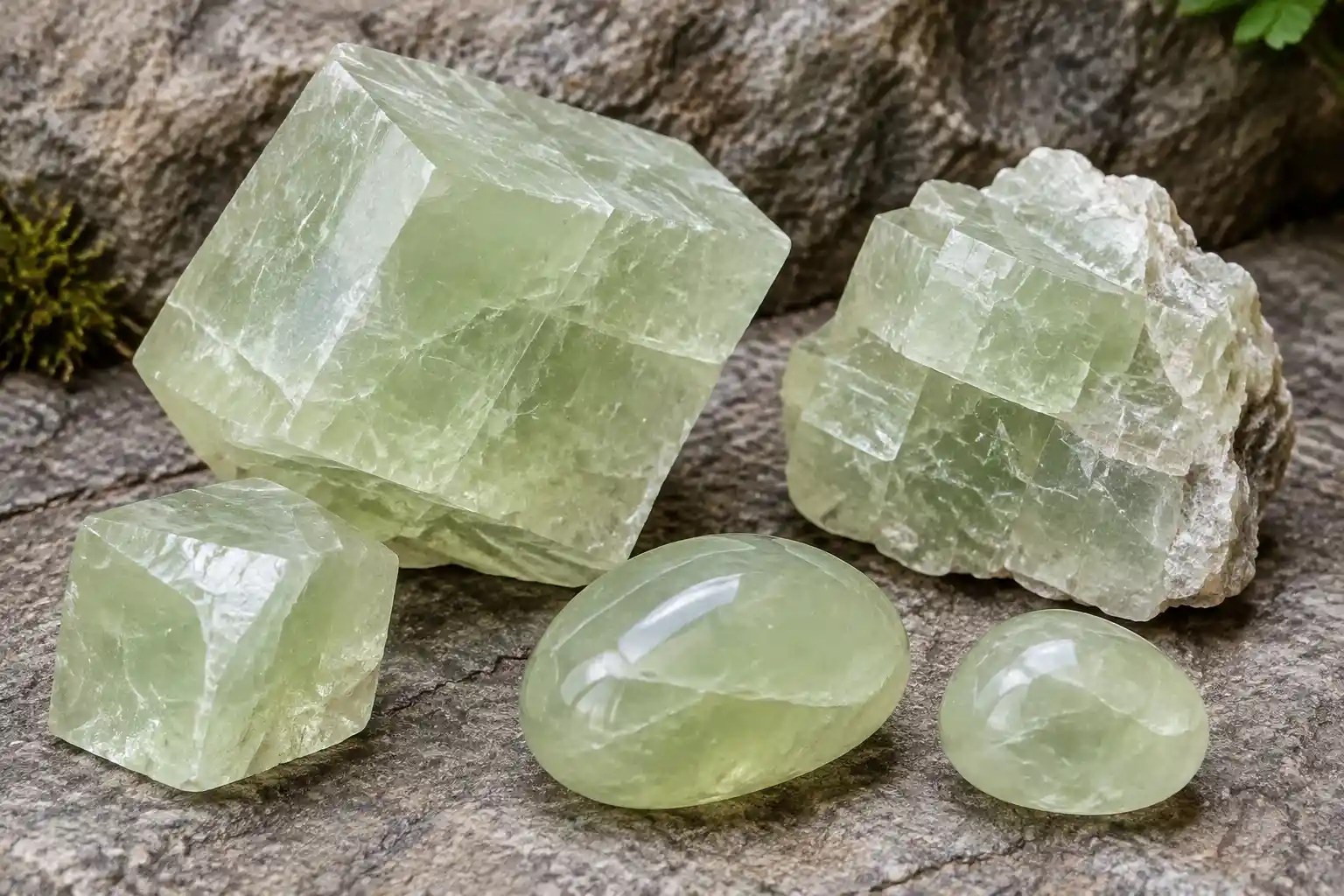
Its pale mint, yellow-green, gray-green, or richer green appearance gives the stone decorative appeal, but its softness and perfect cleavage mean Green Calcite is better suited to mineral collections, carvings, protected decorative objects, educational specimens, and occasional low-impact jewelry than to hard everyday wear. A polished piece can look smooth and luminous, yet it can be scratched by harder household substances and chipped along cleavage planes much more easily than quartz, garnet, or beryl.
Modern crystal traditions add Green Calcite benefits involving emotional calm, renewal, forgiveness, growth, compassion, or heart-centered reflection. These themes can be personally meaningful because green naturally suggests vegetation and renewal, but they are not established medical effects. Green Calcite does not scientifically treat heart disease, anxiety disorders, inflammation, immune problems, hormonal conditions, or other illnesses through ordinary wearing or handling.
7 Green Calcite Benefits at a Glance
- Soft green color gives Green Calcite strong decorative and collector appeal without requiring transparency.
- Perfect rhombohedral cleavage makes the stone valuable for teaching crystal structure and mineral breakage.
- Transparent calcite can demonstrate strong double refraction and important optical principles.
- Mohs hardness 3 provides a clear practical lesson in the limits of soft gemstones and decorative minerals.
- Acid reactivity makes calcite easy to recognize in geological and mineralogical study when testing is appropriate.
- Carvings, polished pieces, and natural crystals provide accessible ways to study one of Earth’s most important carbonate minerals.
- Modern symbolism can represent renewal, calm, or compassion when kept separate from medical claims.
Green Color Adds Decorative Appeal to a Scientifically Important Mineral
Color is the most immediate of the Green Calcite benefits because the variety can range from very pale translucent green to stronger mint, yellow-green, gray-green, or unevenly colored specimens. Calcite itself is capable of appearing in many colors, including white, colorless, yellow, orange, red, blue, green, brown, and gray, depending on impurities, inclusions, defects, and geological history. Green Calcite therefore belongs within a very diverse mineral species rather than representing one completely separate chemical substance.
The precise origin of green color should be described cautiously. Copper, iron, magnesium, nickel, inclusions, and other factors may influence color in different calcites, but assigning one coloring element to every green specimen would oversimplify natural variation. Analytical testing is the stronger approach when exact cause matters. For collectors, this uncertainty can increase rather than reduce interest because similar-looking stones from different localities may have different chemical histories.
These Green Calcite benefits are particularly useful in teaching collections where color is compared with crystal form, cleavage, fluorescence, associated minerals, and locality. A pale green specimen can be aesthetically appealing while still serving as a clear example of calcite’s fundamental properties.
Perfect Rhombohedral Cleavage Makes Green Calcite Excellent for Crystal Education
One of the most important Green Calcite benefits comes from perfect cleavage. Calcite breaks readily along three directions that produce rhombohedral fragments, and this behavior reflects the mineral’s internal crystal structure. A specimen that begins as an irregular piece can therefore split into shapes with repeated angular relationships that are not accidental.
This property helps students understand the difference between cleavage and ordinary fracture. Cleavage follows planes of structural weakness within a crystal, while fracture does not produce the same repeated crystallographic surfaces. Green Calcite makes this relationship easy to demonstrate because the mineral cleaves readily and the resulting faces can be smooth and reflective.
The same feature that makes calcite educational also limits jewelry durability. A polished Green Calcite cabochon or carving may look substantial but can chip or split after a relatively modest impact if force reaches a favorable cleavage direction. This is why Green Calcite benefits are strongest in display, mineral study, carving, and carefully protected ornamental use rather than demanding rings or bracelets exposed to repeated knocks.
Double Refraction Reveals an Important Optical Property of Calcite
Transparent calcite can display strong double refraction, also called birefringence, in which an object viewed through a suitably oriented clear crystal appears doubled. This happens because light entering the anisotropic crystal splits into two rays that travel at different velocities and follow different optical paths. The result is one of the classic demonstrations used to introduce birefringence in mineralogy.
Not every Green Calcite specimen is transparent enough to show dramatic doubling because inclusions, cloudiness, fractures, or dense color can reduce visibility. The property belongs to calcite’s optical structure whether or not it is obvious in a particular polished green stone. Comparing translucent Green Calcite with very clear calcite can therefore make optical mineralogy easier to understand.
These Green Calcite benefits give the mineral educational value far beyond color symbolism. A stone marketed mainly as a decorative crystal belongs to the same species used historically to demonstrate important principles of polarized light and crystal optics.
Mohs Hardness 3 Makes Green Calcite a Useful Lesson in Gemstone Care
Calcite defines hardness 3 on the Mohs scale, placing Green Calcite well below quartz at 7 and below many commonly worn gemstones. This softness is one of the most important practical Green Calcite benefits because it provides a clear example of why attractive color does not automatically make a stone suitable for every form of jewelry.
Dust containing quartz can scratch polished calcite, and contact with harder gemstones can mark the surface during storage. A carving placed on a gritty shelf can lose polish gradually, while a Green Calcite ring may accumulate scratches quickly if worn during ordinary manual tasks. Perfect cleavage adds another vulnerability because a strong blow may cause breakage even when the surface initially appears undamaged.
Gentle handling therefore preserves the stone far better than attempting to make it perform like sapphire or quartz. Soft cloths, padded storage, separate compartments, and protected display locations are practical choices, while rings and bracelets require far more caution than pendants or decorative specimens.
Acid Reactivity Makes Green Calcite Easy to Recognize but Requires Caution
Calcite reacts readily with acids because calcium carbonate is chemically sensitive to acidic solutions. Dilute acid can produce visible effervescence as carbon dioxide gas is released, a classic identification reaction used in geology. Even relatively weak household acids can attack calcite surfaces, which is why Green Calcite should be kept away from vinegar, acidic cleaners, descaling products, and similar liquids.
This chemical behavior creates both educational and practical Green Calcite benefits. Geology students can learn why carbonate rocks such as limestone react to acid, while collectors gain a memorable lesson in why mineral chemistry matters for cleaning. A method that is harmless to quartz can damage calcite quickly because the two minerals respond very differently to acidic conditions.
Destructive acid testing should not be performed casually on polished pieces, carvings, or important specimens because the surface can be etched permanently. A buyer considering where to buy Green Calcite is better served by reliable identification and seller information than by damaging the object after purchase to prove that it reacts with acid.
Green Calcite Connects Decorative Collecting with Carbonate Geology
Calcite is one of the most widespread and geologically important minerals on Earth, occurring in sedimentary rocks, hydrothermal veins, caves, metamorphic rocks, ore deposits, and numerous other environments. Green Calcite benefits therefore include a direct connection between decorative mineral collecting and the larger geological role of calcium carbonate.
Calcite forms major parts of limestone and marble, participates in cave formations such as stalactites and stalagmites, and appears in veins and mineralized cavities alongside many other species. Green coloration in collector specimens adds visual interest to a mineral whose geological importance would remain substantial even if every crystal were colorless.
For collectors, locality can therefore matter as much as color. A specimen’s associated minerals, crystal habit, transparency, fluorescence, matrix, and provenance can reveal much more than a generic commercial label. A polished green block may be attractive, while a well-documented natural crystal can preserve a clearer geological story.
These Green Calcite benefits allow a beginner collection to connect crystal aesthetics with sedimentary geology, mineral chemistry, optical behavior, and carbonate reactions through one readily available mineral.
Carvings and Display Pieces Suit Green Calcite Better Than Heavy-Wear Jewelry
Green Calcite can take an attractive polish, and its soft color makes it popular for spheres, freeforms, carved objects, decorative slabs, and other display pieces. Its softness also makes carving easier than it would be in quartz-rich stones, although that same softness means the finished surface requires protection from scratches and impact.
Large polished pieces can be especially attractive because translucent zones allow light to penetrate partway into the stone, producing a soft luminous appearance rather than high brilliance. Natural cleavage surfaces can create another aesthetic entirely, with reflective planes intersecting the green body color and revealing the mineral’s structure directly.
Jewelry remains possible when expectations are realistic. Pendants, earrings, or protected decorative pieces face less wear than rings, while carvings displayed away from high-traffic areas can remain attractive for many years. These Green Calcite benefits depend on matching the use to the stone rather than demanding durability that its hardness and cleavage cannot provide.
Modern Green Calcite Symbolism Often Centers on Renewal and Calm
Contemporary crystal culture frequently associates Green Calcite benefits with calm, compassion, emotional renewal, forgiveness, optimism, growth, and heart-centered awareness. The soft green color provides an understandable visual foundation for many of these themes because green is widely associated with leaves, vegetation, spring, and new growth.
Someone may keep Green Calcite in a quiet room because its pale color feels restful, use it during journaling because it represents a decision to approach a difficult relationship with greater patience, or choose it as a symbol of starting again after a stressful period. These uses can acquire personal meaning through repeated experience and intention.
Beliefs involving Green Calcite healing properties may extend those themes into claims about the heart, immune system, inflammation, physical detoxification, anxiety disorders, fertility, or other health conditions. Such interpretations belong to spiritual and wellness traditions rather than established clinical medicine. The stone’s calcium content also does not make it a nutritional calcium source through ordinary contact.
Responsible Care Means Avoiding Acids, Abrasion, Heat, and Rough Handling
Green Calcite benefits are easiest to preserve when care reflects the mineral’s softness and chemical reactivity. Routine cleaning should generally use a soft dry or slightly damp cloth rather than acidic solutions, abrasive compounds, steam, or harsh detergents. Prolonged soaking is unnecessary, and any cleaner containing acids should be avoided because it can etch or dull the surface.
Storage deserves equal attention. A calcite carving placed against quartz, garnet, topaz, sapphire, or other harder stones can develop scratches, so separate padded storage is preferable. Natural crystals should be handled over a soft surface because cleavage-related breakage can occur if a specimen is dropped onto tile or stone.
Cutting or carving creates carbonate dust that should not be inhaled unnecessarily, so ventilation, wet methods where appropriate, eye protection, and suitable respiratory controls are sensible workshop precautions. Green Calcite should also not be dissolved deliberately for drinking remedies or ingested as a calcium supplement. Its mineral chemistry is not a substitute for food, medicine, or appropriately formulated nutritional products.
Conclusion
Green Calcite benefits include attractive green color, crystal-structure education, perfect rhombohedral cleavage, optical birefringence, acid-reactivity study, geological significance, carving potential, collecting value, and gentle modern symbolism. Its softness is not merely a disadvantage because hardness 3 and strong cleavage make calcite one of the clearest minerals for demonstrating fundamental geological concepts.
The strongest Green Calcite benefits come from using the stone according to its real properties. It performs far better as a collector specimen, carving, teaching mineral, or protected decorative piece than as demanding everyday jewelry. Symbolism involving renewal, calm, compassion, or growth can remain meaningful when it is kept separate from unsupported medical claims and when the mineral’s sensitivity to acids, scratching, and impact is respected.
FAQs
What are the main Green Calcite benefits?
The most practical Green Calcite benefits include mineral collecting, decorative carving, teaching crystal cleavage, demonstrating calcite’s optical properties, studying acid reactivity, and connecting a colorful specimen with carbonate geology. Its pale green appearance also supports modern symbolism involving renewal or calm, but those meanings are personal and cultural rather than medically demonstrated effects.
What is Green Calcite made of?
Green Calcite is the green-colored variety of calcite, whose chemical formula is CaCO₃. The green appearance can be influenced by trace elements, inclusions, defects, or combinations of these factors, and the exact coloring mechanism can vary between specimens rather than being attributable to one universal impurity.
How hard is Green Calcite?
Green Calcite has a Mohs hardness of 3 because it is calcite, making it considerably softer than quartz and most commonly worn transparent gemstones. This softness means polished surfaces scratch relatively easily, while perfect cleavage creates an additional risk of chipping or splitting if the stone receives a strong impact.
Is Green Calcite suitable for jewelry?
Green Calcite can be used in pendants, earrings, beads, and protected ornamental jewelry, but it is not an ideal choice for rings or bracelets expected to withstand daily knocks and abrasion. Anyone wearing it regularly should protect the surface from harder gemstones, remove the piece during manual tasks, and avoid acidic cleaners that can attack calcium carbonate.
Why does calcite react with acid?
Calcite is calcium carbonate, and acids react chemically with the carbonate component, releasing carbon dioxide and dissolving part of the mineral. This reaction is useful in geological identification, but it also means vinegar, acidic household cleaners, and intentional acid testing can permanently etch a polished Green Calcite surface.
Does Green Calcite show double refraction?
Calcite is strongly birefringent, and sufficiently clear specimens can split light into two rays so an object viewed through the crystal appears doubled. Many Green Calcite pieces are too translucent or included for the effect to be dramatic, but the underlying optical property remains part of calcite’s crystal structure.
Can Green Calcite be cleaned with water?
A lightly damp soft cloth is adequate for many stable Green Calcite pieces, while prolonged soaking is usually unnecessary. Acidic solutions, abrasive powders, steam, harsh chemicals, and aggressive mechanical cleaning should be avoided because the mineral is soft, chemically reactive, and vulnerable along cleavage planes.
Does Green Calcite have healing benefits?
There is no established clinical evidence that Green Calcite treats heart disease, anxiety disorders, inflammation, immune problems, fertility conditions, pain, or other medical concerns through ordinary wearing or handling. Its healing, heart-related, calming, chakra, and energetic associations belong to spiritual and personal traditions and should not replace qualified medical or mental-health care.